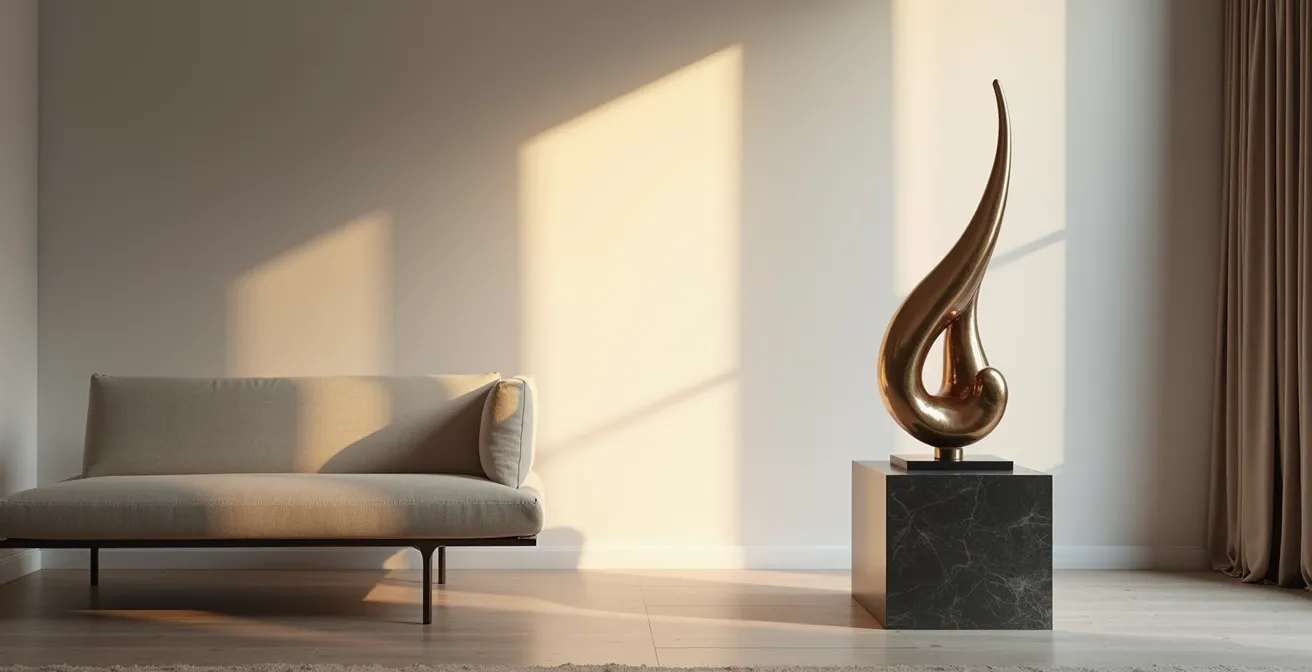
A sculpture’s life depends not on its intrinsic beauty, but on the spatial dialogue it has with its environment.
- The perceived emotion of a piece is directly manipulated by pedestal height and the strategic use of shadow.
- Protecting an artwork’s physical and historical integrity—from fingerprints to floor joists—is a core part of its display.
Recommendation: Stop decorating with art and start curating an experience. Treat your home as a gallery by controlling the viewer’s physical and emotional relationship with each piece.
You’ve acquired a piece of art you love—a sculpture with form, texture, and a story. You place it in your living room, perhaps on an end table or in a well-lit corner, and step back. Yet, something is wrong. Instead of activating the space, it sits there, a beautiful but static object, somehow less alive than when you first saw it. The frustration is common among collectors. We are often told to “find a good spot” or “make sure it has enough light,” but this advice misses the fundamental point. A sculpture is not a lamp or a vase; it is a three-dimensional narrative that demands a relationship with the space around it and the person viewing it.
The conventional approach treats sculpture as a final decorative touch. The real secret, the one curators and professional installers live by, is that the display is not secondary to the art—it is part of the art. The placement of a sculpture is an act of curation that can either mute its voice or amplify it. This isn’t about simply matching colors or styles. It’s about choreographing a gaze, sculpting with shadow, and respecting the silent conversation between the object, its environment, and the viewer. It’s the difference between a sculpture that occupies a corner and one that commands a room.
This guide abandons generic decorating tips. Instead, it offers a curator’s framework for thinking about 3D art in a private space. We will explore how to manipulate height to alter perception, use a single light source to change a face’s expression, and even consider the structural and chemical realities of living with materials like marble and bronze. By understanding these principles, you will learn to transform your sculpture from a silent object into a dynamic, living presence within your home.
This article provides a structured approach, moving from the foundational principles of placement and lighting to the practical necessities of preservation and safety. Explore the sections below to understand how each element contributes to a masterful display.
Summary: A Curator’s Framework for Displaying Sculpture at Home
- Eye Level or Below: Choosing the Right Height for a Pedestal
- Shadow Play: How One Light Can Change the Expression of a Face
- Will It Crash Through the Floor? Calculating Weight for Marble
- Oils and Acids: Why Touching Bronze Ruins the Patina
- Bronze Disease: What Happens When Sculpture Lives in the Garden
- Pushing Back: How External Arches Allowed Walls of Glass
- Chasing the Sun: Why Monet Painted the Same Haystack 25 Times
- Why Humans Must Create: The Biological Drive for Art?
Eye Level or Below: Choosing the Right Height for a Pedestal
The single most impactful decision in placing a sculpture is its vertical position. This isn’t an arbitrary choice; it dictates the psychological relationship between the viewer and the artwork. Placing a sculpture directly at eye level fosters an intimate, peer-to-peer connection. It invites close inspection and conversation, making it ideal for smaller, detailed pieces on shelves or mantels. You are meeting the art on its own terms. This is a dialogue.
Conversely, positioning a sculpture below eye level, typically on a lower pedestal, creates a sense of reverence and contemplation. The viewer looks down upon the piece, as if peering into a world. This distance encourages a more holistic appreciation of its form and mass, rather than just its surface details. This is the classic gallery approach for larger works, giving the object gravitas and a sense of importance. By consciously choosing a height, you are not just finding a place for your sculpture; you are defining how it should be approached and felt. A difference of twelve inches can transform a piece from a familiar companion into an object of veneration.
When displaying multiple sculptures, this principle of height becomes a tool for creating visual rhythm. Varying the heights and sizes of pieces in a group creates a dynamic arrangement that guides the eye across the collection. A flat, uniform display line can feel static and uninspired, whereas a curated landscape of varying elevations adds depth, interest, and a sense of narrative flow to the space. It’s a silent choreography for the viewer’s gaze.
Action Plan: Finding the Optimal Sculpture Height
- Measure the viewer’s average eye level: Determine the typical eye level in your space, which is usually between 57 and 60 inches from the floor. This is your primary reference point.
- Position for intimacy: For small sculptures meant for close viewing, position them at eye level on shelves, mantels, or console tables.
- Position for reverence: For larger or more formal pieces, place the sculpture’s focal point about 12 to 18 inches below the average eye level.
- Test before committing: Use temporary supports like stacked books or boxes to test various heights and see how the piece feels in the space before purchasing a permanent pedestal.
- Create a visual rhythm: When displaying a group of sculptures, intentionally vary their heights to create a more dynamic and engaging composition.
Shadow Play: How One Light Can Change the Expression of a Face
Once height is established, light becomes your most powerful tool for sculpting emotion. A sculpture is not a flat painting; its three-dimensional form comes alive through the interplay of light and shadow. A common mistake is to flood a piece with flat, even light from the front, which effectively erases its depth and character. The true art of lighting lies in using a single, well-placed source to create a dramatic, narrative-rich experience. Angled lighting from above, the side, or even below can completely transform a sculpture’s mood, revealing textures and contours that would otherwise remain invisible.
This is especially true for figurative works. The same face can appear serene and gentle when lit softly from the front, but mysterious or menacing when illuminated with a sharp, raking light from one side. This is the “emotional temperature” of light. For accurate representation, the quality of the light itself is paramount. To see the true colors of the material and patina, your light source requires what experts call a rating of 95+ on the Color Rendering Index (CRI). Beyond color, the warmth or coolness of the light—measured in Kelvin—sets the mood. A warm light (2700K) can make bronze feel intimate and classical, while a cool, neutral light (4000K) gives stainless steel a modern, crisp feel.

As the image above demonstrates, the direction of light is not merely for illumination; it’s a narrative choice. Think of your spotlight as a chisel. By controlling its angle and intensity, you are actively carving the viewer’s perception. You decide which features emerge from the darkness and which recede. This choreographed gaze turns the passive act of looking into an active process of discovery, making the artwork a dynamic entity that changes depending on where the viewer stands and how the light falls.
Will It Crash Through the Floor? Calculating Weight for Marble
Aesthetic considerations must always be grounded in physical reality. Before falling in love with the perfect spot for a heavy marble or bronze sculpture, a curator’s first thought is “structural empathy”—an understanding of the space’s physical limits. A significant point load, especially from a material like marble which can weigh over 170 pounds per cubic foot, can pose a real threat to standard residential flooring. Ignoring this can lead to everything from cracked tiles to catastrophic structural failure. It is a non-negotiable aspect of responsible art ownership.
Understanding your home’s construction is the first step. Where are the load-bearing walls? In which direction do the floor joists run? Placing a heavy sculpture perpendicular to the joists helps distribute the weight across several supports rather than concentrating it on one. For exceptionally heavy pieces, positioning them near a load-bearing wall or a structural column provides the greatest support. If you can, tap the floor to listen for the solid sound of a joist versus the hollow sound of the space between them. This simple act can inform a much safer placement strategy.
For collectors with serious pieces, especially those weighing over 300 pounds, a consultation with a structural engineer is not an overreaction; it is a wise investment. They can calculate the floor’s load capacity and may suggest solutions like using a steel plate under the pedestal. This simple addition works by spreading the concentrated point load over a much larger surface area, dramatically reducing the pressure per square inch. This is the invisible work that makes a bold aesthetic statement possible, ensuring the art elevates the space without compromising its integrity.
Oils and Acids: Why Touching Bronze Ruins the Patina
A sculpture’s surface is its skin. For materials like bronze, this skin—the patina—is a delicate, living history of the object’s interaction with its environment. It is often intentionally cultivated by the artist. The natural oils, salts, and acids on human hands are incredibly corrosive to these surfaces. The urge to touch, to feel the form, is a natural one, but it must be resisted. In fact, conservation specialists warn that a single fingerprint can launch irreversible micro-reactions that permanently darken or etch the patina, a process that can begin within hours.
This is not just a matter of cleanliness; it’s an issue of preservation. The unique finish on a bronze sculpture is the result of a fragile chemical balance. Once disrupted by foreign substances, that balance is permanently altered. While professional conservators can sometimes mitigate the damage, the original, artist-intended surface is often lost forever. The bright, polished knee of a famous bronze statue in a public square is a testament to this destructive power—a mark of affection that is, in reality, an act of slow erosion. Protecting your investment means protecting its surface from the well-intentioned but damaging human touch.
Creating a “zone of reverence” around your sculpture is a key curatorial strategy. This doesn’t require velvet ropes. It can be achieved subtly through intelligent interior design. Use furniture to guide the natural flow of traffic away from the piece. Place the sculpture on an elevated pedestal that lifts it just beyond casual reach. A strategically positioned console table can act as a graceful, natural barrier. Even a pool of focused accent lighting on the floor around the base can create a powerful psychological boundary, signaling that this is a space for looking, not touching. These design choices protect the art while enhancing its special status within the home.
Bronze Disease: What Happens When Sculpture Lives in the Garden
When a sculpture moves outdoors, the challenges to its integrity multiply. It is now exposed to a far more aggressive micro-climate of rain, humidity, pollutants, and fluctuating temperatures. For bronze sculptures, the most insidious threat is “bronze disease.” This is not a quaint term; it’s a form of chloride corrosion that manifests as small, fuzzy, light-green spots on the surface. Unlike the stable, desirable green patina (copper sulfate), bronze disease (copper chloride) is an active and self-catalyzing reaction. If left untreated, it will eat into the metal, causing irreversible pitting and structural decay.
The key to preventing this is careful material selection and placement. Not all materials are suited for every environment. Porous stone can crack in freeze-thaw cycles, untreated wood will rot in wet conditions, and certain metals will rust in humid or coastal climates. When choosing an outdoor piece, it is crucial to opt for materials specifically treated or naturally resistant to your local weather conditions, such as marine-grade stainless steel, corten steel, or properly sealed stone and concrete. For bronze, ensuring good drainage is paramount, as pooling water is a primary catalyst for corrosion.

However, environmental exposure is not always negative. For many outdoor sculptures, the slow evolution of the surface is part of the artwork’s intended lifecycle. The natural patina that develops on bronze or the weathering of stone, as seen in the intricate surface above, can add a layer of beauty and character that tells the story of the sculpture’s life in that specific place. The goal is not to fight nature entirely, but to manage its effects—to encourage a graceful, stable patina while actively preventing destructive corrosion like bronze disease. This requires regular inspection and, when necessary, professional cleaning and waxing to protect the surface.
Pushing Back: How External Arches Allowed Walls of Glass
Gothic architects made a revolutionary discovery: by moving structural supports (like flying buttresses) to the outside of a building, they could free the walls from their load-bearing duties. This allowed them to fill the space with vast walls of stained glass. This architectural principle holds a profound lesson for displaying sculpture: to truly see the art, you must give it space to breathe. This is the concept of negative space—the empty area around and between objects. It is just as important as the object itself.
In a domestic setting, a sculpture crowded by furniture, patterns, and clutter will have its voice muffled. Its form becomes part of the general background noise. To give it presence, you must create a “wall of glass”—a zone of visual quiet—around it. This means placing it against a simple, neutral background. It means resisting the urge to fill the pedestal’s surface with other small objects. The empty space is not wasted; it is a frame that isolates the sculpture, forcing the viewer’s eye to focus on its lines, mass, and texture. This creates a powerful “spatial dialogue” where the art can assert its identity without competition.
This need for space is amplified by the demands of three-dimensional lighting. To truly express an object’s form, it must be viewable and properly lit from multiple angles. As lighting from four or more directions is often required in gallery settings to convey full three-dimensionality, having adequate space around the piece is a practical necessity. It allows for the strategic placement of spotlights and accommodates the viewer’s movement around the object. By pushing back the “visual noise” of the room, you are not just creating a void; you are building a stage for the art to perform.
Chasing the Sun: Why Monet Painted the Same Haystack 25 Times
Claude Monet’s famous haystack series was not about the haystacks themselves. It was an obsessive study of light. He painted the same object over and over to capture the fleeting, transformative effects of the sun at different times of day and in different seasons. This artistic pursuit offers a vital insight for the art collector: a sculpture placed in a room with a window is not one single object, but a series of ever-changing objects. The piece you see in the cool, gentle light of morning is different from the one revealed in the bright, direct light of noon, and different again in the warm, long shadows of the golden hour.
Instead of seeing this as a problem to be solved with blackout curtains, a curator embraces it. When selecting a location, observe how natural light interacts with the spot throughout the day. A polished metal sculpture that creates a beautiful shimmer in the morning might produce a blinding glare at 3 PM. A dark, textured piece that seems somber at midday might reveal incredible depth and warmth as the evening sun rakes across its surface. Positioning a sculpture in relation to the sun’s path is one of the most dynamic ways to bring it to life, ensuring it offers a different experience with each passing hour.
This dynamic interplay between the art and the time of day can be anticipated and leveraged. By understanding the quality of light and the type of shadows it produces, you can place a sculpture to maximize its expressive potential throughout the day.
| Time of Day | Light Quality | Shadow Length | Visual Effect |
|---|---|---|---|
| Morning (9AM) | Cool, Soft | Long, Gentle | Contemplative, Peaceful |
| Noon (12PM) | Bright, Neutral | Minimal | Clear Detail, Documentary |
| Evening (6PM) | Warm, Golden | Long, Dramatic | Romantic, Nostalgic |
| Night (9PM) | Artificial, Focused | Sharp, Defined | Theatrical, Mysterious |
Key Takeaways
- A sculpture’s presence is defined by its relationship with the viewer, a dynamic controlled by height, light, and space.
- Effective display involves a curatorial mindset: choreographing the gaze and sculpting with shadow to evoke a specific emotional response.
- Preserving the art, from its physical surface to the structural integrity of the floor beneath it, is as important as the aesthetic placement itself.
Why Humans Must Create: The Biological Drive for Art?
After navigating the technical considerations of height, light, weight, and space, we arrive at a fundamental question: why go to all this trouble? The answer lies in the deep, almost biological, human need for art. A sculpture is more than an arrangement of mass and volume; it is a vessel for human thought, emotion, and skill. When we bring a sculpture into our homes, we are not just acquiring a decorative object. We are inviting a psychological presence, a focal point for imagination and contemplation that can transform the character of a space.
A thoughtfully placed sculpture does more than just “look good.” It stimulates a psychological effect. It introduces rhythms, contrasts, and a tactile quality that engages our senses on a primal level. The observer feels the artist’s passion and admires the skill, but more importantly, the artwork acts as a catalyst for their own imaginings. It can inject a sense of intellectual gravity, naturalistic calm, or modern dynamism into a room. This is the ultimate purpose of curation: to unlock this potential and allow the artwork to perform its essential function.
Bringing a sculpture to life in your home is the final step in the creative process. The artist began it, and you, the collector, complete it by giving the piece its final context. By applying these curatorial principles, you honor the artist’s intent and fulfill your own deep-seated need to connect with objects of beauty and meaning. You transform a static possession into a dynamic and essential part of your daily life, proving that the drive to display art is intrinsically linked to the very drive that compelled its creation.
Begin today by choosing one piece and one principle from this guide. Observe how the natural light hits one corner of your room, or test a different height for a sculpture you already own. This simple, conscious act is the first step in moving from decorating to curating, and in transforming your collection into a living, breathing part of your home.