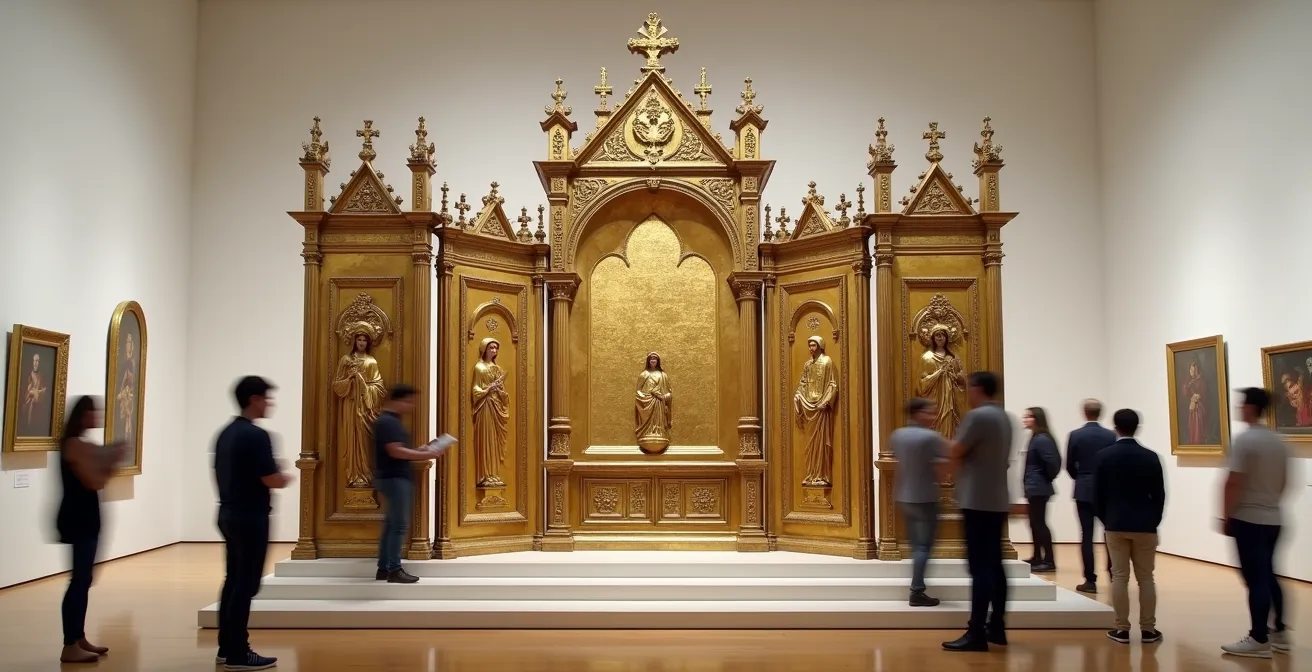
Viewing an altarpiece in a silent, brightly-lit museum is fundamentally misleading because it strips the object of its original, dynamic context.
- Altarpieces were often interactive machines, with wings that opened and closed to mark special liturgical occasions.
- Their gold backgrounds were designed to shimmer and pulse in flickering candlelight, creating an impression of divine, not static, light.
- They were the visual centerpiece of a multi-sensory ritual involving chant, incense, and bells, and were even designed with acoustics in mind.
Recommendation: To truly see an altarpiece, you must mentally reconstruct its original, dynamic liturgical environment and understand its functional role within it.
You stand in the hushed, climate-controlled quiet of a museum gallery. Before you is a massive, gilded panel, its surface covered in solemn figures and intricate details. It’s magnificent, you think, a masterpiece of devotion and skill. But as you gaze at the static painting under the even, shadowless light, a sense of disconnect settles in. You are looking, but are you truly seeing? You know it’s religious art, that it tells a story from the Bible, but something essential feels missing. You have the distinct feeling that you are looking at it all wrong.
That feeling is correct. The fundamental problem is that the museum environment, for all its benefits in preservation, is the very thing preventing you from understanding the object before you. Viewing a medieval or Renaissance altarpiece as a static painting on a wall is like reading a single, torn-out page from an intricate pop-up book or examining a silent engine removed from the car it was built to power. These were not simply pictures; they were functional, theological machines designed to perform within a specific, multi-sensory liturgical context.
To appreciate an altarpiece, we must move beyond seeing it as art and begin to understand it as an artifact of performance. This guide will deconstruct the common museum experience and provide you with the framework to see these objects not as flat, silent panels, but as the interactive, light-shaping, and sound-directing engines of devotion they were designed to be. It’s time to mentally rebuild the world these pieces inhabited to finally see them as they were meant to be seen.
To help you decode these complex objects, this article breaks down the essential context you’re missing in the museum. We will explore their interactive nature, the true meaning of their materials, their physical vulnerabilities, and their role in a full sensory environment.
Summary: Unlocking the True Meaning of a Museum Altarpiece
- Open for Holidays Only: The Interactive Nature of Winged Altars
- Why the Fun Stuff Happens at the Bottom: The Role of the Predella
- The Flatness Trap: Losing the Gold Shimmer Under Electric Light
- Praying to the Image or Through It: The Iconoclast Controversy
- Warping and Splitting: The Nightmare of Moving Panel Paintings
- Why Gold Backgrounds Represented Eternity, Not Just Wealth
- Singing to the Ceiling: Designing Sound for Chant
- Why Tree Rings Are More Reliable Than Stylistic Analysis
Open for Holidays Only: The Interactive Nature of Winged Altars
The vast, single-panel altarpiece you see displayed flat against a museum wall may have once been a complex, hinged machine. Many altarpieces, particularly in Northern Europe, were polyptychs with wings that were kept closed for most of the year. The exterior panels, often painted in muted, everyday scenes (a style known as grisaille), were what a layperson would see during a standard service. The full, glorious, color-and-gold interior was a revelation reserved only for high feast days like Christmas and Easter, or perhaps on the feast day of the church’s patron saint. This was liturgical theater, creating a sense of anticipation and climax within the church calendar.
The act of opening the altarpiece was a significant event, transforming the visual and spiritual focus of the entire sanctuary. This interactive function is completely lost in a museum, where the wings are either permanently fixed open or, more commonly, disassembled and hung as separate paintings. Historical records suggest the scale of this phenomenon; it’s estimated that around 2,000 winged altarpieces existed in the region of Tyrol alone in 1520. As one analysis notes, while it was customary to keep the wings closed, a clever sacristan might open them for a visitor in exchange for a small tip, acknowledging their status as a special attraction even then.
This “performance” aspect is crucial. The altarpiece was not a constant, static image but a dynamic object that marked sacred time. The difference between its everyday appearance and its festive state was a powerful visual metaphor for the difference between the profane world and a glimpse of divine glory. When you see separated panels in a museum, you are seeing the static punchline without the narrative setup.
Why the Fun Stuff Happens at the Bottom: The Role of the Predella
When you look at an altarpiece, your eyes are naturally drawn to the large, central figures: a majestic Madonna, a crucified Christ, or a host of saints. But some of the most intricate and engaging storytelling often happens at the very bottom, in a series of small panels at the base called the predella. This section sat directly on or just behind the altar table, at eye-level for the celebrating priest and close to the communicants kneeling at the altar rail. Its position was no accident; its purpose was to bridge the gap between the earthly, human space of the altar and the transcendent, divine realm depicted above.
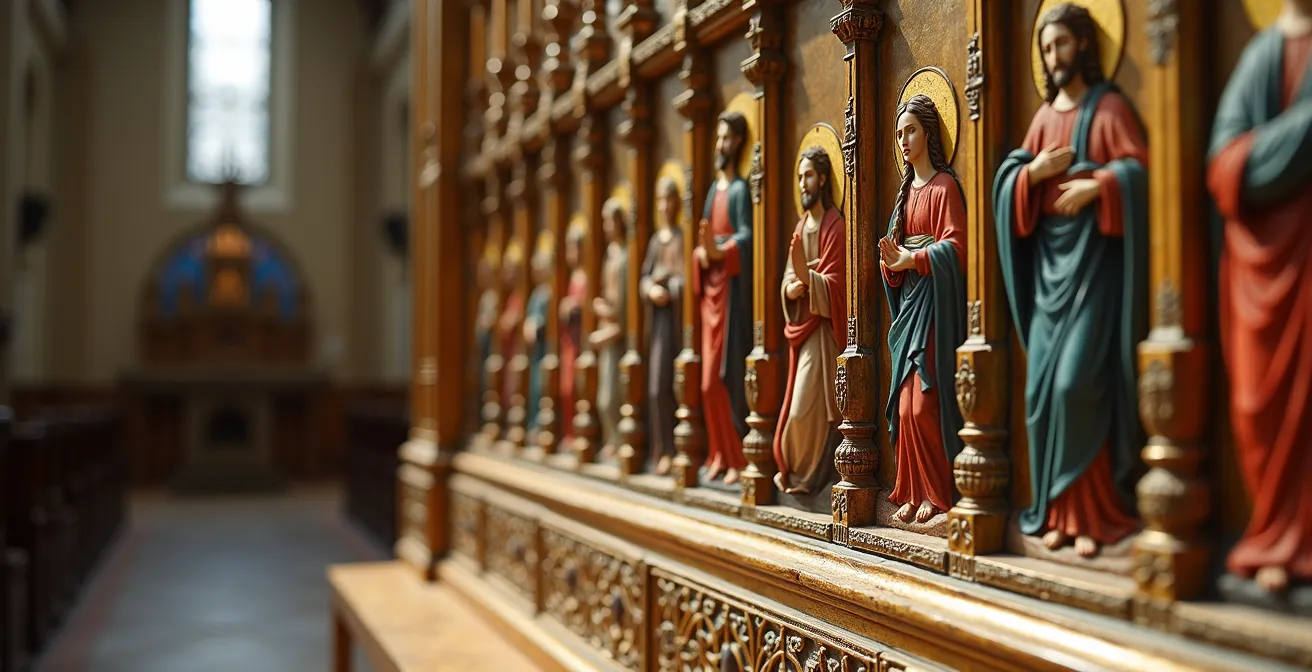
While the main panels often showed iconic, timeless figures, the predella was the space for narrative. Here, artists would depict lively, detailed scenes from the lives of the saints or the passion of Christ. These were the “action sequences”—the martyrdoms, miracles, and human dramas that grounded the divine figures in a relatable story. For example, as an analysis from The National Gallery explains, the predella of Giovanni del Ponte’s “Ascension of John the Evangelist” altarpiece is a key element that grounds the sacred story in relatable human detail, connecting the altar space to the main image. In a museum, the altarpiece is often raised on a pedestal, lifting the predella far from its intended viewing height and severing this crucial connection to the viewer.
The predella was the link between the viewer’s world and the world of the painting. Its proximity invited close, intimate examination, serving as a focus for personal devotion. When separated or raised too high, its narrative power is diminished, and it becomes just another decorative element rather than the functional foundation it was designed to be.
The Flatness Trap: Losing the Gold Shimmer Under Electric Light
Perhaps the most significant distortion of the museum environment is its lighting. We see gold leaf backgrounds under diffuse, uniform, electric light, and they appear flat, opaque, and merely decorative—a shiny yellow backdrop. This is a profound misunderstanding of the material’s intended effect. These backgrounds were designed to be seen by the dynamic, flickering light of dozens, if not hundreds, of candles. In this environment, the gold leaf would never be static. It would pulse, shimmer, and dematerialize the surface, creating an active, living field of divine light, or lux divina.
Conservation studies show that gold leaf surfaces appear flat under uniform museum lighting, a stark contrast to their behavior in candlelight. Artists knew this and enhanced the effect by tooling, punching, and incising the gilded surface (a technique called ‘punchwork’) to create textures that would catch the moving light from a thousand different angles. This created a heavenly, non-natural space that was visibly distinct from the earthly realm depicted with pigments. Under the deadening glare of a museum spotlight, this intricate surface work is flattened, and the entire effect is lost. The gold becomes a solid, inert material rather than an active, shimmering light source.
The next time you are in a museum, you can try to counteract this effect. Don’t stand still. Move from side to side, crouch down, and change your viewing angle to see how the light catches the surface differently. You might catch a glimpse of the dynamic, dazzling effect that was central to the altarpiece’s theological purpose.
Your Action Plan for Viewing Gold Leaf in a Museum
- Move side to side to catch different angles of light reflection on the gold surface.
- Crouch down or stand on tiptoes to vary your viewing angle and see how the light play changes.
- Look for areas where the museum lighting creates shadows, which can help reveal the textured punchwork.
- Focus on the edges where gold meets painted areas to observe the intentional contrast between divine light and earthly color.
- Step back and then forward to see how your distance from the panel affects the gold’s perceived luminosity and presence.
Praying to the Image or Through It: The Iconoclast Controversy
An altarpiece was not just an illustration; it was a focal point for prayer, a conduit to the divine. This created a delicate theological tension: was the faithful praying *to* the physical object, or *through* the object to the holy figure it represented? This question was at the heart of the great Iconoclast controversies, which led to the widespread destruction of religious images at various points in history. The style of the artwork itself was often a direct response to this debate.
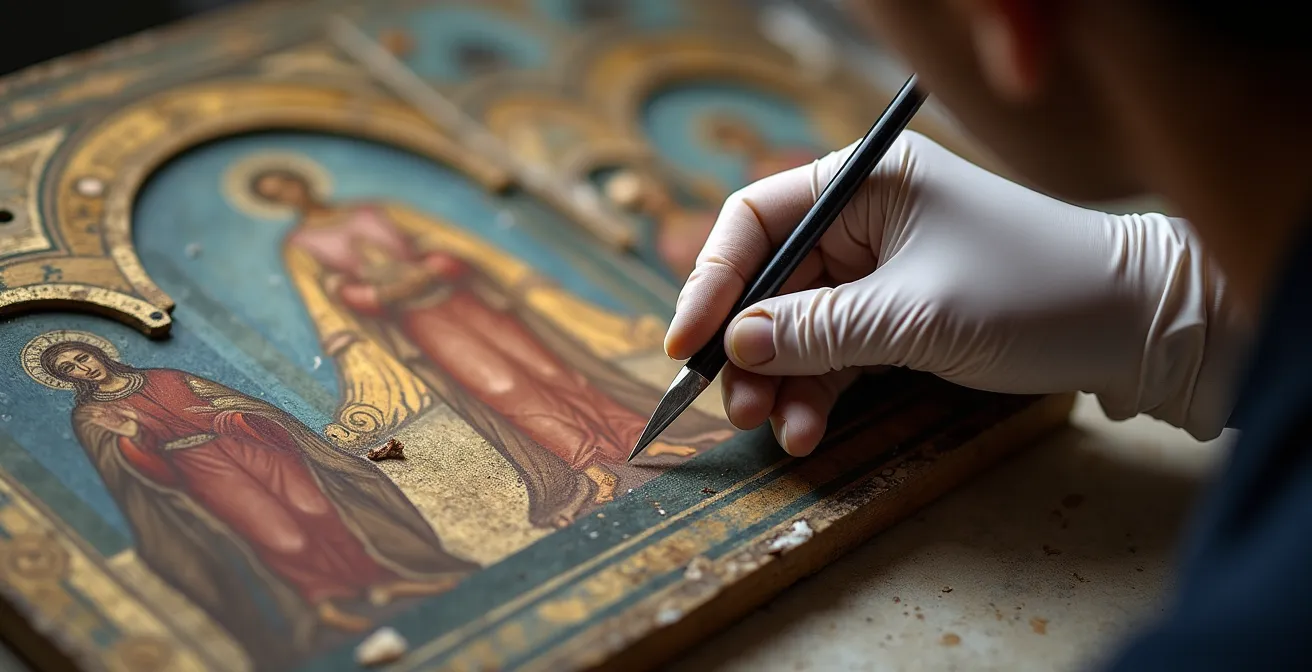
As one art historical analysis puts it, the distinction is key: a highly realistic, emotionally charged depiction of a suffering Christ might invite an emotional prayer directed *to the image itself*. In contrast, a more stylized, flattened, and iconic representation of Christ encourages the viewer to pray *through the image* to the divine prototype it symbolizes. The physical evidence of this intense relationship is often visible on the artworks themselves. In museums, you can sometimes see areas on a panel—a hand, a foot, the face of the Virgin—that are worn smooth. This is the result of centuries of devotional touching and kissing, a physical manifestation of faith that a museum rope and stanchion now forbid.
Conversely, you may see panels with faces scratched out or figures deliberately gouged. This is not accidental damage; it is the work of iconoclasts, who saw the images as idols and sought to “kill” their spiritual power by defacing them. Both the loving touch and the violent attack are powerful testaments to the fact that these were not seen as mere decorations. They were perceived as powerful, active objects with a direct link to the sacred, capable of inspiring profound devotion or intense hatred. The sterile museum environment erases this history of visceral, human interaction.
Warping and Splitting: The Nightmare of Moving Panel Paintings
The altarpiece you see in a museum is made of wood, a hygroscopic material that is in a constant, subtle state of flux. It expands in humidity and contracts in dryness. For centuries, these panels existed in the relatively stable, if often damp and cool, environment of a stone church. Their structure and the gesso and paint layers on top of them were acclimatized to this specific world. The move into a modern, climate-controlled museum, with its dry air and stable temperature, represents a violent shock to their physical existence.
This environmental shift is a conservationist’s nightmare. As the wood rapidly loses moisture it has held for centuries, it begins to warp, crack, and split. The paint layers, which are less flexible, can flake and pop off the contracting wooden support. A fascinating study of fragmented late medieval altarpieces from Norwegian churches reveals the dramatic consequences of this movement. Conservators describe these panels as ‘living objects’ that constantly expand and contract with humidity, and document the severe damage caused by moving them between different environments. The pristine, stable surface you see in a museum is often the result of immense and ongoing conservation efforts to battle the panel’s natural inclination to self-destruct in its new home.
The very act of “saving” these objects by moving them to a museum initiated a process of physical trauma. This is a crucial, invisible part of their story. The loss of so many altarpieces over the centuries due to war and theological disputes, such as the Reformation, is a well-known tragedy. But even for those that survived, the journey to the safety of the museum was fraught with its own physical peril, a battle against the very nature of the material from which they are made.
Why Gold Backgrounds Represented Eternity, Not Just Wealth
The most common assumption about the extensive use of gold in altarpieces is that it was simply a display of wealth and patronage. While gold was certainly expensive, this view is a modern oversimplification that misses the profound theological symbolism of the material. In medieval and Renaissance art, gold was not just a precious metal; it was the physical embodiment of divine light, or *lux divina*. It represented the non-natural, uncreated, and eternal light of heaven.
As theological analysis of the period clarifies, there was a deliberate and meaningful contrast at play. Pigments—the reds, blues, and greens—were used to represent the colors and light of the earthly, created world. Gold was used to represent the sacred, timeless space of eternity. When an artist placed a golden halo around a saint’s head or set a scene against a golden background, they were not just adding decoration; they were making a clear statement, visually lifting the figure or event out of earthly time and into the realm of the divine.
Gold represented ‘lux divina’ (divine light), a non-natural, eternal light source, while pigments represented the colors and light of the earthly, created world.
– Medieval art theology analysis
A compelling piece of evidence against the “gold as wealth” theory comes from analyzing artists’ contracts. In many cases, the cost of the finest blue pigment, genuine ultramarine made from grinding lapis lazuli imported from Afghanistan, actually exceeded the cost of the gold leaf used on the same painting. Analysis of medieval artists’ contracts published by art historians confirms that while gold was costly, its value was primarily symbolic and theological, not merely a vulgar display of money. The choice of material was driven by meaning, not just budget.
Singing to the Ceiling: Designing Sound for Chant
The profound silence of the museum gallery is perhaps the most misleading sensory deprivation of all. An altarpiece was never meant to be viewed in reverent quiet. It was the visual centerpiece of a rich, multi-sensory liturgical drama. As a study on devotional art notes, it was “experienced amidst chanting, ringing bells, the scent of incense, and the movement of the liturgy.” Sound, in particular, was an integral part of its environment. The altarpiece stood in a space filled with the human voice, primarily through Gregorian chant.
Some of the largest altarpieces may have even been designed with acoustics in mind, functioning as architectural components that helped shape the sound of the church. Their towering structures, angled wings, and carved canopies could act as acoustic reflectors, catching the sound from the choir in the chancel and projecting it out into the nave where the congregation stood. A prime example is Michael Pacher’s St. Wolfgang Altarpiece in Austria. Standing over 11 meters (about 36 feet) high, its vast, complex structure of angled panels and intricate carvings was perfectly positioned to amplify and direct the sound of the choir, making the chant an enveloping, all-encompassing experience.
When we look at an altarpiece on a museum wall, we see a silent object. But we should try to imagine it in its original sonic context: resonating with the vibrations of chanted psalms, punctuated by the sharp ring of the sanctus bell, all shrouded in the sweet, thick smell of burning incense. The visual experience was inseparable from the auditory and olfactory one. It was a complete sensory immersion designed to transport the faithful, and removing the sound is like watching an opera with the volume turned off.
Key takeaways
- From Static to Interactive: The most important conceptual shift is to see an altarpiece not as a single painting, but as a potential “machine” with moving parts that marked sacred time.
- From Flat Gold to Dynamic Light: Understand that gold leaf was not just decoration but a medium meant to come alive and shimmer in the flickering, dynamic light of candles, representing divine eternity.
- From Silent Art to Sensory Engine: An altarpiece must be mentally placed back into its full sensory context—the sounds of chant and bells, the smell of incense—to be truly appreciated as the focal point of a liturgical performance.
Why Tree Rings Are More Reliable Than Stylistic Analysis
While understanding the liturgical function of an altarpiece is key to seeing it correctly, another set of tools helps us reconstruct its physical history and biography. For centuries, dating a panel painting relied on stylistic analysis—comparing the artist’s brushwork, composition, and figure types to other known works. This method, while essential, is inherently subjective. However, the scientific method of dendrochronology, or tree-ring dating, has provided a level of objective certainty that has revolutionized the field.
Because most panels were made of oak, scientists can analyze the pattern of tree rings in the wood. By comparing this unique sequence of wide and narrow rings to established regional “master chronologies,” they can determine the exact year the tree was felled with astonishing precision. This provides a *terminus post quem*—a date after which the painting must have been made. Dendrochronological studies confirm that panels can be dated to exact calendar years, giving art historians a firm, scientific anchor for their research.
This technique reveals far more than just a date. For example, extensive dendrochronological work on Early Netherlandish paintings has proven that many were painted on high-quality “Baltic oak” panels. This wood was shipped from the Vistula region (modern-day Poland) through ports of the Hanseatic League to workshops in Bruges and Ghent. This single fact, undiscoverable through stylistic analysis alone, tells us a tremendous amount about medieval timber trade routes, economic networks, and the logistical operations of a painter’s workshop. It proves that the creation of an altarpiece was not just an act of artistic devotion, but also the endpoint of a sophisticated international supply chain.
The next time you stand before an altarpiece in a museum, you are equipped with a new set of eyes. You can see not just a painting, but a deconstructed machine. You can imagine its wings swinging open on Easter morning, see the gold shimmering in the candlelight, and hear the faint echo of chant in the gallery’s silence. You are no longer looking at it wrong; you are looking through the museum’s display to see the vibrant, functional, and powerful object it once was.