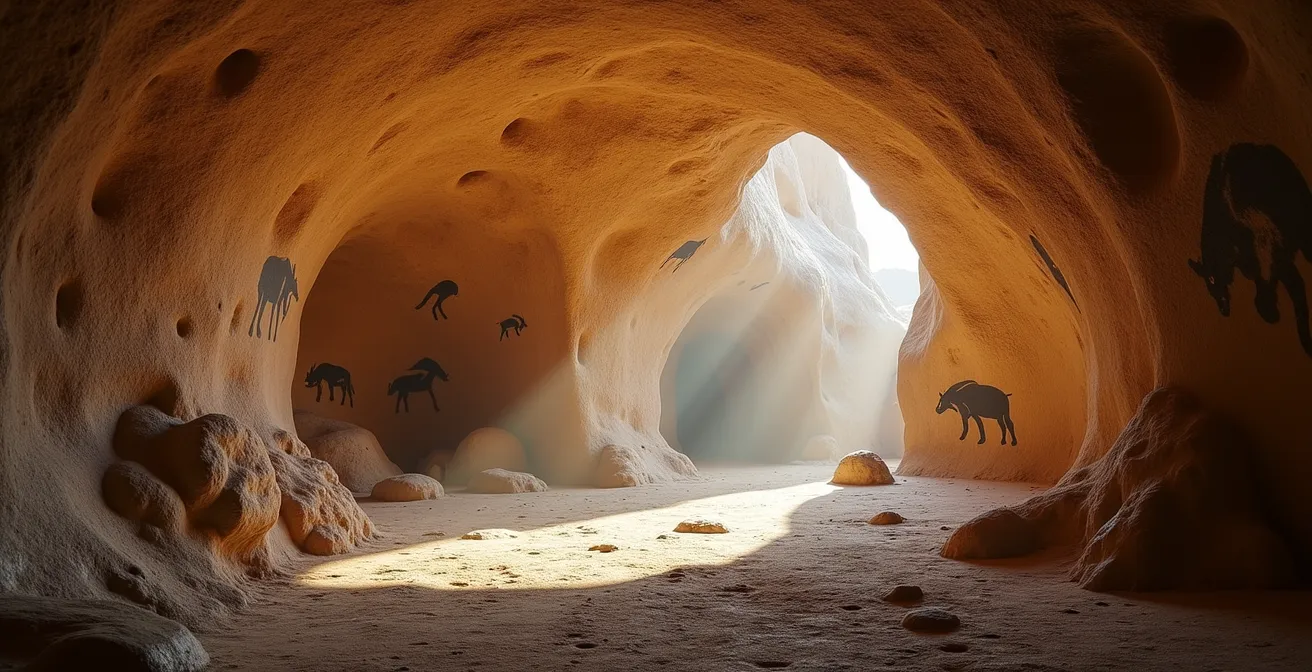
Contrary to the simple notion that Lascaux is closed just to “protect the paintings,” the truth is a stark scientific reality. The cave is under a permanent conservation quarantine, fighting an ongoing biochemical assault triggered by human presence. The carbon dioxide from our breath creates acid that dissolves the art, while invisible molds, once introduced, threaten to erase it entirely. The replica, Lascaux IV, is therefore not a consolation prize but a crucial scientific and ethical solution to witness this heritage without destroying it.
For any heritage enthusiast, the feeling is familiar and deeply frustrating. You travel to the Vézère Valley, the heartland of prehistoric art, only to be told the one site you dream of seeing—the original Lascaux cave—is sealed shut. You are directed instead to Lascaux IV, a breathtaking but undeniably modern facsimile. The common explanation, that the closure protects the 20,000-year-old paintings from the damage caused by tourists, feels true yet unsatisfying. It simplifies a catastrophic series of events into a tidy, manageable narrative, leaving you with a sense of loss, a form of archeological grief for an experience you can never have.
This explanation, however, barely scratches the surface. The decision to permanently close Lascaux in 1963 was not merely a preventative measure; it was an emergency response to a rapid and devastating micro-ecosystem collapse. The cave is not just a gallery of ancient art; it is a delicate, sealed biosphere that was thrown into chaos by the modern world. But what if the key to understanding this irreversible decision lies not in the simple presence of people, but in the invisible, aggressive chemical and biological warfare that our bodies unwittingly wage on the past? The story of Lascaux’s closure is one of a biochemical assault, a lesson in humility, and the triumph of science in preserving a memory we almost erased.
This article delves into the precise scientific reasons behind the permanent quarantine of the original cave. We will explore the destructive power of a single human breath, the painstaking process of creating a perfect replica, and the catastrophic biological invasion that nearly consumed Lascaux forever. By understanding the fragility of this irreplaceable treasure, we can reframe our visit to its replica not as a compromise, but as a profound act of conservation.
To navigate this complex story of preservation and loss, this guide breaks down the critical factors that led to the cave’s closure and the solutions that allow us to experience its magic today. Explore the science, the artistry, and the difficult choices that define Lascaux’s modern legacy.
Summary: Why the Lascaux Cave Is Sealed from the Public
- How Human Breath Destroys 20,000-Year-Old Pigments in Minutes
- How Artisans Recreate Prehistoric Texture with Millimeter Precision
- Lascaux IV or Pech Merle: Choosing Between Fame and Authenticity
- The Mold Outbreak That Almost Erased Lascaux Forever
- When VR Becomes the Only Way to Visit Endangered Heritage
- Manganese and Ochre: Sourcing Colors Without a Supply Chain
- How to Crowdfund a Restoration Project When Grants Fail
- How Paleolithic Artists Used Rock Formations to Animate Figures
How Human Breath Destroys 20,000-Year-Old Pigments in Minutes
The primary agent of destruction inside Lascaux was not touch or vandalism, but something as innocent as human breath. Before its closure, the cave saw up to 1,800 visitors per day, each one exhaling carbon dioxide (CO2). In a stable, sealed environment, the cave’s atmosphere maintained a delicate equilibrium. The introduction of thousands of people dramatically increased the CO2 concentration and, just as critically, the humidity from their breath. This combination triggered a relentless biochemical assault on the artwork.
The science is straightforward and brutal. When the excess CO2 from human exhalation reacts with the condensed water vapor on the cool cave walls, it produces carbonic acid. This weak but persistent acid is the same agent that carves out limestone caves over millennia, but on the painted surfaces, its effect is tragically rapid. An analysis of the cave’s environmental crisis confirmed that this acid attacks both the paintings and their rock canvas, causing the ancient pigments to lose their color. In the most severe cases, the chemical attack on the limestone support can lead to the rock crumbling away entirely, taking the art with it.
This process is not theoretical; it was actively observed during the short period the cave was open to the public. The vibrant blacks, reds, and yellows that had survived for 200 centuries began to fade and degrade in just two decades. The closure was not a choice but a necessity to halt this invisible, acidic erosion. The cave’s atmosphere had to be returned to its pre-discovery state, a “conservation quarantine” to protect it from the very people who cherished it most.
How Artisans Recreate Prehistoric Texture with Millimeter Precision
Faced with the permanent closure of the original cave, the French government and scientific community embarked on one of the most ambitious heritage replication projects ever conceived: Lascaux IV. This is not merely a set of photographs on a wall; it is a high-fidelity facsimile designed to reproduce the experience of the cave with astonishing accuracy. The goal was to create a vessel for the art’s memory, allowing the public to bear witness without participating in the original’s destruction.
The process began with cutting-edge technology. The original galleries were scanned with lasers to create a 3D digital model of the cave’s every contour. According to the project’s scientific documentation, this data was used to construct the replica’s shell with an accuracy of one millimetre or less. This structural precision ensures that the scale, perspective, and unique topography that the Paleolithic artists worked with are perfectly preserved for the modern visitor. The feeling of being inside the confined, undulating space of the original is masterfully recreated.
This digital skeleton was then brought to life by the hands of master artisans. This stage is where science meets art, a process that mirrors the ingenuity of the original creators. The image below shows the meticulous labor involved.
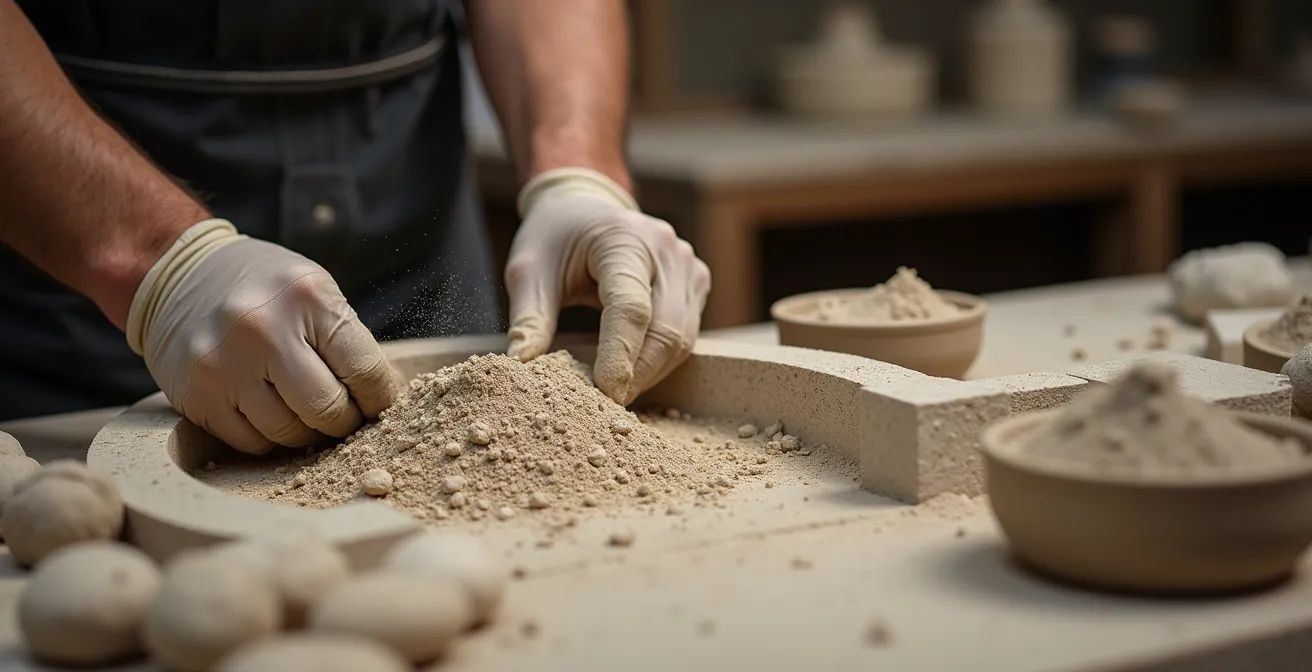
Using a mix of stone powder, mortar, and natural resins, artists painstakingly applied the “skin” of the cave onto the shell. They then projected images of the original paintings onto this textured surface and, for 2.5 years, a team of twenty painters repainted every figure by hand. They used the same natural pigments—ochre, manganese oxide—and even mimicked the presumed techniques of the original artists. The result is more than a copy; it’s a resurrection, allowing the spirit of the art to live on in a stable, accessible form.
Lascaux IV or Pech Merle: Choosing Between Fame and Authenticity
For the dedicated traveler, the closure of Lascaux presents a difficult choice. Do you visit Lascaux IV, the world-famous, perfect replica that contains every known painting? Or do you seek out an authentic, original Paleolithic cave that remains open to the public, such as the nearby Pech Merle or Font-de-Gaume? This decision pits the allure of fame and completeness against the profound, almost spiritual, experience of standing in the same space as our ancient ancestors.
There is no right answer, as each option offers a fundamentally different experience. Lascaux IV provides a comprehensive, educational, and visually stunning immersion. You see all the art, including the iconic Hall of the Bulls, in a controlled, perfectly lit environment. In contrast, a visit to an original cave like Pech Merle is an exercise in reverence and restraint. Access is often limited to smaller groups, the lighting is dimmer to protect the art, and you may only see a fraction of the paintings. Yet, the air is thick with history. You are breathing (carefully filtered) air in a space that has been a sanctuary for millennia. The following table highlights the key differences in the experience, using the original Lascaux as a baseline for authenticity.
| Aspect | Lascaux IV Replica | Original Cave |
|---|---|---|
| Public Access | Small groups of 30 with guided tours | Accessible only to a very select number of scientists |
| Paintings Coverage | 100% of paintings reproduced | Original 17,000-year-old artwork |
| Environmental Control | Temperature, air pressure and dampness identical to original at 13 degrees | Strict monitoring, no public access since 1963 |
Ultimately, the choice depends on your personal goals as a heritage enthusiast. Are you there to see the art in its entirety, or to feel the aura of the place itself? To help navigate this decision, a structured approach can clarify your priorities.
Your Checklist for a Meaningful Cave Art Experience
- Visitor Priorities: List your primary goals. Is it to see the most famous images, experience an authentic atmosphere, or understand the scientific context?
- Site Inventory: Gather information on available sites, noting which are originals (e.g., Pech Merle, Font-de-Gaume) and which are replicas (e.g., Lascaux IV, Chauvet 2).
- Authenticity Alignment: Confront your desires with reality. Does a guided tour in a perfect replica align with your vision, or does the raw, albeit more limited, experience of an original cave feel more true to your quest?
- Emotional Resonance: Read reviews focusing on the “feeling” of the visit. Do visitors describe awe and wonder, or a sense of clinical distance? This helps gauge the potential emotional impact.
- Visit Logistics: Plan your visit by booking tickets well in advance, and understand the specific rules of access (group size, photography restrictions) to manage your expectations and ensure a respectful experience.
The Mold Outbreak That Almost Erased Lascaux Forever
While the slow, acidic erosion from human breath was a primary driver for closing Lascaux, a far more aggressive and visible threat accelerated the crisis: a biological invasion. The careful balance of the cave’s micro-ecosystem, stable for millennia, was shattered not just by visitors but by the very attempts to manage their impact. In the early 2000s, during work to install a new air conditioning system, a disaster unfolded.
Conservation efforts inadvertently created the perfect storm for a microbial catastrophe. As detailed in a report on the crisis, the influx of workers from the outside, who did not follow strict disinfection protocols for their footwear, introduced foreign microbes into the cave. This, combined with the disturbance of the floor soil, led to a rampant infestation of Fusarium solani, a resilient white mold. The mold, feeding on the newly unstable environment, spread rapidly across the cave floor and began climbing the walls, directly threatening the paintings. This was a clear sign of a full-blown ecosystem collapse.
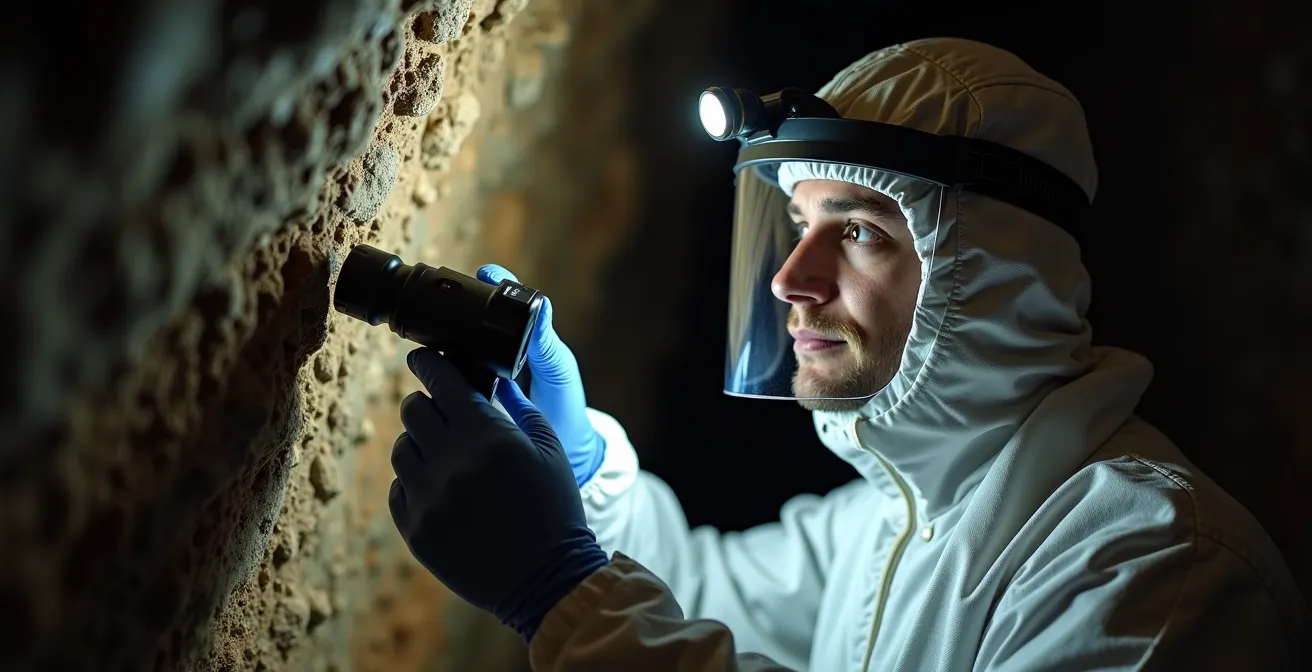
The situation became so dire that the cave was nicknamed “the green sickness” and later “the black sickness” as different species of fungi and bacteria bloomed. Scientists in full protective gear, resembling a biohazard team, were called in to fight the outbreak. This image powerfully conveys the reality of the cave today—not a tourist site, but a fragile patient in intensive care.
The battle against the mold was a desperate one, involving fungicides and painstaking manual cleaning. While the outbreak was eventually brought under control, it was never completely eradicated. The spores remain dormant in the soil, a permanent threat ready to re-emerge if the cave’s climate is disturbed again. This catastrophic event served as the final, brutal confirmation that large-scale human access and the delicate art of Lascaux are fundamentally incompatible. The cave must remain in a permanent conservation quarantine to prevent another, potentially final, biological assault.
When VR Becomes the Only Way to Visit Endangered Heritage
The stark reality of Lascaux’s fragility has forced a radical rethinking of what it means to “visit” a heritage site. With the original cave sealed to all but a handful of scientists, physical access is no longer a viable option for the public. The strictness of this quarantine is absolute. UNESCO’s management plan has imposed an extreme limit on human presence within the original cave, with some regulations capping it at a total of 800 hours of total annual human presence. This tiny window is reserved exclusively for essential scientific monitoring and conservation, leaving zero room for tourism.
This reality has catalyzed innovation in digital access. Alongside physical facsimiles like Lascaux IV, virtual reality (VR) is emerging as a powerful tool for heritage preservation and dissemination. Projects now offer complete, explorable 3D models of the cave, allowing a global audience to “enter” the space from anywhere in the world. These virtual tours are not simple videos; they are immersive experiences that allow users to move through the galleries, examine paintings up close, and access layers of information that would be impossible to convey during a physical tour.
For the heritage enthusiast who grieves the loss of the authentic experience, this may initially feel like another compromise. Yet, it represents a paradigm shift. Digital preservation offers a form of access that is infinitely scalable and completely non-destructive. It allows us to satisfy our curiosity and our desire to connect with the past without contributing to its demise. As more and more world heritage sites become endangered due to climate change, environmental instability, or the pressures of over-tourism, the Lascaux model—a combination of high-fidelity physical replicas and immersive digital experiences—is becoming the blueprint for the future. It is an ethical and sustainable way to ensure that these universal treasures continue to inspire humanity for generations to come, long after their original doors have been sealed.
Manganese and Ochre: Sourcing Colors Without a Supply Chain
The genius of the Lascaux artists is evident not only in their breathtaking compositions but also in their profound understanding of their local environment as a source of materials. In an era without supply chains or specialized stores, they were master chemists and geologists, sourcing and processing a vibrant palette of pigments directly from the earth beneath their feet. Their entire artistic toolkit was gathered from the immediate vicinity of the Vézère Valley.
The primary colors used in the cave are a direct reflection of the region’s geology. The rich reds, yellows, and browns came from ochre, a natural clay earth pigment rich in iron oxide, which was abundant in the local soil. Artists would find these deposits, grind the raw ochre into a fine powder, and then mix it with a binder to create a usable paint. The deep, powerful blacks that outline so many of the animal figures were derived from manganese dioxide. This mineral was found both inside and outside the caves, often as soft, crayon-like chunks that could be used for drawing directly or ground into a powder for paint.
The process of creating paint was an art in itself. After grinding the pigments, artists would mix them with a liquid binder to give the paint substance and help it adhere to the limestone walls. While the exact binders are still debated by scientists, likely candidates include cave water (rich in calcium carbonate), animal fat, or plant juices. This paint could then be applied with primitive brushes made from animal hair or twigs, or even sprayed from the mouth or through a hollow bone to create the soft, airbrushed effects seen in many of the artworks. By skillfully mixing these few base pigments, they were able to create a range of intermediate shades, adding depth and realism to their creations.
How to Crowdfund a Restoration Project When Grants Fail
The creation of Lascaux IV was a monumental undertaking, not just artistically but financially. With a reported budget in the realm of €66 million, the project was far beyond the scope of a simple museum exhibit, requiring substantial state and regional funding. This level of investment is a testament to the cultural importance of Lascaux. However, it also highlights a critical problem in heritage preservation: what happens when a site is not as famous as Lascaux? For thousands of other important but less celebrated sites, government grants are scarce and securing funding for restoration or replication is a constant struggle.
This is where modern funding models, particularly crowdfunding, are becoming an essential tool. When traditional grant avenues fail, turning to the public offers a powerful alternative. A successful heritage crowdfunding campaign is not simply a donation drive; it is a strategic effort to build a community around a shared goal of preservation. It requires framing the project with a sense of urgency, often by highlighting a clear conservation timeline and the specific threats a site faces.
The most effective campaigns offer tangible connections to the project. Instead of just asking for money, they create tiered rewards that give donors a sense of ownership. These can range from simple digital rewards, like exclusive access to 3D models or behind-the-scenes updates, to more significant opportunities for larger donors, such as private tours or having their name associated with a part of the restoration. Partnering with local cultural influencers and historians can also amplify the message, lending credibility and reaching a wider audience. For many at-risk sites, this democratic approach to funding is not just an option; it’s becoming their only hope for survival, transforming public passion into the financial resources needed to save our shared history.
Key takeaways
- The closure of Lascaux was not just preventative; it was an emergency response to a catastrophic collapse of the cave’s stable micro-ecosystem.
- Human breath creates carbonic acid that chemically dissolves the 20,000-year-old pigments, while microbes introduced from the outside caused a devastating mold outbreak.
- Lascaux IV is a high-fidelity facsimile, accurate to the millimeter, created as a scientific and ethical solution to allow public access without destroying the original.
How Paleolithic Artists Used Rock Formations to Animate Figures
The artists of Lascaux were not painting on flat canvases. They were working within a dynamic, three-dimensional space, and their genius lies in how they integrated the cave’s natural topography into their art. The walls of the cave are uneven, full of bulges, cracks, and curves. Rather than viewing these as imperfections to be ignored, the artists used them to bring their figures to life. This intimate dialogue between the artist’s vision and the natural form of the rock is one of the most sophisticated aspects of Paleolithic art.
As one analysis of the artwork notes, this was a deliberate and masterful technique. In the “Lascaux Caves Facts and Mysteries” published on DocumentaryTube, it is highlighted:
The art in the caves is painted on and engraved into the uneven walls of the cave. The artists worked with the edges and curves of the walls to enhance the composition. The result is an impressive display of animals and abstract symbols.
– DocumentaryTube, Lascaux Caves Facts and Mysteries
A swelling in the rock might become the powerful shoulder of a bison. A crack in the limestone could be transformed into the leg of a horse or the spear that has wounded it. This technique adds a sculptural quality to the two-dimensional paintings, giving the animals a sense of volume and presence. When viewed by the flickering light of an animal-fat lamp, these natural contours would have made the figures appear to shift and move, creating a truly animated and immersive experience for the prehistoric viewer.
Furthermore, the artists employed clever compositional techniques to create the illusion of motion. One of the most famous examples is the “crossed bison” in the Nave, which demonstrates this perfectly. By depicting the bison’s legs in a crossed, dynamic posture, the artist imbues the figure with a sense of powerful forward momentum. In other areas of the cave, artists used repetition, drawing multiple heads or legs on a single animal to suggest a figure in motion. This technique, a precursor to modern animation, shows a highly developed understanding of visual storytelling, transforming a static wall into a vibrant, living scene.
To truly appreciate this monumental act of preservation, the next step is to visit Lascaux IV not as a substitute for a lost experience, but as a powerful testament to the heritage we are fighting to protect.