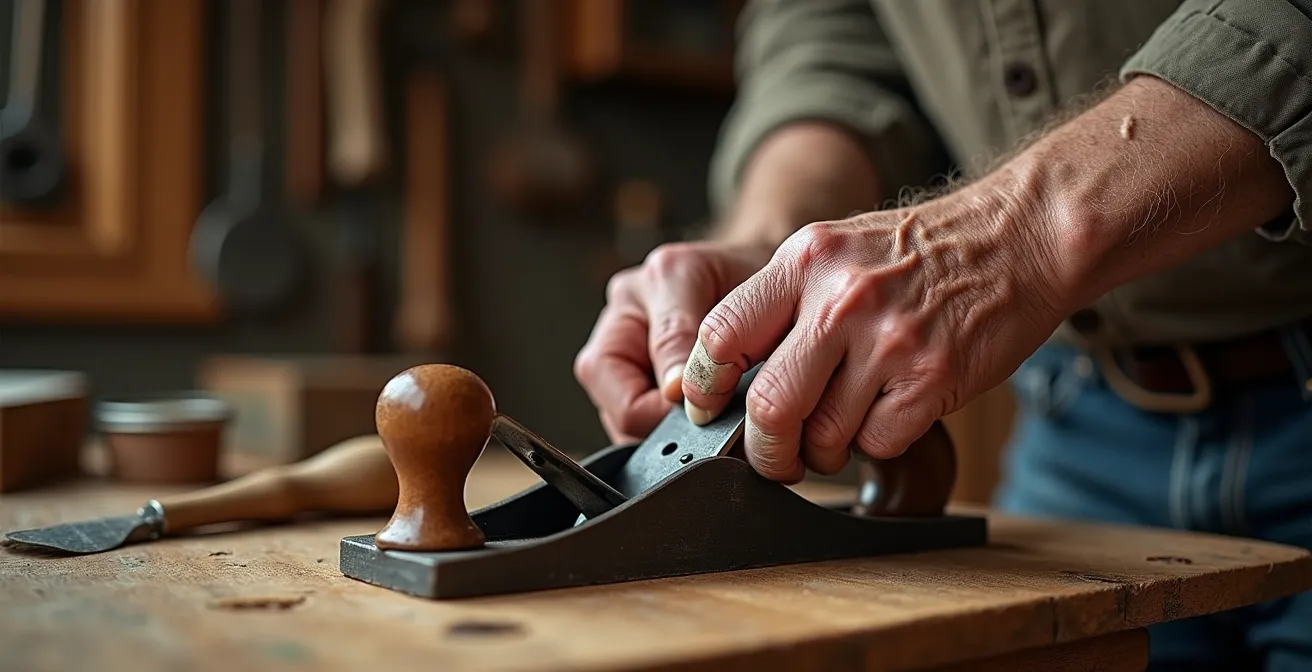
The neurological mastery defining a great artisan is the very mechanism that triggers their body’s inevitable collapse over a 40-year career.
- Decades of repetitive motion create a “somatic debt” of micro-traumas, leading to chronic conditions like Repetitive Strain Injuries (RSIs).
- The intense focus (“flow state”) required for mastery makes artisans ignore crucial pain signals, accelerating irreversible physical damage.
Recommendation: True mastery involves not just perfecting the craft, but implementing proactive ergonomic strategies and accepting physical evolution as part of the career lifecycle.
The image of the master artisan is one of serene focus and effortless skill. We envision gnarled hands moving with an innate wisdom, shaping wood, clay, or metal as if by instinct. This romanticized vision, celebrated in countless stories, celebrates the outcome of 10,000 hours of dedication. We see the beautiful object, the flawless finish, and assume the body behind it is a perfectly honed instrument, forever in tune with its task. The common advice to simply “take breaks” or “use good posture” barely scratches the surface of the physiological war being waged within.
But what if this narrative is dangerously incomplete? From a clinical and ergonomic perspective, the truth is far more complex and sobering. The very neurological adaptations that forge a master are simultaneously the architects of their body’s eventual, inevitable failure. The artisan’s body is not just a tool; it’s a biological system under decades of extreme, specialized stress. This accumulation of physical cost, or “somatic debt,” is often ignored until it’s too late, leading to a state of neurological betrayal where the mind’s commands can no longer be executed by a failing body.
This article moves beyond the romanticism to offer a clinical dissection of this process. We will explore how the brain’s automation of movement creates a paradox of performance and pain. We will analyze the hidden environmental costs, the psychological traps of deep focus, and the final “ergonomic endgame” where adaptation becomes a matter of survival. This is the untold story of what happens to the master’s body when the labor of a lifetime comes due.
To fully understand the physical journey of a master artisan, from the peak of their skill to the challenges of their later years, this guide breaks down the key physiological and ergonomic stages. The following sections will provide a detailed look into the science of mastery and the reality of its long-term cost.
Summary: The Artisan’s Physical Journey: Mastery and Its Toll
- 10,000 Hours: How the Brain Automates Complex Hand Movements
- Dust and Fumes: The Hidden Health Cost of Traditional Sanding
- The Zone: Why Artisans Lose Track of Time While Shaping
- Custom Grips: How Tools Evolve With the Master’s Hand
- Reading Surface with Skin: The Sensory Superpower of Polishers
- Surviving the 3-Month Isolation of the Grand Prix de Rome Competition
- Climbing into the Abyss: The Physical Risk of Creating Cave Art
- What Happens When the Last Master Glassblower Retires?
10,000 Hours: How the Brain Automates Complex Hand Movements
The concept of “10,000 hours” represents the brain’s remarkable ability to achieve automaticity. Through relentless practice, complex sequences of movement are transferred from the conscious prefrontal cortex to the basal ganglia and cerebellum. This creates “muscle memory,” allowing the artisan to perform intricate tasks with subconscious speed and precision. However, this neurological triumph sets a dangerous trap. As Dr. Joseph Herrera, a physiatrist at Mount Sinai Health System, notes, artisans are highly vulnerable to Repetitive Strain Injuries (RSIs), particularly in the shoulder, elbow, and hand. The automated movements, repeated millions of times, create micro-traumas in soft tissues that accumulate into a significant “somatic debt.”
This creates a profound physiological paradox. The brain becomes hyper-efficient at executing a task, while the physical structures—tendons, ligaments, and nerves—begin to degrade under the strain. The artisan’s body becomes a specialized machine, but one without interchangeable parts. The problem is compounded by age-related physical decline. Even among elite performers, research from sports medicine shows that physical performance declines accelerate from age 70 onwards in master athletes, involving progressive loss of muscle mass and flexibility. For an artisan, this means the brain continues to send signals for movements the body can no longer safely or effectively perform, leading to what can be described as a neurological betrayal.
Dust and Fumes: The Hidden Health Cost of Traditional Sanding
Beyond the mechanical strain on muscles and joints, the artisan’s workshop is often an environment of invisible threats. The very materials that are sources of beauty—exotic woods, potent solvents, fine finishing powders—release microscopic particles and volatile organic compounds (VOCs) into the air. Traditional sanding, in particular, aerosolizes wood dust, which can be inhaled deep into the respiratory system. Over a career spanning decades, this constant exposure represents a significant, often underestimated, health risk. It’s a prime example of accumulating somatic debt through environmental factors.
While the risk of severe illness may seem statistically low, the long-term nature of the exposure is the critical factor. For instance, medical authorities studying woodworking hazards estimate that only about one woodworker in 1,400 will get nasal cancer after an average of 40 years of exposure. Although the odds are small, the consequence is severe, and it is a direct result of cumulative, career-long exposure. The true danger lies in the normalization of this environment. Many artisans become accustomed to the smell of sawdust or solvents, viewing it as an integral part of the creative process rather than a persistent occupational hazard.
This underscores the need for a proactive, rather than reactive, approach to safety. As Michael McCann of the Center for Occupational Hazards in New York City advises, assuming the worst is the safest strategy:
The best procedure to follow is to assume that the wood being used has been processed with dangerous chemicals and take the necessary precautions.
– Michael McCann, Center for Occupational Hazards, New York City
The Zone: Why Artisans Lose Track of Time While Shaping
Every creator knows the “flow state” or “the zone”—a state of deep immersion where time seems to dissolve, the outside world fades away, and the work flows effortlessly. This psychological peak is where an artisan’s best work is often produced. However, from an ergonomic standpoint, this state is a physiological paradox. While the mind is deeply engaged and gratified, the body’s internal warning system—pain, stiffness, fatigue—is effectively silenced. The artisan, lost in the act of shaping or polishing, may hold an awkward posture for hours or repeat a straining motion thousands of times without conscious awareness of the damage being done.
This temporal disconnection is a major contributor to the accumulation of somatic debt. Each session in the zone, while creatively productive, can be a significant deposit of micro-trauma into the body’s physical “account.” The very passion that drives the work becomes a mechanism for self-injury. As Dr. Joseph Herrera explains, the compulsion to continue working while inspired directly conflicts with the body’s need for recovery.
Although making art is a passion-driven activity, and it’s difficult for artists to stop when they’re absorbed in what they’re doing, intermittent periods of rest are one of the best ways to prevent repetitive stress injuries.
– Dr. Joseph Herrera, Mount Sinai Health System
The image of the solitary artisan, lost in their work, is a powerful and romantic one. Yet, it also depicts a moment of high physical risk, where the drive for perfection overrides the instinct for self-preservation.
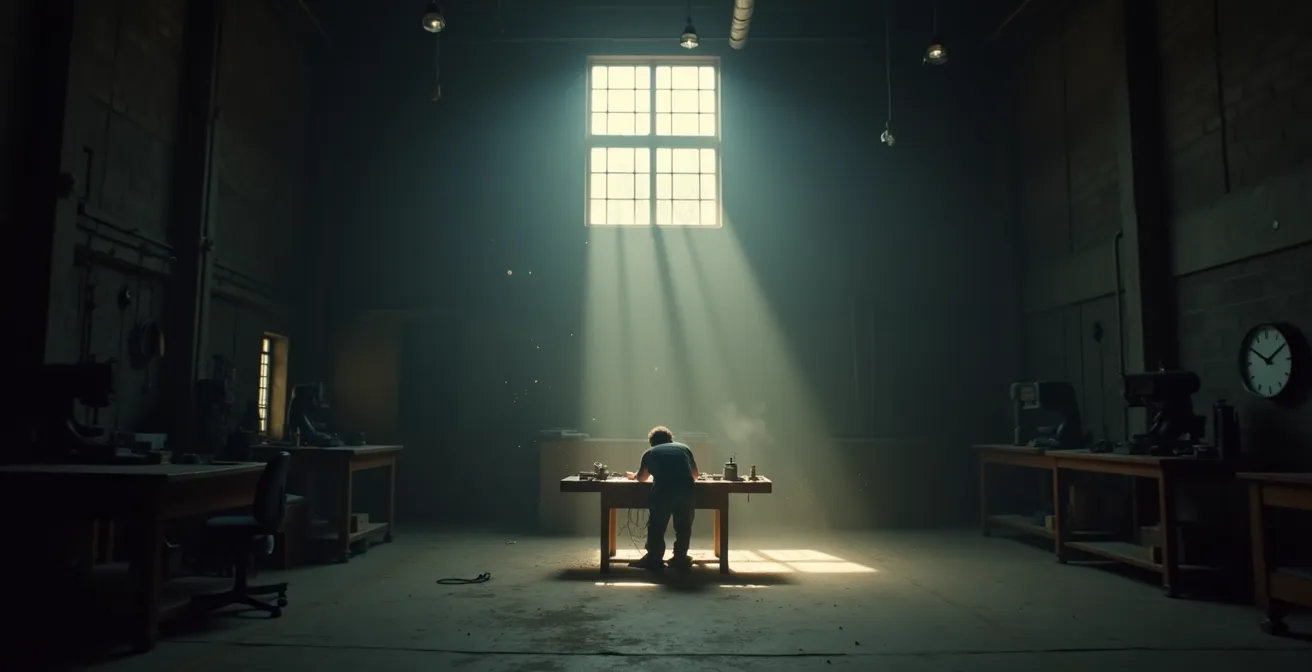
This deep focus, as depicted here, is both a source of creative genius and a significant ergonomic hazard. The challenge for the aging artisan is to learn how to access this state without paying an unsustainable physical price, balancing creative immersion with the body’s non-negotiable need for rest and variation in posture.
Custom Grips: How Tools Evolve With the Master’s Hand
A master artisan’s tools are often extensions of their own body. Over years of use, a wooden handle wears down to perfectly match a grip; the weight of a hammer becomes an intuitive part of the arm’s swing. This symbiosis between hand and tool is a mark of deep experience. However, as the body begins to fail, this relationship must change from one of comfort to one of medical necessity. The tool, once an enabler of skill, can become a source of pain. Customizing grips and modifying tools is no longer about preference; it’s about the ability to continue working at all.
This transition marks a critical phase in the “ergonomic endgame.” Pain forces the artisan to re-evaluate every point of contact with their work. This is not a sign of weakness, but a necessary adaptation. For instance, Michelle Berry of Berry Colorful Yarnings found that the simple act of hand-winding yarn skeins was the source of debilitating wrist pain. To save her business and her craft, she had to fundamentally change her process, hiring help and using devices like niddy-noddies to reduce the specific strain that was causing the injury. The tool or technique had to evolve because her body could no longer pay the physical price.
For many aging artisans, this means actively seeking out ergonomic solutions to augment their failing physical capabilities. The focus shifts from pushing through the pain to intelligently working around it. These adaptations are crucial for extending a career and managing chronic conditions.
Your Action Plan: Ergonomic Adaptations for Longevity
- Assess your workspace: Use ergonomic chairs with lumbar supports for long sitting periods and consider sit-stand desks to vary your working position.
- Modify your tools: Apply padding or specialized ergonomic grips to existing tools to reduce vibration and force required.
- Incorporate external support: Use splinting, braces, and compression gloves to support vulnerable joints like wrists and elbows during intensive work.
- Rethink digital interfaces: If your craft involves computer work, employ specially designed mice and keyboards engineered to reduce strain.
- Implement structured rest: Schedule mandatory breaks to interrupt repetitive motions, even when in a state of flow, to allow tissues to recover.
Reading Surface with Skin: The Sensory Superpower of Polishers
One of the most profound skills a master artisan, especially a woodworker or sculptor, develops is a heightened haptic sense. Their fingertips become exquisitely sensitive instruments, capable of “reading” a surface to detect imperfections—subtle waves, rough spots, or changes in texture—that are invisible to the naked eye. This sensory superpower allows for a level of finish that machines cannot replicate. The skin itself becomes a primary tool for quality control. But this tool, like any other part of the body, is subject to wear and tear. Over decades, this hyper-sensitivity can degrade through a process of sensory erosion.
The very factors that build the skill can also destroy it. Constant friction leads to calluses, which dull sensitivity. Exposure to solvents and chemicals can dry and crack the skin. Nerve endings can be damaged by the vibration of power tools, leading to numbness or tingling. The biological reaction is complex; while some individuals become more prone to allergic reactions, others experience a deadening of the senses. For example, research on occupational sensitivities indicates that only 2 to 5 people out of 100 develop unhealthy sensitivity to wood chemicals, but for those who do, it can be career-ending. For the majority, the greater risk is the slow, creeping loss of the very sense they rely on most.
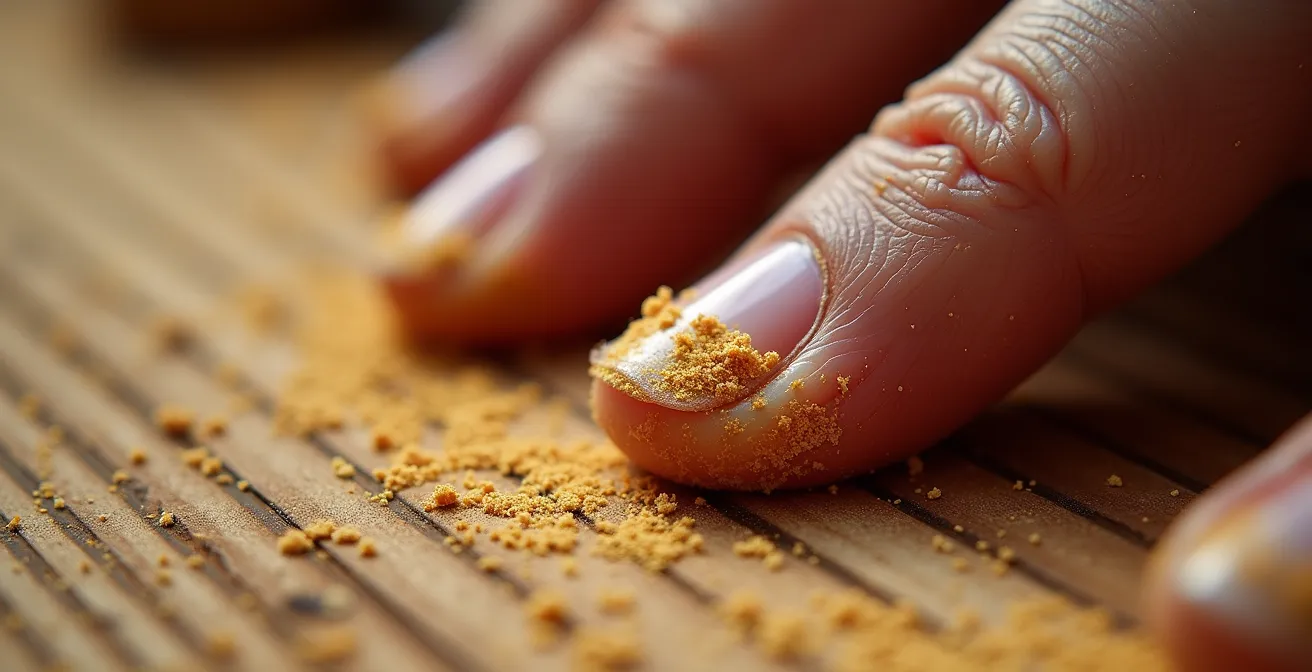
The weathered fingertips of a master tell a story of both profound skill and physical cost. Each line and callus is a testament to countless hours of labor. The tragedy of sensory erosion is that the artisan can lose their most subtle and valuable instrument, forcing them to rely more on sight or other, less precise methods. This loss is not just a practical handicap; it can be a deeply dispiriting experience, severing the intimate connection between the creator and their material.
Surviving the 3-Month Isolation of the Grand Prix de Rome Competition
Intensive, high-stakes environments like the historic Grand Prix de Rome competition, where artists were isolated for months to produce a masterpiece, represent an accelerated accumulation of somatic debt. In these pressure-cooker situations, artists push their bodies to the absolute limit, sacrificing sleep, posture, and well-being for the sake of their art. This period of extreme effort can lay the foundation for injuries and chronic conditions that will emerge decades later. It is a stark example of how the pursuit of excellence can demand a physical price that is paid in installments over an entire career.
This relentless drive is not dissimilar to that of a professional athlete. The physical decline that follows a career of peak performance is a well-documented phenomenon. Even for those who maintain a high level of activity, the body’s capacity diminishes. Research on master athletes shows a progressive loss of muscle mass, declines in force-generating capacity, and decreased flexibility, all of which characterize the muscular changes underlying performance declines. For an artisan, whose body is their primary instrument, confronting this physical decline is not just a practical challenge but a profound emotional one. It can feel like a loss of identity.
The process of coming to terms with a body that can no longer perform at its peak is a form of grief. Acknowledging this grief is a critical step toward healthy adaptation. As Dr. Susan Block of Harvard-affiliated Brigham and Women’s Hospital explains, this acceptance can open the door to new ways of being and creating.
Men have the power to deal with the issues that contribute to their grief. By acknowledging diminishing strength, men can give themselves room to grieve and grief can pave the way for new adaptations that can be healing and healthy.
– Dr. Susan Block, Harvard-affiliated Brigham and Women’s Hospital
Climbing into the Abyss: The Physical Risk of Creating Cave Art
The physical toll of craftsmanship is not a modern phenomenon. It is an ancient and fundamental aspect of making things by hand. Consider the prehistoric artists who created the masterpieces at Lascaux or Chauvet. They worked by the flickering light of animal-fat lamps, inhaling thick smoke while contorting their bodies to paint on uneven cave ceilings. They climbed rickety wooden scaffolding and squeezed through tight passages, enduring extreme physical hardship to create their art. Their work was a testament to human creativity, but it undoubtedly came at a great physical cost.
While the tools and materials have changed, the core ergonomic challenges remain. The modern artisan may have traded the risk of falling from a scaffold for the chronic hunch over a workbench, but the strain is still present. The nature of the risk has simply evolved. The following table illustrates how the physical burdens have shifted, but not disappeared, from ancient times to today.
| Risk Factor | Ancient Artisans | Modern Artisans |
|---|---|---|
| Primary Strain | High-impact, low-frequency (stone tools) | Low-impact, high-frequency (power tools) |
| Posture Issues | Cave ceiling painting positions | Workbench hunching, repetitive positions |
| Chemical Exposure | Natural pigments, smoke | Solvents, synthetic finishes, dust |
| Career Length | Shorter lifespan limited exposure | 40+ years cumulative damage |
This comparison, based on an understanding of occupational hazards in craftsmanship, reveals a critical insight: modern artisans face a longer period of cumulative damage. While an ancient artist’s career might have been cut short by other dangers, a modern master can work for 40 or 50 years, allowing decades for repetitive strain and chemical exposure to compound into debilitating conditions. The problem isn’t new; its timeline has just been extended.
Key Takeaways
- Mastery’s Paradox: The same neurological automation that creates expert skill is what leads to repetitive strain and long-term physical breakdown.
- Somatic Debt is Real: An artisan’s career involves accumulating “somatic debt”—a combination of mechanical micro-traumas and environmental exposures that comes due after decades.
- Adaptation is Survival: The “ergonomic endgame” for a master artisan is not about quitting, but about intelligently adapting tools, techniques, and roles to work around the body’s limitations.
What Happens When the Last Master Glassblower Retires?
The retirement of a master artisan is more than the end of one person’s career; it can represent a critical break in a chain of knowledge passed down through generations. When a body, after 40 or more years of labor, can no longer perform the demanding tasks of the craft—whether it’s the intense heat and physical exertion of glassblowing or the fine motor control of engraving—the “ergonomic endgame” is reached. This is the final stage where pain and physical limitation foreclose the ability to practice the craft in its original form. It is a moment of profound personal and cultural loss.
This transition is often met with frustration and grief. However, accepting this new reality is the first step toward a different kind of mastery. As Dr. Susan Block from Harvard’s Department of Psychosocial Oncology and Palliative Care suggests, this is a new chapter, not the end. The focus must shift from physical execution to the preservation and transmission of knowledge. Many master crafters facing retirement due to physical decline find new purpose by shifting their roles. Some become mentors, hiring assistants to handle the physical labor while they provide creative direction and quality control. Others transition exclusively to teaching, consulting, or writing, ensuring their lifetime of accumulated wisdom is not lost.
This final adaptation is perhaps the most important. It transforms the artisan from a “maker” into a “legacy-holder.” By embracing the role of a teacher or mentor, the master ensures that their skills, refined over a lifetime of physical sacrifice, will outlive their own body’s ability to perform them. It is the ultimate act of mastery: preserving the craft itself for the next generation, even when one’s own hands can no longer do the work.
Ultimately, a sustainable career in craftsmanship requires a proactive and informed approach to one’s own physical well-being. By understanding the long-term ergonomic risks from day one, artisans can take steps to manage their somatic debt, allowing them to extend their creative lives and, when the time comes, transition gracefully into roles that preserve their invaluable legacy.