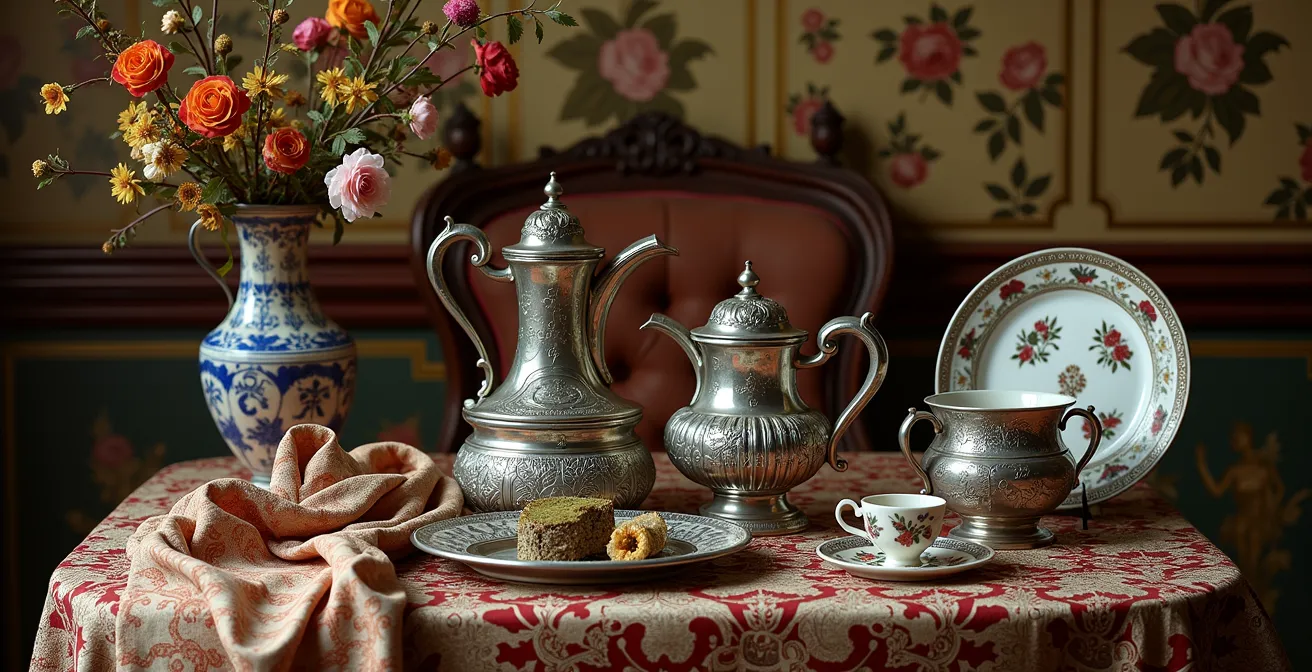
Decorative patterns are often dismissed as mere ornamentation, chosen for their aesthetic appeal. This view overlooks their function as covert political actors throughout history. Far from being passive, patterns have been actively designed and deployed as tools of propaganda, secret codes for subversion, and bold declarations of imperial power, embedding complex narratives of identity and conflict into everyday objects.
A floral motif on a teacup, a geometric design on a scarf, a classical column on a government building. We encounter patterns so frequently that they become part of our visual background, their presence registered but their meaning rarely questioned. For the curious observer, however, these recurring designs can feel like a half-remembered language. There is a nagging sense that these motifs are not arbitrary; that a choice was made, a message intended. This intuition is correct. The decorative arts are a rich repository of political and cultural history, where patterns function as a sophisticated, and often covert, visual vernacular.
Conventional analysis of political art often focuses on overt works—the grand history painting or the confrontational protest poster. Yet, this overlooks a more subtle and pervasive form of communication. The history of decorative patterns is a history of power, identity, and rebellion written in a coded script. These designs are not merely symbols; they are active agents in cultural dialogues. They can be invented to project a fantasy of empire, used to pass clandestine messages under the nose of a repressive regime, or appropriated to display dominance over another culture.
This article moves beyond the surface to decode the hidden lives of these patterns. We will investigate how seemingly innocuous designs become charged with political significance. By examining specific motifs—from the imagined pagodas of Chinoiserie to the revolutionary Phrygian cap—we will uncover the mechanisms by which a simple pattern transforms into a statement, revealing the intricate ways art and politics are woven into the very fabric of our material world.
To understand this complex language, this exploration will unpack the stories behind some of history’s most significant decorative motifs. Each section reveals a different facet of how patterns act as political agents in art and design.
Summary: Why That Flower Pattern Might Be a Political Statement?
- Imagined Pagodas: How Europe Invented a Fake Asia via Decor
- Saying “I Love You” with a Fern: Victorian Botanical Codes
- Who Owns the Shield: Reading Coat of Arms on Antique Silver
- Phrygian Caps on Plates: Secret Support for the Revolution
- Paisley’s Journey: How a Persian Motif Conquered Scottish Textiles
- Painting the King as a Pear: The Rise of Political Caricature
- Exporting Columns: How Neoclassicism Became a Tool of Empire
- 3D Printing Clay: Is It Cheating or Evolution?
Imagined Pagodas: How Europe Invented a Fake Asia via Decor
In the 18th century, European drawing rooms were flooded with a peculiar vision of the East. Porcelain, textiles, and furniture were adorned with whimsical scenes of lantern-lit gardens, long-moustached mandarins, and fanciful pagodas. This style, known as Chinoiserie, was not an authentic representation of Chinese culture but rather a European invention, a fantasy constructed from fragmented travelogues and a burgeoning desire for the exotic. As historian Misti Justice notes, Chinoiserie was the “combined product of colonial exploration and exotic fantasy,” a dreamscape that served specific political and economic functions.
This aesthetic was fueled by an insatiable appetite for Chinese goods, most notably tea. With 18th-century English potteries making fortunes through imitation when authentic porcelain orders could take years, a domestic industry of “fake” Chinese patterns was born. This wasn’t just about decoration; it was about participating in a global trend that signaled wealth and worldliness. By creating a sanitized, idyllic, and non-threatening version of Asia, European powers could consume its aesthetic while maintaining a sense of cultural superiority. The Chinoiserie pattern was, in effect, a form of aesthetic colonialism.
The possession and display of these objects became a political act. According to art historian Dennis Carr, by embracing these patterns, colonial residents “celebrated the global reach of their respective mother countries and asserted their own position within the worldwide market for Asian goods and ideas.” The imagined pagoda on a teacup was more than a pretty picture; it was a symbol of imperial reach and economic power, a pattern designed to domesticate the foreign and affirm a Eurocentric worldview.
Saying “I Love You” with a Fern: Victorian Botanical Codes
In the socially restrictive Victorian era, where open displays of emotion were a major social taboo, a new and subtle form of communication blossomed: floriography, or the language of flowers. This intricate system assigned specific meanings to different plants and their arrangements, allowing individuals to convey complex messages of love, disdain, or warning without uttering a single word. A bouquet was no longer just a gift but a coded letter, and botanical patterns on jewelry, fans, and home decor became a form of covert signaling.
This “secret code was an appealing outlet for Victorians,” explains historian Erica Weiner, providing a way to navigate the rigid constraints of society. A red tulip declared love, while lavender signified distrust. The way flowers were presented also mattered: an upright bouquet conveyed a positive message, while an inverted one signaled the opposite. This visual vernacular turned everyday botany into a powerful tool for private expression, transforming decorative floral patterns from simple ornamentation into deeply personal, and sometimes political, statements.

The coded nature of floriography could also be weaponized for iconoclastic subversion, a tactic used to signal belonging to a marginalized group.
Case Study: Oscar Wilde’s Green Carnation
A famous example of this botanical code being used for political identity is attributed to Oscar Wilde. He allegedly asked his friends to wear an artificially dyed green carnation on their lapels. As homosexuality was deemed “unnatural” by society, Wilde chose a deliberately unnatural flower as a subversive badge of identity. This act, described in a detailed history of floriography, transformed a simple floral accessory into a potent symbol of defiance and queer identity within a hostile social landscape.
Who Owns the Shield: Reading Coat of Arms on Antique Silver
Among the most structured and explicitly political patterns in decorative art is the coat of arms. Far from being a random assortment of symbols, heraldry is a rigorous visual system of identification, lineage, and social standing. When found engraved on an antique piece of silver, a coat of arms acts as a historical document, declaring not just the owner’s identity but their legal and social rights. To read a coat of arms is to decode a language of power, one where every color, shape, and symbol carries a specific, legally recognized meaning.
The grammar of heraldry is built on a few key components. The tinctures (colors and metals) have specific names, such as Gules for red (signifying a warrior or martyr) and Or for gold (generosity). The field, or background of the shield, is divided by geometric lines called ordinaries, like the ‘fess’ (a horizontal band) or ‘pale’ (a vertical band). Finally, charges—the symbols placed on the shield, such as lions (courage), eagles (power), or fleur-de-lis (royalty)—add another layer of meaning. The combination of these elements created a unique visual signature for a family or individual.
The ownership of a coat of arms was, and in many places still is, a legally protected right. Its presence on an object like a silver platter or tankard was a public claim to a particular status. It could signify inherited nobility, a royal grant of arms for service to the crown, or the merging of two powerful families through marriage (represented by impalement, where two shields are combined). Therefore, the pattern wasn’t merely decorative; it was a legally binding signature and a public declaration of one’s place in the social hierarchy.
Your Action Plan: How to Read a Coat of Arms
- Identify the Field and Tinctures: Note the primary colors and metals of the shield’s background. Look for patterns like checks (chequy) or stripes (barry) that define the field itself.
- Recognize the Ordinaries: Look for the main geometric divisions. Is there a cross, a chevron (inverted V), or a saltire (X-shaped cross)? These are the fundamental structural elements.
- Interpret the Charges: Identify the main symbols on the shield. Are they animals, mythical beasts, plants, or objects? Research their traditional heraldic meanings.
- Look for Additions: Check for elements outside the shield, like a crest (above the shield, often on a helmet), a motto (on a scroll below), or supporters (figures holding the shield). These provide further clues.
- Analyze the Composition: If the shield is divided (a practice called ‘quartering’), it likely represents the union of different family lines or inherited titles. Each quadrant tells a part of the family’s story.
Phrygian Caps on Plates: Secret Support for the Revolution
During the French Revolution, expressing royalist or republican sympathies openly could be a death sentence. In this climate of fear and suspicion, everyday objects became canvases for covert political allegiance. A seemingly innocent decorative plate or snuffbox could carry patterns that signaled one’s loyalty to the revolutionary cause. One of the most potent of these symbols was the Phrygian cap, a soft, conical cap with the top pulled forward, which became an unmistakable emblem of liberty and the fight against tyranny.
Originally associated with ancient Phrygia (in modern-day Turkey), the cap was believed in antiquity to have been worn by emancipated slaves in the Roman Empire. This historical connection made it the perfect symbol for the revolutionaries seeking to free themselves from the “slavery” of monarchical rule. The pattern of the cap, painted on faience plates, woven into textiles, or placed atop a pike, was a silent but powerful declaration of support for the Republic. To own or display such an object was to align oneself with the revolution, making a decorative choice a profound political statement.
The use of a simple, repeatable motif to represent a complex political ideology is a recurring theme in history. A recognizable symbol can unify a movement and make its ideals instantly accessible, a tactic that continues into the modern era.
Modern Parallel: The DSA’s Rose Logo
A contemporary example of this is the rose, a symbol with a long history in socialist movements. The Democratic Socialists of America (DSA) adopted a logo featuring a red rose held by interlocking black and white hands. As detailed in a report by The Outline on the political use of roses, this simple pattern effectively communicates the group’s commitment to socialism and racial equality. Like the Phrygian cap, the rose serves as an aesthetically pleasing and emotionally resonant identifier that condenses a political platform into a single, powerful image.
Paisley’s Journey: How a Persian Motif Conquered Scottish Textiles
The swirling, teardrop-shaped motif known as Paisley is today synonymous with 19th-century Scottish textiles, the hippie movement of the 1960s, and high-end fashion. Its origins, however, lie far from Scotland, in the Persian ‘boteh’ or ‘buta’—a stylized floral spray or cypress tree representing life and eternity. The journey of this pattern from Persia and India to the mills of Paisley, Scotland, is a classic tale of cultural appropriation and the economics of empire.
In the 18th and 19th centuries, expensive cashmere shawls featuring the boteh motif were imported from Kashmir by the British East India Company. They became the ultimate status symbol for wealthy European women, a tangible sign of their connection to the vast and “exotic” British Empire. The demand was so high, and the originals so costly, that European manufacturers sought to replicate the pattern. The weavers in the town of Paisley, Scotland, became so proficient at mass-producing affordable imitations that their town’s name became permanently attached to the motif, effectively erasing its Persian and Indian origins in the popular imagination.
This act of renaming and mass-production is a prime example of what sociologist Thorstein Veblen called a benefit of a ruling class. In his seminal work, The Theory of the Leisure Class, he argued:
The ability to appropriate was one of the benefits afforded specifically to a ruling class.
– Thorstein Veblen, The Theory of the Leisure Class
The story of Paisley is therefore not just about a beautiful design. It is about aesthetic imperialism, where a pattern is stripped of its original cultural context, renamed, and commodified for the benefit of a colonial power. The pattern’s semiotic drift—from a symbol of life in Persia to a symbol of wealth in Britain and finally to a symbol of counterculture in America—shows how a motif’s meaning is constantly in flux, shaped by the forces of trade, power, and politics.
Painting the King as a Pear: The Rise of Political Caricature
Political statements in art are not always hidden; sometimes they are aggressively overt. The rise of political caricature in the 19th century, particularly in France, weaponized the power of pattern and repetition to mock and undermine authority. The most famous example of this is the transformation of King Louis-Philippe I into a pear (“poire” in French, also slang for “fool” or “fathead”).
The caricature, created by artist Charles Philipon, began as a simple courtroom sketch showing the king’s face gradually morphing into a pear. Published in the satirical magazine La Caricature, the image went viral. The simple, repeatable shape of the pear became a shorthand for ridiculing the monarch. It was scrawled on walls, printed in pamphlets, and even carved into objects. This act of iconographic subversion used a simple pattern to dismantle the carefully constructed image of royal authority, proving that a repeated visual insult could be more powerful than a thousand critical essays.

This use of a repeated, stylized pattern as a form of political protest has endured. From simple graffiti to sophisticated street art, the strategy of using a recognizable motif to convey a political message remains a cornerstone of activism.
Case Study: Banksy’s Stenciled Protests
The anonymous street artist Banksy employs a similar strategy. Using stencils—a form of pattern-making—he creates instantly recognizable and politically charged images that critique war, consumerism, and state authority. His 2015 works in Gaza, created to highlight the Israeli-Palestinian conflict, or his murals near the Calais migrant camp, used repeated motifs like the “girl with a balloon” to create an inescapable visual commentary. Like the pear, Banksy’s stencils are patterns that provide an alternative perspective on political issues, their repetition across the urban landscape amplifying their message.
Exporting Columns: How Neoclassicism Became a Tool of Empire
Architecture is perhaps the most imposing form of decorative art, and its patterns speak volumes about power. The Neoclassical style, which dominated Western architecture in the 18th and 19th centuries, is a prime example of a pattern language used to project imperial authority. Characterized by its use of classical orders (Doric, Ionic, Corinthian columns), grand scale, and rational symmetry, Neoclassicism was a deliberate revival of the architecture of ancient Greece and Rome.
Empires like Britain and France, and later the fledgling United States, adopted this style for their most important government buildings, museums, and banks. The choice was deeply political. By clothing their institutions in the architectural patterns of the Roman Empire, these nations were making a clear visual claim to be the modern-day heirs of Roman power, law, and civilization. The pattern of the Corinthian column on a bank in London or a courthouse in Virginia was not an arbitrary aesthetic choice; it was a declaration of cultural and political legitimacy.
This “export” of classical patterns across the globe became a tool of empire. As colonial powers built administrative centers in India, Africa, and the Americas, they often did so in the Neoclassical style. These buildings stood in stark contrast to local architectural traditions, acting as a constant, physical reminder of colonial rule. The pattern language of Neoclassicism was, in this context, a form of aesthetic imperialism, imposing a foreign visual order as a symbol of dominance.
Case Study: Victor Hugo’s Chinese Room
The complex interplay of aesthetic choice and politics is visible even at a domestic scale. An analysis of Victor Hugo’s “Chinese Room” on Guernsey reveals how interior design reflected colonial dynamics. Assembled in the 1860s, this room combined authentic Chinese objects with European-made Chinoiserie. This creative mixture reflected not only the 19th-century revival of Rococo and Chinoiserie patterns but also France’s complex and often aggressive political relationship with China during a period of colonial expansion.
Key Takeaways
- Patterns as Propaganda: Seemingly innocent decorative styles like Chinoiserie were often constructed fantasies used to project economic power and imperial reach.
- Patterns as Code: In repressive societies, systems like floriography allowed patterns to function as a secret language for conveying forbidden emotions and identities.
- Patterns as Power: The appropriation and renaming of motifs like Paisley, or the structured language of heraldry, demonstrate how patterns are used to declare social status and colonial dominance.
3D Printing Clay: Is It Cheating or Evolution?
The journey of patterns from handcrafted symbols to mass-produced commodities continues to evolve. While the title “3D Printing Clay” suggests a focus on a specific technology, it can be interpreted more broadly as a metaphor for the ongoing evolution in how political patterns are created, reproduced, and disseminated. Today, the “printing” of a political message happens not just in clay or on textiles, but across digital platforms at lightning speed. The core principle, however, remains the same: the use of a repeated visual to create meaning and build community.
The 20th and 21st centuries have seen artists and activists continue to harness the power of pattern for political ends. During the 1960s counterculture movement, for example, flowers—particularly daisies—became ubiquitous symbols of peace and non-violent protest, a stark contrast to their earlier, more coded use in the Victorian era. The meaning of the floral pattern had undergone another semiotic drift, evolving to meet the political needs of a new generation.
Contemporary artists have further pushed the boundaries of how patterns can be used for critique. An article on modern floral symbolism highlights how artists weaponize decorative patterns to comment on society. For instance, artist Yayoi Kusama’s obsessive use of repetitive motifs like polka dots and floral patterns in her “Infinity Nets” serves as a powerful critique of mass production and consumerism. The endless repetition becomes unsettling, transforming a cheerful pattern into a commentary on conformity and obsession.
Whether through a hand-carved woodblock, a Scottish loom, a protestor’s stencil, or a digital algorithm, the ability to replicate a pattern is the source of its political power. Each new technology—from the printing press to the 3D printer to the social media meme—is a new form of “clay” that allows for the faster, wider, and more complex dissemination of these visual political actors. This is not cheating; it is the natural and ongoing evolution of a visual language as old as art itself.
The patterns that surround us are a living archive. By learning to read them, we gain a deeper understanding not only of art history, but of the enduring human impulse to embed our most profound beliefs, conflicts, and aspirations into the objects we create.