
The “starving artist” myth is built on a lie: that talent is all that matters. A successful art career is not about waiting to be discovered; it’s about proactively managing your art practice as a business.
- Your artwork is a product, your story is your brand, and galleries are strategic partners, not saviors.
- Platforms like Instagram are not just for exposure; they are data-driven sales channels and tools for market intelligence.
Recommendation: Stop thinking like an artist waiting for a break and start acting like the founder of your own creative enterprise.
You’ve poured your soul onto the canvas. Your technique is sharp, your vision is clear, and your studio is filled with work you’re proud of. Yet, the gallery emails go unanswered, and your sales are sporadic at best. It’s a frustratingly common story, leading many brilliant artists to a single, demoralizing conclusion: maybe their work just isn’t good enough. This is where the narrative needs to shift. The conventional wisdom focuses on honing your craft and building a portfolio, assuming that pure talent will inevitably be recognized. But this overlooks a crucial truth that separates thriving artists from struggling ones.
The art world, for all its talk of passion and aesthetics, is a market. It operates on principles of branding, supply and demand, and strategic positioning. While your creativity is the engine, it’s business acumen that provides the steering wheel and the map. The idea that your work should “speak for itself” is a romantic but dangerous fallacy in a world saturated with visual content. The key isn’t to abandon your artistic integrity; it’s to augment it with a founder’s mindset. What if the real barrier to your success isn’t the quality of your art, but the absence of a strategy for its journey into the world?
This guide is designed to reframe your perspective. We will move beyond the platitudes of “make great art” and dissect the essential business components of a modern art career. From controlling your narrative and pricing your work with confidence to leveraging digital platforms and building genuine resilience, you will learn to treat your career not as a lottery, but as a venture you can actively build and scale. It’s time to become the CEO of your own artistic enterprise.
To navigate this complex but rewarding journey, we will explore the core pillars of building a sustainable art career. The following sections break down the essential strategies, from mastering your message to understanding the true nature of value in the art market.
Summary: Building Your Career Beyond the Canvas
- Writing About Your Work: Why “It Means Whatever You Want” Is a Bad Answer
- Exclusive or Open: The Pros and Cons of Signing with a Gallery
- Algorithms vs. Curators: Building a Career on Instagram
- Consistency is Key: How to Price Your First Solo Show
- Surviving the “No”: Resilience Strategies for Creatives
- The “By Appointment” Myth: How to Access VIP Viewing Rooms
- Why a Canvas of the Same Size Can Cost €500 or €50,000
- Is It Art If I Just Sign It? The Legacy of Duchamp’s Urinal
Writing About Your Work: Why “It Means Whatever You Want” Is a Bad Answer
One of the most common mistakes emerging artists make is abdicating control over their work’s narrative. When a potential collector asks, “What does it mean?” responding with “It means whatever you want it to mean” is not an invitation for interpretation; it’s a failure of marketing. In the business of art, you are not just selling an object; you are selling a story, a perspective, and a piece of your unique vision. Leaving that story blank invites confusion and devalues the work. Narrative control is your first and most powerful business tool.
A compelling artist statement is not academic jargon; it is a strategic communication asset. It serves different functions for different audiences: it provides curators with conceptual entry points, gives collectors emotional and intellectual hooks to invest in, and helps journalists frame your work for a wider audience. A great narrative connects your past explorations, current work, and future ambitions, creating a coherent and investable trajectory. It transforms a one-off purchase into a long-term interest in your development as an artist. Remember, you are the primary authority on your work, and your ability to articulate its value is directly proportional to a collector’s confidence in acquiring it.
This doesn’t mean you must dictate a single, rigid meaning. Instead, you should provide a compelling framework. Use the “Hook, Story, Offer” model: grab attention with a powerful opening (the Hook), explain the “why” behind your process or concept (the Story), and present the artwork as an opportunity to own a piece of that story (the Offer). This positions you as a confident guide, not a passive creator, and is fundamental to building a strong artist brand from day one.
Exclusive or Open: The Pros and Cons of Signing with a Gallery
The decision to sign with a gallery or remain independent is one of the most significant strategic choices in an artist’s career. The traditional path of gallery representation offers undeniable advantages, primarily in market access and price validation. Having a dealer advocate for your work provides a level of credibility that is difficult to achieve alone. Indeed, gallery-represented artists can command 50-200% higher prices than their unrepresented peers. This price inflation, however, comes at a steep cost: a commission that is typically 50% of every sale.
Signing exclusively with a gallery means entrusting a significant part of your business to a partner. This partner takes on the burden of marketing, mounting exhibitions, and leveraging their network of collectors and curators. This can free you up to focus on creating. However, it also means relinquishing control over pricing, exhibition schedules, and even the narrative around your work. The independent path, empowered by digital platforms, offers an alternative with 100% autonomy and 100% of the sales revenue. You control your brand, your pricing, and your client relationships directly. The trade-off is that you are now responsible for every aspect of the business, from marketing and sales to shipping and client services, which can be a significant drain on creative time.
There is no single right answer; the choice depends on your career goals, business acumen, and personality. The key is to see it not as “getting discovered” but as choosing a business model. Are you a founder who wants to build and control your own brand from the ground up, or are you a creator who prefers to partner with a specialist to handle the commercial side? The following table breaks down this critical decision.
| Aspect | Gallery Representation | Independent Path |
|---|---|---|
| Commission | Typically 50% of sales | Artists entitled to 100% of sales |
| Marketing Reach | Dealer networks with collectors and curators, strategic placement in collections | Virtual gallery space with global audience, unburdened by high real-estate costs |
| Control | Shared decision-making on pricing and exhibitions | Full autonomy over pricing, presentation, and sales strategy |
| Support Services | Mounting exhibitions, publishing scholarship | Self-managed or outsourced to assistants |
Algorithms vs. Curators: Building a Career on Instagram
Whether you choose gallery representation or the independent path, one platform has become the undeniable center of the art world’s gravity: Instagram. It has evolved from a simple portfolio tool into a powerful engine for discovery, marketing, and sales. For the modern artist, ignoring Instagram is like a 19th-century painter refusing to exhibit in a salon. The data is clear: recent art market statistics reveal that 74% of art buyers use Instagram for art-related purposes, and a staggering 29% made a direct purchase through the platform in 2023. This is not just a platform for exposure; it is a direct-to-consumer marketplace.
Building a career on Instagram requires treating it as a business, not a diary. This means moving beyond simply posting photos of finished work. A successful strategy involves a mix of content that builds your brand and engages your audience: behind-the-scenes process videos, discussions of your concepts, virtual studio tours, and stories that reveal your personality. This content builds a community and creates a direct line to potential collectors, bypassing traditional gatekeepers. The goal is to transform passive followers into an engaged audience and, eventually, into patrons. You are no longer just an artist; you are a content creator and a community manager.
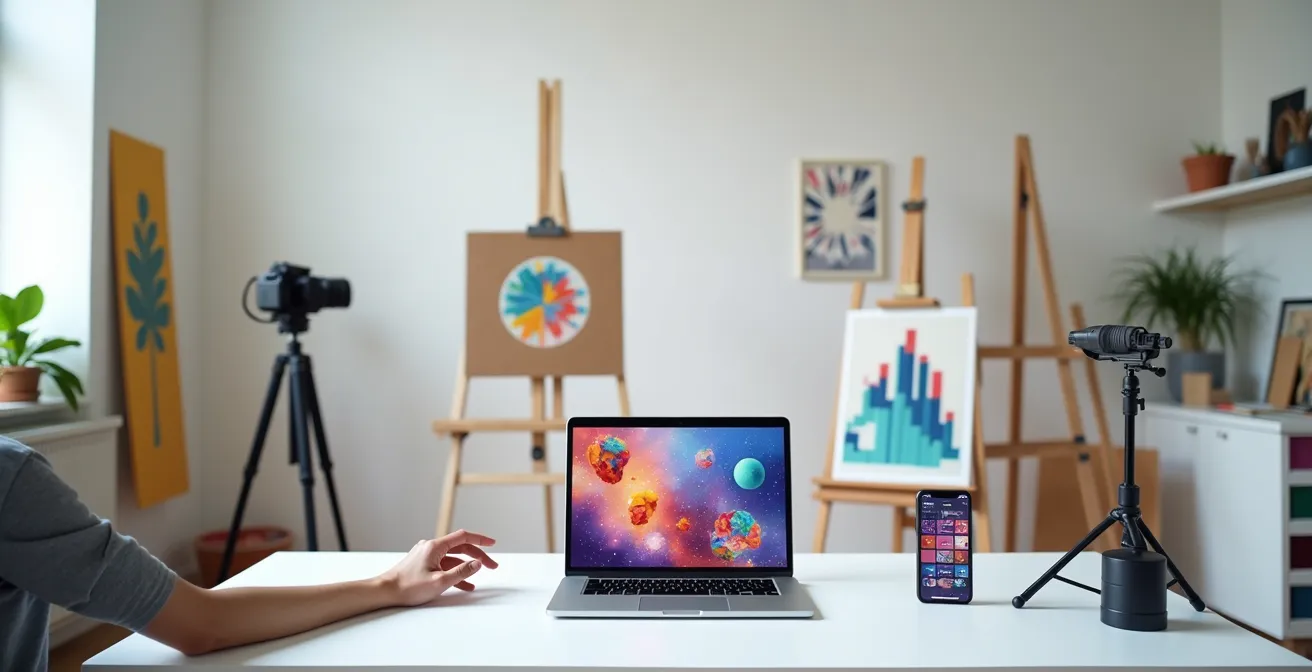
This shift in power is one of the most significant trends in the contemporary art market. As one analysis highlights, the artist’s voice is becoming paramount. According to a recent Art Market Report from Very Private Gallery:
78% of online art buyers see artists as the chief influencers, a jump from 71% in 2022.
– Art Market Report, Very Private Gallery Art Market Analysis
This data confirms that you, the artist, are the most powerful asset in your own marketing. The algorithm, when understood and leveraged correctly, can become your most effective curator, delivering your work to a global audience of potential buyers who are actively looking for art just like yours. Your Instagram is your digital storefront, gallery, and PR firm rolled into one.
Consistency is Key: How to Price Your First Solo Show
Pricing is often the most intimidating aspect of the art business for emerging artists. It feels arbitrary and deeply personal, but it should be approached with strategic, data-driven objectivity. The most important rule for your first solo show—and your career in general—is consistency. A collector needs to see a clear, logical pricing structure. If two canvases of the same size and complexity have wildly different prices, it erodes trust and signals a lack of professional confidence. The price should be based on a formula, typically factoring in size, medium, and complexity, not on your emotional attachment to a particular piece.
To establish your formula, you must conduct market research. Identify artists who are at a similar stage in their career, with a comparable exhibition history and style. What are their price points? This isn’t about copying; it’s about gathering market intelligence to position yourself appropriately. Under-pricing can be as damaging as over-pricing, as it may signal a lack of confidence or quality. It’s also important to recognize that the market is dynamic. Just a few years ago, the ceiling for an “emerging artist” was around $10,000. Today, market analysis shows that the definition has exploded to $30,000-45,000 for artists in high demand, demonstrating significant market shifts.
Once you set your prices, be prepared to defend and increase them strategically. A history of consistent, incremental price increases (e.g., 10-15% annually or after a successful show) is a sign of a healthy, growing career. However, the market can be volatile, as one real-world example illustrates.
Case Study: New York Artist’s Pricing and Income Fluctuation
A New York-based artist with a consistent strategy of pricing paintings between $7,000 and $40,000 experienced dramatic income shifts. After implementing moderate 10% price increases two to three times over five years, his income grew from $50,000 pre-2020 to over $300,000 per year during the market boom of 2020-2022. However, with the subsequent market correction, his expected income fell sharply to just $35,000 in the current year. This case highlights that even with a solid pricing strategy, external market forces play a massive role in an artist’s financial reality.
Surviving the “No”: Resilience Strategies for Creatives
An art career is a marathon of rejection. You will hear “no” far more often than you will hear “yes.” “No” from galleries, “no” from grant applications, “no” from juried shows, “no” from collectors. If you internalize each rejection as a verdict on your talent or self-worth, your career will be short and painful. Strategic resilience is the ability to separate your business self from your creative self and to treat rejection not as a personal failure, but as market feedback.
This mindset shift is crucial for long-term survival and success. The art economy is notoriously fickle, and even established artists face uncertainty. As one industry analysis notes, the pressure is constant.
Being a professional artist has never been a stable career, and apprehension about the possibility of having to give up one’s practice to pay bills hovers over many artists. For others, embarking on a second career has been a meaningful antidote to the fickleness of the art economy.
– Art Industry Analysis, Artnet News Market Report
Building resilience, therefore, is an active practice. It involves creating systems to process rejection productively. One powerful method is to keep a “Rejection Log.” Instead of deleting the “no” emails, document them. Note who the rejection came from and any feedback provided. Over time, patterns may emerge, providing valuable market intelligence. Perhaps your work is being submitted to the wrong type of galleries, or your application proposals need refinement. This transforms rejection from an emotional blow into a data point for strategic adjustment.

It is equally important to build a support system outside of the art world to maintain perspective and protect your mental health. Finally, you must define success on your own terms. Celebrate process-based wins—mastering a new technique, completing a challenging series, or simply showing up to the studio consistently. These internal victories provide the validation needed to weather the external storms of the market.
Your Action Plan for Building Strategic Resilience
- Start a Rejection Log: Track all rejections and any feedback received. Review it quarterly to identify patterns and gather market intelligence rather than feeling personal defeat.
- Define Your Own Success: Write down what success means to you, separate from sales or gallery representation. What are your personal artistic goals? Revisit this list regularly to stay grounded in your own vision.
- Cultivate a Non-Art Network: Schedule regular time with friends and family who are completely outside the art world. This provides a crucial reality check and a safe space from industry pressures.
- Celebrate Process Milestones: Set and celebrate non-commercial goals, such as finishing a complex piece, learning a new skill, or filling a sketchbook. This builds internal validation independent of market reception.
- Separate Your “Selves”: Dedicate specific time for your “Creative Self” (making art) and your “Business Self” (admin, marketing, applications). This compartmentalization helps absorb business rejections without damaging your creative core.
The “By Appointment” Myth: How to Access VIP Viewing Rooms
For many emerging artists, the world of high-end galleries feels like a fortress, with “VIP Viewing Rooms” and “By Appointment Only” signs serving as impenetrable walls. The myth is that you need an exclusive invitation or a secret connection to get your work seen. The reality is that galleries, like any business, are constantly looking for new “inventory”—artists whose work is compelling, professional, and, most importantly, sellable. The challenge is not a lack of opportunity, but a surplus of competition. Galleries are inundated with submissions, and getting noticed requires a strategic, value-first approach, not just a cold email.
The numbers reveal a stark reality: gallery slots are scarce. A recent gallery survey shows that 46% of galleries took on only one or two new artists last year, with a similar number planned for this year. This means your approach must be targeted and professional. Instead of a mass email blast, identify a small number of galleries whose program genuinely aligns with your work. Then, your goal is to get on their radar screen long before you ask for a studio visit. Follow them on Instagram, engage thoughtfully with their posts, and attend their openings as an interested observer, not a desperate artist with a portfolio under your arm.
Your digital presence is your primary tool for warming up these cold contacts. Galleries now use online platforms as a primary scouting tool. In fact, one report revealed that online marketplaces (42%) and Instagram are more impactful for meeting new clients than even prestigious art fairs (36%), though in-person gallery visits remain the top source at 55%. This tells you the path: build a strong, professional online presence first. Let them discover your work and your growing community of followers digitally. When you finally do make contact, you’re not a stranger; you’re an artist they may already recognize, approaching them with a well-researched understanding of their program. You are offering them a business opportunity, not asking for a favor.
Why a Canvas of the Same Size Can Cost €500 or €50,000
One of the most baffling aspects of the art market for outsiders—and many artists—is the seemingly arbitrary nature of pricing. How can two paintings of identical size, material, and technical skill have prices that differ by a factor of 100? The answer is that you are not selling canvas and paint. You are selling a concept, a brand, and a financial instrument. The art object’s price is often decoupled from its physical attributes and is instead tied to the narrative and market position of the artist.
The high-end art market functions less like a market for goods and more like a market for unique assets. A staggering $1.7 trillion is held in privately owned art assets globally, but only about $65 billion worth of art trades hands annually. This means the vast majority of art is not being actively bought and sold; it is being held as a store of value, similar to real estate or gold. A €50,000 painting is priced that way because the artist has built a career (often with gallery backing) that gives collectors confidence that the work will retain or increase its value over time. This value is built on factors like exhibition history, inclusion in major collections, critical acclaim, and auction results—all of which form the artist’s brand.
For an emerging artist, this means the €500 price tag reflects the current state of your brand’s development. It is the entry point. The journey from €500 to €50,000 is the process of systematically building that brand value. It’s also critical to understand the business model of the galleries you target. Data shows that most galleries’ businesses are built on more accessible price points. A survey revealed that the two most important value segments for galleries are the $5,000-$10,000 range (39%) and the under $5,000 range (39%). This demonstrates that a gallery’s tier and client base directly influence the price ceiling for the artists they represent, regardless of the art’s physical size. Your pricing must align with the market segment you aim to enter.
Key Takeaways
- Your art career is a business; treat it like one by developing a strategy for your brand, marketing, and sales.
- Control your narrative. A clear artist statement and story are powerful tools that build value and collector confidence.
- Leverage digital platforms like Instagram not just for exposure, but as a primary channel for sales and market intelligence.
Is It Art If I Just Sign It? The Legacy of Duchamp’s Urinal
When Marcel Duchamp signed a urinal and called it “Fountain,” he did more than shock the art establishment; he laid the foundation for the modern art market. The legacy of that act is the principle that the value of an artwork can reside entirely in the idea and the artist’s signature, not in the physical craft. This is the ultimate expression of the artist’s brand. An artist like Andy Warhol or Banksy can sell works for millions because their signature represents a powerful, globally recognized brand and a set of ideas. The physical object is merely the vehicle for that brand.
For an emerging artist, this concept is both liberating and daunting. It means your success is not limited by your technical skill alone. A powerful concept, a unique perspective, and a compelling story can create immense value. However, it also means you are in the business of building a brand, a task that goes far beyond the studio. You are competing in a market where conceptual rigor and cultural relevance are commodities. The following table illustrates how these different factors play out in the market for different types of artists.
| Artist Type | Market Characteristics | Price Range Factors |
|---|---|---|
| Established Conceptual Artists (Warhol, Banksy) | Large bodies of work with prices ranging from under $5,000 to seven-figure sums | High public profiles, large bodies of work, and range of price points |
| Emerging Ultra-Contemporary | 48% of galleries prioritize artists born 1975-1989, 32% focus on those born after 1990 | Conceptual rigor, technical innovation, cultural relevance |
| Traditional Craft-Focused | Limited to physical skill demonstration | Material costs, time investment, technical proficiency |
This table shows that while craft is a factor, the biggest value drivers in the contemporary market are tied to the artist’s profile and conceptual strength. Ultimately, the question “Is it art?” is answered by the market. If you can build a narrative and a brand compelling enough that someone is willing to acquire it, then it is. This ties back to the core mission of running your career as a business: defining your own value. As one contemporary artist aptly put it when asked to define success:
Being an artist is asking yourself every day how you really want to live. When you find that you’re continually using that question as a compass to guide you in your daily life, that’s a mark of success.
– Contemporary Artist, Artwork Archive Artist Success Survey
By embracing these business strategies, you are not selling out; you are buying in—into a sustainable, long-term career where your talent can finally get the platform it deserves. The next logical step is to start building your strategic plan today.