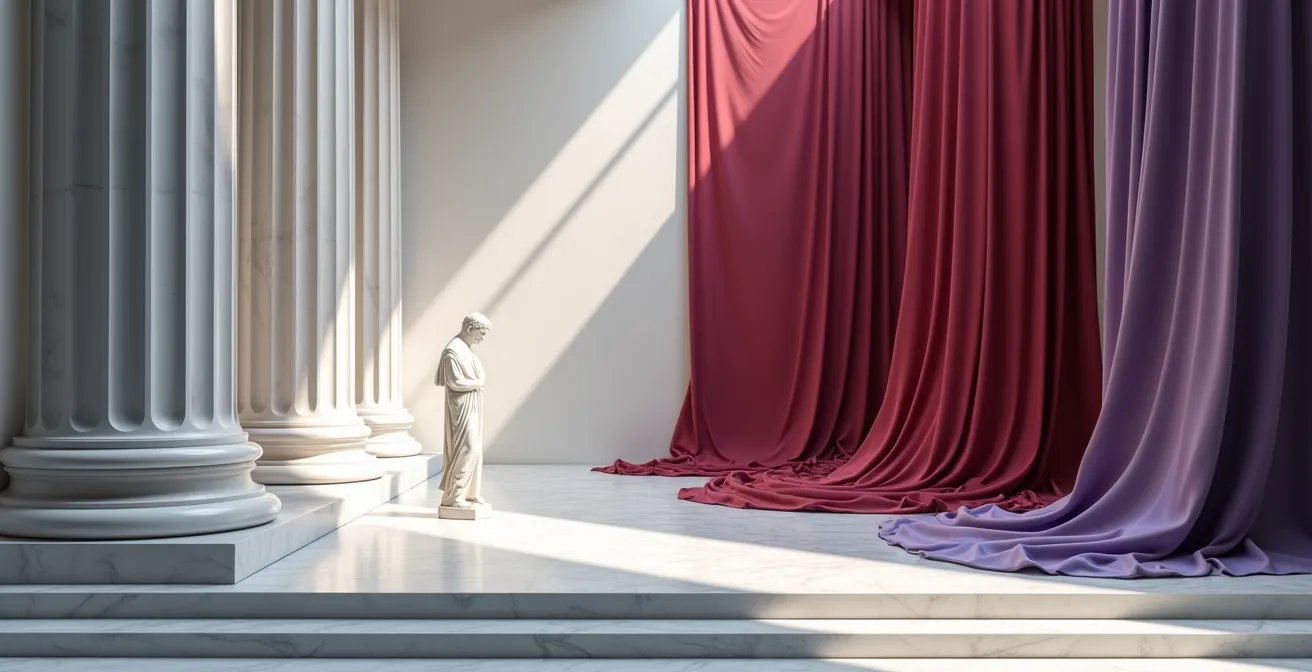
Neoclassical art is often perceived as cold and unemotional, a sterile rejection of feeling. The truth, however, is more profound. This wasn’t an absence of passion but a deliberate philosophical choice to replace the chaos of private sentiment with the clarity of public virtue. The movement’s stark geometry and rational order were not a lack of heart, but a revolutionary attempt to build a better, more logical society, one brushstroke and one column at a time.
For a soul attuned to the passionate swells of Romanticism, the world of Neoclassicism can feel like a foreign land. Its paintings and sculptures, with their stoic heroes, rigid postures, and severe architectural backdrops, often seem to lack the very thing that makes art feel alive: emotion. Faced with the turbulent, sentimental excesses of the preceding Rococo style—an art of private dalliances and aristocratic fantasy—it is easy to see Neoclassicism as a simple, cold-hearted reaction. But this view misses the radical philosophical ambition at its core.
The Enlightenment thinkers who shaped this era were not opposed to feeling itself, but to the social and moral decay they associated with unbridled, private sentiment. They sought to create a new kind of art for a new kind of citizen. This art would not be a mirror for personal whims but a blueprint for the public good. It was an aesthetic project of immense scale, aimed at educating, inspiring, and structuring society along rational, virtuous lines. The rejection of emotion was not an end in itself; it was a necessary sacrifice to achieve a higher goal: moral clarity.
But if the true key was not simply reacting against curves and color, but rather championing a new “moral geometry,” how did this manifest in practice? This article explores the intellectual foundations of Neoclassicism, examining how the rediscovery of ancient ruins, the demand for virtuous narratives, and an obsession with archaeological truth forged an art form that valued the straight line of reason over the unpredictable curve of passion. We will dissect how this aesthetic became a tool of empire, reshaped the image of power, and, in a final ironic twist, created the very conditions for the birth of modern art.
To understand this profound shift, this article breaks down the core tenets and consequences of the Neoclassical revolution. The following sections will guide you through the movement’s archaeological inspirations, its moral ambitions, its stylistic battles, and its ultimate, unexpected legacy.
Summary: The Grand Design of Neoclassical Art
- The Pompeii Effect: How One Excavation Changed European Furniture
- Painting Virtue: Why Art Was Expected to Teach You How to Behave
- Line vs. Color: The Ingres-Delacroix Feud Explained
- Cleaning Up the Mess: Why Straight Lines Replaced Curves
- Did Romans Really Wear That? The Obsession with Archaeological Detail
- Exporting Columns: How Neoclassicism Became a Tool of Empire
- Tall, Strong, and Young: The Lies Behind Royal Portraits
- How the Academy’s Strict Rules Accidentally Created Modern Art
The Pompeii Effect: How One Excavation Changed European Furniture
The turn towards rational order was not born in a philosopher’s study alone; it was unearthed from volcanic ash. When systematic excavations began in Pompeii in 1748, Europe was given a direct, unfiltered window into the daily life and aesthetic principles of the Roman world. This was not the Rome of myth or Renaissance interpretation, but a tangible reality of forms, objects, and spaces. For designers and architects weary of the whimsical, asymmetrical flourishes of Rococo, Pompeii offered a powerful alternative: an aesthetic of clarity, strength, and geometric precision.
This discovery had an immediate and profound impact on decorative arts, particularly furniture. The complex, sinuous curves that had defined the previous era were suddenly seen as decadent and structurally dishonest. In their place, a new vocabulary of form emerged, directly inspired by the artifacts and buildings of Pompeii and Herculaneum.
Case Study: The Transformation of European Furniture Design
The rediscovery of Pompeii acted as a catalyst for a complete overhaul of furniture making. Artisans and their patrons abandoned the organic, nature-inspired motifs of Rococo in favor of a new, architectonic style. Tables were constructed like miniature temples with clean lines and fluted legs. Chairs began incorporating the forms of classical columns and sabre legs derived from Greek *klismos* chairs. Cabinets and commodes were designed with the severe, symmetrical logic of building facades. As detailed in a guide to the Neoclassical style, the focus shifted dramatically towards structural robustness and what was perceived as archaeological accuracy, often prioritizing these intellectual values over simple physical comfort. This was not just a change in style; it was a change in philosophy, embedding the ideals of the Roman Republic into the very objects of daily life.
The Pompeii effect, therefore, was to provide the “proof” that a society built on reason and order produced an art of enduring, logical beauty. The straight line was no longer just a line; it was a connection to a glorious, virtuous past.
Painting Virtue: Why Art Was Expected to Teach You How to Behave
With a new formal vocabulary established, Neoclassicism needed a purpose beyond mere aesthetics. Enlightenment thinkers like Denis Diderot championed the idea that art had a critical social function: it must be a school of morals. Art was no longer for the frivolous amusement of the aristocracy but for the civic education of the public. Its highest calling was to depict virtuous behavior, celebrate self-sacrifice for the state, and provide clear, unambiguous moral instruction. Art was to be an engine of public good.
This idea found its ultimate expression in the work of Jacques-Louis David. His 1784 masterpiece, *Oath of the Horatii*, became the definitive manifesto of Neoclassical painting. The scene—depicting three Roman brothers swearing an oath to their father to fight to the death for their city—is a masterclass in moral geometry. The rigid, determined forms of the men contrast sharply with the collapsing, emotional forms of the women, visually separating the world of public duty (masculine, rational, active) from private grief (feminine, emotional, passive). This was a message the public was hungry for; an analysis of the era notes how the 1785 Salon had to extend its hours for weeks to accommodate the massive crowds that flocked to see it.
The painting’s composition reinforces this didactic purpose. To properly convey its message of stoic resolve, every element is designed for maximum clarity and impact.

As this modern recreation suggests, the power of such an image lies in its triangular composition and its focus on the clear, decisive gesture of the oath. There is no ambiguity, no distracting background detail. The lighting, reminiscent of Caravaggio, throws the moral choice into stark relief. The message is as clear and unyielding as the swords at the painting’s center: personal feeling must be subordinated to civic virtue. This was art as a public sermon, a visual lesson in how to be a good citizen.
Line vs. Color: The Ingres-Delacroix Feud Explained
The philosophical divide between reason and emotion was not just a matter of subject but was fought on the very surface of the canvas. This conflict is perfectly encapsulated in the famous rivalry between Jean-Auguste-Dominique Ingres, the standard-bearer of late Neoclassicism, and Eugène Delacroix, the champion of Romanticism. Their feud boiled down to a fundamental question: what is the primary element of painting? For Ingres and the Neoclassicists, the answer was unequivocally line (disegno). For Delacroix and the Romantics, it was color (colore).
This was far more than a technical disagreement. The line represented everything the Enlightenment held dear: intellect, order, precision, and the eternal, unchanging forms that could be grasped by the rational mind. A perfect contour was seen as a moral and intellectual achievement. Color, by contrast, was associated with the senses, with fleeting emotion, and with the chaotic, subjective nature of individual perception. To prioritize color was to indulge in the very sensory world that Neoclassicism sought to control and order. Thus, the debate between Ingres and Delacroix became a proxy war for the soul of art itself.
The following table, based on the core principles of Neoclassicism versus Romanticism, breaks down the philosophical underpinnings of this artistic schism. It highlights how a choice of technique was, in fact, a political and philosophical statement.
| Aspect | Line (Neoclassical/Ingres) | Color (Romantic/Delacroix) |
|---|---|---|
| Philosophy | Rational, eternal forms of the mind | Sensory, emotional expression |
| Political Association | Order and authority of the Academy | Individual freedom and emotion |
| Technique | Precise contours, smooth surfaces | Visible brushstrokes, vibrant hues |
| Priority | Drawing as foundation | Color as primary expression |
This table illustrates that the preference for line was not merely a stylistic tic. It was the logical conclusion of a worldview that placed reason above all else. Ingres’s famously smooth, almost invisible brushwork aimed to erase the artist’s emotional hand, presenting the subject as an objective, timeless truth defined by its perfect contours. Delacroix’s visible, energetic brushstrokes did the opposite, celebrating the subjective, emotional process of creation. The battle was set: the clarity of the intellect against the passion of the senses.
Cleaning Up the Mess: Why Straight Lines Replaced Curves
The Neoclassical obsession with the straight line was a direct assault on what was perceived as the moral and aesthetic chaos of the Rococo. The “tyranny of the curve”—the endless S-scrolls, shell-like motifs, and asymmetrical flourishes of the previous style—was seen as more than just frivolous. It represented a world of artifice, indulgence, and structural dishonesty. In contrast, the straight line and the simple geometric form (the square, the circle, the rectangle) were emblems of truth, rationality, and order. This stylistic shift was a form of purification, a “cleaning up” of art and design to align them with the new Enlightenment virtues.
This change happened with remarkable speed. According to historical analyses of furniture, the new Neoclassical style with its emphasis on straight lines was first adopted by Parisian furniture makers in the 1760s, marking a definitive break. But this was not just a matter of taste. The shift to geometric forms had a powerful economic driver: it was perfectly aligned with emerging industrial production methods. A straight-legged chair is far easier to standardize, reproduce, and manufacture than one with complex, handcrafted cabriole legs. Reason and efficiency went hand in hand.
The visual below captures this dramatic transition, contrasting the clean, severe order of Neoclassical architecture with the “ghost” of the Rococo’s organic complexity that has been stripped away.

This image perfectly illustrates the movement’s core mission: to impose a rational grid upon the world. The columns, the perfect right angles, and the unadorned surfaces all speak to a desire for a world that is legible, predictable, and governed by universal rules. The straight line became the visual symbol of moral and intellectual rectitude, while the curve was relegated to the status of a dangerous, untrustworthy distraction. In this new world, beauty was found not in complexity, but in austere simplicity.
Did Romans Really Wear That? The Obsession with Archaeological Detail
If art’s new purpose was to convey moral truth, then that truth had to be built on an unshakeable foundation. For Neoclassical artists, this foundation was archaeological accuracy. An artist could no longer invent a fantasy version of the ancient world, as painters of the Renaissance and Baroque had done. To be taken seriously, one had to become a historian and a researcher. The correctness of a helmet, the drape of a toga, or the design of a column was not a trivial detail; it was a testament to the artist’s commitment to truth. This obsession transformed the artist’s role from a mere creator to that of a scholar–practitioner.
This quest for authenticity became a moral imperative. By presenting a “correct” and meticulously researched vision of the Roman Republic, an artist could implicitly critique the perceived corruptions and falsehoods of their own time. It was a way of saying, “This is how things *should* be, based on the proven virtues of the past.”
Case Study: Archaeological Accuracy as Moral Authority
Jacques-Louis David again provides the ultimate example of this principle. As concerned with realism as he was with political idealism, he felt he could not paint his *Oath of the Horatii* in Paris. He successfully petitioned to travel to Rome specifically to copy the architecture and artifacts from life, ensuring his depiction was as accurate as possible. This act was revolutionary. It reframed artistic creation as an act of research. As noted in a detailed analysis of David’s work, this obsession with getting the details right served as a powerful moral weapon. The historical “truth” of the scene lent its moral message—civic duty over personal desire—an undeniable authority. This archaeological authority made the painting’s critique of the lavish and “corrupt” French court all the more potent.
This commitment meant that a painting’s power was derived not just from its composition or subject, but from its verifiable relationship to the historical record. The artist’s studio became part-library, part-museum, filled with plaster casts of statues and engravings of ancient ruins. Every detail was a piece of evidence in a grand, moral argument for a return to classical reason.
Key Takeaways
- Neoclassicism’s “coldness” was a deliberate philosophical choice, replacing private emotion with the ideal of public virtue.
- The rediscovery of Pompeii provided a tangible, geometric aesthetic that was seen as more rational and honest than Rococo’s curves.
- Art was given a didactic purpose: to teach moral lessons and build better citizens, with artists like David using historical accuracy as a tool of moral authority.
Exporting Columns: How Neoclassicism Became a Tool of Empire
An aesthetic based on universal principles of reason and order was destined to become a global language. Neoclassicism’s clean lines, grand scale, and direct allusions to Greek democracy and Roman law made it the perfect architectural style for nations and empires wishing to project an image of enduring power, legitimacy, and enlightened governance. The column and the pediment were no longer just architectural elements; they were symbols of a universal order that could be exported and implemented anywhere in the world, from the new American republic to the colonies of the British Empire.
The style’s modular, rule-based nature made it easily adaptable and reproducible on a global scale. As a result, an astonishing architectural uniformity spread across the globe. As one study on the style’s reach notes, virtually every government edifice from Philadelphia to Sydney adopted the Neoclassical style. This created a visual grammar of power, where a courthouse in Ohio, a parliament in Australia, and a museum in St. Petersburg could all speak the same language of authority, reason, and imperial reach. This was architectural colonialism, using the supposedly universal values of classicism to legitimize rule over diverse local cultures.
To understand how this style was so effectively deployed as a tool of empire, it is useful to break down its key symbolic components.
Action Plan: Deconstructing Empire Style Architecture
- Identify Classical Details: Look for Doric, Ionic, or Corinthian columns, pediments, and friezes. These were used as universal symbols of law and reason, linking the new power to ancient Greece and Rome.
- Analyze Wall Surfaces: Note the use of plain, often white or pale, walls. This was not just a stylistic choice but was meant to suggest moral purity, honesty, and a departure from the “corrupt” colors of the old regime.
- Assess the Scale: Observe the grandeur and often intimidating scale of the buildings. This was designed to impress and overwhelm the individual, reinforcing the power and permanence of the state or empire.
- Recognize Modular Design: See how the rule-based, symmetrical design could be easily taught and exported. An architect could be trained in Paris or London and build a “correct” Neoclassical building anywhere.
- Question Universalism: Confront the use of columns and pediments in local contexts. These elements claimed universal values while often ignoring or supplanting indigenous architectural traditions.
Through these elements, Neoclassicism became more than just an art style; it became a highly effective and self-replicating instrument of cultural and political power, one that continued to shape civic architecture well into the 20th century.
Tall, Strong, and Young: The Lies Behind Royal Portraits
Just as Neoclassicism provided a new architecture for the state, it also offered a new way to represent its leaders. The age of the divinely ordained monarch, draped in ermine and dripping with jewels, was over. The new era demanded a new kind of ruler: a first citizen, a stoic administrator, a military genius whose power came not from divine right, but from merit and service to the state. Royal and imperial portraiture had to be completely reinvented to communicate these new, rationalized ideals of power.
Artists like Jacques-Louis David and the sculptor Antonio Canova became masters of this new political branding. They stripped away the opulent trappings of the past and replaced them with the stark, powerful symbolism of the classical world. Rulers were depicted as Roman emperors, Greek philosophers, or nude, god-like heroes. This was not about capturing a literal likeness, but about constructing an idealized public image that embodied the virtues of the state: strength, reason, self-control, and timeless authority.
Case Study: The Idealized Representations of Napoleon
No figure illustrates this reinvention better than Napoleon Bonaparte. His court artists brilliantly used Neoclassical tropes to transform the image of the Corsican general into an emperor of classical stature. As chronicled by analyses of Neoclassical art, Antonio Canova sculpted two colossal statues of Napoleon as Mars the Peacemaker, depicted as a physically perfect, nude classical god. Meanwhile, David’s famous painting *Napoleon Crossing the Alps* presents a wildly idealized view of the actual event, showing a calm and heroic Napoleon astride a magnificent rearing steed, in stark contrast to the reality of him crossing the mountains on a humble mule. These portraits were powerful works of propaganda, emphasizing duty and function over birthright and casting Napoleon as the modern heir to Caesar and Alexander the Great.
This idealization was a calculated lie, but it was a lie in service of a larger political truth. It communicated that the new leader’s authority was rooted in the timeless, rational principles of the classical world, not the arbitrary whims of heredity. By portraying leaders as tall, strong, young, and impossibly heroic, Neoclassicism created the modern cult of the political personality, an image built on stoic ideals rather than divine sanction.
How the Academy’s Strict Rules Accidentally Created Modern Art
For decades, the French Royal Academy of Painting and Sculpture was the absolute arbiter of artistic taste and the chief enforcer of Neoclassical doctrine. It established a rigid hierarchy of genres, placing “history painting”—large-scale depictions of historical, mythological, or biblical scenes—at the absolute pinnacle of artistic achievement. Below this were portraiture, genre scenes (scenes of everyday life), landscape, and, at the very bottom, still life. This system was designed to uphold the moral and intellectual priorities of Neoclassicism, rewarding art that engaged with grand human themes and dismissing art that simply recorded the visible world.
However, this rigid system contained the seeds of its own destruction. By devaluing genres like landscape and still life, the Academy inadvertently turned them into zones of freedom and experimentation for artists who did not fit the official mold. Pushed to the margins, these “lesser” genres became the laboratories where the foundational principles of modern art would be developed. Artists began to explore light, color, and form for their own sake, detached from the burden of telling a moral story.
Case Study: The Academy’s Hierarchy as a Catalyst for Rebellion
The Academy’s rigid control eventually led to a crisis. As more artists began to experiment with new styles, the jury of the official Salon exhibition rejected an increasing number of works. The outcry from these rejected artists was so great that in 1863, Emperor Napoleon III established the *Salon des Refusés* (Salon of the Rejected) to display their work. This event is now seen as a turning point in the history of art. It legitimized the idea that there could be valid art outside the Academy’s official sanction and paved the way for the first Impressionist exhibition in 1874. As a history of the academic system explains, the Academy’s failure to adapt necessitated the creation of a whole new art ecosystem, one based on independent exhibitions, private galleries, and the concept of an avant-garde that defined itself in opposition to the establishment.
In a final, beautiful irony, the system created to enforce the eternal truths of reason and order proved too brittle to survive. The Neoclassical pursuit of perfection and its dismissal of subjective, sensory experience created a vacuum that Romanticism, Realism, and eventually Impressionism would rush to fill. The Academy’s strict rules, meant to preserve tradition, had accidentally created the conditions for permanent revolution.
The next time you stand before a “cold” Neoclassical painting, look beyond the stoic faces and straight lines. See it not as an absence of emotion, but as a powerful, ambitious, and ultimately fragile attempt to build a more rational world. Your next museum visit can be an exploration of this grand philosophical project.
Frequently Asked Questions About Neoclassicism
What is the difference between Neoclassicism and Romanticism?
The core difference lies in their guiding philosophy. Neoclassicism, championed by artists like Ingres, valued reason, order, public duty, and clarity, expressed through precise lines and controlled compositions. Romanticism, led by figures like Delacroix, prioritized emotion, individualism, nature’s sublime power, and personal experience, expressed through vibrant color and dynamic, often chaotic, brushwork.
Why was Jacques-Louis David so important to Neoclassicism?
Jacques-Louis David was the quintessential Neoclassical painter. His works, like *The Oath of the Horatii*, became the visual manifestos of the movement. He perfectly fused the era’s moral and political ambitions with a severe, archaeologically informed style, effectively defining how art could serve as a tool for civic education and political propaganda.
What are the main characteristics of Neoclassical art?
Key characteristics include an emphasis on order, symmetry, and clarity; the use of subject matter from classical Greek and Roman history and mythology; a preference for strong, crisp lines over soft colors; and a didactic or moralizing purpose, aiming to inspire virtues like courage, patriotism, and self-sacrifice.