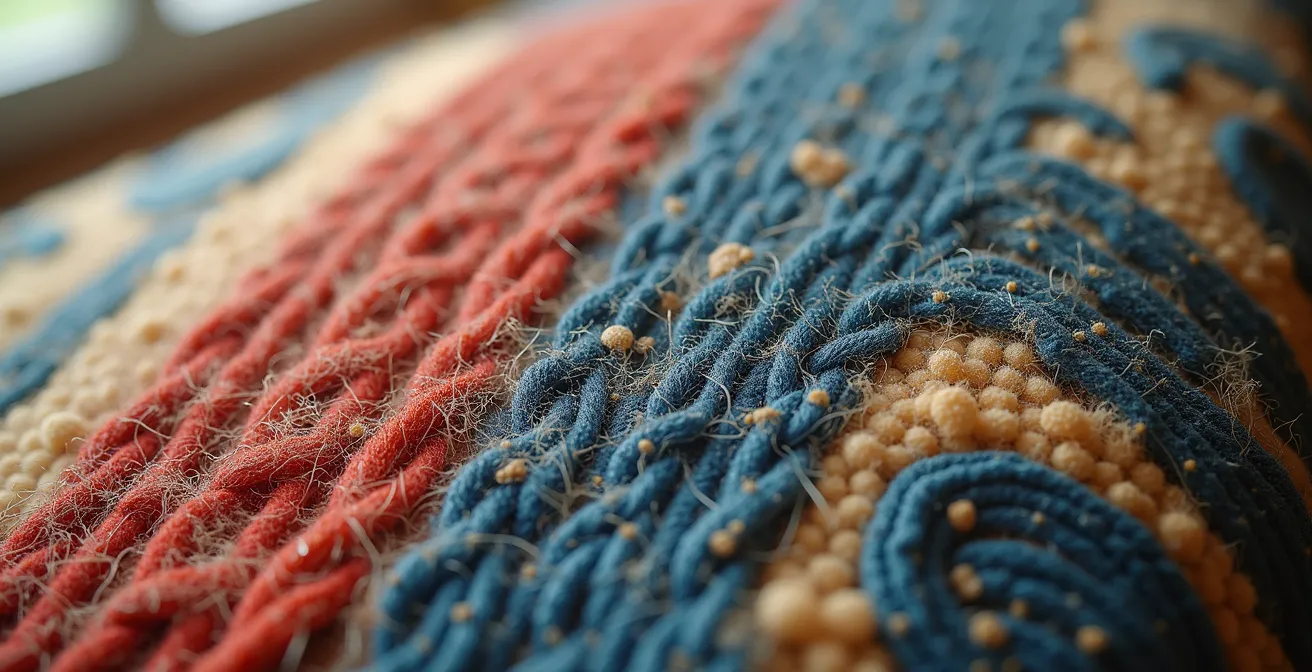
Protecting a historic tapestry goes far beyond simply keeping it out of the sun; it requires understanding the invisible molecular warfare light wages on its very structure.
- Fugitive dyes, especially the yellow components in green, degrade chemically, altering the artwork’s intended color palette.
- Light not only fades color but weakens the physical wool and silk fibers, making them susceptible to tearing under their own weight.
- Understanding these degradation patterns is the key to both preservation and authentication.
Recommendation: Shift from passive avoidance of light to an active strategy of monitoring, correct hanging, and controlling the entire environment to counteract chemical, physical, and biological threats.
For any curator or custodian of a historic house, the presence of a large-scale tapestry is both a privilege and a profound responsibility. The common wisdom dictates keeping these textile marvels in low light, a rule universally acknowledged but seldom deeply understood. This advice, while correct, is dangerously incomplete. It treats preservation as a passive act of avoidance, when in reality, it must be an active, informed campaign against a relentless process of decay. The true enemy is not just the visible brightness of the sun, but the energy carried by its photons, which instigates a cascade of irreversible chemical and physical damage.
The fight to preserve a tapestry is waged on multiple fronts: against the chemical breakdown of dyes, the physical strain of gravity on weakened fibers, and the biological assault of pests. Merely dimming the lights without addressing these interconnected vulnerabilities is like defending a castle by only guarding the main gate. The real key to stewardship is not in following a simple rule, but in understanding the science of decay. It is in grasping *why* a vibrant green forest scene slowly shifts to a somber blue, or how the very method used to display a piece can become its undoing.
This article will deconstruct the primary threats to your tapestry, moving beyond platitudes to offer a conservator’s perspective. We will examine the molecular mechanisms of photodegradation, the principles of structural support, and the protocols for environmental control. By understanding the ‘why’ behind the damage, you can implement a ‘how’ that ensures your collection endures not just for years, but for generations.
To navigate this complex subject, this guide is structured to address each threat systematically. The following sections will explore the science behind color fading, the mechanics of hanging, and the strategies for protecting your textile from all forms of environmental degradation.
Summary: The Conservator’s Guide to Tapestry Preservation
- Blue Fades First: Why Historic Tapestries Look So Green
- Velcro vs. Rings: How to Hang Heavy Wool Without Tearing It
- Vacuuming History: The Micro-Suction Technique for Old Fabric
- Moths and Beetles: The Silent Eaters of Collections
- Insulating Stone Walls: Why Castles Needed Tapestries to Be Habitable
- The Vanishing Green: Why “Bois Vert” Turns Brown in UV Light
- The Mold Outbreak That Almost Erased Lascaux Forever
- How to Distinguish a Real Aubusson from a Machine-Made Copy?
Blue Fades First: Why Historic Tapestries Look So Green
One of the most common misinterpretations of historic tapestries is their predominantly blue-green appearance. This is not an aesthetic choice of the period but a chemical artifact of centuries of light exposure. The vibrant, lifelike greens so prized by weavers were often a composite dye, created by first dyeing the wool fibers blue with indigo and then overdyeing them with a yellow, typically from the weld plant. This created a rich, nuanced spectrum of greens. However, the dyes are not equally stable. The yellow component is a fugitive dye, meaning it is far less lightfast than the robust indigo.
Over time, exposure to light initiates a process of photodegradation that specifically targets and breaks down the yellow dye molecules. The stable blue indigo remains, so the original green appears to “fade” into blue. A tangible example of this is seen in the collections of the Metropolitan Museum, where the backs of 16th-century tapestry cushion covers, shielded from light for over four centuries, reveal shockingly bright and modern-looking colors. The original vivid palette is still there, perfectly preserved. In contrast, a 2023 microfading study confirmed that while indigo dyes are highly lightfast, yellows lose their intensity, causing green to shift toward a bluish olive with a measurable decay rate.
This phenomenon is a critical lesson in textile conservation. The color you see today is often a ghost of the artist’s original intent. Our primary duty is to halt this transformation by rigorously controlling light exposure, preserving the remaining fugitive dyes before they are lost forever. Every hour of unnecessary light erases a little more of the tapestry’s true history.
Velcro vs. Rings: How to Hang Heavy Wool Without Tearing It
While light is the primary chemical aggressor, an equally potent threat to a tapestry is physical: gravity. A large wool tapestry is immensely heavy, and this constant, downward force creates mechanical stress on the very fibers that give it form. Traditional hanging methods, such as rings or loops sewn to the top edge, concentrate this entire weight onto a few small points. Over decades, this focused stress causes the horizontal weft threads to stretch and break, leading to scalloping, distortion, and eventual tearing.
Worse still are outdated methods of tacking a tapestry directly to a frame. As conservation specialists at Hyde Park documented, tapestries stretched with nails spaced even a few centimeters apart cannot hang freely. This results in severe vertical elongation and unsightly bulges in the lower sections, a phenomenon known as “creep” in materials science. The goal of a proper hanging system is not just to display the work, but to distribute its weight perfectly evenly across its entire top edge.
The modern conservation standard is a hook-and-loop fastener system, often referred to by the brand name Velcro. A soft, continuous strip of the loop-side fabric (usually a stable polyester felt) is meticulously hand-stitched to a supportive linen webbing, which is then sewn onto the back top edge of the tapestry. The corresponding hook-side strip is attached to a wooden batten mounted on the wall. This system allows the tapestry’s full weight to be supported uniformly, eliminating stress points and preventing distortion.
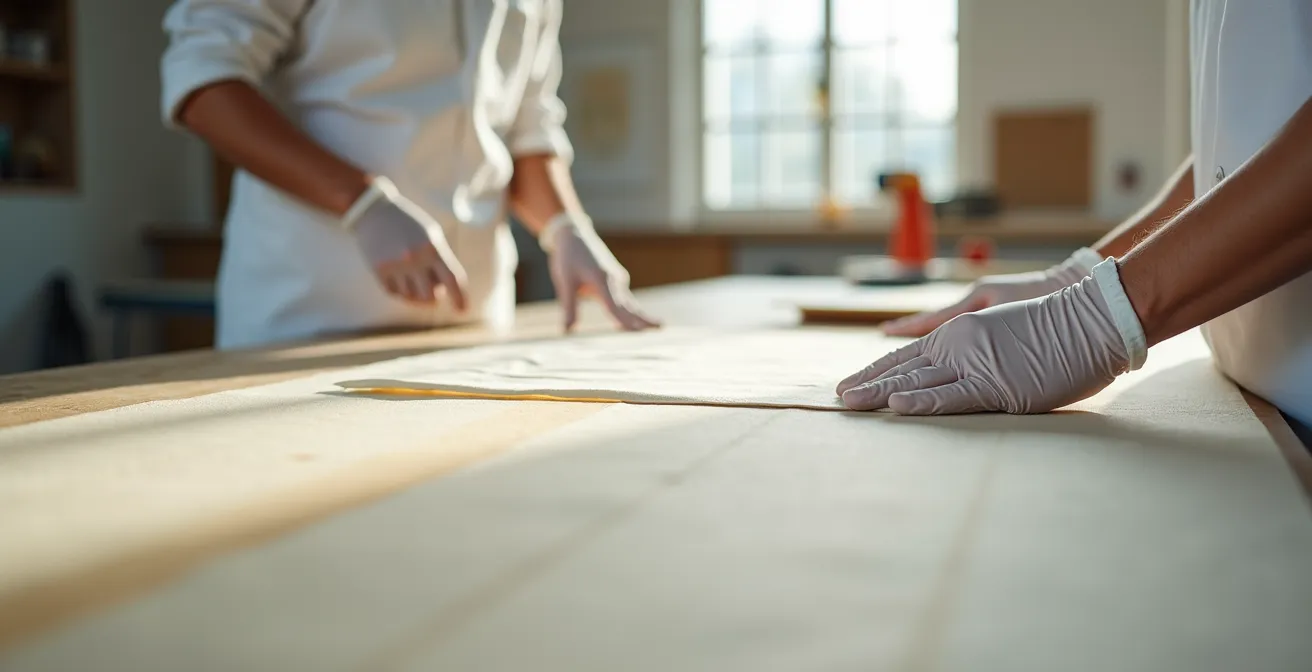
This method provides a continuous, even line of support that is both incredibly strong and easily reversible, a core tenet of modern conservation. It respects the object’s integrity while providing the structural stability necessary for long-term display. Choosing the right hanging system is as crucial as controlling the light.
Vacuuming History: The Micro-Suction Technique for Old Fabric
Beyond light and gravity, the third great enemy of tapestries is airborne dust and pollutants. This particulate matter is not inert; it is often acidic and abrasive. As it settles into the wool fibers, it acts like microscopic sandpaper, cutting into the strands with every vibration. Furthermore, it is hygroscopic, meaning it attracts moisture, creating an ideal microenvironment for mold growth. It also serves as a food source for pests. Therefore, surface cleaning is a critical, albeit delicate, part of any preservation strategy.
Aggressive cleaning is unthinkable. The use of water or solvents by a non-professional is a guaranteed route to disaster, causing dye bleed and fiber shrinkage. The only safe method is controlled-suction vacuuming. This is not done with a standard household appliance. Conservators use a variable-speed vacuum fitted with a micro-tool attachment. Crucially, a piece of fine mesh screen is placed over the vacuum nozzle and held slightly above the tapestry’s surface. This allows the vacuum to pull dust up through the screen without the nozzle ever making direct contact with the fragile fibers.
The process is methodical, performed with the tapestry laid flat on a clean surface. The conservator works in a grid, moving slowly across both the front and back. The sheer time this takes is a testament to its delicacy. During the conservation of the Solebay Tapestry at the Royal Museums Greenwich, the team spent over 200 hours just preparing the textile for cleaning, which involved removing old, damaging patches and a tight linen lining. This preparatory work underscores that proper cleaning is a complex conservation treatment, not a simple housekeeping task. It must be undertaken with immense patience and a deep respect for the object’s fragility.
Moths and Beetles: The Silent Eaters of Collections
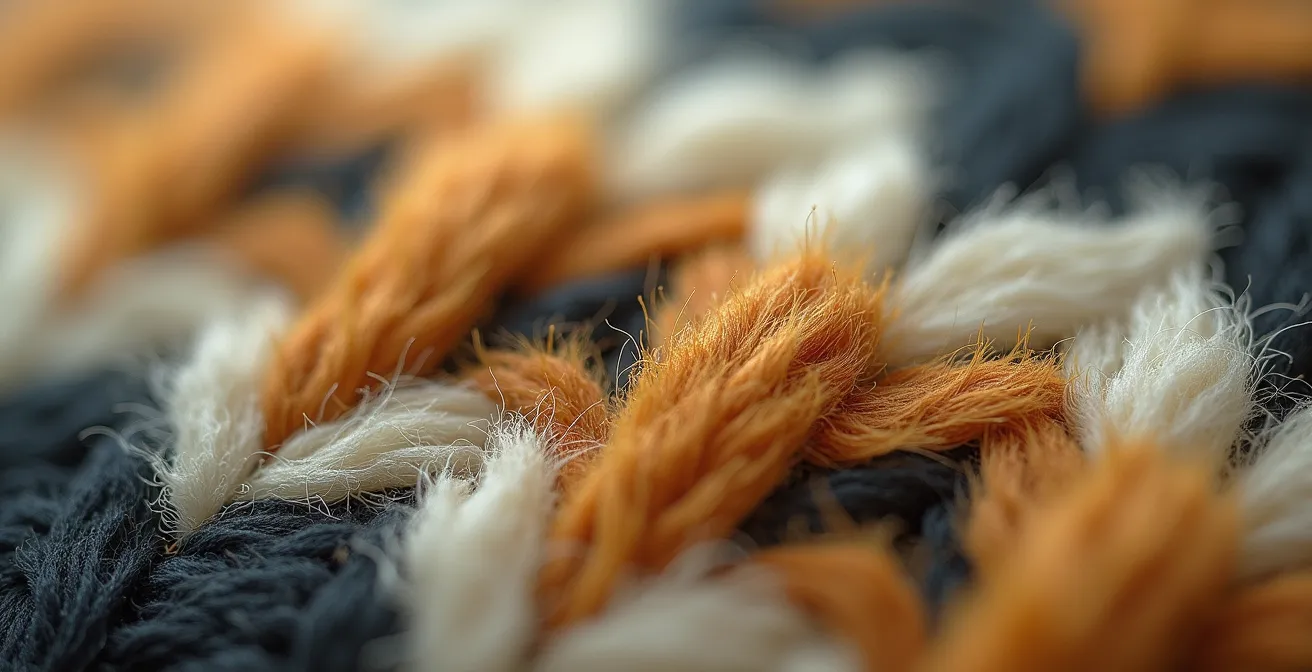
Even in a perfectly light- and climate-controlled room, a silent threat can be reducing a tapestry to dust: insect pests. Wool and silk are protein fibers, making them a highly nutritious food source for the larvae of certain insects. The primary culprits are not the flying adults, but their voracious young. According to integrated pest management research, the most destructive species in museum collections are the webbing clothes moth (Tineola bisselliella) and various species of carpet beetle (Anthrenus sp.). Their larvae graze on the fibers, often from the back of the tapestry, leaving behind a trail of threadbare patches and silken webbing.
The damage is often catastrophic because it goes unnoticed until it is extensive. The key to protection is not reacting to an infestation, but implementing a proactive program of Integrated Pest Management (IPM). IPM is a systematic, data-driven approach that prioritizes monitoring and prevention over chemical intervention. The goal is to create an environment that is inhospitable to pests and to catch any new arrivals before they can establish a population.
A successful IPM program involves regular, documented inspection of sticky traps placed in strategic, low-traffic areas. This data helps identify “hot spots” and seasonal cycles, allowing for targeted responses. When an infestation is confirmed, the preferred treatment is non-chemical, such as controlled freezing or creating an anoxia environment (depriving the insects of oxygen in a sealed enclosure), which is lethal to all life stages of the pest without harming the textile.
Action Plan: Implementing a Basic IPM Protocol
- Place numbered and dated traps strategically throughout the building, focusing on corners, near doors, vents, and potential entry points.
- Document trap locations on floor plans and maintain consistent placement for tracking trends over time.
- Inspect traps weekly and record all findings to identify ‘hot spots’ and seasonal pest activity cycles.
- Use pheromone traps specifically for webbing clothes moths and carpet beetles to monitor these high-risk species.
- If an active infestation is detected on an object, isolate it immediately and consult a conservator about non-chemical treatments like anoxia or freezing.
Insulating Stone Walls: Why Castles Needed Tapestries to Be Habitable
To fully grasp our role as custodians, we must understand the original function of tapestries. In the medieval and Renaissance periods, they were not simply decorative. In the cavernous, uninsulated stone halls of castles and great houses, they were a critical piece of technology. A massive wool tapestry served as a formidable barrier against cold and drafts, trapping a layer of air between itself and the stone wall, effectively acting as a form of insulation. They transformed a cold, damp, and acoustically harsh space into a more habitable environment, providing both physical and visual warmth.
This functional purpose dictated their monumental scale. They had to cover vast expanses of wall to be effective. As a Textile Conservation Specialist from the “Loss and Dyeing” project noted, tapestries are more than just dyed textiles; they are essentially enormous woven pictures that fundamentally altered the character of a room. This duality of function and art is key to their nature. They were designed to be robust, but not to endure for half a millennium under the assault of modern lighting and environmental instability.
While colour is an important aspect of all dyed textiles, the pictorial aspect of a tapestry makes it particularly crucial. Aside from adding physical and visual warmth to a cold castle hall, tapestries are essentially large pictures.
– Textile Conservation Specialist, Loss and Dyeing: Fading, Conservation, and Orchil Dyes in Tapestries
Our modern methods must respect this history. When we prepare a tapestry for display, we often add a full linen backing, a support system that strengthens the original structure and bears its weight when hanging. This intervention, common throughout textile conservation, is an acknowledgment that the object can no longer perform its original function without assistance. It has transitioned from a piece of functional furnishing to a fragile artifact requiring our active protection.
The Vanishing Green: Why “Bois Vert” Turns Brown in UV Light
The mystery of the shifting greens in tapestries deepens when we examine specific color recipes and their degradation pathways. The term “bois vert,” or green wood, often refers to a particular shade of green that, over time, degrades into a nondescript brown or beige. This is a different chemical process than the green-to-blue shift caused by the fading of yellow over indigo. Here, the entire composite dye structure is unstable and transforms under light exposure.
Many historic green dyes were complex mixtures. The dye analysis of 17th-century Flemish tapestries reveals that weld, a source of yellow dye, was the dominant colorant identified, present in 43% of yarns. This is because it was the primary yellow used in combination with blue indigo to create a vast range of greens. Together, the triad of weld (yellow), indigo (blue), and madder (red) accounted for nearly 89% of all color identifications, forming the backbone of the weaver’s palette.
The problem arises from the inherent instability of these organic compounds. When a green was produced by overdyeing a blue with a yellow, the less stable yellow compounds are the first to break down. As one chemical analysis study describes, as time passes and the textile is exposed to light, the yellow compounds from the weld plant degrade, and eventually, only the “blue-jeans blue” of the indigo is left. This explains the classic shift to a blue-dominated landscape. The “bois vert” phenomenon likely involves a different, more complex yellow or a mordant that itself darkens and discolors with age and light exposure, pulling the entire color toward brown.
The Mold Outbreak That Almost Erased Lascaux Forever
While this guide focuses on textiles, a stark warning comes from an entirely different field of heritage preservation: the cave paintings of Lascaux. In the early 2000s, a catastrophic outbreak of black mold, Stachybotrys, threatened to completely obliterate these 17,000-year-old masterpieces. The cause was a disruption of the cave’s delicate environmental equilibrium, primarily due to changes in air circulation and humidity introduced by a new climate control system. This disaster serves as a potent reminder that environmental stability is paramount, and that threats can emerge from unexpected quarters, including our own attempts to preserve.
For tapestries, the equivalent threat is high relative humidity (RH). Wool and silk are highly hygroscopic, absorbing moisture from the air. An RH above 65% creates the perfect breeding ground for mold, which feeds directly on the fibers and dyes, causing irreversible staining and structural weakening. This risk is compounded by the presence of dust, which retains moisture. Therefore, maintaining a stable RH, typically between 45% and 55%, is a non-negotiable aspect of tapestry care.
This connects directly back to the primary enemy: light. Light is energy, and it accelerates all chemical reactions, including those that cause decay. As conservation research explains, the energy from UV light is powerful enough to break the chemical bonds within dye molecules.
The energy from UV light can break up molecules. Certain structures emit visible light, and minor disruption can alter chromatic properties. This is why museum tapestry rooms are dark – it’s damage control.
– Conservation Research, Textile Investigations – Loss and Dyeing
The lesson from Lascaux is that preservation is holistic. You cannot protect against light while ignoring humidity, or manage pests while allowing dust to accumulate. All these factors are interconnected in a complex system of decay. A conservator’s job is to manage this entire system, not just one part of it.
Key Takeaways
- True preservation is an active science, not a passive set of rules; it requires understanding the ‘why’ of decay.
- Color change is a chemical process: fugitive yellow dyes fade, leaving the more stable blue indigo behind.
- A proper hanging system (hook-and-loop) is critical to distribute weight evenly and prevent physical tearing from gravity.
How to Distinguish a Real Aubusson from a Machine-Made Copy?
All the knowledge we’ve accumulated about degradation—the fugitive nature of dyes, the differential fading rates, the effects of centuries of exposure—culminates in a surprisingly practical application: authentication. The very signs of decay that we fight to prevent are also the tell-tale signatures of authenticity. A modern, machine-made copy of an Aubusson tapestry may replicate the design, but it cannot replicate the genuine patina of age forged by centuries of interaction with its environment.
One of the most revealing indicators is the differential fading of colors. As comparative fading studies demonstrate that after an equivalent of 300 years of daylight exposure, the robust indigo blue shows some fading but significantly less than other colors. A once-vibrant pale orange stripe might degrade into a nondescript beige, while the blue beside it remains relatively strong. A forger is unlikely to have the sophisticated chemical knowledge to reproduce this specific, uneven pattern of aging across dozens of different dyes.
The ultimate test is to compare the front of the tapestry with the back. On a genuine antique, the back, having been shielded from light, will exhibit colors that are dramatically more vibrant and saturated than the front. This stark contrast is the fingerprint of time. In the Antonio Ratti Textile Center at the Met, this principle is used as a core authentication method. By examining magnified images of dyed threads from both sides, experts can confirm the presence of natural dyes and the authentic, light-induced degradation that a modern synthetic copy simply will not possess. The damage we seek to halt is, paradoxically, the unimpeachable proof of its history.
Your role as a custodian is therefore not merely to protect, but to understand. By internalizing the principles of photodegradation, mechanical stress, and environmental control, you elevate your practice from one of simple housekeeping to that of a true conservator. This deeper knowledge allows you to make informed decisions, to anticipate threats, and to ensure the textile treasures in your care can continue to tell their stories for centuries to come.