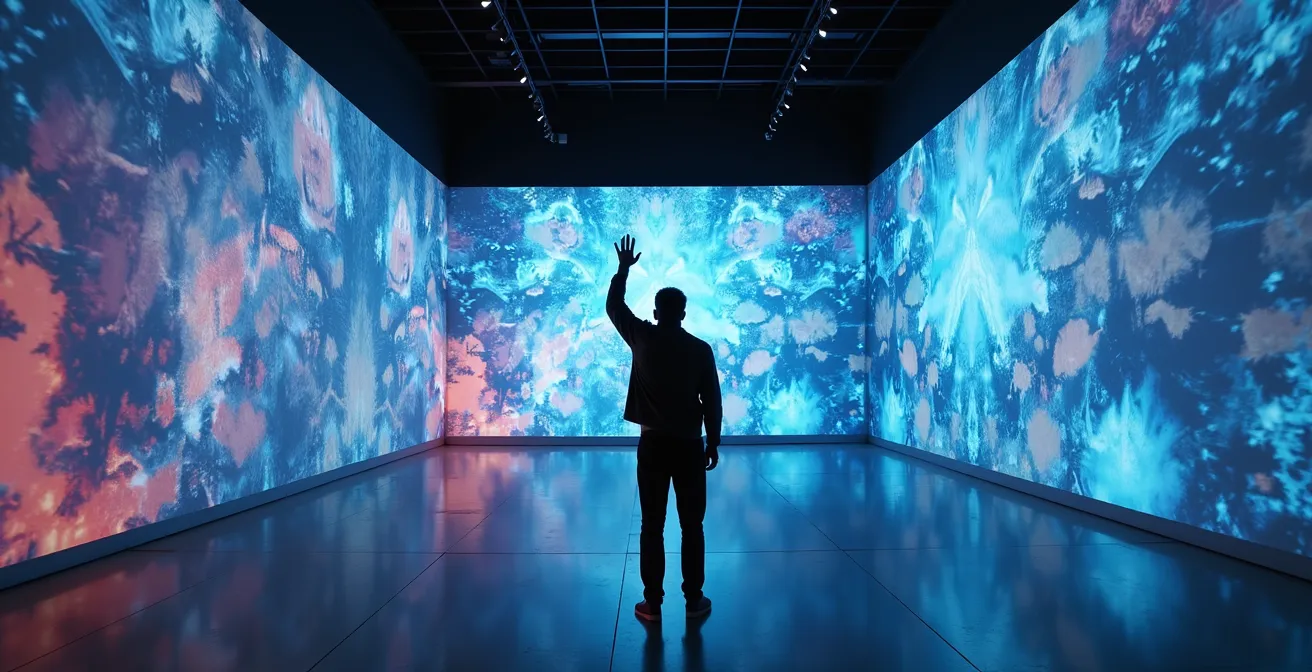
Contrary to the belief that immersive art offers a deeper connection, it often engineers ‘cognitive burnout’ by deliberately overwhelming our brains.
- These exhibits weaponize sensory overload (lights, sound) to hijack our limited attention, preventing deep thought.
- Their “Instagrammable” nature creates a dopamine loop, replacing artistic contemplation with the shallow reward of social media validation.
Recommendation: Approach these experiences with critical awareness, consciously managing your attention to distinguish genuine artistic engagement from manufactured spectacle.
You bought the ticket with anticipation. You expected to be transported, to lose yourself in a dazzling world of light, sound, and color. Instead, you walk out of the immersive art exhibit feeling strangely hollow, overstimulated, and mentally drained. The experience feels less like artistic enrichment and more like surviving a two-hour assault on your senses. You might even feel a tinge of guilt, wondering why you couldn’t just enjoy the spectacle like everyone else feverishly capturing it on their phones. The problem, however, isn’t you. It is the experience itself, which is often meticulously designed to produce this exact outcome.
As a cognitive psychologist specializing in the attention economy, I argue that many of these popular exhibits are not designed for inspiration but for consumption. They operate on principles that lead to what I term cognitive burnout. The common critique that they are merely “Instagram backdrops” is true, but it’s a symptom of a much deeper issue. These spaces are cognitive traps, engineered to hijack our brain’s attentional and reward systems. They overwhelm our capacity for processing information, short-circuit our ability to think critically, and replace the slow, rewarding work of contemplation with the quick, addictive hit of digital validation.
This article will deconstruct the psychological mechanisms at play. We will move beyond the surface-level debate of whether this is “real art” and instead analyze exactly how these environments affect your brain. We’ll explore the science of sensory overload, the addictive nature of photogenic “traps,” the corporate machinery driving this trend, and ultimately, how to reclaim your attention and find genuine meaning in an age of manufactured wonder. Understanding the “why” behind the exhaustion is the first step toward becoming a more conscious cultural consumer.
This analysis will guide you through the intricate design of these experiences, from the neurological impact of their soundscapes to the economic forces shaping their very existence. By exploring each facet, we can build a more complete picture of this modern cultural phenomenon.
Summary: Deconstructing the Immersive Experience
- Brain Overload: How Strobe Lights and Soundscapes Affect Memory
- Spectator or Performer: Who Is Really Creating the Experience?
- Instagram Traps: Why Photogenic Art Often Lacks Substance
- Glitch Art: Finding Beauty in Broken Code and Errors
- Touching the Virtual: When Will We Feel Digital Textures?
- Darkness and Crowds: The Safety Risks of Light Festivals
- Ticket Sales vs. Education: The Museum’s Eternal Dilemma
- How Projection Mapping Turns Buildings into Living Canvases
Brain Overload: How Strobe Lights and Soundscapes Affect Memory
The feeling of being overwhelmed in an immersive exhibit is not just a vague sensation; it’s a measurable cognitive state. Our brains have a finite capacity for attention and information processing. Traditional museums already test this limit, a phenomenon known as “museum fatigue.” In fact, foundational research from the Florida Museum of Natural History found that visitors’ attention significantly declines after just 30 minutes. Immersive exhibits amplify this effect exponentially by creating an environment of intense sensory overload. Flashing strobe lights, loud, looping soundscapes, and constantly moving visuals create what cognitive scientists call a high “cognitive load.”
This overload is not neutral. It actively impairs higher-level cognitive functions like memory formation and critical analysis. When your brain is dedicating all its resources to simply processing a barrage of stimuli, it has little left for contemplation or making meaningful connections. As researcher Stephen Bitgood notes, this fatigue is a result of “object competition from the simultaneous presentation of multiple stimuli.” You are not absorbing art; you are in a state of constant, low-level cognitive crisis, trying to decide where to look next. This is attentional hijacking in its purest form.
Multiple factors of museum fatigue include exhaustion, satiation from repeated exposure to similar exhibits, stress, information overload, object competition from the simultaneous presentation of multiple stimuli, limited attention capacity, and the decision-making process.
– Stephen Bitgood, Visitor Studies Journal
Ultimately, according to studies on cognitive load in museums, the visual content of an exhibition is fundamental to shaping visitor experience. When that content is designed to overwhelm rather than guide, the experience shifts from educational to exhausting. The memory you form is not of the art’s message, but of the overwhelming sensation itself, which is a hallmark of cognitive burnout.
Spectator or Performer: Who Is Really Creating the Experience?
Immersive exhibitions often market themselves with language of empowerment and creativity, inviting you to “step into the art” and become part of the experience. This positions you as a performer or co-creator. However, from a cognitive standpoint, this is a misleading narrative. In reality, the high-sensory, low-information environment often reduces the visitor to a state of passive consumption. You are not actively interpreting complex symbols or engaging with a challenging artistic thesis; you are being guided through a pre-packaged set of stimuli designed to elicit a predictable “wow” response.
This shift from active interpretation to passive consumption is not accidental. It is the business model. As noted in VICE Magazine, these are not grassroots art projects but highly profitable, replicable products. The goal is to create a consistent, scalable “experience” that can be deployed worldwide. This industrial approach prioritizes spectacle over substance because spectacle is easier to sell and requires less of the nuanced, costly curatorial work that defines traditional art institutions.
Many of these ‘experiences’ are operated by sinisterly named, multi-million dollar businesses like teamLAB, Brain Hunter Co., and Fever Labs. Sure, art has always been big business, but immersive art seems to be uniquely ripe for raiding by faceless corporations.
– VICE Media, VICE Magazine
The scale of this industry is staggering. It’s estimated that these corporate-led immersive productions generate in excess of $1 billion annually. In this model, the visitor is not a performer but a product moving through a system. Your predictable reactions—the gasp at the big reveal, the selfie in the infinity room—are the desired output. You are not creating the experience; the experience is creating a predictable reaction in you.
Instagram Traps: Why Photogenic Art Often Lacks Substance
The most visible symptom of cognitive burnout in immersive art is the compulsion to photograph everything. This is often dismissed as vanity, but it’s a predictable neurological response to the environment’s design. These exhibits are filled with “Instagram traps”—perfectly lit, visually striking scenes that are optimized for a smartphone camera. This design directly taps into our brain’s reward system, creating a powerful dopamine loop that replaces artistic contemplation with the pursuit of social validation.
This paragraph introduces the core issue. To better visualize this modern phenomenon, consider the following scene.

As the image suggests, the focus shifts from outward observation to inward validation. When you take a photo and anticipate posting it, your brain is primed for a reward. Research confirms that the addictive nature of social media activates the brain’s reward center by releasing dopamine, especially through variable reward schedules. The exhibit provides the stimulus, and your phone provides the mechanism for the reward. This loop is so powerful that it hijacks your attention. Instead of asking, “What does this art mean?” you are asking, “What is the best angle for my photo?” This is not engagement; it is a task-oriented behavior that drains cognitive resources and leaves no room for genuine aesthetic experience.
Case Study: Instagram’s Algorithmic Dopamine Loop
The compulsion to photograph in these exhibits mirrors the very design of social media platforms. Studies on Instagram’s algorithms reveal a deliberate manipulation of our reward system. The platform sometimes withholds “likes” only to deliver them in a sudden, larger batch later. This creates a negative prediction error (fewer likes than expected) followed by a strong positive prediction error (more likes than expected), which triggers a more potent dopamine release. Immersive exhibits function as the physical-world equivalent, offering a series of visually rewarding “moments” perfectly engineered for this digital feedback cycle.
Your Action Plan: Reclaiming Your Attention in an Immersive Exhibit
- Pre-Visit Intent: Before entering, define a personal goal. Is it to understand a concept, feel a certain emotion, or simply observe? Articulate a purpose beyond just “getting good pictures.”
- Tech-Free First Pass: Commit to experiencing the entire exhibit once without taking out your phone. Allow your eyes and brain to process the environment without the filter of a lens.
- Identify the Narrative: Actively search for a story, theme, or message. Challenge yourself to find a deeper meaning beneath the surface-level spectacle.
- Sensory Decompression: These spaces are intentionally overwhelming. Plan to take short breaks in quieter, less stimulating areas to give your brain a chance to reset and avoid total cognitive burnout.
- Post-Visit Reflection: After you leave, take five minutes to articulate or write down what you actually felt or learned. Compare this to the photos you took. Which is a more meaningful memory?
Glitch Art: Finding Beauty in Broken Code and Errors
While many mainstream immersive experiences rely on slick, polished, and endlessly looping perfection, a counter-movement in digital art offers a powerful antidote: Glitch Art. This form embraces the unpredictable, the chaotic, and the broken. Glitch artists find beauty in system malfunctions, corrupted data, and digital errors, turning technological failures into compelling aesthetic statements. This approach stands in stark contrast to the highly controlled, commercially driven spectacle of a typical light festival.
From a cognitive perspective, Glitch Art is fascinating because it re-engages the viewer’s critical mind. Instead of being lulled into passive consumption by flawless projections, the viewer is confronted with an imperfection that demands attention and interpretation. You are forced to ask, “Why does it look like this? Is this intentional? What does this failure reveal about the technology we take for granted?” This process of inquiry is the very essence of active artistic engagement, something often missing from more commercial experiences.
Exhibition Spotlight: Pinakothek der Moderne’s ‘GLITCH’
A notable exploration of this form was the ‘GLITCH’ exhibition at Munich’s Pinakothek der Moderne. The exhibition showcased how artists deliberately harness malfunctions to create their work, describing it as one of the “most unpredictable art forms.” As the museum itself explained, “glitch art specifically draws attention to the aesthetics of the flawed.” By curating and contextualizing these works, the museum elevated digital error from a simple nuisance to a legitimate artistic medium with roots stretching back to early photography. It demonstrates a path for digital art that provokes thought rather than just providing a backdrop.
Glitch art, therefore, challenges the illusion of digital perfection that underpins so many exhausting immersive exhibits. It reminds us that technology is fragile and that a system’s flaws can often be more interesting and human than its intended function. It offers a way out of the cognitive burnout cycle by rewarding curiosity and critical thought over passive admiration.
Touching the Virtual: When Will We Feel Digital Textures?
If the current model of immersive art leads to sensory overload, what is the alternative? One of the most promising frontiers for creating deeper, more meaningful digital experiences lies in haptics—the science of touch. While current exhibits primarily bombard our eyes and ears, the integration of tactical feedback could shift the focus from a purely visual spectacle to a multi-sensory engagement. Imagine not just seeing a virtual recreation of a historical artifact, but feeling its texture, weight, and temperature through a haptic glove.
This is not science fiction. The technology is already being used to create more profound connections in museum settings. The key difference is intent. Instead of using technology for overwhelming scale, it can be used for intimate detail. As research shows, incorporating touch can dramatically increase engagement and understanding. For example, one study found that the vibrotactile glove approach considerably improves user accuracy, efficiency, immersion, and satisfaction in virtual tasks. This suggests a future where digital art is not just seen, but felt.
This is the potential future of interaction, where technology enhances, rather than overwhelms, our senses.

This move toward haptics could fundamentally change the cognitive impact of digital art. Rather than forcing the brain to process a wide field of chaotic visual information (leading to overload), it would allow for focused, deep exploration of a single object. This encourages a state of “flow” and contemplation, the opposite of cognitive burnout.
Case Study: Manchester Museum’s Haptic Interactive System
The Manchester Museum has pioneered this approach with a system that allows visitors to “touch” artifacts through a haptic stylus. Users can explore a 3D digital model and feel its topography, texture, and resistance. As the project leaders note, the goal is not to replace the real object but to “augment visitor understanding.” This represents a philosophical shift: using technology to deepen curiosity and provide information, not just to entertain. It’s a model for how immersive tech could evolve to serve education and genuine connection.
Darkness and Crowds: The Safety Risks of Light Festivals
Beyond the direct cognitive load imposed by the art itself, the physical environment of many immersive exhibits is a significant contributor to mental exhaustion and even poses safety risks. These spaces are often dark, crowded, and labyrinthine. This combination of factors acts as a powerful environmental stressor, further depleting the limited cognitive resources you need to appreciate the experience.
In a dark, unfamiliar space, your brain is on high alert. You are subconsciously tracking the movement of the crowd, navigating uneven floors, and trying to maintain your personal space. Each of these actions requires a small but constant stream of micro-decisions. This constant, low-level vigilance consumes mental energy, a process directly linked to the concept of museum fatigue. You are not just looking at art; you are actively engaged in a complex spatial navigation task under stressful conditions.
Navigating a complex, dark space with unpredictable flows of people requires constant micro-decisions, depleting the same mental resources needed to appreciate the art itself.
– Museum Fatigue Research
This environment is the antithesis of the calm, well-lit, and orderly space of a traditional gallery, which is designed to minimize cognitive distractions and focus attention on the artwork. In an immersive light festival, the environment itself becomes a primary source of cognitive load. By the time you reach the main installation, your brain may already be too fatigued from the simple act of navigating the space to engage with it meaningfully. The feeling of exhaustion is compounded by the feeling of being herded, turning an artistic outing into a stressful ordeal.
Ticket Sales vs. Education: The Museum’s Eternal Dilemma
Why are these cognitively draining experiences proliferating? The answer lies in a simple and powerful motivator: money. Immersive spectacles are immensely profitable, creating a significant dilemma for traditional museums struggling with funding and declining attendance. These institutions are caught between their educational mission and the undeniable financial success of the immersive entertainment model. The sheer numbers are hard to ignore and create immense pressure to adapt.
The business model is built on high volume and ticket prices that far exceed typical museum admission. A single blockbuster exhibit can generate revenue that an entire museum might take years to accumulate. For instance, an analysis in Artnet highlights the staggering success of one major player in the field. It was reported that in a single year, some 2.4 million people paid approximately $25 each to experience teamLab’s Planets exhibition in Tokyo alone. This equates to roughly $60 million from one exhibit in one city.
However, adopting this model comes at a high curatorial cost. As the same Artnet analysis points out, the very nature of these dark, music-filled environments leaves “little scope for the curatorial texts and commentary that are the lifeblood of a traditional museum exhibition.” An institution’s primary assets are its collection and the expertise of its curators. The immersive model de-emphasizes both, favoring spectacle over the deep, contextual knowledge that museums are uniquely positioned to provide. This creates a difficult trade-off: chase the revenue from high-sensory entertainment or stick to a less profitable, but more profound, educational mission.
This economic pressure forces a shift in priorities. The goal becomes maximizing throughput and creating photogenic moments rather than fostering a deep, lasting engagement with art and history. The result is an experience that may be financially successful but leaves the visitor cognitively burnt out and intellectually unfulfilled.
Key takeaways
- Immersive art often induces ‘cognitive burnout’ by overwhelming the brain’s processing capacity with excessive sensory stimuli.
- The “Instagrammable” design of these exhibits hijacks our attention by creating dopamine-driven reward loops, replacing contemplation with content creation.
- The business model is driven by large corporations engineering high-revenue, scalable “experiences” rather than fostering unique artistic engagement.
How Projection Mapping Turns Buildings into Living Canvases
A key technology driving the immersive trend is projection mapping, the art of turning irregular surfaces like buildings, natural landscapes, and complex industrial objects into dynamic video displays. At its best, this technique can be breathtaking, creating a sense of wonder by transforming a familiar object into something magical and alive. This relies on what some researchers call an “existing emotional connection” with the object being transformed. Seeing your city’s iconic town hall suddenly appear to crumble, bloom with flowers, or launch into space is a powerful experience because it plays with your established perception of a known entity.
However, this very power is also what makes it a perfect tool for attentional hijacking. The “wow” factor of projection mapping is an incredibly effective way to capture a mass audience’s attention instantly. The sheer scale and novelty short-circuit critical thought and induce a state of passive awe. But once the initial surprise wears off, the experience can quickly feel hollow if it lacks a deeper narrative or conceptual underpinning. The spectacle can become an end in itself, a dazzling display of technical skill that says very little.
This technique serves as a perfect metaphor for the broader immersive art phenomenon. It has the potential to be a powerful tool for storytelling and creating profound new ways of seeing the world. Yet, it is more often deployed as a mechanism for creating shallow, fleeting spectacle. The transformation of the building is temporary, and the memory of it is often less about a message or an idea, and more about the simple fact that it happened. It provides the perfect fodder for a 30-second social media clip—a quick hit of visual wonder, easily consumed and just as easily forgotten.
To truly appreciate these works, one must learn to look past the initial spectacle and ask what, if anything, is being communicated. Approaching these experiences with a critical, psychologically-informed lens is the key to separating fleeting entertainment from genuinely inspiring art.