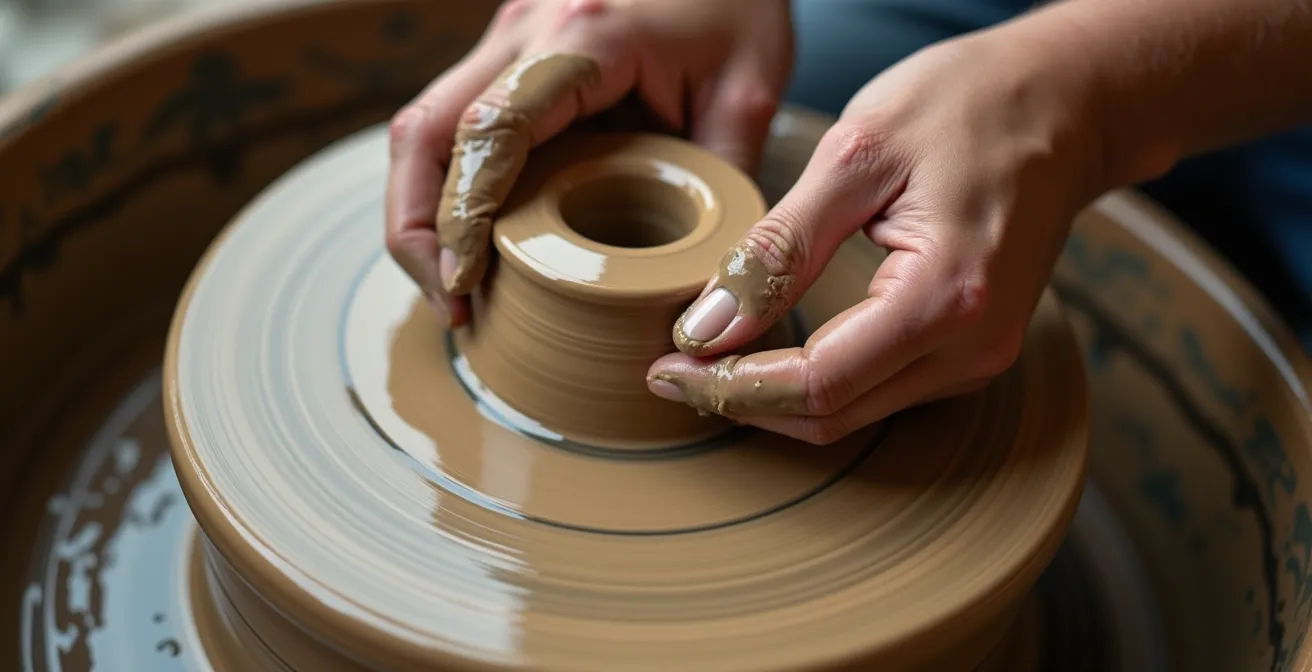
Contrary to the popular belief that art is a mere skill or decorative hobby, it is a fundamental biological imperative hardwired into our species for survival. This drive is not about talent but is an essential cognitive tool for processing trauma, navigating social complexity, and strengthening our mental resilience. Understanding this evolutionary function is the key to unlocking its profound therapeutic benefits.
The impulse to create is one of the most mysterious and universal traits of our species. From the first ochre handprints on a cave wall to a child’s sprawling crayon masterpiece, the act of making art seems as fundamental as language itself. We often categorize it as a hobby, a profession, or a form of therapy—optional activities for the talented or the troubled. But this view misses the essential truth. The drive to create is not a luxury; it is a core feature of our biological and psychological programming, a tool forged by evolution to ensure our survival and well-being.
Most discussions about creativity focus on its outcomes: a beautiful painting, a moving song, a feeling of relaxation. They treat the act as a pleasant diversion or a method for self-expression. This perspective, however, fails to explain why humans across all cultures and throughout all of history have relentlessly engaged in artistic behavior, often at great cost. What if the urge to draw, sculpt, or sing is a non-negotiable biological function, a cognitive mechanism designed to help us process the world, regulate our nervous systems, and bond with our tribe? This is the perspective of evolutionary psychology, which sees art not as a product, but as an adaptive behavior.
This article will deconstruct the biological mandate behind human creativity. We will explore how making things serves as a pre-verbal language for processing trauma, why our rational brain often sabotages this innate drive as we age, and how art functions as a social glue. By reframing creativity as an essential part of our evolutionary toolkit, we can better understand its profound necessity for our mental health and reconnect with an instinct we were all born with.
This exploration will follow the arc of our creative instinct, from its role in deep psychological healing to its function in defining our societies. The following sections break down the biological and psychological components of why we are compelled to make art.
Summary: The Biological Drive for Art
- Beyond Words: Processing PTSD Through Non-Verbal Creation
- The Inner Critic: Why We Stop Drawing at Age 10
- The Monster Genius: Can We Love the Art of Bad People?
- Who Draws the Line: The Psychology of Being Offended by Art
- Suffering for Art: Do You Need to Be Miserable to Be Creative?
- Brain Overload: How Strobe Lights and Soundscapes Affect Memory
- Drawing Without Thinking: How to Bypass the Rational Brain
- Why Cubism Was the Most Radical Break in 500 Years of Art
Beyond Words: Processing PTSD Through Non-Verbal Creation
When the human nervous system experiences a threat so profound that language and rational thought collapse, it reverts to a more primal state of being. This is the domain of trauma, a physiological reality that often defies verbal narrative. For individuals with Post-Traumatic Stress Disorder (PTSD), a condition affecting a staggering 23 out of 100 veterans who use VA care, the body remains locked in a state of high alert. In this state, the creative act becomes more than expression; it becomes a biological necessity for regulation.
The mechanism behind this is explained by Polyvagal Theory (PVT), which focuses on the physiological state as the root of trauma response. It posits a concept called neuroception: the nervous system’s subconscious ability to scan for safety and danger. Traumatic events can damage this system, biasing it towards a defensive state. Non-verbal creation—drawing, sculpting, painting—allows the individual to communicate directly from this traumatized physiological state, bypassing the often-inaccessible language centers of the brain. It is a way of externalizing the somatic markers of fear and creating a new relationship with them.
As the founder of PVT, Stephen Porges, explains, successful therapy is about changing one’s perception of their own internal state. The process of creating art can be a direct pathway to this recalibration.
Through the promotion of bodily attunement via neuroception, an individual may be able to identify somatic markers that denote a transition from a prosocial to a defensive state following threat or trauma-related processing.
– Stephen Porges, Frontiers in Psychology
By making a physical object that represents the internal chaos, the creator engages in a form of evolutionary rehearsal. They can safely interact with the “monster” on paper or in clay, gradually teaching their nervous system that the threat is not present, and shifting their neuroception from danger back to safety. It is a testament to art’s function as a primal, pre-linguistic survival tool.
The Inner Critic: Why We Stop Drawing at Age 10
Virtually every young child creates with uninhibited joy. Their drawings are a riot of color and form, free from the constraints of realism or the fear of judgment. Yet, around the age of 10, a profound shift occurs. The free-flowing creativity of childhood often dries up, replaced by self-consciousness and a paralyzing inner critic. This is not a failure of talent but a predictable collision of two different brain systems: the ancient, intuitive drive to create and the newly developing, analytical prefrontal cortex.
As children develop more sophisticated cognitive abilities, they become acutely aware of social comparison and the concept of “correctness.” The rational brain begins to judge the creative output against a perceived standard of reality. A drawing of a horse is no longer just a joyful expression; it is now “wrong” because its legs are too short or its color is unrealistic. This is the birth of the inner critic, a manifestation of the logical brain attempting to impose order on the chaotic, non-linear process of creation. This cognitive shift from process to outcome effectively severs the connection to the primal creative impulse.
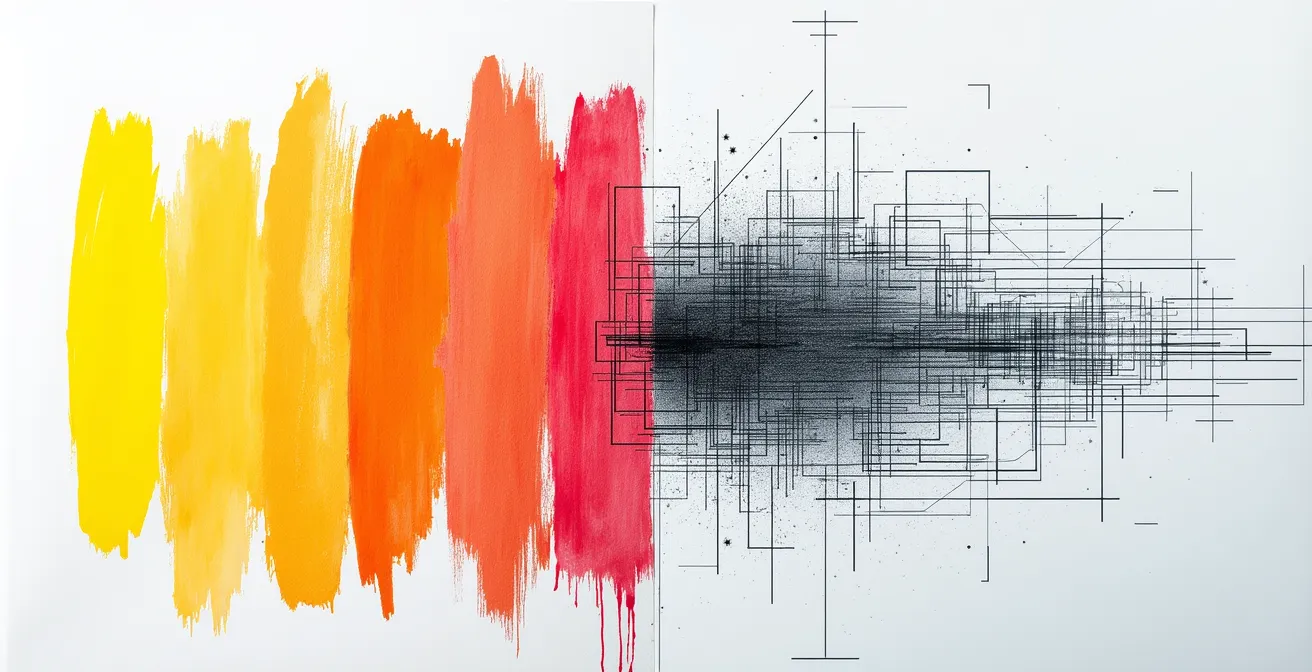
This transition represents a major fork in our developmental path. Some individuals learn to integrate these systems, using their analytical skills in service of their creative vision. But for many, the fear of not being “good enough” leads to a complete shutdown of artistic activity. They internalize the belief that they are “not creative,” confusing a learned inhibition with a lack of innate ability. This is a profound loss, as it disconnects us from a biological tool designed for emotional regulation and problem-solving.
The Monster Genius: Can We Love the Art of Bad People?
The history of art is littered with “monster geniuses”—creators of breathtaking beauty who were, by any reasonable measure, morally reprehensible individuals. This paradox forces a difficult question: can and should we separate the art from the artist? From an evolutionary psychology perspective, the question is less about morality and more about machinery. Is the neurobiological engine of creativity functionally separate from the parts of the brain that govern empathy, ethics, and social behavior?
Research suggests that the creative process relies on a specific set of biological and cognitive functions. It is not a mystical gift but a product of a healthy, well-connected brain. This creates a biological framework for understanding how genius and monstrosity can coexist in one person.
Access to an intact knowledge and conceptual semantic systems, healthy neural connectivity, and normal levels of neurotransmitters such as dopamine, are likely essential for creativity.
– Dahlia W. Zaidel, Frontiers in Human Neuroscience
This “machinery” view suggests that a person can possess the optimal neural hardware for artistic innovation while having a severely malfunctioning “moral hardware.” The systems for pattern recognition, abstract thinking, and aesthetic judgment can operate at a high level, independent of the capacity for compassion or ethical reasoning. The “monster genius” may not be a paradox at all, but a stark example of the modular nature of the human brain. Their art is a product of a finely tuned creative subsystem, while their behavior is a product of a broken or underdeveloped social-emotional subsystem.
This doesn’t excuse their actions, but it does provide a biological lens through which to view the work. We can appreciate the output of the creative machinery—the painting, the symphony—as a testament to what that specific neural configuration can achieve, while simultaneously condemning the actions of the person who housed it. It allows us to study the art for its technical and aesthetic merits without endorsing the artist’s character.
Who Draws the Line: The Psychology of Being Offended by Art
Art’s power to provoke is as fundamental as its power to soothe. When a piece of art causes public outrage, the reaction is often visceral and deeply personal. This isn’t mere disagreement over taste; it’s a powerful psychological response rooted in our species’ need for social cohesion and shared identity. Offense at art is the immune response of a culture’s value system. The biological universality of art is a proven fact; as Harvard research shows, no culture exists without it, indicating its deep adaptive function.
One of the most compelling evolutionary explanations for art is what scholar Ellen Dissanayake calls the impulse to “make special.” She argues that humans are driven to take ordinary objects, places, and behaviors and elevate them through ritual and decoration. This act of “making special” strengthens community bonds by creating a shared reality and a collective set of symbols that define the “us.” According to this theory, art evolved as a technology for social bonding, which directly improved the survival chances of the group.
When a work of art violates these shared symbols or deeply held values, it is perceived not as an attack on an individual’s taste, but as an attack on the integrity of the tribe itself. It threatens the symbolic order that holds the group together. The emotional outrage is a manifestation of a primal, protective instinct. The person who is offended is, on a subconscious level, defending the boundaries of their social reality. The line they draw is the perimeter of their group’s identity.
This explains why controversies often erupt around art that deals with religion, national identity, or sexuality—the very pillars of cultural value systems. The artist may be exploring a personal vision, but the audience receives the work through the filter of their own neuroception of social safety. If the art is perceived as a threat to the group’s stability, the defensive reaction is swift and powerful, a biological impulse to protect the collective.
Suffering for Art: Do You Need to Be Miserable to Be Creative?
The myth of the “tortured artist” is one of the most persistent and damaging tropes in our culture. It’s the romantic notion that great art can only be born from great suffering, that misery is the fuel for the creative fire. While it’s true that many artists have channeled their pain into their work, the idea that suffering is a prerequisite for creativity is a biological falsehood. In fact, our brains are specifically wired to make the creative process a source of pleasure and reward, not pain.
From a neurobiological standpoint, the act of creation is fundamentally a rewarding experience. It is a form of problem-solving and world-building that is deeply satisfying to the human brain. This isn’t just a feeling; it’s a chemical reality. The engagement in an artistic act, whether it’s successful or not, triggers the brain’s primary reward pathway.
As confirmed by extensive brain imaging studies, the process is intrinsically pleasurable. It has been shown that creating art activates the brain’s reward centers, releasing dopamine, the same powerful neurotransmitter associated with love, delicious food, and music. This dopamine hit reinforces the behavior, encouraging us to do it again. Evolution would not have built a reward system around an activity that was detrimental to our survival. The pleasure of creation is an adaptive trait, designed to motivate us to engage in an activity that hones our problem-solving skills, improves our manual dexterity, and regulates our emotional state.
So where does the myth come from? Often, it’s a correlation-causation error. Individuals with high sensitivity may be more prone to both psychological distress and profound artistic expression. They don’t create *because* they suffer; rather, they use the biologically rewarding process of creation as a tool to *manage* their suffering. Art is the medicine, not the disease.
Brain Overload: How Strobe Lights and Soundscapes Affect Memory
Our brain is a masterful filtering machine, constantly processing a torrent of sensory information to construct a coherent reality. But what happens when that input is deliberately manipulated to create an overwhelming experience? Immersive art installations, using intense strobe lights, disorienting soundscapes, and vast visual projections, push our sensory processing to its absolute limit. These environments are not just spectacles; they are live experiments in cognitive and perceptual boundaries, revealing how our biology responds to sensory overload.
When faced with a rapid, unpredictable barrage of stimuli like strobe lights, the brain’s normal predictive models fail. The visual cortex struggles to keep up, which can induce altered states of consciousness, from disorientation to euphoria. This sensory flood can disrupt the hippocampus’s ability to encode short-term experiences into long-term memory. The experience becomes a series of intense, fragmented moments rather than a continuous narrative. This is why you might remember the *feeling* of an installation—the awe, the confusion, the adrenaline—more vividly than the specific sequence of events.
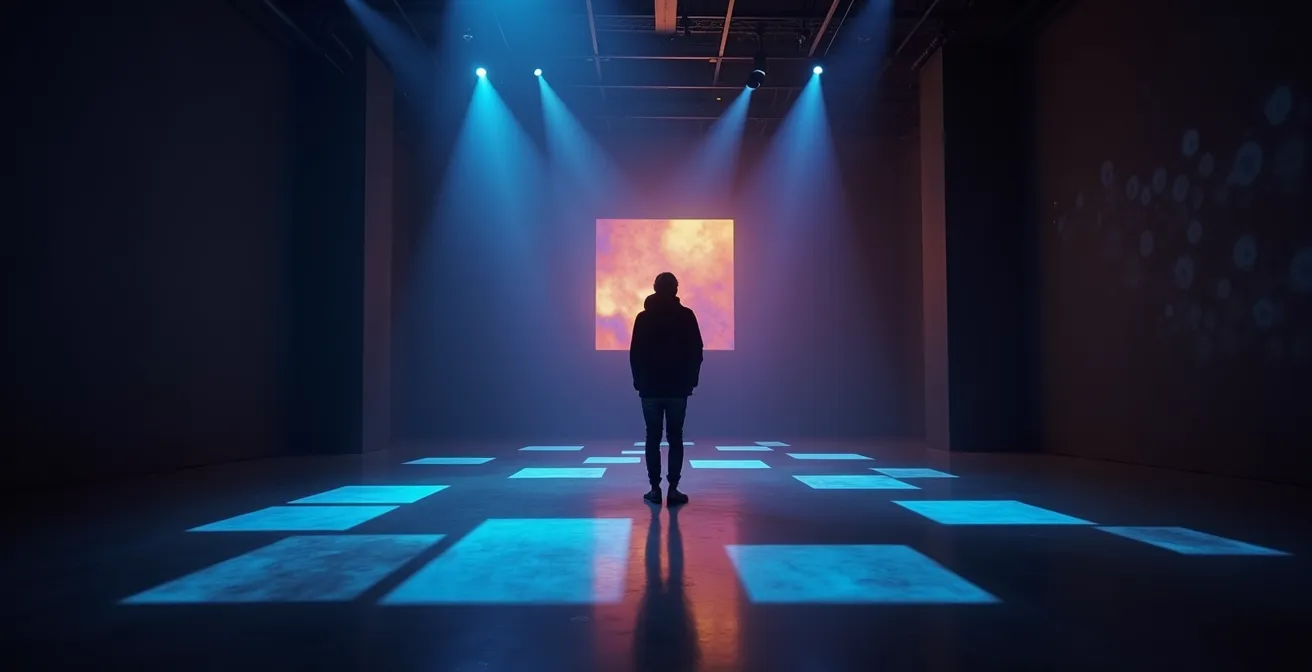
Soundscapes work on a different, more primal level. Complex, non-linear audio can directly influence our autonomic nervous system. Low-frequency drones can trigger a state of unease or alertness (a sympathetic “fight-or-flight” response), while complex, layered harmonies can induce a feeling of safety and connection (a parasympathetic “rest-and-digest” response). Artists who master this are essentially “playing” the visitor’s nervous system. They are manipulating the raw data of neuroception to create a purely physiological emotional journey.
This kind of art demonstrates that our aesthetic experience is not a purely intellectual judgment. It is a full-body, biological event. The artist is designing a sensory environment that temporarily hijacks our brain’s normal processing, forcing us into a state of pure, unmediated presence. It is a powerful reminder that our experience of reality is a fragile construction, built from the sensory data our brain chooses to let in.
Drawing Without Thinking: How to Bypass the Rational Brain
The greatest obstacle to adult creativity is often the brain itself—specifically, the over-developed prefrontal cortex that acts as our inner critic. It judges, analyzes, and compares, stifling the fluid, intuitive expression we had as children. To reconnect with our innate creative drive, we must learn to perform a cognitive bypass: to find techniques that quiet the rational mind and allow the more ancient, non-verbal parts of the brain to take the lead. This isn’t about “turning off” your brain, but about shifting your cognitive gears.
One of the most effective methods is to engage in automatic drawing or “doodling.” By focusing on the physical sensation of the pen moving across the paper without a specific goal or outcome in mind, you occupy the analytical brain with a simple motor task. This frees up subconscious resources to express themselves in abstract shapes and lines. Other techniques include drawing with your non-dominant hand, which disrupts ingrained motor control and forces a more intuitive approach, or setting a timer for a very short period (e.g., two minutes) to create a sense of urgency that overrides perfectionism.
The goal of these exercises is to achieve a “flow state,” a psychological concept where a person is fully immersed in an activity with a feeling of energized focus. In this state, the sense of self and the passage of time seem to fade away. It is the optimal neurobiological state for creativity, where the critical “self” is silenced and the creative “process” takes over. Artists and scientists have taken this concept of bypassing the rational to its extreme, as seen in the field of BioArt.
Case Study: Microvenus, Art Encoded in DNA
In a radical act of cognitive bypass, artist Joe Davis moved beyond traditional media to collaborate with geneticists at MIT. In his 1990 work, “Microvenus,” he translated an ancient Germanic rune representing female earth life into a binary code, which was then synthesized into a sequence of DNA. This artistic code was inserted into the genome of an E. coli bacterium. This act represents the ultimate circumvention of rational critique, embedding a symbolic, artistic idea directly into the fundamental biological substrate of life itself, where it could replicate and exist far beyond human judgment.
Action Plan: How to Bypass Your Rational Brain
- Timed Sprints: Set a timer for 5 minutes. Draw or write continuously without stopping or judging until the timer goes off. The goal is momentum, not quality.
- Non-Dominant Hand: Attempt to draw a simple object (like a cup or a plant) with your non-dominant hand. This breaks habitual motor patterns and silences the part of your brain that expects perfection.
- Blind Contour Drawing: Fix your eyes on an object. Place your pen on a piece of paper and, without looking at the paper, trace the object’s contours with your eyes and hand simultaneously. This forces a direct connection between seeing and doing, bypassing the analytical brain.
- Sensory Deprivation/Alteration: Try drawing while listening to instrumental music with no clear rhythm, or in a dimly lit room. Altering your sensory input can help disrupt your brain’s default, critical mode.
- Start from a Mark: Make a random scribble, spill, or mark on the paper. Then, your task is not to create something from nothing, but to respond to the mark that is already there. Turn it into something recognizable.
Key takeaways
- The drive to create is not a skill but a biological imperative, a survival tool hardwired by evolution.
- Art serves as a vital, non-verbal method for processing trauma by allowing the nervous system to regulate itself outside of language.
- The “inner critic” that stifles adult creativity is the analytical brain overriding our innate, intuitive creative impulse—an inhibition that can be unlearned.
Why Cubism Was the Most Radical Break in 500 Years of Art
For nearly five centuries, Western art operated under a single, dominant cognitive framework: linear perspective. This system, perfected during the Renaissance, was a technology for creating a convincing illusion of three-dimensional space on a two-dimensional surface. It trained the human brain to see and value a specific, singular viewpoint. Then, in the early 20th century, Cubism, led by Picasso and Braque, shattered this framework. It was not just a new style; it was a radical rewiring of perception and a profound demonstration of art’s power to alter our fundamental cognitive processing.
Cubism rejected the idea of a single, fixed viewpoint. Instead, it attempted to depict an object from multiple viewpoints simultaneously. A face might be shown in profile and head-on at the same time; a guitar might be deconstructed into its geometric components and reassembled on the canvas. To a brain conditioned by 500 years of linear perspective, these images were initially jarring and nonsensical. They were cognitively dissonant. They forced the viewer’s brain to abandon its automatic processing and actively work to make sense of the visual information.
This was Cubism’s true revolution. It was not about what was being painted, but *how* the brain was being asked to see it. It replaced a passive model of viewing with an active one. The artwork was no longer a window into an illusory world, but a conceptual field that had to be navigated and pieced together by the viewer. It was a direct engagement with the process of perception itself. It revealed that “reality” in art is a convention, a set of rules our brains have agreed to follow. By breaking those rules so completely, Cubism exposed the underlying code of our visual processing.
This movement stands as a historical case study of art’s role as a tool for cognitive evolution. It challenged and ultimately changed the way an entire culture perceived the world, proving that art does not just reflect reality—it actively constructs and reconstructs the very neural pathways we use to understand it. The break was so radical because it wasn’t just a break with artistic tradition, but with a deeply ingrained mode of neurological processing.
Embracing our biological need to create is not about becoming a professional artist; it is about reclaiming an essential part of our human toolkit for well-being. By engaging in creative acts, we are not just making things—we are regulating our nervous systems, sharpening our minds, and connecting with a legacy of survival that stretches back millennia. The first step is to simply begin, to pick up a pen or a piece of clay, and allow this fundamental human drive to find its expression.