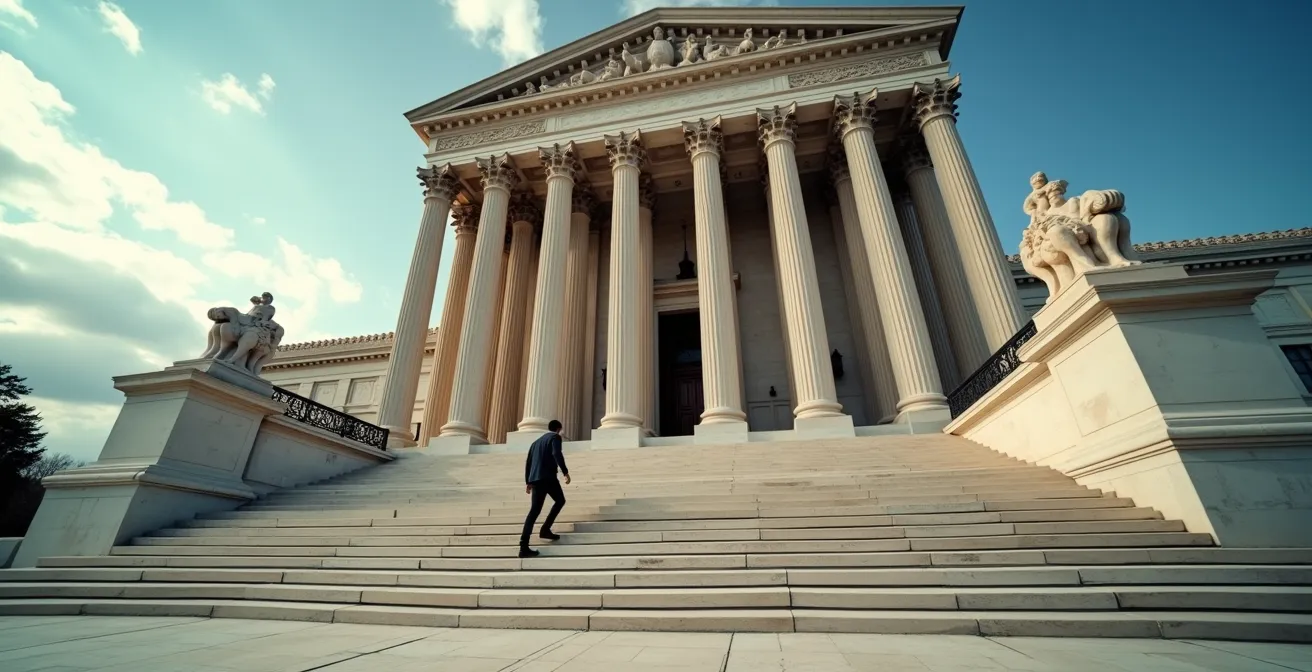
Contrary to the simple explanation of ‘tradition,’ the persistent use of Greco-Roman forms in government architecture is a deliberate semiotic strategy. This article decodes the visual language of power, revealing how scale, materials, and urban planning are engineered not just to house government, but to psychologically frame the state’s authority as permanent, legitimate, and absolute.
Walk through the capital of almost any nation—from Washington D.C. to Vienna, Kolkata to Helsinki—and you’ll notice an uncanny similarity in its official architecture. Courthouses, parliaments, and national archives are overwhelmingly rendered in a style that evokes ancient Greece and Rome. They feature stately columns, triangular pediments, and soaring domes. The common explanation points to Neoclassicism, an 18th-century revival of classical aesthetics. But this answer only addresses the ‘what,’ not the ‘why.’
The truth is more profound. This architectural choice is not a simple matter of aesthetic preference; it is a conscious act of political communication. Government buildings are designed as a form of visual language, a system of signs and symbols meant to convey a very specific message about power, legitimacy, and the relationship between the state and the individual. To understand why your capitol looks like a temple, one must learn to read the semiotics of its stone, scale, and symmetry.
This article moves beyond a surface-level historical overview to decode this architectural lexicon. We will explore how specific design elements are used to intimidate, inspire, and organize not just space, but society itself. By dissecting the visual syntax of these structures, from their imposing facades to their economic footprint, we reveal the hidden ideology built into the very foundations of government.
To navigate this complex subject, this analysis will break down the core components of this architectural language. We will examine how scale manipulates perception, how symbolic forms connect earthly power to divine ideals, and how the materials themselves are chosen to communicate a message of permanence and immutability.
Summary: Decoding the Architectural Language of Government Power
- The Tiny Human: Designing Spaces to Intimidate the Public
- Under the Dome: Connecting the Leader to the Heavens
- The Avenue of Power: Creating Vistas That Highlight the Ruler
- Granite vs. Sandstone: Building for the Next Millennium
- Topple or Recontextualize: What to Do With Statues of Dictators?
- Versailles: The Golden Prison Designed to Watch Everyone
- Masking the Windows: The Geometry of Projecting on 3D Surfaces
- How a Listed Monument Increases Neighborhood Real Estate by 20%
The Tiny Human: Designing Spaces to Intimidate the Public
The primary message of neoclassical government architecture is one of power, and its most direct tool is scale. These buildings are intentionally designed to make the individual citizen feel small, a technique of engineered intimidation. By creating a dramatic disproportion between the human body and the structure, the architecture establishes a clear visual hierarchy: the state is vast, powerful, and overwhelming, while the individual is diminutive and subordinate. This is not a byproduct of the design; it is its central purpose. As noted by experts at ArchitectureCourses.org, “Government buildings project power. They signal permanence. They shape how citizens see authority.”
This psychological framing is achieved through specific elements. Consider the ubiquitous colonnades, grand staircases, and cavernous halls. These are not merely functional. A flight of 50 steps when 10 would suffice, or a doorway 30 feet high, serves to dwarf the visitor. The design of the Lincoln Memorial in Washington D.C., for example, features 46 outer columns each 6 feet in diameter and 34 feet tall, dimensions that render the human form insignificant in comparison. The experience of entering such a space is one of physical and psychological submission.
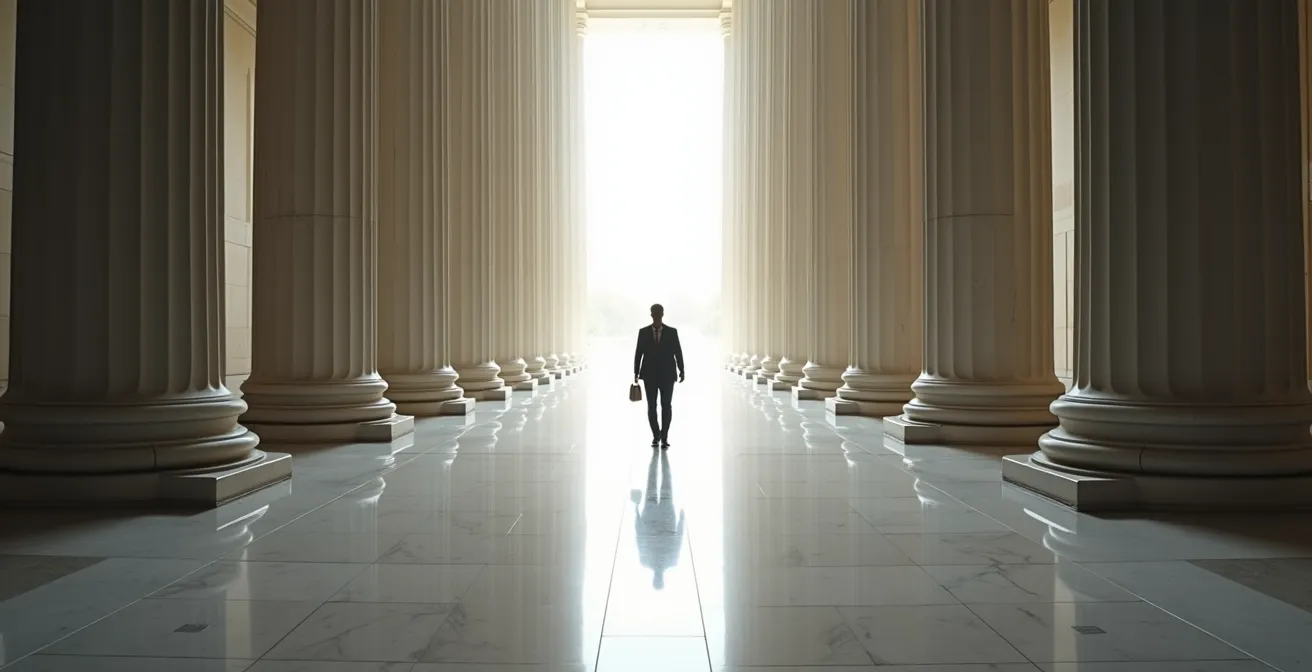
This effect is further amplified by materiality and acoustics. Vast expanses of polished marble or granite reflect sound, creating echoes that magnify the emptiness and scale of the hall. A single person’s footsteps become a stark, lonely sound in a cavernous void, reinforcing their isolation in the face of the institution’s immense presence. The architecture tells you, before any official does, that you are entering a domain where you are not the one in control.
Action Plan: How to Decode Architectural Intimidation
- Points of Contact: Identify all elements designed for human interaction—doors, stairs, windows, and benches. How do their proportions relate to your own body?
- Collecte: Inventory the non-functional elements that exist purely for scale, such as oversized columns, vast empty plazas, or excessively high ceilings.
- Coherence: Compare the building’s stated mission (e.g., “Hall of Justice”) with the feeling its scale evokes. Does it feel welcoming and just, or imposing and authoritarian?
- Memorability/Emotion: Note your immediate emotional response upon entering. Do you feel awe, anxiety, reverence, or insignificance? How does the architecture achieve this?
- Plan of Integration: Mentally remove the intimidating elements. How does this change the building’s message? This reveals which parts are “speaking” the language of power most loudly.
Under the Dome: Connecting the Leader to the Heavens
If columns and scale establish the horizontal power of the state over the citizen, the dome asserts its vertical authority, creating a symbolic connection to the heavens. The dome is one of the most potent symbols in the architectural lexicon, signifying universality, divinity, and a higher order. While Greek temples used a post-and-lintel system, the grand dome is a Roman engineering innovation, famously exemplified by the Pantheon. Its adoption in government buildings like the U.S. Capitol or St. Paul’s Cathedral in London is a deliberate act of symbolic legitimacy.
The architectural semiotics are clear: by placing the seat of governance under a dome, the design implies that the laws and decisions made beneath it are aligned with a higher, almost divine, principle. It visually connects earthly power with celestial order. This is perfectly illustrated by the U.S. Capitol. As an analysis points out, its dome is not merely decorative; it is a core symbol of democratic ideals, using classical forms to link the republic’s governance to the revered principles of ancient Greece and Rome. The dome becomes a unifying focal point, the ‘axis mundi’ of the nation where the terrestrial and the transcendent meet.
Case Study: The U.S. Capitol Dome as Symbol of Democratic Authority
The U.S. Capitol exemplifies how Neoclassical buildings use domes to symbolize universality and reach. The dome isn’t just architectural decoration—it’s a symbol of democratic ideals connecting earthly governance to higher principles through classical forms that reference ancient Greece and Rome.
Interestingly, this symbolic reach for the heavens is often paired with a message of earthly accessibility. As the Fiveable History of Architecture guide notes, “Neoclassical buildings such as parliaments, courthouses, and libraries are designed to convey a sense of openness, transparency, and accessibility.” This creates a powerful dual message: the state’s authority is divinely sanctioned and absolute, yet it is also theoretically open and transparent to the people it governs. The dome looks to the heavens, while the grand staircases and open porticos invite the public in, creating a balanced, albeit carefully constructed, image of democratic power.
The Avenue of Power: Creating Vistas That Highlight the Ruler
The language of government architecture extends beyond individual buildings to organize the entire urban landscape. Grand, wide avenues are a key part of this visual syntax, designed to create powerful sightlines that terminate at a symbol of state power. This technique, perfected in European capitals like Paris under Baron Haussmann, uses the city grid itself as a tool to assert governmental primacy. The avenue becomes a stage, and the government building is its main event.
These vistas are not accidental. They are meticulously planned to subordinate the surrounding environment to a central axis of power. The avenue funnels the citizen’s gaze, and often their physical movement, towards the seat of authority. It carves a path of importance through the chaotic fabric of the city, visually declaring that all roads lead to the state. This is evident in cities across the world, where major boulevards are aligned to offer a perfect, uninterrupted view of the parliament, palace, or primary court.
A prime example of this principle is the National Mall in Washington D.C. It is far more than a park; it is an urban power axis. According to a historical overview from the U.S. General Services Administration, this design approach creates monumental perspectives that visually assert the government’s dominance over civic life. The long, open vista connecting the Capitol Building to the Lincoln Memorial, with the Washington Monument at its center, is a masterclass in using urban planning as a statement of national identity and governmental authority. It transforms a collection of buildings into a cohesive narrative of power.
This is reinforced by the monumental scale with grand entrances, tall columns, and imposing facades that define the buildings along these avenues. The entire ensemble works together, creating a processional experience that elevates the act of approaching the government from a simple journey into a civic ritual, constantly reminding the citizen of the state’s central role.
Granite vs. Sandstone: Building for the Next Millennium
The message of power is not only conveyed through form and scale but also through the very materials used. The choice of granite, marble, and limestone is a critical part of the architectural language, intended to signify permanence, immutability, and timelessness. While a building of wood or brick can house a government, a building of massive, precisely cut stone declares that the institution it houses is not temporary. It is here to stay, aspiring to the longevity of the mountains from which the stone was quarried.
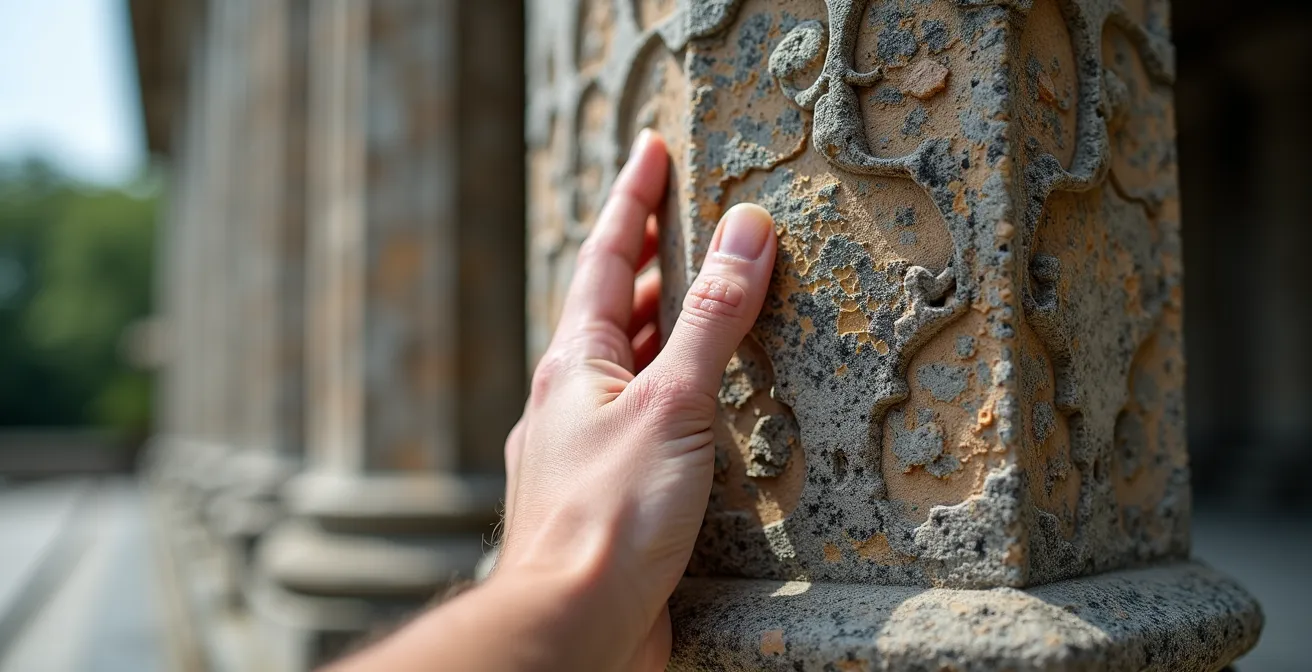
This material choice connects directly to the classical models. The ancient Greeks understood the power of material symbolism. They constructed their most important temples using limestone protected by marble dust stucco or, for the most prestigious buildings like the Parthenon, pure white marble. This was not just for durability but for its aesthetic of purity, value, and perfection. When neoclassical architects adopted these materials, they also adopted their associated meanings. Building a courthouse in granite is a statement that the justice administered within is as solid and enduring as the stone itself.
This use of material as a symbol of strength and unity became particularly pronounced during periods of national consolidation or after conflicts. As the U.S. General Services Administration explains, “After the Civil War, the Department of the Treasury constructed grand public buildings to express the power and stability of the federal government, an affirmation of unity and strength.” The heavy, fire-resistant masonry was a physical manifestation of an unbreakable union. The message was clear: governments may change and conflicts may arise, but the state, embodied in its stone edifices, endures.
The texture, color, and weathering of the stone over centuries add another layer to this semiotic message. The patina of age does not suggest decay but rather confirms the building’s—and the institution’s—ability to withstand the test of time, grounding its authority in a deep, seemingly eternal history.
Topple or Recontextualize: What to Do With Statues of Dictators?
The language of neoclassical architecture, designed to project timeless authority, becomes deeply problematic when that authority is associated with oppression, colonialism, or dictatorship. The very permanence that was once its greatest strength becomes its most significant liability. What happens when the “timeless” values represented by the architecture are revealed to be the values of a conqueror? This question is at the heart of modern debates surrounding monuments and buildings from colonial eras or toppled regimes.
Neoclassical architecture was a major tool of empire. As one analysis highlights, “Neoclassical architecture is often criticized for its associations with colonialism, where it was used to impose authority and power in occupied regions.” For colonial powers, building a grand, Roman-style administrative center in a foreign land was a powerful statement of dominance. It visually replaced local culture with an imported, “superior” civilization, asserting control not just militarily but also culturally.
The Victoria Memorial in Kolkata, India, serves as a poignant case study. Built to commemorate Queen Victoria, Empress of India, its grand marble form is a masterpiece of the Indo-Saracenic style infused with Neoclassical elements. It was intended as an unambiguous symbol of the British Raj’s power and permanence. Today, it stands in a post-colonial democracy, forcing a difficult conversation. Does it remain a symbol of imperial dominance, or can it be recontextualized as a part of the city’s complex history? Such buildings raise complex questions about whether to preserve, remove, or alter these powerful symbols of a painful past.
Neoclassical architecture is often criticized for its associations with colonialism, where it was used to impose authority and power in occupied regions.
– ArchitectureCourses.org, Neoclassical Architecture Analysis
The debate over toppling statues of dictators or colonial figures is the most visible manifestation of this conflict. The statue is the most literal representation of the power structure, and its removal is a symbolic act of reclaiming history. The buildings themselves, however, present a greater challenge. They are functional parts of the urban fabric, and the question becomes one of reinterpretation—transforming a symbol of oppression into a site of memory, education, or even resistance.
Versailles: The Golden Prison Designed to Watch Everyone
Long before the rise of Neoclassicism, the template for using architecture as an instrument of absolute state control was perfected at the Palace of Versailles. While stylistically Baroque, not Classical, Versailles provided a foundational lesson in political architecture that would influence state buildings for centuries: centralize power by controlling the physical space occupied by the elite. It was less a home for the king and more a machine for governance.
King Louis XIV’s strategy was brilliant and ruthless. By moving his court from Paris to the sprawling, isolated palace, he forced the French nobility to abandon their regional power bases and live under his constant watch. As historians from ArchitectureCourses.org state, “Versailles was used as a theater of power, forcing nobles into the palace to centralize control.” Life at court was a highly ritualized performance, with every aspect—from waking up to dining—governed by strict etiquette revolving around the king. The architecture was the stage for this performance.
The layout of the palace itself was a diagram of power. The king’s bedroom was at the literal and symbolic center, from which all main axes of the palace and its vast gardens radiated. This design broadcast a clear message: the king is the sun, and the entire universe of the state revolves around him. The endless corridors, opulent halls, and lack of privacy turned the palace into a golden prison. Nobles were too busy jockeying for position and favor within the palace’s intricate social ecosystem to plot against the crown from their distant estates.
Versailles demonstrated that architecture could be more than symbolic; it could be an active mechanism of social and political engineering. It showed that by controlling the environment, a ruler could effectively neutralize threats and consolidate absolute authority. This principle—that the structure of a government building can shape the behavior of those within it—is a direct ancestor of the more subtle psychological framing seen in later neoclassical designs.
Masking the Windows: The Geometry of Projecting on 3D Surfaces
The solid, permanent message of stone, so carefully crafted over centuries, is now facing a new kind of dialogue: the ephemeral, agile language of digital light. Projection mapping technology has introduced a powerful way to temporarily alter, subvert, or comment upon the static facades of government buildings. This creates a fascinating interplay between the permanent architectural text and a transient digital overlay, effectively “masking the windows” and surfaces with new meanings.
This technology allows artists, activists, and even the state itself to “re-skin” these monumental buildings. The complex geometry of projecting a coherent image onto a three-dimensional surface with columns, windows, and pediments is a technical challenge, but its success opens up a new frontier in civic discourse. A building that stands for enduring state power can, for one night, become a canvas for protest, a celebration of a cultural event, or a memorial for a tragedy. The dialogue between stone and light becomes a public spectacle.
This practice takes several forms, each with a different relationship to the building’s inherent power. The state might use projection mapping for national holidays, reinforcing its own narrative by bathing the building in patriotic colors or imagery. Conversely, activists can use “guerilla projections” to superimpose critical messages onto these same symbols of authority, creating a potent, if fleeting, act of dissent without causing any physical damage. The building is forced into a conversation it was never designed to have.
The rise of digital interventions represents a significant shift in the semiotics of government architecture. It challenges the idea that the meaning of these buildings is fixed and eternal. Here are some of the ways this dialogue is unfolding:
- Projection mapping temporarily ‘re-skins’ classical government buildings for celebrations or protests.
- Guerilla projections superimpose critical imagery onto symbols of state power.
- Digital overlays create dialogue between permanent stone messages and ephemeral digital content.
- Augmented reality allows virtual annotations and historical layers to be viewed through a device without any physical alteration.
Key Takeaways
- Government architecture is a deliberate visual language of power, not just a matter of historical style.
- Key elements like monumental scale, divine domes, and permanent materials are chosen to psychologically frame the state’s authority over the citizen.
- This static language of stone is now being challenged and reinterpreted by both post-colonial critiques and modern digital technologies.
How a Listed Monument Increases Neighborhood Real Estate by 20%
The power of government architecture is not purely symbolic or psychological; it translates into tangible economic value. The prestige, stability, and monumental beauty of these buildings create an economic “halo effect” that directly impacts the surrounding district. While designed to represent the people, these structures often make their immediate vicinity unaffordable for the average citizen, a paradox at the heart of civic architecture.
The phenomenon is known as “value by association.” A neighborhood that contains a stately, historically significant government building is perceived as more stable, prestigious, and desirable. This symbolic capital is quickly converted into real capital. Studies and market observations have shown this effect can be quantified, sometimes resulting in as much as a 20% increase in neighborhood real estate values compared to similar areas without such a monument. The building acts as an anchor of value, pulling up the prices of all surrounding residential and commercial properties.
However, this economic boon has a significant downside. The very security measures designed to protect these symbols of the state can stifle the local economy. The creation of sterile “security perimeters”—with bollards, blast walls, and restricted access—can create dead zones that kill street-level commerce and pedestrian foot traffic. This creates a “moat” of lifelessness around the government hub, isolating it from the vibrant city life it is supposed to serve.
This ultimately contributes to a process of gentrification. As property values and rents rise, the original residents and small businesses are often priced out, replaced by high-end law firms, lobbying groups, and luxury apartments that can afford the premium of proximity to power. In a deep irony, the monumental building constructed in the name of “the people” ends up creating an exclusive enclave that most people cannot afford to live or work in, transforming a civic center into an elite one.
Now, when you pass a courthouse or capitol, look beyond the stone facade. See the columns not as decoration but as a measure of your own scale. See the dome as a claim to higher authority. See the granite as a declaration of permanence. You are not just looking at a building; you are reading a carefully composed text about power, and you now have the tools to begin decoding its language.
Frequently Asked Questions about Why Every Government Building Looks Like a Greek Temple
How do government buildings affect local property values?
Monumental government buildings create a ‘halo effect’ where their symbolic prestige and stability translate directly into measurable economic value for surrounding districts through a process known as ‘value by association’.
What negative economic impacts can security measures have?
Security perimeters including bollards, restricted access, and sterile plazas can stifle street-level commerce and create lifeless ‘moats’ around government hubs, reducing foot traffic and economic activity.
Does monumental architecture contribute to gentrification?
Yes, there’s a paradox where buildings meant to represent ‘the people’ can make their immediate surroundings unaffordable for average citizens through gentrification driven by increased prestige and property values.