Contrary to the popular belief that gunpowder alone made stone walls obsolete, the transformation of 16th-century castles was a calculated strategic pivot. Power was no longer projected through physical defense but through theatrical architecture. Fortresses evolved into palaces, replacing military hardware like thick walls and moats with “architectural software”—grand windows, ornate facades, and ceremonial spaces—designed to control politics and broadcast immense status.
Stand before a medieval fortress, and its purpose is unmistakable: grim, thick walls, narrow arrowslits, and a commanding position built for brutal defense. Now, picture a Renaissance château from the Loire Valley. It’s open, adorned with vast windows, and surrounded by elegant gardens. A tourist or student of history might ask a simple question: what happened to the walls? The common answer is gunpowder. The cannon, it is said, rendered stone fortifications useless, forcing a change in design. But this is a convenient oversimplification.
While the rise of artillery certainly altered military strategy, it doesn’t fully explain the dramatic shift from fortress to pleasure palace. The real story is more complex and far more strategic. The 16th century witnessed a fundamental redefinition of power. Feudal lords, once regional warlords, were being brought under the heel of a centralized monarchy. The castle’s role changed from a bastion of military defiance to a stage for social and political theater. The architectural changes that followed were not signs of defensive failure, but expressions of a new kind of power.
This wasn’t merely about choosing aesthetics over function; it was about deploying aesthetics as a new, more sophisticated weapon. This article will deconstruct this architectural revolution, analyzing how every element of the traditional fortress was systematically dismantled and repurposed. We will explore how defensive features became decorative, how comfort became a tool of social control, and how the very structure of the castle was redesigned to project an unassailable new image of authority.
For those who prefer a visual format, the following video offers a fascinating look into the principles of medieval castle construction, providing a perfect baseline to understand the radical changes of the Renaissance.
To fully grasp this transformation, we will examine the key architectural components that were reimagined. This analysis will follow the strategic logic of the 16th-century builders, revealing how each change contributed to a new architectural language of power.
Summary: Deconstructing the Palace: An Architectural Revolution
- Letting the Sun In: How Glass Changed the French Lifestyle
- Water for Show: When Defenses Became Garden Features
- The Slate Tax: The Cost of Replacing a Acre of Roof
- Freezing at the Ball: The Failure of Fireplaces in Large Halls
- DNA in Stone: Leonardo da Vinci’s Influence on French Stairs
- Versailles: The Golden Prison Designed to Watch Everyone
- Laser vs. Chemical Cleaning: Removing Grime Without Dissolving History
- How Did They Lift Stones That Heavy Without Cranes?
Letting the Sun In: How Glass Changed the French Lifestyle
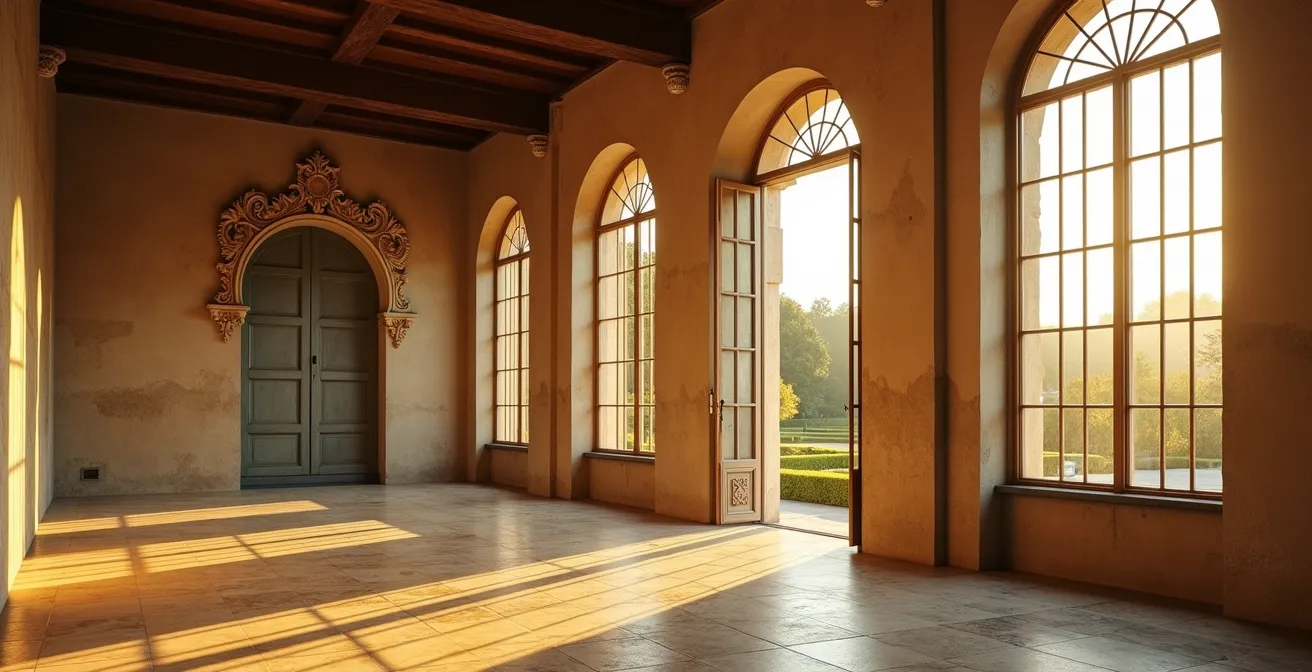
One of the most striking differences between a medieval fortress and a Renaissance palace is the treatment of light. The former hoards darkness behind narrow slits designed to repel attackers; the latter bathes its interiors in sunlight through vast, grid-like windows. This was not a simple upgrade but a radical statement of intent. Replacing solid stone with fragile glass was the ultimate declaration that the owner feared no siege. It was a broadcast of security and control, a form of weaponized aesthetics that turned the building itself into a symbol of peaceful dominion.
This choice was also a flagrant display of wealth. Far from being a cost-saving measure, historical records show that large glass panes in the 16th century were initially more expensive than the very stone walls they replaced. The Château de Blois perfectly exemplifies this transition. Its facades feature large mullioned windows that took the place of defensive openings. These windows were not just about illumination; they were designed to offer carefully framed, “uninterrupted views over the gardens, which have been designed as veritable outdoor living rooms.” The wall was no longer a barrier against the world but a frame through which to view one’s own orderly and beautiful domain.
The shift created a new domestic lifestyle. Interiors became brighter, more open, and integrated with the surrounding landscape. The psychological impact was profound: the home was no longer a grim sanctuary against a hostile world but a bright, airy stage for a life of leisure and sophistication. Light itself became a luxury commodity, and its architectural celebration was a clear signal of one’s place in the new social order.
Water for Show: When Defenses Became Garden Features
If windows announced a new confidence, the transformation of the moat confirmed it. In medieval strategy, the moat was a critical piece of military hardware—a wet, formidable barrier that kept siege engines and attackers at bay. By the 16th century, this vital defensive asset was systematically decommissioned and redeployed as a decorative feature. The water that once promised a bloody defense now served only to provide a pleasing reflection of the sky and the château’s elegant facade.
This architectural pivot is perfectly captured at palaces like Fontainebleau, where, by 1537, the formidable defensive moat had been converted into an ornamental carp pond, complete with decorative fountains. The strategic function was entirely erased and replaced by a purely aesthetic one. These tamed bodies of water were integrated into a new and powerful concept: the formal garden. Symmetrical canals, geometric ponds, and playful fountains demonstrated a mastery over nature that mirrored the king’s mastery over his kingdom. The chaos of warfare was replaced by the mathematical precision of landscape design.
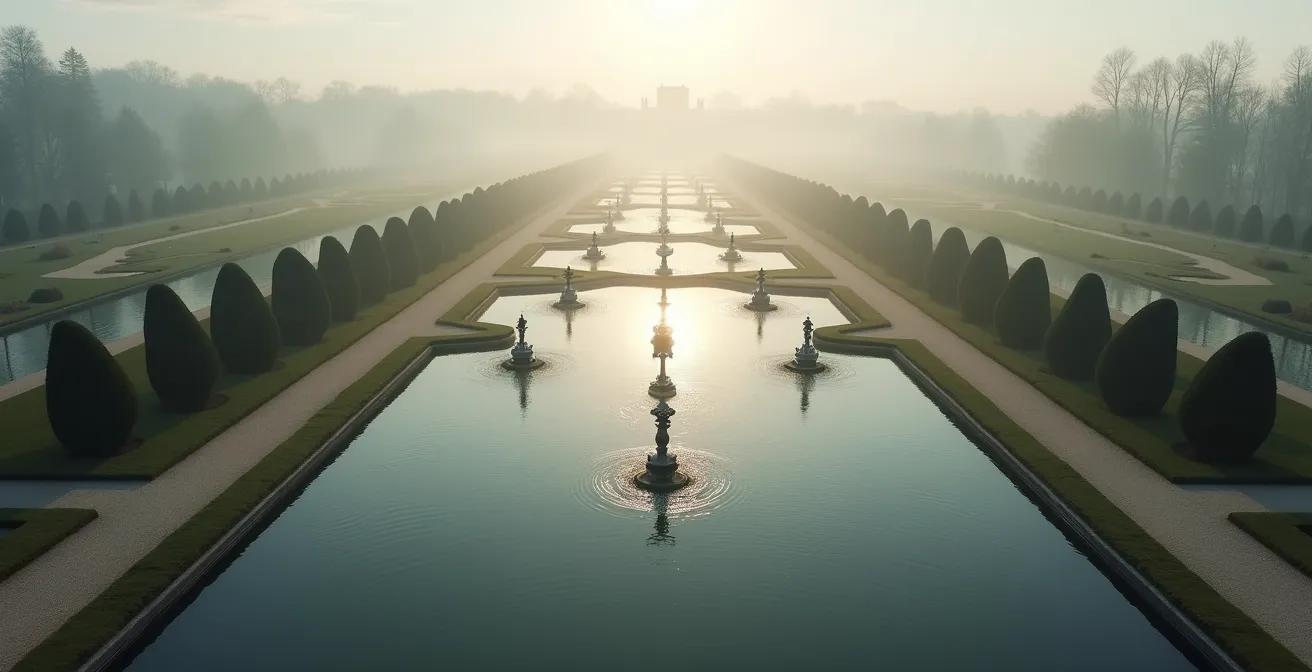
This repurposing of a defensive feature into a garden element is a prime example of the shift from a logic of survival to a logic of spectacle. The message was clear: the owner’s power was so absolute that they could afford to turn their primary defense into a playground. A moat protected a warlord; a grand canal and fountains displayed the serene authority of a cultured prince. The threat was no longer repelled at the walls; it was made irrelevant by the political stability the château’s owner guaranteed.
The Slate Tax: The Cost of Replacing a Acre of Roof
From the ground, the most prominent feature of a Renaissance château is often its vast, steep, and ornate roof. This, too, was a deliberate departure from the medieval model. A fortress roof was flat, low-slung, and hidden behind stone battlements. It was a functional fighting platform—a place for sentries to walk and archers to fire from. In stark contrast, the Renaissance roof was designed to be seen, serving as a massive, intricate crown for the building.
As one architectural historian noted, “The roofline became a primary canvas for displaying status, visible from miles away.” The move to steep roofs covered in expensive slate tiles, punctuated by a forest of ornate dormers, chimneys, and finials, was an explicit change in architectural grammar. This was a status broadcast on a monumental scale. Slate was a costly material requiring specialized craftsmen, and its extensive use was a clear indicator of immense wealth. The roof was no longer a hidden, functional component but the building’s most visible and expensive advertisement.
This table illustrates the profound strategic and aesthetic differences between the two approaches to roofing.
| Feature | Medieval Fortress (pre-1500) | Renaissance Palace (16th century) |
|---|---|---|
| Primary Material | Flat stone, wood beams | Slate tiles, ornate timber frames |
| Roof Angle | Low/flat for defense walks | Steep (45-60°) for aesthetics |
| Maintenance Cost | Military garrison upkeep | Specialized craftsmen for slate |
| Visual Impact | Hidden behind battlements | Visible from miles away |
| Decorative Elements | None – purely functional | Dormers, chimneys, finials |
By sacrificing the defensive function of the roof in favor of a highly visible and costly aesthetic, the château’s owner sent an unambiguous message. Their power was not located on the battlements but in the treasury and the political stability they commanded. The roof became the building’s primary billboard, signaling nobility and wealth from miles around.
Freezing at the Ball: The Failure of Fireplaces in Large Halls
Inside the new palaces, the grand fireplace became the centerpiece of the great hall. Monumental in scale, carved with heroic figures, and crowned with coats of arms, these fireplaces were powerful symbols of hospitality and lordship. Yet, from a practical standpoint, they were a spectacular failure. Their design, with a wide-open flue, was incredibly inefficient. In fact, architectural studies show that monumental Renaissance fireplaces were often only 20% thermally efficient, with the vast majority of heat escaping straight up the chimney.
So why build them? Because their primary function was not thermal, but theatrical. The fireplace was a stage. Proximity to its weak warmth became a physical manifestation of social status. The most important guests were seated near the fire, while those of lesser rank shivered in the drafty hall. The case of Hampton Court Palace’s Great Hall is telling: despite its massive fireplace, the hall was notoriously cold and required walls to be covered in expensive tapestries, which provided the actual thermal insulation by trapping air and blocking drafts. The fireplace was the symbol of warmth, but the tapestries did the real work.
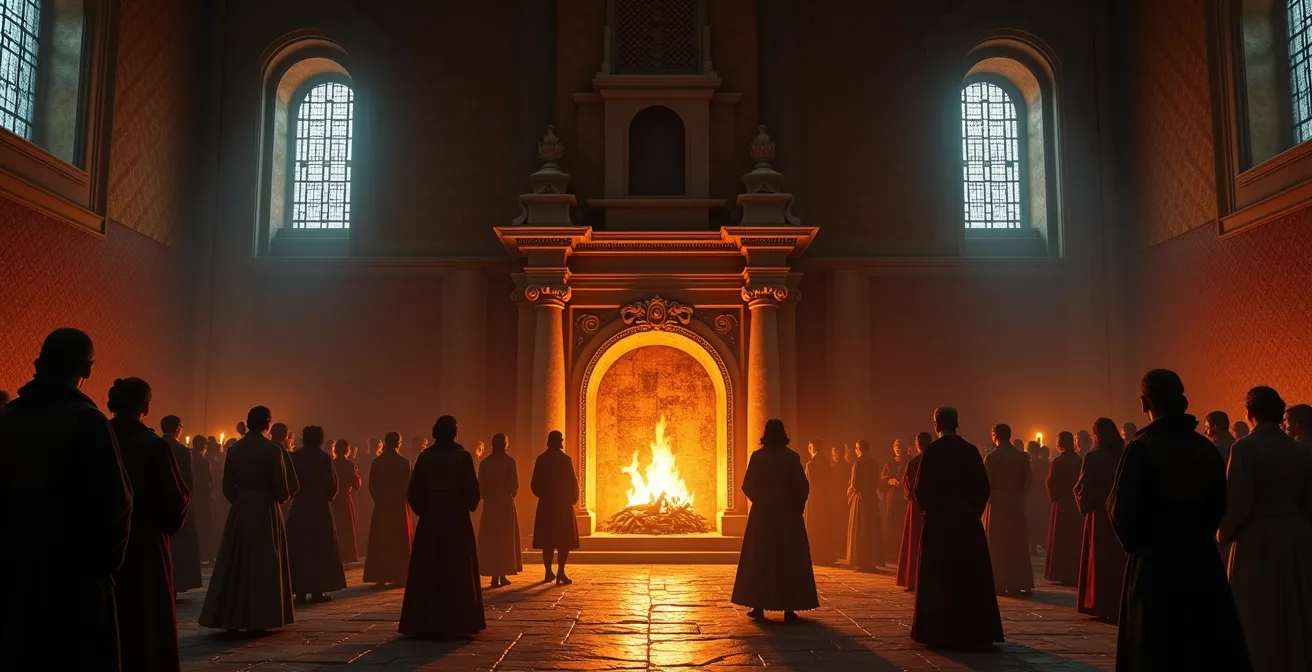
This illustrates a key principle of Renaissance palace design: symbolic function often trumped practical utility. The great hall was a theater of courtly life, and the fireplace was a crucial piece of stagecraft. It organized the social space and visually reinforced the hierarchy of power. It didn’t matter if you were cold, as long as everyone could see where you stood in relation to the host. It was a perfect piece of theatrical fortification, defending social order rather than the building itself.
DNA in Stone: Leonardo da Vinci’s Influence on French Stairs
Even the humble staircase was transformed from a purely functional element into a masterpiece of engineering and art. In a medieval fortress, stairs were narrow, steep, and spiral, always turning clockwise to give a right-handed defender the advantage over an ascending attacker. They were a cramped and dangerous part of the defensive system. In the Renaissance, the staircase became a grand, sweeping promenade, a stage for dramatic entrances and the elegant procession of the court.
The most iconic example of this is the revolutionary double-helix staircase at the Château de Chambord, whose design is widely attributed to the influence of Leonardo da Vinci. This architectural marvel consists of two intertwined spirals, allowing two people to ascend or descend simultaneously without ever meeting. Its function is purely ceremonial. It is wide, bright, and centrally located, designed not for hasty defense but for a graceful, theatrical journey between floors. It is a piece of architectural software that facilitates social performance rather than military action.
As a French architecture authority notes, such a staircase is “a masterpiece of stereotomy (the art of cutting and assembling stones).” It represents a new mastery of geometry and engineering, a physical manifestation of the intellectual “rebirth” of the era. The complexity and elegance of the design were a statement in themselves, showcasing the patron’s access to the finest minds and craftsmen of the age. It turned the simple act of moving through the building into a public spectacle, a continuous performance for the eyes of the court.
Versailles: The Golden Prison Designed to Watch Everyone
The logical endpoint of this architectural evolution was the Palace of Versailles. Here, all the principles of theatrical fortification and status broadcast were combined into a single, overwhelming system of control. Versailles had no need for thick defensive walls; its power lay in a different kind of architecture. As historian Matthew Johnson observes, “Physical walls were replaced by the far more effective walls of courtly etiquette.” The palace was designed as a machine for domesticating the French nobility.
Louis XIV understood that the greatest threat to his power came not from foreign armies but from his own powerful aristocrats. His solution was to force them to live at court, transforming them from regional military powers into court dependents. He achieved this through architecture. The palace’s layout—specifically the enfilade, a series of rooms with doorways aligned on a single axis—created a system of controlled visibility and access. A noble’s status was measured by how far down the enfilade they were permitted to go, with the ultimate prize being access to the King’s bedchamber.
At its peak, Louis XIV required as many as 10,000 nobles and courtiers to reside at or attend court at Versailles. Trapped in a gilded cage, their lives became a constant performance under the watchful eye of the King. Their energy was consumed by navigating complex rituals and jockeying for royal favor, leaving no time or resources for plotting rebellion back on their own estates. Versailles was the ultimate expression of architectural software: a building designed not to keep people out, but to lock them in through social pressure and surveillance. It was a golden prison, and its blueprint was power.
Laser vs. Chemical Cleaning: Removing Grime Without Dissolving History
Our modern image of Renaissance châteaux is often one of weathered, romantic grey stone. This impression is largely inaccurate. Architectural archives reveal that many Loire Valley châteaux built with bright white tuffeau limestone were originally dazzling white, gleaming in the sun. This was not an accident but a core part of their function as a “status broadcast.” A brilliant white facade, visible from afar, was a symbol of purity, wealth, and modernity.
Furthermore, these white stone walls were often just the canvas. As seen at the Château de Blois, facades frequently featured painted decorations in vibrant colors and even gilding to mimic the glories of classical antiquity. These were not somber stone monuments; they were colorful, dynamic displays of power and artistic patronage. Maintaining this appearance required constant, expensive upkeep. The dazzling effect was integral to the owner’s image, and letting the facade grow grimy would have been a sign of declining fortune.
Today, conservationists face the challenge of removing centuries of grime without damaging the delicate stone or any remaining traces of original polychromy. This is where modern techniques like micro-sandblasting and laser cleaning come into play, allowing for a precision that older chemical methods could not achieve. When you visit a restored château today, you are seeing something much closer to the original, shocking brilliance intended by its builders.
Action Plan: How to Read a Restored Château Façade
- Identify the Stone: Look for the bright, creamy color of tuffeau limestone. Note the difference between cleaned sections and any remaining weathered, grey areas to appreciate the original impact.
- Search for Polychrome Traces: Examine sheltered spots like the underside of ledges or deep within carvings. You may find faint remnants of the original paint or gilding.
- Analyze the Details: Note the sharpness of the carvings. Laser cleaning can preserve fine details that would be eroded by harsher methods, giving a better sense of the original craftsmanship.
- Assess the Mortar: Observe the joints between stones. Clean, sharp mortar indicates recent restoration, while eroded joints may be part of the original structure, showing its age.
- Evaluate the Overall Intent: Step back and ask: does this feel like an intimidating fortress wall or a vibrant, decorated surface designed to impress and delight? The answer reveals its true purpose.
Key Takeaways
- The shift from fortress to palace was a strategic choice to project political power, not just a reaction to gunpowder.
- Defensive elements like moats and fortified roofs were deliberately transformed into decorative features to signal security and wealth.
- Interior architecture, from grand staircases to inefficient fireplaces, was designed as a stage for courtly life and social hierarchy.
How Did They Lift Stones That Heavy Without Cranes?
A common misconception about Renaissance construction is that it was achieved with primitive technology. This leads to the question of how builders managed to lift the massive, perfectly cut stones required for these ornate palaces. The answer, as noted by one medieval construction expert, is that “They did have cranes—treadwheel cranes and shear legs—often inherited from the great cathedral builders.” The true innovation was not in raw lifting power but in how that power was applied.
The focus of medieval construction was on lifting brute, functional blocks to build thick, defensive walls as quickly as possible. In the Renaissance, the emphasis shifted dramatically to precision. The goal was no longer just to raise a stone, but to place a delicate, intricately carved, and perfectly finished piece of facade with hairline accuracy. The engineering challenge evolved from one of force to one of finesse. The value was in the perfection of the final appearance, not the speed of construction.
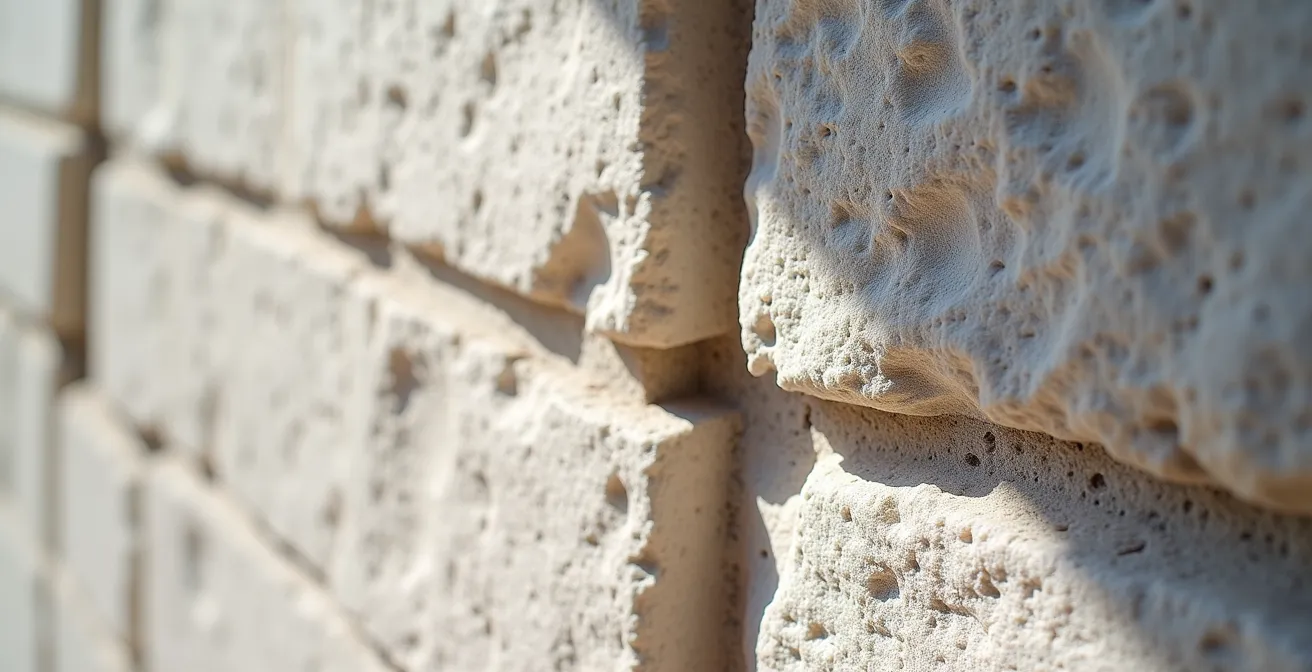
This demand for perfection had massive logistical implications. The finest materials were required, representing another layer of status broadcast. It was a logistical feat, with some perfect unblemished stone blocks traveling over 100 miles via river transport to the construction site. Only the wealthiest and most powerful patrons, namely the king and his inner circle, could command such a complex supply chain. The very material of the building, sourced with great difficulty and expense, became a testament to the owner’s reach and resources. The stones themselves told a story of power before they were even laid.
Ultimately, the decline of the thick-walled castle was a symptom of a new political reality. By understanding that architecture was redeployed as a primary tool of statecraft, every open window and ornamental feature becomes a legible part of a brilliant strategic narrative. To continue your exploration, the next logical step is to analyze how these principles were applied in a specific regional context, such as the iconic châteaux of the Loire Valley.