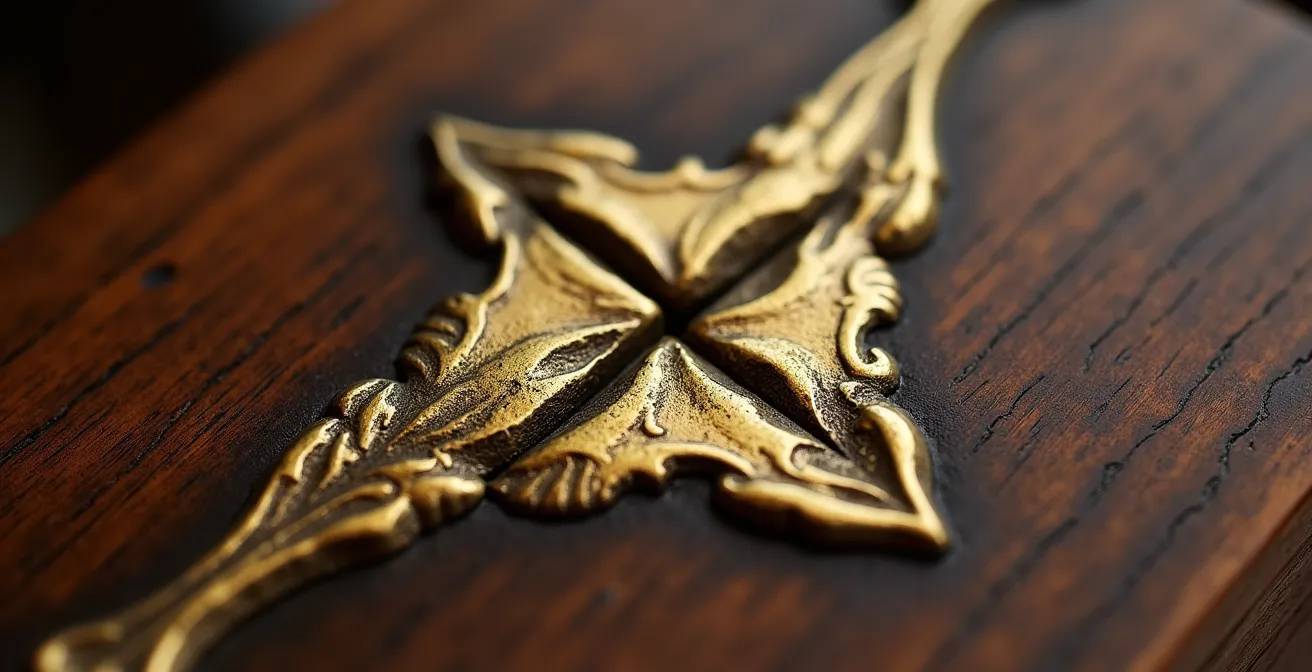
The catastrophic splitting of wood around bronze mounts is not random, but a predictable failure of structural engineering.
- Wood is an anisotropic material; its movement is non-uniform and powerful when subjected to humidity changes.
- Bronze mounts act as a fixed mechanical restraint, creating concentrated stress vectors that exceed the wood’s shear strength.
Recommendation: Effective conservation requires managing the rate of environmental change, not just the absolute humidity, and understanding the specific construction of each piece.
For any restorer or custodian of antique furniture, the sight of a hairline crack radiating from a gilt-bronze mount is a sign of a deep, internal conflict. It is often attributed to the simple fact that wood and metal expand at different rates. While true, this explanation is incomplete. It fails to capture the complex structural mechanics at play—a battle of forces dictated by wood grain, humidity, and the very construction of the piece. Understanding this conflict is not about a single solution, but about diagnosing the specific forces at work.
The common advice to “maintain stable humidity” is a platitude that ignores the physics involved. The real issue is often the rate of change, or “hygroscopic shock,” which overloads the material’s capacity to adapt. This article moves beyond generic advice to provide a structural analysis. We will dissect the material science, from the hidden dangers in historic finishes to the legal frameworks governing the materials themselves. The goal is to shift the perspective from seeing damage as an inevitable accident to understanding it as a predictable outcome of opposing forces. By grasping these principles, a conservator can move from reactive repair to proactive preservation.
This guide provides a technical framework for understanding and managing these material conflicts. The following sections explore distinct but interconnected facets of furniture conservation, from material science to legal compliance.
Contents: A Structural Analysis of Material Conflict in Furniture
- Beautiful but Deadly: The Health Cost of 18th Century Gilding
- The Exploding Commode: What Happens When Humidity Drops too Fast
- Ammonia or Soap: How to Brighten Bronze Without Ruining It
- The “C” Crown: Reading Stamps on French Bronze Mounts
- Stress Points: How Tight Fabric Warps Chair Frames
- Warping and Splitting: The Nightmare of Moving Panel Paintings
- To Re-Gild or Consolidate: When New Gold Ruins the Patina
- Can You Sell Your Grandmother’s Rosewood Table Legally?
Beautiful but Deadly: The Health Cost of 18th Century Gilding
The luminous, gold-like finish of ormolu (gilt bronze) mounts is a hallmark of high-style 18th-century furniture. However, this beauty was achieved through a perilous process: fire-gilding. This technique involved applying an amalgam of gold and mercury to the bronze, then heating the object until the mercury vaporized, leaving a bonded layer of gold. The process was lethally effective, but the inhaled mercury vapors had a devastating human cost. Historical records suggest that French gilders in the 18th century rarely lived past the age of forty, succumbing to neurological damage and other effects of mercury poisoning.
This historical reality has modern implications for conservators. The residual mercury is not just a historical footnote; it remains within the metal’s structure. Modern scientific analysis confirms its presence in significant quantities. For example, synchrotron-based X-ray fluorescence studies on historic objects have revealed mercury content from 8% to over 20% in fire-gilded layers. This means that any conservation treatment involving abrasion, heavy cleaning, or heating of original ormolu mounts can potentially release trace amounts of mercury. While the risk to a modern restorer is minimal compared to that of an 18th-century artisan, it necessitates a cautious approach, proper ventilation, and the use of personal protective equipment. The glittering surface of a commode is a testament to both exquisite artistry and a forgotten occupational hazard.
The Exploding Commode: What Happens When Humidity Drops too Fast
The dramatic term “exploding commode” describes the catastrophic failure of wood when subjected to rapid environmental change, particularly a sudden drop in relative humidity (RH). This phenomenon is a direct result of wood’s nature as an anisotropic and hygroscopic material. It absorbs and releases moisture from the air, causing it to swell and shrink. Crucially, this movement is not uniform: wood moves significantly across the grain (tangentially and radially) but very little along the grain. A bronze mount, being metal, is largely indifferent to humidity but expands and contracts with temperature. Its movement is minimal and uniform (isotropic).
This creates a fundamental conflict. The bronze mount and its screws provide a point of mechanical restraint. As the wood substrate (often a veneer over a solid carcase) tries to shrink in a dry environment, the immovable mount holds it in place. Stress builds up in the wood fibers around the fasteners until it exceeds the material’s elastic limit. The result is a split, typically following the wood grain, as this is its path of least resistance. The speed of the humidity change is the critical factor. Slow, seasonal shifts may be accommodated, but a rapid “hygroscopic shock”—like moving furniture from a humid location to a centrally heated, dry building—is what causes the most damage.
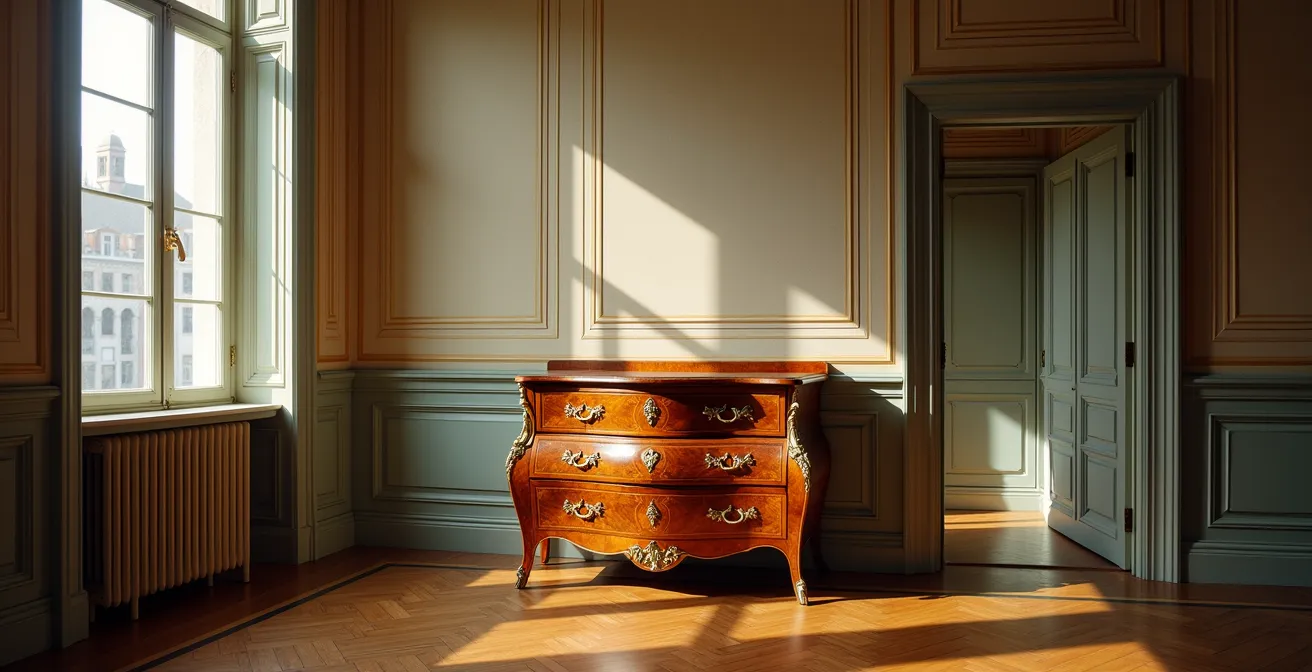
Conservation experts provide clear guidelines to mitigate this. They recommend maintaining a stable environment, ideally with a relative humidity between 35%-45% in winter and 55%-65% in summer. The key is to avoid abrupt fluctuations that induce these destructive stress vectors. The damage seen is a physical manifestation of this internal battle between the natural movement of wood and the rigid constraint of metal.
Ammonia or Soap: How to Brighten Bronze Without Ruining It
Cleaning gilt-bronze mounts is one of the most contentious tasks in furniture conservation. The goal is to remove accumulated dirt and grime without stripping the original gilded surface or, just as importantly, the historic patina. Aggressive cleaning methods, particularly those involving ammonia or harsh abrasives, can irrevocably damage the delicate gold layer and alter the object’s character. The safest approach begins with the least invasive method: a soft, dry brush to remove loose dust. If further cleaning is required, a solution of deionized water with a few drops of a conservation-grade, non-ionic detergent can be applied sparingly with a cotton swab, followed by a meticulous “rinse” with a swab dampened with only deionized water, and then careful drying.
A primary concern during cleaning is preventing corrosion. While bronze is relatively stable, it can develop green corrosion spots (copper sulfates) in poor environmental conditions. According to metal conservation specialists, most atmospheric corrosion can be prevented if relative humidity is kept below 65%. This highlights the synergy between cleaning and environmental control. Before any cleaning attempt, it is crucial to distinguish between dirt, corrosion, and patina. Patina is the desirable, subtle layer that time bestows on an object.
Patina is the subtle wear, the softening of the original burnish, and the visual integration of the gold with its preparatory layers. Damage is active flaking, significant losses, or clumsy, discolored old repairs.
– Fine Art Restoration Company, Conservation Guidelines for Gilt Bronze
This distinction is the cornerstone of ethical conservation. Removing dirt is appropriate; stripping away the history encoded in the patina is a destructive act. Strong chemicals like ammonia should be avoided entirely by all but the most experienced conservators, as they can chemically alter both the bronze and the delicate gold layer.
The “C” Crown: Reading Stamps on French Bronze Mounts
The bronze mounts on French furniture are not merely decorative; they can also be documents. From March 1745 to February 1749, a tax was levied in France on all objects containing copper. To indicate the tax had been paid, a stamp of a crowned ‘C’ was struck into the bronze. The presence of this stamp is therefore a powerful tool for dating a piece, or at least its mounts, to this specific four-year period. However, its absence means little, as the tax was widely evaded, and its presence can be faked on later copies. A genuine ‘C’ stamp provides a firm terminus post quem (the date after which an object must have been made) and is a mark of authenticity sought by collectors.
The Case of Charles Cressent: Guilds and Quality Control
The intricate relationship between cabinetmaking (ébénisterie) and bronze work (fonderie-ciselure) was strictly policed by the powerful Parisian guilds. Cabinetmakers were forbidden from making their own mounts. One famous exception was the master ébéniste Charles Cressent (1685-1768), who trained as a sculptor. Insistent on controlling the quality of his creations from start to finish, he maintained his own workshop for casting and chasing his bronzes. This violation of guild rules led to multiple prosecutions and fines, as detailed in records of his career. His work is celebrated today precisely for this seamless integration of wood and metal, a direct result of his defiance of the guild system.
Beyond tax stamps, the manufacturing technique itself can offer dating clues. The fire-gilding process, with its reliance on mercury, was the dominant method throughout the 18th century. Concerns over its health impact led France to officially outlaw the use of mercury in gilding around 1830, though its use continued in some workshops for decades. The subsequent development of electroplating in the 1840s created a new type of gilded surface—more uniform, often brighter, and lacking the subtle depth and variation of a fire-gilded piece. An expert can often distinguish between the two techniques by eye, using the method of manufacture as another key to an object’s history.
Stress Points: How Tight Fabric Warps Chair Frames
The structural integrity of a chair frame is a delicate balance of joinery and material strength. While we often focus on the conflict between wood and metal, another significant source of stress is upholstery. Modern upholstery techniques and materials can introduce destructive forces that historic frames were not designed to withstand. The use of high-density synthetic foam and tightly stretched synthetic fabrics, applied with powerful pneumatic staple guns, creates a constant, high-tension “shrink-wrapping” effect. This continuous pull can distort and warp the chair’s wooden frame, pulling joints apart and causing rails to bow over time.
This is a stark contrast to traditional upholstery methods, which used materials like horsehair, stitched edges, and webbing that had a degree of compliance and were applied with less overall tension. The stress vectors created by modern, tight upholstery are particularly damaging to curved elements like the seat rails of a bergère or the crest rail of a rococo-style chair. The frame is placed under a permanent load that it was never engineered to bear. This stress is compounded by environmental factors. For historic furniture with mixed materials, conservators recommend a stable temperature range; a range of 16 to 22 degrees Celsius is considered ideal for pieces with wood and metal elements, as it minimises thermal expansion and contraction.
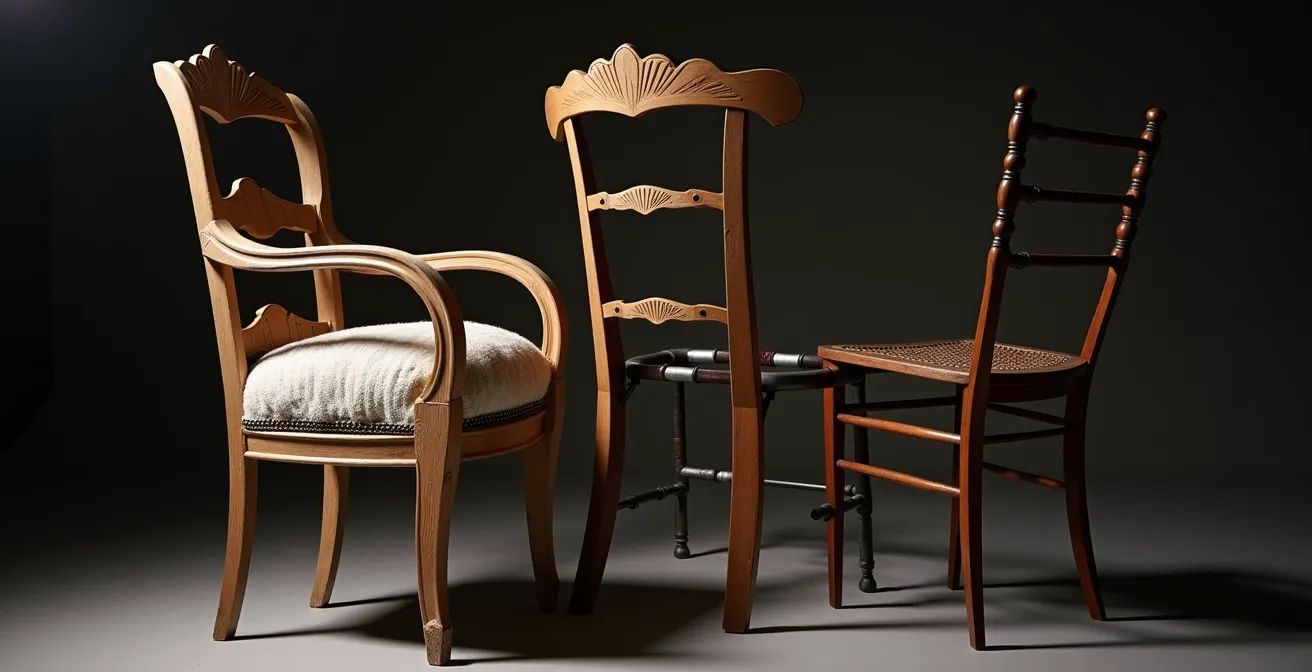
For a restorer, this means a conservation-led approach to upholstery is paramount. It involves choosing materials sympathetic to the original construction, avoiding excessive tension, and using techniques that respect the frame’s inherent flexibility. The goal is to upholster the chair in a way that is supportive but not constrictive, ensuring the frame itself is not compromised by its coverings.
Warping and Splitting: The Nightmare of Moving Panel Paintings
While this analysis focuses on furniture, the structural conflict between materials is perfectly illustrated by the conservation of wood panel paintings. A panel painting is, in essence, a veneer (the paint and gesso layers) on a solid wood substrate. Like a tabletop or commode door, the wood panel is an anisotropic material that moves in response to humidity. The paint and gesso layers, however, are far less flexible. As the panel swells and shrinks, it places the rigid paint layer under immense stress, leading to cracking (craquelure), flaking, and paint loss.
To prevent the panel from warping, past restorers often attached a rigid “cradle”—a grid of fixed wooden battens—to the reverse. This approach is a classic example of mechanical restraint. The intention was to hold the panel flat, but the result was often disastrous. By preventing the wood from moving naturally, the cradle caused stress to build up within the panel until it fractured, often creating more severe cracks than it was meant to prevent. This historical intervention is a powerful lesson in conservation: fighting the inherent nature of a material is often more destructive than accommodating it.
The Evolution of Cradles: From Rigid Restraint to Accommodated Movement
The failure of rigid cradles led to a revolution in panel painting conservation. Modern conservation science has developed flexible or spring-loaded cradles. These structures provide support to restrain major warping but include mechanisms—such as springs or sliding channels—that allow the panel to expand and contract with minor humidity fluctuations. This approach accepts the principle of differential movement and aims to manage it rather than fight it. The goal is to allow for micro-movements while preventing macro-deformation, a philosophy directly applicable to furniture conservation.
The sensitivity of these objects is extreme. To prevent damage, conservation guidelines from institutions like The Henry Ford suggest that changes in relative humidity should not exceed 5% per day. This highlights the importance of gradual acclimatization for any wooden artifact, be it a painting or a piece of furniture, when moving it to a new environment.
To Re-Gild or Consolidate: When New Gold Ruins the Patina
When a piece of fire-gilded ormolu shows signs of wear, the restorer faces a critical decision: should the surface be re-gilded or should the existing finish be consolidated? Re-gilding, especially with modern techniques, can obliterate the object’s historical and aesthetic integrity. The original fire-gilding process, which involved heating the amalgam until the mercury vaporized at its boiling point of 357°C, created a uniquely beautiful surface. The gold layer was often subtly varied and was applied over a preparatory layer of colored clay, or ‘bole’.
This traditional method has a visual quality that modern replacements cannot replicate. As conservation experts note, the difference is stark and immediately apparent to a trained eye.
Original water gilding has a deep, soft luminosity because light penetrates the thin gold leaf and reflects off the colored ‘bole’ (clay) layer beneath. Modern repairs or ‘gold paint’ create a harsh, flat, metallic surface.
– Fine Art Restoration Company, Ormolu Conservation Guidelines
Consequently, the current best practice in conservation strongly favors consolidation over replacement. This involves carefully cleaning the existing surface and, if necessary, applying a stable, reversible consolidant (like a conservation-grade acrylic resin in a solvent) to secure any flaking or fragile areas of the original gilding. The goal is to preserve every possible fragment of the original finish. Re-gilding is now considered a last resort, reserved only for cases where the original surface is almost entirely lost and the bronze is suffering from active corrosion. Even then, the new gilding should be clearly documented as a modern intervention.
Key Takeaways
- Wood is Anisotropic: It moves differently along and across its grain. This is the root cause of most structural failures when it is restrained.
- Rate of Change is Key: Rapid shifts in humidity (“hygroscopic shock”) are far more damaging than slow, seasonal changes.
- Preserve Original Surfaces: Conservation prioritizes consolidating original finishes (like gilding and patina) over replacement, which destroys historical evidence.
- Understand the Law: The trade of certain historic materials, like rosewood, is regulated. Provenance and documentation are critical for legal sale and ownership.
Can You Sell Your Grandmother’s Rosewood Table Legally?
Beyond the physical preservation of an object, a modern owner or restorer must navigate a complex legal landscape, particularly concerning materials from endangered species. Rosewood is a prime example. Due to over-harvesting, most species of rosewood (Dalbergia) are now listed under CITES (the Convention on International Trade in Endangered Species of Wild Fauna and Flora), an international agreement to protect threatened plants and animals. This has profound implications for the sale, transport, and even repair of antique furniture made from these woods.
The legality of a sale often hinges on the object’s age and documentation. For most jurisdictions adhering to CITES, there is an “antiques exemption.” Generally, this means that a finished item made before a certain date can be traded more freely. For rosewood, the critical date is often March 3, 1947. A piece of furniture proven to be manufactured before this date is generally considered exempt from the strictest CITES regulations. However, the burden of proof lies with the owner. Without clear provenance—such as a dated receipt or inclusion in a dated photograph—it can be difficult to prove an item qualifies for the exemption. Brazilian rosewood (Dalbergia nigra) is under the highest level of protection (Appendix I), making its commercial trade almost entirely illegal without specific permits.
Action Plan: Documenting Rosewood for Legal Sale
- Gather Provenance: Locate any dated receipts, family letters mentioning the piece, or old family photographs where the furniture is visibly present.
- Secure Appraisals: Commission a formal appraisal from a certified expert who can help date the piece based on construction, style, and materials.
- Verify Species: If documentation is weak, consider professional wood identification to confirm if the species is one of the highly restricted varieties like Brazilian rosewood.
- Check Local Laws: CITES regulations are implemented differently by each country. Verify the specific requirements for import, export, or sale in your jurisdiction.
- Apply for Certificates: For items made after 1947 or for international trade, you will likely need to apply for CITES permits (such as an Article 10 Certificate in the EU), a process that requires robust documentation.
These regulations turn a simple act of selling an heirloom into a matter of legal compliance. For restorers, it also means being cautious about sourcing old wood for repairs, as using a piece of restricted rosewood without documentation could render the entire object untradeable.
Applying these structural, chemical, and legal principles requires careful assessment. The first step is to begin by documenting the specific construction, material composition, and environmental conditions of your objects to develop a targeted and responsible conservation strategy.