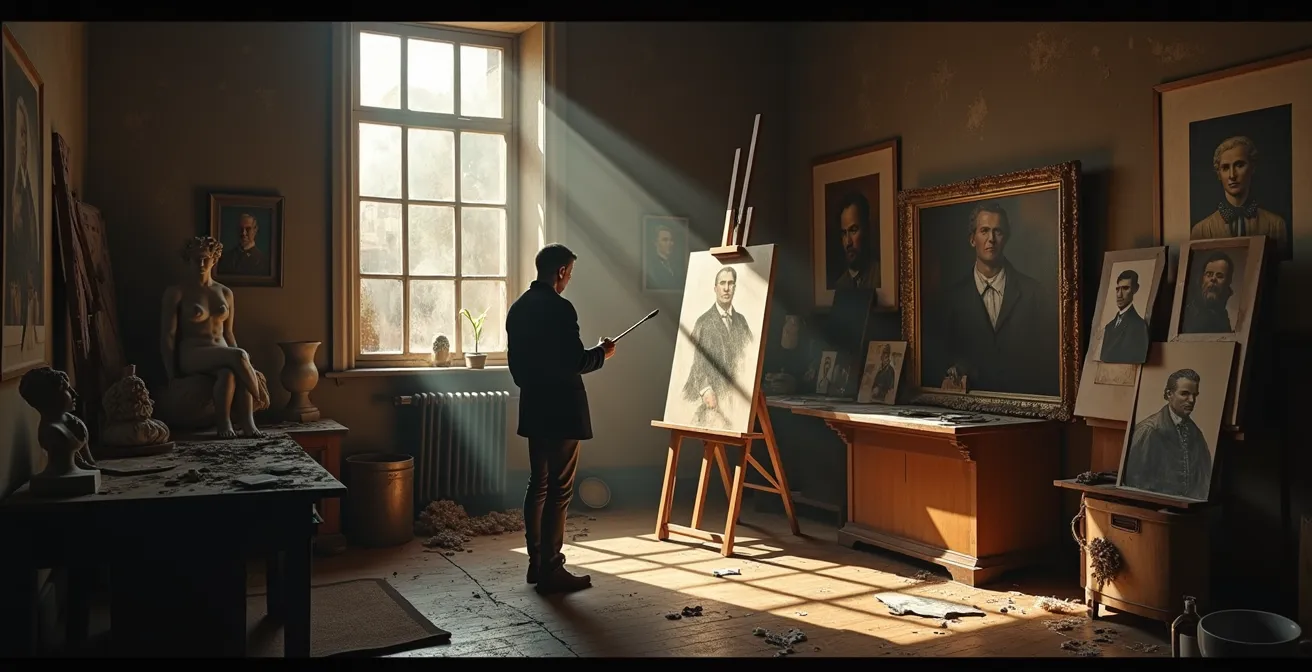
Contrary to popular belief, dramatic shifts in art after a revolution are not just about propaganda; they are the result of the total collapse and violent rebuilding of an entire artistic ecosystem.
- Patronage networks evaporate overnight, forcing artists to find new clients and purposes for their work.
- Supply chain disruptions and material scarcity compel artists to innovate with unconventional mediums.
- New technologies and the rise of private dealers dismantle the state’s monopoly on taste, creating new markets.
Recommendation: To understand revolutionary art, look beyond the canvas at the social and economic machinery that produces it—from the availability of paint to the politics of who buys it.
A student of art history can feel a sense of aesthetic whiplash when moving from the delicate, frothy paintings of the Rococo period to the stark, rigid lines of Neoclassicism. The transition is so abrupt it feels like a declaration of war. The common explanation is that revolutions usher in new ideologies, and art simply follows suit, becoming a form of propaganda for the new regime. While there is truth to this, it overlooks the deeper, more chaotic and structural reasons for such violent artistic change. It’s not just that the new leaders wanted different pictures on their walls; the entire system for creating, funding, and distributing art was fundamentally broken and remade.
The reality is far more complex than a simple change in taste. It involves the very material of art itself, the social standing of the artist, and the economic channels through which art flows. To truly grasp why a revolution’s aftermath sparks such a dramatic visual transformation, we must look beyond the subject matter and analyze the collapse of the old artistic ecosystem. This means examining the tangible pressures: patrons being executed, supply chains for pigments being severed, and new media technologies suddenly enabling mass communication outside of official control. The shift from one style to another is not a polite debate; it’s a symptom of a society in upheaval.
This article will deconstruct the mechanisms behind these seismic shifts. We will explore how artists navigate the loss of their patrons, how new forms of media emerge from the chaos, and how even the scarcity of materials can forge a new aesthetic. By understanding these underlying forces, the violent change from one style to another becomes less a mystery of taste and more a logical, observable consequence of revolution.
The following sections will delve into specific case studies, from the French Revolution to the dawn of Modernism, to illustrate how the machinery of art is reconfigured in times of extreme social and political change. This exploration provides a comprehensive framework for understanding these pivotal moments in art history.
Summary: The Systemic Collapse Behind Revolutionary Art
- The David Dilemma: How to Survive When Your Patron Is Guillotined
- Painting the King as a Pear: The Rise of Political Caricature
- Why the Nude Disappeared During the Bourbon Restoration
- The Napoleon Theft: How Exploring Europe Filled the Louvre
- Painting on Cardboard: How Supply Shortages Changed Modernism
- When the State Lost Control of Taste: The Rise of Private Dealers
- Phrygian Caps on Plates: Secret Support for the Revolution
- Why Neoclassicism Hated Emotion and Adored Geometry
The David Dilemma: How to Survive When Your Patron Is Guillotined
The career of Jacques-Louis David, the preeminent artist of the French Revolution, serves as a masterclass in artistic survival. Before the revolution, he was a celebrated painter within the royal system. After, he became a fervent Jacobin, a friend of Robespierre, and the de facto artistic director of the new Republic. His pivot was not merely ideological; it was a necessary adaptation to the complete implosion of his world. When your patrons, the nobility and the monarchy, are systematically dismantled, an artist faces a stark choice: adapt or become obsolete. David chose adaptation with ferocious commitment.
His survival was a testament to his ability to make himself indispensable to whichever power was ascendant. He didn’t just paint; he designed festivals, organized propaganda, and sat on committees that decided the fate of other artists. According to historical records, David was imprisoned twice during the tumultuous shifts of the revolution but managed to not only survive but also emerge to become the First Painter to Napoleon. Even during his imprisonment, his skill was in such demand that he was allowed to paint portraits for wealthy survivors of the Terror, a clear sign that talent could, at times, transcend politics. His career demonstrates a key principle of revolutionary art: the most successful artists are often those who best navigate the new, treacherous social and political landscape.
The “David Dilemma” reveals that an artist’s role expands dramatically during a revolution. They are no longer just creators of beautiful objects but must become political operators, strategists, and survivors. David’s trajectory shows that when the traditional artistic ecosystem collapses, personal brand and political agility become as crucial as painterly skill. His work is a direct reflection of this, shifting from the stoic heroism of the early revolution to the imperial grandeur of the Napoleonic era, always in service of the prevailing power.
Painting the King as a Pear: The Rise of Political Caricature
Before the revolution, overt political criticism in art was a dangerous game, tightly controlled by the Royal Academy and its Salons. However, the breakdown of state authority and the simultaneous advent of new printing technologies created a perfect storm for a new, democratic, and deeply subversive art form: political caricature. The ability to mass-produce images meant that for the first time, visual satire could reach a broad, literate and semi-literate audience, completely bypassing official channels of taste and control. This was a radical shift in the distribution mechanism of the artistic ecosystem.
The most famous example is the transformation of King Louis-Philippe into a pear (“poire” in French, a slang term for “fool” or “fathead”) by caricaturists like Charles Philipon and Honoré Daumier. This simple visual association was devastatingly effective, making the king an object of public ridicule. This explosion of satire was fueled by advancements in lithography. Indeed, art history records show cheap printing techniques democratized political satire in the 1830s, turning it into a powerful weapon for the opposition. Artists could now respond to daily political events with speed and wit, shaping public opinion in ways previously unimaginable.
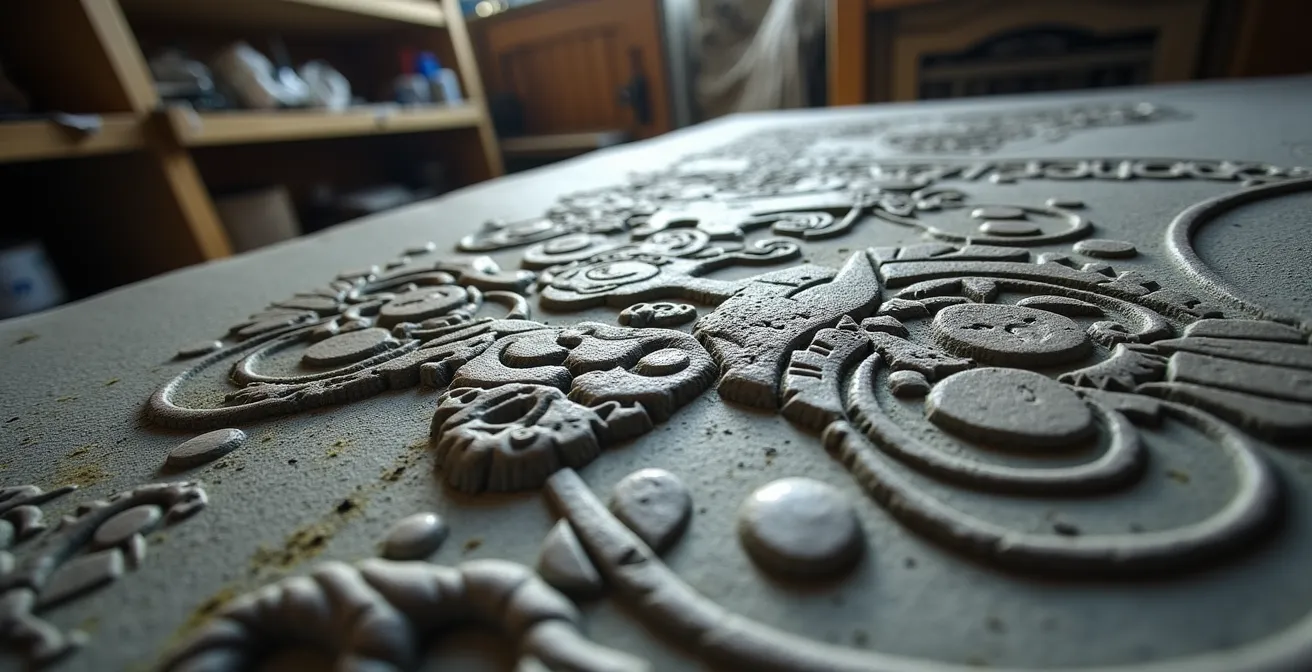
This image of a lithographic press highlights the technology that powered this change, transforming art from a luxury good into a medium for mass communication.
The rise of caricature demonstrates that when the state loses its grip on the means of artistic production, art doesn’t just change—it can become a force of revolution itself. It proves that the power of an image is not just in its aesthetic quality but in its accessibility and reproducibility. The pear became more than a drawing; it was a meme, a symbol of dissent that could be scrawled on any wall, instantly understood by all.
Why the Nude Disappeared During the Bourbon Restoration
After the turmoil of the Revolution and the grandiose ambition of the Napoleonic Empire, the Bourbon Restoration (1814-1830) sought to turn back the clock. This was not just a political project but a cultural one, aimed at restoring a sense of order, piety, and social hierarchy. In this new climate, the heroic, classical nude—so central to Neoclassical artists like David—became politically and socially problematic. It was associated with the pagan-republican ideals of the Revolution and the imperial ego of Napoleon. The new regime required a new visual language, one that was less public and bombastic and more private and sentimental.
The result was a significant shift in subject matter. Large-scale historical epics gave way to smaller, meticulously rendered scenes from medieval and Renaissance history, a style that came to be known as the “Troubadour style.” These paintings celebrated the Christian monarchy and chivalric romance, offering a nostalgic and idealized vision of France’s past. The nude, with its connotations of universal truth and public virtue, was replaced by the fully clothed historical figure, rooted in a specific, national, and Christian narrative. This was a conscious move to re-moralize art for a more conservative clientele.
As one analysis of the period notes, the shift was a deliberate recalibration of social values:
The Restoration promoted a more private, clothed, and ‘decent’ body politic
– Art History Analysis, Post-Revolutionary French Art
The disappearance of the nude was therefore not an aesthetic whim but a direct consequence of a change in the ideological function of art. The new patrons—a mix of old aristocracy returning from exile and the newly ennobled bourgeoisie—wanted art that affirmed their values of piety, family, and tradition, not art that reminded them of the revolutionary fervor they had just survived. The clothed body represented a contained, controlled, and socially appropriate individual, in stark contrast to the universal, “uncontrollable” citizen symbolized by the classical nude.
The Napoleon Theft: How Exploring Europe Filled the Louvre
Napoleon Bonaparte understood the power of art as a symbol of national glory better than anyone. His military campaigns across Europe were not just for territorial conquest; they were also the largest, most systematic art confiscation campaigns in history. The Louvre, renamed the Musée Napoléon, was to become a central repository for all the world’s masterpieces, a testament to France’s cultural supremacy. This act of plunder fundamentally reconfigured the artistic ecosystem of the entire continent, centralizing Europe’s cultural heritage in Paris.
From Italy, Napoleon’s armies seized masterworks by Raphael and Veronese, as well as ancient marvels like the Apollo Belvedere. From Germany and the Low Countries came treasures by Rubens and Rembrandt. According to museum records, thousands of artworks were systematically confiscated between 1796 and 1815, transported to Paris by the wagonload. For the first time, French artists and the public had access to an unprecedented range of art history, all under one roof. This vast, centralized collection had a profound impact on French artists, exposing them directly to styles and techniques that had previously been known only through prints or travel.
The irony is that this grand project of centralization ultimately led to decentralization. After Napoleon’s fall in 1815, a massive effort was undertaken to restitute the stolen works. This forced restitution process spurred the creation of new national museums across Europe, from Berlin to Amsterdam, as returning artworks became symbols of recovered national identity. Each country began to build its own art historical narrative, fostering the development of distinct national schools and styles. Napoleon’s looting, intended to establish French dominance, inadvertently helped create the very concept of the national museum and the nationalistic art histories that defined the 19th century.
Painting on Cardboard: How Supply Shortages Changed Modernism
Revolutions and wars don’t just destroy political systems; they shatter supply chains. For artists, this can mean a sudden and acute scarcity of traditional materials like quality canvas, oil paints, and fine paper. This material constraint is not merely an inconvenience; it can become a powerful force for aesthetic innovation. When artists are forced to make do with what they can find—cardboard, burlap, house paint, scrap wood—they often discover new expressive possibilities that end up defining a new style. This was a key factor in the development of several early Modernist movements.
Following the devastation of World War I and the ensuing economic collapse in Germany, artists of the German Expressionist movement faced extreme shortages. They turned to rough, cheap materials out of necessity. This “art of poverty,” or *arte povera*, was later elevated into a core aesthetic principle, where the rawness of the material was seen as a more authentic and direct expression of the harsh realities of modern life. The texture of the cardboard or the crudeness of the woodcut became part of the work’s emotional impact, a far cry from the polished surfaces of academic painting.
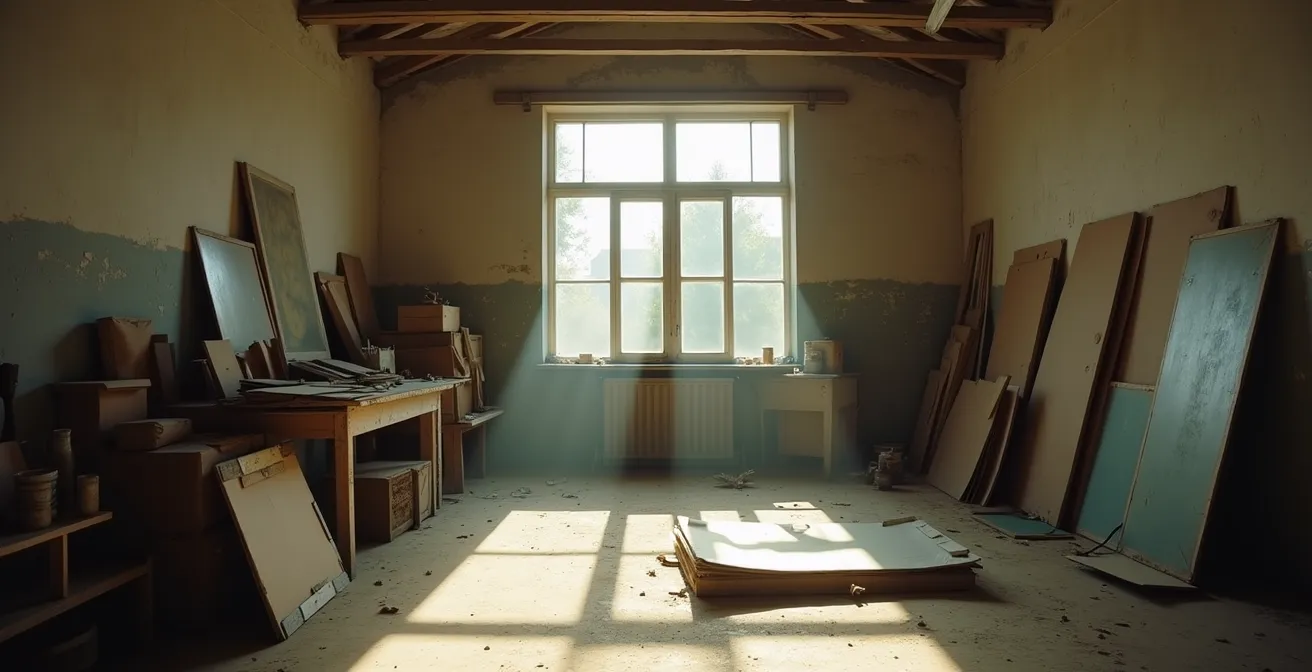
This sparse, makeshift studio illustrates the environment of scarcity that forced a generation of artists to reinvent their practice from the ground up.
This phenomenon shows that a core component of the artistic ecosystem—the material itself— is a powerful agent of change. The slick, refined surfaces of pre-war art were impossible to produce and felt emotionally dishonest in a world torn apart. The embrace of poor materials was both a practical solution and a profound artistic statement, rejecting the bourgeois values of the world that had led to the catastrophe. Modernism’s break with tradition was, in part, born from the literal scraps of a collapsed society.
When the State Lost Control of Taste: The Rise of Private Dealers
For centuries in France, the path to artistic success ran through one institution: the Royal Academy of Painting and Sculpture. It controlled art education, set official standards of taste, and, most importantly, ran the Paris Salon, the official exhibition that could make or break an artist’s career. Revolution and political instability severely weakened the Academy’s authority. In the vacuum it left, a new and powerful figure emerged in the artistic ecosystem: the private art dealer. These individuals, operating outside the state system, would become the new “taste brokers.”
The Case of Durand-Ruel and the Impressionists
Perhaps no dealer was more influential than Paul Durand-Ruel. While the Academy and the Salon critics ridiculed the Impressionists for their “unfinished” and “vulgar” paintings, Durand-Ruel saw their revolutionary potential. He bought their work, hosted their exhibitions in his private gallery, and cultivated a new client base of wealthy, forward-thinking industrialists and American collectors. He effectively created a parallel market that allowed the Impressionists to survive and eventually triumph without the approval of the official art world.
This shift from state patronage to a private market was a fundamental restructuring of the art world’s economics. It represented a transfer of power from a centralized, conservative institution to a decentralized network of entrepreneurial dealers. This new system favored innovation and individuality, as dealers sought out the “next big thing” to market to their clients. According to market analysis, by 1900, private dealers controlled over 60% of art sales in Paris, signaling the definitive end of the Academy’s monopoly. The artist was no longer a supplicant to the state but a partner to a gallerist. This created the conditions for the rapid succession of “isms” (Impressionism, Post-Impressionism, Fauvism) that characterized the birth of Modernism.
Phrygian Caps on Plates: Secret Support for the Revolution
During a revolution, expressing one’s political allegiance can be a matter of life and death. When open declarations of support for a cause are dangerous, ideology goes underground, embedding itself into the fabric of everyday life. The French Revolution saw an explosion of political symbolism in seemingly apolitical objects. Furniture, clothing, and even dinnerware became carriers of coded messages, creating a “symbolic infrastructure” that allowed citizens to signal their loyalties discreetly. This phenomenon shows how the artistic ecosystem expands to include domestic crafts and design.
The Phrygian cap, the red bonnet worn by liberated slaves in ancient Rome, became the most potent symbol of revolutionary liberty. It appeared everywhere: as a finial on a clock, a motif on wallpaper, or painted onto the back of a ceramic plate. Owning and using such an object was a quiet act of political solidarity. Similarly, still life paintings, traditionally a “safe” and apolitical genre, were repurposed to carry hidden meanings. A specific combination of flowers could represent fallen martyrs, while a broken piece of pottery could symbolize the shattered monarchy. These objects transformed the home into a private political space.
This embedding of meaning was a strategic way to navigate a perilous environment. It allowed for the circulation of revolutionary ideas under the nose of a sometimes-repressive regime. The objects themselves became part of the revolution’s cultural work, fostering a sense of shared identity and purpose among supporters. It highlights that in times of upheaval, the definition of “art” broadens to include any object capable of carrying symbolic weight and political meaning. The most powerful art isn’t always what hangs in a museum; sometimes, it’s the plate from which you eat.
Key Takeaways
- Artistic change is not just about ideas; it’s driven by the collapse of patronage, supply chains, and institutions.
- New technologies, like lithography, can democratize art and turn it into a political weapon outside of state control.
- Material scarcity forces innovation, leading artists to develop new aesthetics based on the reality of their limited resources.
Why Neoclassicism Hated Emotion and Adored Geometry
The stark, rational, and geometric style of Neoclassicism was a direct and forceful rejection of the art that preceded it: Rococo. Where Rococo was frivolous, sensual, and ornate, celebrating the leisurely pursuits of the aristocracy, Neoclassicism was severe, moralizing, and orderly. This “aesthetic whiplash” was no accident. Neoclassicism was the visual manifestation of the Enlightenment, a philosophical movement that championed reason, logic, and civic virtue over aristocratic decadence and emotional excess. The style itself was an argument.
The movement’s visual vocabulary was heavily indebted to the rediscovery of the Roman cities of Pompeii and Herculaneum. As archaeological records confirm, the Pompeii excavations starting in 1748 directly influenced over 80% of Neoclassical artists, who saw in the clean lines, rational spaces, and stoic subject matter of Roman art the perfect antidote to the “corrupt” and “disorderly” nature of Rococo. The straight line, the simple column, and the balanced composition became moral statements, symbolizing republican integrity and self-sacrifice. Emotion was seen as a corrupting influence, a feature of the undisciplined and effeminate aristocracy. Neoclassicism, by contrast, was deliberately masculine, rational, and instructive.
This intellectual framework provided the fuel for the revolution’s artistic program. Art was not meant to please, but to educate and inspire citizens to virtuous action. The geometric order of a painting like David’s *Oath of the Horatii* was intended to reflect the ideal of a rational, ordered society. It was the visual blueprint for a new world, built on principles, not privilege. The hatred of emotion and love of geometry was, therefore, a deeply political and philosophical stance, arguing for a new kind of society through a new kind of art.
Action Plan: How to Analyze Art from a Revolutionary Period
- Identify the Patronage: Who paid for this art? The old regime, the new state, or a private citizen? This will tell you whose values it likely represents.
- Analyze the Materials: Is it a grand oil on canvas or a rough sketch on cardboard? The material itself reveals the economic conditions of its creation.
- Decode the Symbols: Look for objects, colors, or gestures that may have held specific political meaning at the time (e.g., a Phrygian cap, a broken chain).
- Assess the Style: Is the style a continuation of what came before, or a violent break from it? Characterize the nature of the change (e.g., from ornate to simple, emotional to rational).
- Consider the Distribution: Was this a unique object for a private home, or a mass-produced print for public consumption? This defines its role in the wider artistic ecosystem.
Understanding these violent shifts requires us to act as sociologists, observing the entire system in which art is made. When a revolution occurs, it’s not just the king who is deposed, but the entire artistic infrastructure that supported him. The resulting art is the fossil record of that cataclysmic change. To truly read it, one must look beyond the frame and see the forces that shaped the artist’s hand. Begin today to analyze art not just as an image, but as evidence of a society in motion.