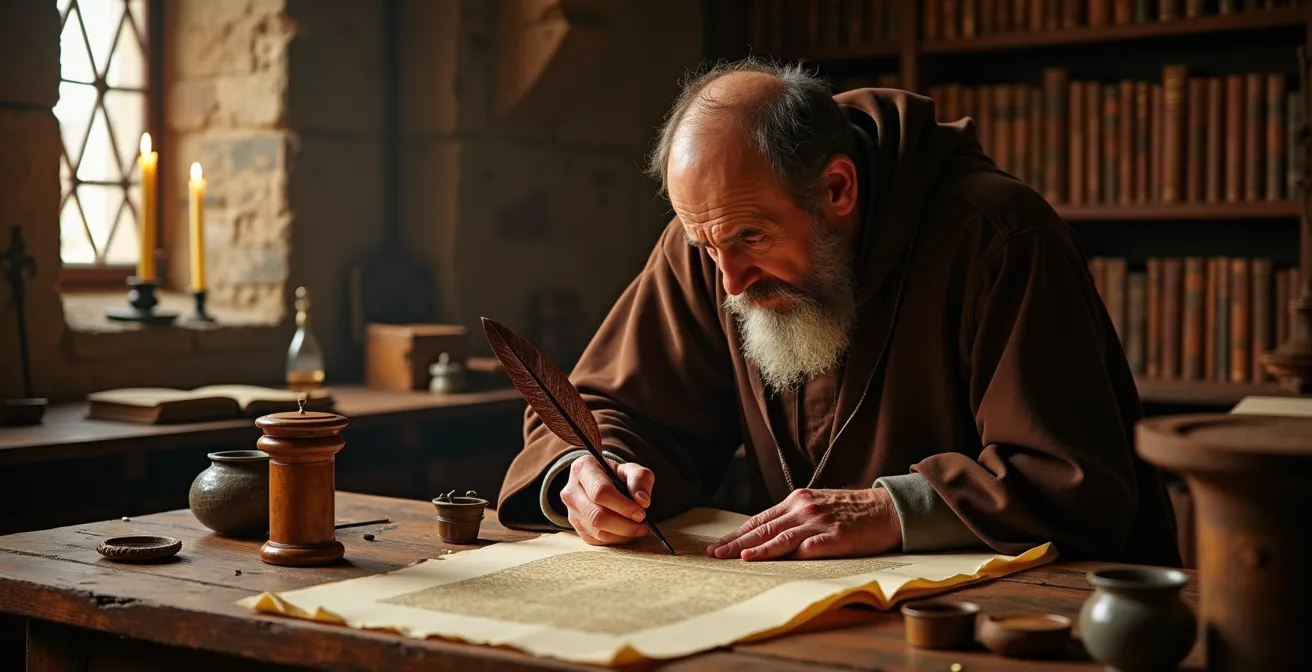
A medieval book’s immense value wasn’t just due to manual labor; it was a high-stakes economic venture driven by massive material investment and specialized, hazardous crafts.
- The primary cost was often the material itself—a single bible could require the skins of an entire farm’s flock.
- Production involved a complex value chain of paid, urban artisans, from scribes to binders and illuminators who worked with toxic pigments.
Recommendation: Next time you see an illuminated manuscript, look past the beautiful art to see the intricate and costly ecosystem of craft, risk, and capital it represents.
In a world of instantaneous downloads and mass-market paperbacks, the idea that a single book could be worth a small fortune—equivalent to the price of an entire farm—seems almost mythical. To a modern reader, a book is an object of information or entertainment, easily produced and widely accessible. But for a medieval patron, a manuscript was a monumental investment, a status symbol, and an object of profound artistic and spiritual significance. The common understanding is that they were expensive simply because they were “handmade” by monks in quiet monasteries. While true, this explanation barely scratches the surface.
The real story is one of a complex economic ecosystem. The cost was not just in the scribe’s time, but in a long and perilous value chain that began with livestock and ended with shimmering, often toxic, colors. It involved a network of specialized artisans, contractual negotiations, and significant upfront capital. This was not merely craft; it was a sophisticated, high-risk industry. To truly appreciate one of these masterpieces is to understand the full weight of its creation. This exploration will dissect the anatomy of that cost, moving from the very foundation of the page to the final, gilded flourish, revealing the true price of knowledge and beauty in the Middle Ages.
For those who prefer a visual format, the following video offers a compelling immersion into the world of manuscript creation, perfectly complementing the detailed economic and artisanal breakdown in this guide.
To fully grasp the economic scale of these incredible objects, this article breaks down each component of their value. Below is a summary of the key stages in the production chain, from the raw materials to the final decorative elements that defined a manuscript’s worth.
Summary: The Economic Anatomy of a Medieval Manuscript
- Vellum vs. Parchment: The Difference That Defined Quality
- Scribe or Illuminator: Who Really Added the Value?
- The “Monk’s Doze”: How Boredom Altered History in Manuscripts
- When Books Left the Monastery: The Rise of Secular Guilds
- Arsenic and Lead: The Deadly Cost of Bright Colors
- Paisley’s Journey: How a Persian Motif Conquered Scottish Textiles
- Why Gold Backgrounds Represented Eternity, Not Just Wealth
- How to Distinguish Real Gold Leaf from Cheap Metal Imitations
Vellum vs. Parchment: The Difference That Defined Quality
Before a single word could be written, a medieval book began its life not in a study, but in a field. The very surface of the page, the parchment, was the single greatest material investment. Made from processed animal skin—typically sheep, goat, or calf—it was a resource-intensive and physically demanding product. The highest quality, known as vellum, was made from the delicate skin of newborn or even stillborn calves, prized for its smooth, almost translucent finish. This initial material cost often dwarfed all other expenses combined.
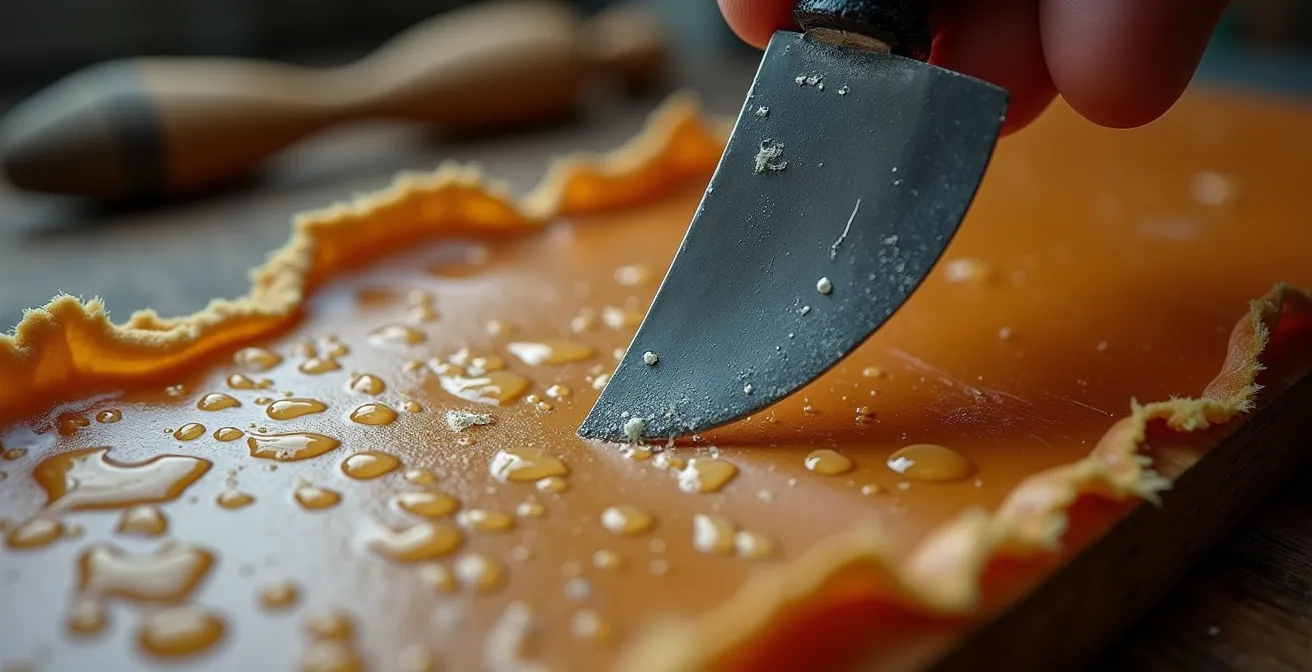
The scale of this material investment is staggering. Consider the Codex Amiatinus, a monumental 8th-century Bible. As a tangible case study, its creation demonstrates the immense resources required. Historical analysis suggests that to produce its 2,060 large pages, the artisans needed the skins of approximately 500 sheep. This was not a trivial number; it represented the entire flock of an average medieval farm. The book’s very foundation was, quite literally, the price of a substantial agricultural enterprise, a level of material capital unthinkable for modern publications.
Scribe or Illuminator: Who Really Added the Value?
Once the costly parchment was prepared, the human element entered the value chain. The romantic image of a lone monk toiling in a silent scriptorium is an incomplete picture, especially in the later Middle Ages. Book production was a collaborative industry involving a cast of highly specialized artisans, often organized under a central contractor or bookseller known as a *libraire*. Each specialist added a distinct layer of value, and their labor was a significant, calculated expense. The primary roles were clearly defined, forming a sophisticated production line.
As the Getty Museum explains, this was a multi-stage process involving a team of experts. A project manager would oversee the entire operation from start to finish. According to their research, this professional would “employ scribes who wrote the text out by hand, illuminators who made the illustrations, and binders who put those pages together to make a book.” Each of these roles required years of training. The scribe was responsible for the painstaking task of copying the text with precision and consistency, while the illuminator was the artist who brought the page to life with intricate decorations and miniature paintings. To place this in context, English manuscript inventories from before 1340 show an average valuation of 8 shillings and 3 pence—a considerable sum at a time when a skilled laborer might earn a few pence per day.
The “Monk’s Doze”: How Boredom Altered History in Manuscripts
The meticulous labor of the scribe was fraught with risk. A moment’s inattention—the proverbial “monk’s doze”—could lead to a slip of the pen, a misspelling, or an omission. On a surface as expensive as parchment, such an error was a costly disaster. It could ruin an entire folio, wasting both the valuable material and the hours of labor already invested. Consequently, the process of proofreading and correction was not an afterthought but a formal, budgeted stage in the manuscript’s production. The scribe’s work was checked by a corrector, who would scrape away mistakes with a sharp knife or add corrections in the margins.
This attention to detail highlights how every step was quantified. While detailed price lists are rare—an analysis of nearly 24,000 manuscript colophons found fewer than 50 mentioning specific prices—surviving contracts give us a clear picture. One 14th-century account breaks down the costs for a specific book, revealing a detailed budget. For instance, the raw parchment cost 8 sols and 8 deniers, but the scribal labor was far more at 29 sols and 4 deniers. Crucially, a separate line item for “Correction” was budgeted at 2 sols and 10 deniers. This demonstrates that mitigating human error was a recognized and monetized part of the production workflow, a form of insurance against the high cost of materials.
When Books Left the Monastery: The Rise of Secular Guilds
By the 13th and 14th centuries, the center of high-end book production had largely shifted from isolated monasteries to bustling urban centers. This transition marked the rise of a secular, commercial book trade driven by professional guilds and workshops. Universities created demand for textbooks, and a growing wealthy bourgeoisie sought lavish Books of Hours as status symbols. This commercialization transformed the manuscript from a purely devotional object into a luxury commodity, complete with contracts, down payments, and deadlines.

A surviving contract from medieval Brittany provides a fascinating glimpse into this business. It details an agreement where a patron commissioned a missal and psalter from the artisan Raoul de Cerisay. The terms were explicit: Cerisay was to receive 80 livres for his work, plus an additional 30 sous for bread and wine during the production period. The payment schedule was also stipulated, with half paid in advance and the final half upon successful delivery. This was not the work of a monk fulfilling a spiritual duty; it was a commercial transaction between a client and a professional craftsman. This artisanal ecosystem has left a legacy of objects whose value has endured for centuries, with medieval manuscripts today commanding prices that start at $10,000 and can easily reach into the millions at auction.
Arsenic and Lead: The Deadly Cost of Bright Colors
The luminous colors that make illuminated manuscripts so breathtaking came at a steep, and often dangerous, price. Pigments were not bought in tubes from a shop; they were sourced from rare minerals, exotic insects, and complex chemical processes. Their cost contributed significantly to a manuscript’s value, but so did the physical risk involved in handling them. Many of the most vibrant colors were derived from highly toxic substances, turning the illuminator’s workshop into a hazardous environment.
A prime example is Orpiment, the source for a brilliant yellow. As one manual on medieval crafts notes, “orpiment, which is a sulfide of arsenic… can react unfavorably with other pigments and can turn black from exposure to air.” The instability of the pigment was a financial risk, but the arsenic component was a direct threat to the artisan’s health. Long-term exposure to these materials could lead to chronic illness and early death, a hidden human cost embedded in the beauty of the final product.
The following table outlines some of the common pigments used, their brilliant colors, and the dangerous components they contained, underscoring the real-world hazards of the illuminator’s art. As an analysis of these materials shows, the pursuit of beauty involved direct contact with poisons like lead, mercury, and arsenic.
| Pigment | Color | Toxic Component | Origin |
|---|---|---|---|
| Orpiment | Yellow | Arsenic sulfide | Natural mineral |
| Lead White | White | Lead carbonate | Lead sheets + vinegar |
| Vermillion | Red | Mercury sulfide | Cinnabar mineral |
| Malachite | Green | Copper carbonate | Copper ore |
Paisley’s Journey: How a Persian Motif Conquered Scottish Textiles
The story of a medieval book is also a story of connection, where ideas and artistic styles traveled vast distances. A fascinating parallel can be seen in the journey of decorative motifs, such as the famous Paisley pattern. This teardrop-shaped design, known as *boteh*, originated in Persia centuries ago as a symbol of life and eternity. It traveled along trade routes like the Silk Road, eventually arriving in Europe. By the 19th century, weavers in the Scottish town of Paisley had become so famous for producing textiles with this motif that the pattern itself took the town’s name. This journey from a Persian symbol to a Scottish icon shows how motifs can migrate and transform across cultures and centuries.
Case Study: The Sarajevo Haggadah – A Crossroads of Cultures
This same spirit of cultural fusion is vividly present within the manuscript tradition itself. The Sarajevo Haggadah stands as a prime example. This breathtaking 14th-century Hebrew illuminated manuscript from Northern Spain is a crossroads of artistic styles. Created for a Jewish community, its illustrations show the influence of the surrounding Christian Gothic art as well as motifs that hint at the region’s Islamic artistic heritage. It is a testament to how manuscript workshops were not isolated bubbles, but were often melting pots where different artistic traditions met, merged, and created something entirely new and beautiful.
Whether it is a Persian design on a Scottish shawl or a fusion of religious art styles in a Spanish-Jewish manuscript, the movement of motifs tells a story of global connection. These journeys added layers of meaning and exoticism, further enhancing the perceived value of the objects they adorned. They are a reminder that even in the Middle Ages, the world was more interconnected than we often imagine.
Why Gold Backgrounds Represented Eternity, Not Just Wealth
No element is more synonymous with the luxury of an illuminated manuscript than gold. Its presence instantly signaled a book of immense value and importance. However, the use of gold was not merely a display of conspicuous consumption; it was a profound act of symbolic investment. In religious manuscripts, a background of shimmering gold was not meant to represent earthly wealth. Because gold does not tarnish or decay, it was the perfect material representation of the divine, the heavenly realm, and eternity itself. It transformed the page from a simple surface into a window onto an incorruptible, sacred space.
Artisans employed two main techniques to apply gold, each with a different cost and visual effect. The most prestigious method was applying gold leaf—gold hammered into tissue-thin sheets—over a raised cushion of a plaster-like substance called gesso. This surface was then burnished with a smooth, hard stone, creating a brilliant, three-dimensional glow that would catch and reflect candlelight in a dynamic way. A simpler, less expensive method involved using “shell gold,” which, as a medieval manual explains, is “made of powdered gold suspended with gum. It was cheaper and could be applied with a pen or brush” like paint. While still valuable, it lacked the dazzling, reflective quality of true gold leaf.
Key Takeaways
- The primary cost of a medieval manuscript was the immense material investment in parchment, which could require an entire flock of sheep for a single volume.
- Production relied on a sophisticated value chain of specialized, paid artisans—scribes, illuminators, binders—working in a commercial, guild-based system.
- The value was multidimensional, combining tangible costs (toxic pigments, real gold) with profound symbolic capital (representing eternity, status, and divine light).
How to Distinguish Real Gold Leaf from Cheap Metal Imitations
Given the immense value that real gold added to a manuscript, it’s not surprising that cheaper imitations were sometimes used. For a codicologist, patron, or modern collector, being able to distinguish genuine gold leaf from less valuable substitutes like tin or silver leaf (often glazed with yellow to mimic gold) is a crucial skill. While definitive analysis often requires scientific tools, there are several visual clues an observant eye can use to assess the authenticity of the gilding. These clues relate to the material’s chemical properties, its behavior over time, and the specific ways it was applied by medieval artisans.
The most telling characteristic of gold is its incorruptibility. Unlike other metals, it does not react with the air. This fundamental property provides the clearest path to identification. A careful examination of the gilded surface, paying attention to its luster, color, and any signs of degradation, can reveal the true nature of the material used by the illuminator centuries ago.
Action Plan: Verifying Authentic Gold Leaf in Manuscripts
- Check for Tarnish: Examine the edges and any cracked areas of the gilding. Real gold never tarnishes or blackens. If you see any black or gray discoloration, you are likely looking at silver or a tin alloy that has oxidized over time.
- Analyze the Craquelure: Look closely at the pattern of tiny cracks (craquelure) on the gilded surface. Genuine, thinly hammered gold leaf develops a unique, web-like cracking pattern as the gesso and parchment beneath it age and flex. Base metal foils crack differently, often in more rigid, linear patterns.
- Assess the Luster: Observe how the surface reflects light. Burnished gold leaf over gesso has a deep, liquid-like, three-dimensional glow that seems to shift with the viewing angle. Imitations or flatter shell gold often have a more static, one-dimensional shine.
- Look for Uniform Color: Under magnification, inspect the color consistency. Real gold will have a uniform, warm hue. Areas of discoloration or spotting, especially greenish or brownish tones, can indicate the presence of copper in an alloy or the degradation of a yellow glaze over a base metal.
- Consult Historical Records: When possible, examine any related contracts or workshop records. Commissioning documents for high-status manuscripts sometimes specified the use of “fine gold” or a certain number of gold leaves, providing textual proof of the materials intended for use.
Ultimately, a medieval manuscript is far more than an old book. It is a survivor, a dense artifact of a lost economic world. Understanding that its price was rooted in a farm’s worth of livestock, the life’s work of a team of artisans, and a literal engagement with poison and precious metal allows us to see it not just as art, but as a monumental achievement of craft and commerce. The next step is to carry this new perspective with you into museums and libraries, to see these objects for what they truly are.
Frequently Asked Questions About Medieval Manuscript Illumination
How was gold leaf applied to medieval manuscripts?
Gold leaf was applied over a raised cushion of gesso, a plaster-like mixture. Once the leaf was laid down, it was burnished with a smooth, hard tool, often made of agate or a wolf’s tooth, to create a brilliant, dynamic glow that caught the light, especially from candles.
What’s the difference between shell gold and gold leaf?
Shell gold was powdered gold mixed with a binder like gum arabic, which could be painted on with a brush or pen. Gold leaf consisted of extremely thin, hammered sheets of gold that were applied over a prepared surface for a much more brilliant and three-dimensional effect. Leaf was generally more expensive and prestigious.
Why did gold backgrounds symbolize eternity?
Gold does not tarnish, corrode, or decay over time. Its incorruptible nature made it the perfect physical and visual metaphor for the divine, heaven, and eternity in religious manuscripts. Its unchanging shimmer represented a realm beyond earthly decay.