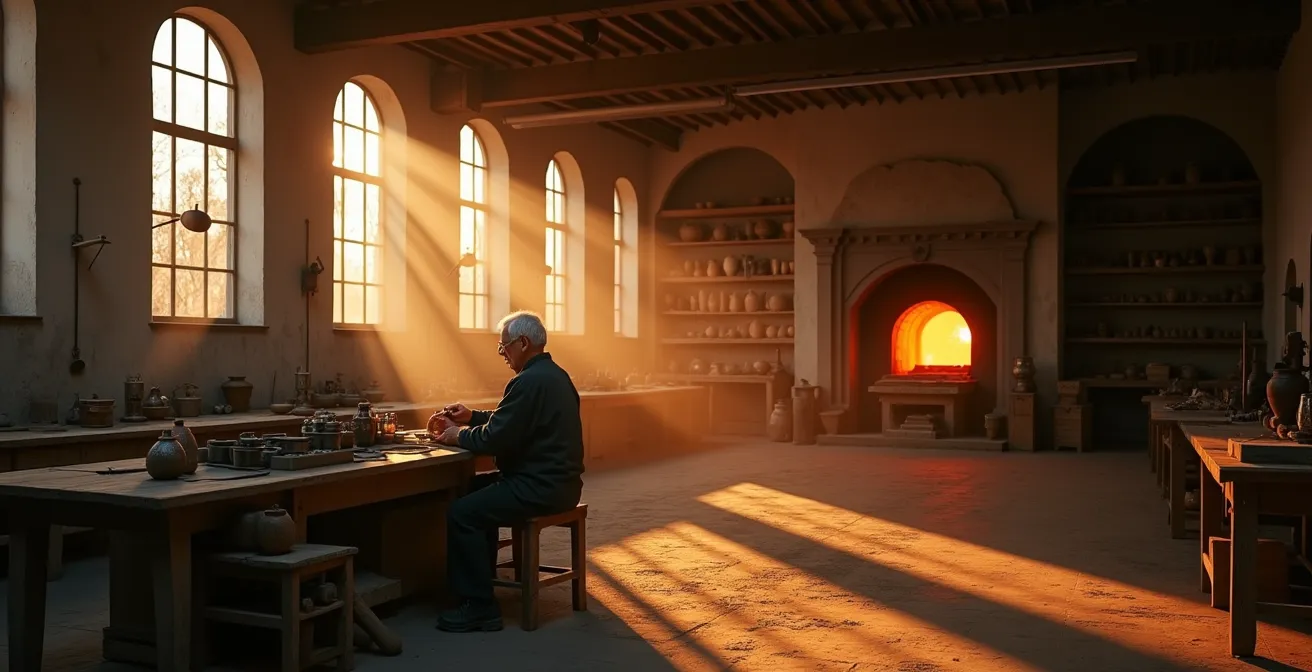
The disappearance of a master artisan is not a cultural loss, but a critical policy failure.
- State-level recognition is insufficient without robust systems for knowledge codification and economic viability.
- Modern technology and market strategies are not threats to tradition, but essential tools for its survival.
Recommendation: Shift from passive preservation to an active policy of “heritage engineering” that secures the transmission, profitability, and recruitment pipeline for master crafts.
The retirement of the last master glassblower—or weaver, or luthier—is a silent catastrophe. It marks the irreversible end point of a lineage of knowledge stretching back centuries. This is not merely a nostalgic loss; it is a critical failure in cultural policy. For too long, the preservation of intangible cultural heritage has been treated as a matter of archival interest or passive appreciation. We document, we admire, and we lament the decline. This approach has proven to be a strategy for managed extinction.
The common response involves suggesting that governments should offer more grants or that consumers should simply “buy handmade.” While well-intentioned, these are surface-level solutions to a systemic crisis. They fail to address the core challenges: the economic precarity of the profession, the brutal physical toll on the artisan’s body, and the absence of a viable pipeline for succession. The fundamental issue is that we are trying to save a living tradition with museum-piece policies.
The true key lies not in simply funding the past, but in engineering a sustainable future for it. This article abandons the passive stance and instead proposes an urgent, multi-pronged policy framework. We will dissect the mechanisms that make or break the survival of a craft, moving beyond platitudes to actionable strategy. The central thesis is this: preserving intangible heritage requires a deliberate act of policy engineering focused on three pillars: formal state recognition, robust economic viability, and advanced technological codification of embodied knowledge.
This guide will deconstruct successful national models, evaluate cutting-edge technologies for skill preservation, and outline economic strategies that allow master crafts to thrive, not just survive. It is a blueprint for transforming cultural heritage from a fragile relic into a resilient, living asset.
Summary: What Happens When the Last Master Glassblower Retires?
- Japan vs. France: How Nations Support Master Craftsmen
- Video or VR: How to Record a Hand Movement for Posterity?
- Pricing the Hours: Can Traditional Craft Pay a Living Wage?
- Champagne for Crafts: Why “Limoges” Must Be Made in Limoges
- TikTok Potters: How Social Media Is Saving Old Trades
- Who Will Replace the Masters? The Recruitment Crisis in Luxury Crafts
- How Artisans Recreate Prehistoric Texture with Millimeter Precision
- Why the Body of a Master Artisan Fails After 40 Years of Labor
Japan vs. France: How Nations Support Master Craftsmen
State recognition is the foundational policy step in signaling a craft’s national importance. However, the models for conferring this status vary dramatically, with Japan and France offering two of the world’s most robust, yet philosophically different, frameworks. Understanding these systems is critical for any policymaker aiming to build an effective heritage preservation strategy. They demonstrate that official designation must be more than an honorific; it must be an integrated system of support and promotion.
Japan’s system of “Living National Treasures” (Ningen Kokuhō) is an elite, targeted approach. It focuses on identifying individual masters who embody the highest level of a specific skill. The government confers this title on a select few who are then charged with preserving their art form. The system is intentionally exclusive; an official report confirms that Japan’s Living National Treasure program maintains a strict cap at 116 individuals at any one time, with only 58 of those representing traditional crafts. This scarcity elevates the status of the masters and their work, creating immense cultural value.
The maximum number of Living National Treasures is capped at 116. The only way to get on the list when it’s full is to first be amazing at a traditional Japanese craft or performing art and then wait for someone whom you probably deeply admire to, well, die.
– Tokyo Weekender Editorial, Japan’s Living National Treasures: Keepers of Traditional Culture
In contrast, France’s Meilleur Ouvrier de France (MOF) competition is a broader, more meritocratic system. Rather than being appointed, artisans earn the title through a grueling, high-stakes competition. The MOF designation is not limited by numbers and covers over 200 different crafts. Since its inception in 1924, nearly 10,000 laureates have been recognized, validating a wider base of expertise and creating a larger community of recognized masters. The 2024 centennial event alone drew 30,000 visitors, demonstrating the program’s significant public reach and its role as a powerful engine for promoting craft careers.
Video or VR: How to Record a Hand Movement for Posterity?
Once a master is recognized, the next urgent policy question is how to codify their knowledge before it is lost forever. For centuries, this transmission was purely physical—the apprentice watching and mimicking the master. Today, technology offers a path to preservation at an unprecedented level of fidelity. While simple video recording provides a visual record, it fails to capture the most critical component of mastery: embodied knowledge. This refers to the non-verbal, intuitive intelligence held in an artisan’s hands—the precise pressure, the subtle hesitation, the rhythm of movement.
This is where advanced technologies like haptic feedback and virtual reality (VR) become critical policy tools, not just novelties. Haptic gloves, equipped with sophisticated sensors, can record the intricate details of a master’s hand movements, translating muscle memory into digital data. This data can then be used to create immersive VR training simulations where an apprentice can “feel” the master’s technique. It moves preservation from a 2D visual record to a 4D sensory experience. Investing in this technology is investing in a scalable, high-fidelity method of knowledge transfer.

The market is already recognizing the potential. As a testament to its growing importance, the haptic technology market is expected to reach a value of $5 billion by 2028. For cultural policymakers, this signals a crucial opportunity. Subsidizing the creation of haptic archives for endangered crafts is a direct and powerful intervention. It creates a permanent, distributable record of mastery that can outlive its final human practitioner and train generations to come, ensuring the movements themselves are never truly lost.
Pricing the Hours: Can Traditional Craft Pay a Living Wage?
State recognition and technological archives are meaningless if artisans cannot afford to practice their craft. The romanticized image of the “starving artist” is a policy failure, not a badge of authenticity. Ensuring economic viability is arguably the most critical pillar of any serious heritage preservation strategy. This requires moving beyond a reliance on one-off grants and developing sustainable economic models that allow traditional craft to command a premium price and provide a living wage.
Direct subsidies play a role in providing a stable floor. For instance, Japan’s Living National Treasures receive a special annual government grant of 2 million yen (approximately $15,000 USD). While modest, this stipend is designed to cover basic expenses, allowing the master to focus on the transmission of their skills through teaching and production without constant financial pressure. This model acknowledges that the act of preservation itself is a public good worthy of direct financial support, supplementing income from sales.
However, long-term viability must come from the market. A key strategy is to align traditional crafts with modern consumer values, particularly sustainability. The upcycling movement offers a powerful example. By transforming discarded materials into high-value objects, artisans tap into a powerful market narrative. In France, this trend is a significant economic driver; data shows sustainable craftsmanship is growing rapidly, with 60% of French artisans now involved in upcycling, fueling a 7% market growth. This proves that traditional skills can be positioned not as relics of the past, but as solutions for a sustainable future, thereby justifying a higher price point.
A successful policy must therefore be twofold: provide a baseline of direct support to de-risk the profession, while simultaneously fostering market conditions—through branding, certification, and alignment with modern values—that enable artisans to achieve financial independence. The goal is to make mastery a viable career, not a vow of poverty.
Champagne for Crafts: Why “Limoges” Must Be Made in Limoges
Building on the need for economic viability, one of the most potent policy tools for protecting and elevating a craft is the establishment of a Geographical Indication (GI). Much like Champagne can only come from the Champagne region of France, or Parmesan cheese from its specific region in Italy, a GI legally links a product’s quality and authenticity to its place of origin. This mechanism is a powerful defense against mass-produced imitations and a cornerstone of premium pricing strategy.
Limoges porcelain is a prime case study. The “Limoges” designation is not merely a brand; it is a legally protected mark guaranteeing that the piece was created in the Limoges region of France according to centuries-old techniques. This protection allows artisans to command a premium, as consumers are purchasing not just a beautiful object, but a verifiable piece of French cultural heritage. The GI transforms the craft from a generic product category (“porcelain”) into a unique, geographically-bound asset. This has a stabilizing effect on the local craft economy, with data indicating that approximately half of artisans in Limoges continue the tradition, supported by a steady 3% annual market growth.
The classic elegance of the creations fashioned from Limoges porcelain is eminent for its pristine white hue and intricate hand-painted motifs. Each piece is celebrated for its meticulous craftsmanship, transforming it into a cherished heirloom.
– Rural Handmade Editorial, Exploring The Top 10 Handmade Products And Sustainability Trends
For policymakers, pursuing GI status for significant regional crafts is a strategic imperative. It provides three key benefits: it protects artisans from unfair competition, it serves as a powerful marketing tool that builds global brand equity, and it justifies the premium price necessary for a living wage. By legally defining “what” can be called a certain craft and “where” it must be made, a GI builds an economic moat around a tradition, ensuring that the value generated flows back to the community that sustains it.
TikTok Potters: How Social Media Is Saving Old Trades
While top-down policies like GIs and state recognition are essential, the future of craft preservation also depends on bottom-up innovation, particularly in how artisans connect with a global audience. Social media platforms, often dismissed as frivolous, have emerged as powerful tools for audience building, direct-to-consumer sales, and knowledge dissemination. They offer a way to bypass traditional gatekeepers like galleries and retailers, creating a direct line between the creator and the collector.
Platforms like TikTok and Instagram are perfectly suited for the visual and process-oriented nature of craft. Short-form videos showcasing the “oddly satisfying” moments of a craft—a perfect pot being thrown on a wheel, molten glass being shaped—can attract millions of views, building brand awareness on a massive scale. This digital presence does more than just entertain; it educates a new generation about the skill and labor involved in handmade goods, justifying premium prices and fostering a new class of digitally-native collectors. Young artisans are no longer isolated in their workshops; they are global content creators.

For cultural policy, the imperative is to support artisans in leveraging these tools. This doesn’t mean running a state-sponsored TikTok channel, but rather funding digital literacy programs, providing grants for content creation equipment, and facilitating workshops on e-commerce and digital marketing. The goal is to equip artisans with the skills to build their own sustainable businesses in the digital age. This empowers them to control their own narrative and revenue streams, reducing dependence on grants or patronage.
Action Plan: Monetizing Craft Heritage on Social Media
- Use YouTube tutorials to showcase techniques and build an audience before formal training.
- Create Instagram content documenting the creative process to attract collectors.
- Launch Patreon subscriptions for exclusive behind-the-scenes content and early access.
- Leverage TikTok’s short-form videos to demonstrate ‘oddly satisfying’ craft moments.
- Build email lists through free online workshops to convert viewers into customers.
Who Will Replace the Masters? The Recruitment Crisis in Luxury Crafts
Even with robust state support, technological archives, and viable economic models, a heritage preservation strategy will fail if there is no one to inherit the knowledge. The recruitment and training of a new generation of artisans is the most pressing human challenge. In many fields, particularly those associated with luxury goods, there is a looming succession crisis. The pipeline of apprentices is drying up, threatening to break the chain of transmission for good.
The reasons are complex: the perception of manual labor as being low-status, competition from more lucrative modern professions, and the immense difficulty and time commitment required to achieve mastery. Institutions like France’s MOF competition, while prestigious, highlight the extreme difficulty of entry. With fewer than 100 titles awarded annually across over 200 categories, and candidates often dedicating years to multiple attempts, the path to the top is exceptionally arduous. This high barrier can be as much a deterrent as it is an incentive.
To counter this, policy must focus on creating tiered and accessible pathways into the craft. Japan’s system offers a valuable lesson here. While the Living National Treasures are the pinnacle, there is a broader, more accessible designation of “Traditional Craftsman.” As of February 2023, while Living National Treasures are capped, Japan has certified 4,441 Traditional Craftsmen. This creates a formal, recognized professional class below the level of “master,” providing a clear career ladder and a sense of professional identity for skilled practitioners who may not reach the absolute zenith of their field.
Addressing the recruitment crisis requires a systemic approach. This includes integrating craft education into mainstream schooling to elevate its status, creating modern apprenticeship programs that offer fair wages and clear career progression, and publicly celebrating the achievements of skilled artisans at all levels—not just the top 0.1%. The future of craft depends on making it an attractive, respected, and accessible career choice.
How Artisans Recreate Prehistoric Texture with Millimeter Precision
As we address the preservation of craft, the ultimate goal is to capture not just the form but the feeling—the very texture of mastery. This returns us to the concept of embodied knowledge. How can we truly digitize the subtle, intuitive movements that an artisan has perfected over a lifetime? This is where the most advanced motion capture technologies move from the realm of science fiction to essential archival tools. The goal is to create a digital twin of the artisan’s hands.
Move beyond visual recording to discuss the digitization of ’embodied knowledge.’ Haptic feedback gloves and high-fidelity motion capture record the pressure, speed, and subtle hesitations of a master’s hands, translating muscle memory into actionable data.
– HaptX Technologies, Advanced Haptic Technology for Professional Training
High-fidelity haptic systems, like those used for surgical training, can record data at a granular level. They capture not just the position of the hand in 3D space, but also the force exerted by each finger, the speed of a gesture, and the minute tremors that define an expert’s touch. This is how artisans can recreate prehistoric textures with millimeter precision: by studying and internalizing the physical data of past techniques, whether through direct apprenticeship or, potentially, through these new technological intermediaries.
For policymakers, the challenge is choosing the right tool for the job, balancing precision with cost. While professional-grade systems offer unparalleled detail, more accessible technologies can also play a role. The following comparison, based on a recent analysis of the VR glove market, illustrates the spectrum of available options.
| Technology | Precision Level | Price Range | Key Application |
|---|---|---|---|
| HaptX Gloves | 130+ feedback points/hand | $12,000+ | Surgical training, engineering |
| SenseGlove Nova | Force feedback simulation | $3,000-5,000 | Industrial training |
| bHaptics TactGlove | Vibration-based haptics | Under $299 | Entry-level VR gaming |
Investing in a national program to create haptic archives of master artisans’ skills is a 21st-century Library of Alexandria project. It ensures that even if a craft’s lineage is broken, the core physical knowledge is not lost to time and can be resurrected with a fidelity that a simple video could never provide.
Key takeaways
- The survival of master crafts depends on a policy shift from passive appreciation to active ‘heritage engineering’.
- A sustainable framework must integrate three pillars: state recognition, economic viability, and technological codification of skills.
- Recruitment and the physical limitations of aging masters are the most time-sensitive factors, demanding immediate policy action.
Why the Body of a Master Artisan Fails After 40 Years of Labor
The final, unassailable fact in the preservation equation is the human body. A master artisan’s greatest asset—their hands, their eyes, their physical stamina—is also a finite resource. Decades of repetitive, physically demanding, and often hazardous work take an enormous toll. The glassblower’s lungs, the potter’s back, the engraver’s eyes—all are subject to wear and degradation. This is not a peripheral concern; it is the ticking clock against which all preservation efforts are measured.
The prestige of titles like MOF or Living National Treasure often obscures the immense personal sacrifice required. As MOF laureate Thomas Marie reflects on his journey, the memory is not just of glory, but of the cost. The physical and mental burden is immense.
The MOF competition and its preparation are definitely in my top lifetime memories. The hours of preparation, the stress of the competition, the recognition for all the work and commitment, has changed me forever.
– MOF Thomas Marie, What is a Meilleur Ouvrier de France
This physical decline underscores the urgency of the other pillars in our framework. The window of opportunity to capture a master’s embodied knowledge with haptic technology is limited to their active years. The need to establish a recruitment pipeline is made more acute by the reality that today’s masters will not be able to practice forever. The demographic data on heritage designations reflects this; since 1955, the toll of decades of craftsmanship is evident as over 1,400 people have held the Living National Treasure title in Japan, a number that grows primarily as existing masters pass away.
Therefore, a comprehensive cultural heritage policy must include provisions for the artisans themselves: access to healthcare that addresses profession-specific ailments, ergonomic support in workshops, and retirement planning that honors their lifelong contribution. Recognizing the physical cost of craft is not just a matter of compassion; it is a strategic necessity. It extends the working life of a master, providing a wider window for knowledge transmission and ensuring that their final years are lived in dignity, not destitution.
The evidence is clear: leaving the survival of our most precious cultural traditions to chance is a guarantee of their demise. A passive, appreciative stance is no longer sufficient. The moment requires a paradigm shift towards a proactive, systemic, and urgent approach. It is time for cultural policymakers to become cultural engineers, building the frameworks that will allow these traditions to thrive for generations to come. The first step is to conduct a national audit of at-risk crafts and design a bespoke intervention based on the pillars outlined here.