
Attributing an unsigned artwork isn’t a simple checklist, but a forensic investigation where conflicting evidence must be weighed by a detective-like art historian.
- Scientific data like tree-ring dating provides objective timelines that can override subjective stylistic analysis.
- Historical documents and ownership records (provenance) can be misleading, incomplete, or even forged.
- The true skill lies in identifying which piece of evidence—the material, the document, or the style—tells the most credible story.
Recommendation: Approach art attribution not by looking for confirmation, but by seeking out contradictions and understanding why they exist.
A masterpiece hangs in a gallery, its power undeniable, yet its creator remains a mystery. There is no signature scrawled in the corner, no monogram hidden in the shadows. For a student or enthusiast, the process by which experts assign such a work to a specific master can seem like an arcane art itself, a blend of intuition and encyclopedic knowledge. The common explanation points to a neat “three-legged stool”: connoisseurship (the expert’s eye), provenance (the ownership history), and scientific analysis. This model, however, masks the messy, fascinating reality of the work.
True attribution is rarely so straightforward. It is a forensic investigation. Evidence is collected, witnesses are interviewed (in the form of historical documents), and the ‘body’ itself—the physical artwork—is subjected to intense scrutiny. But what happens when the evidence conflicts? When the paper trail points to one artist, but the brushwork screams another? When science proves the materials are from a later period than the supposed artist’s life? This is where the real detective work begins. The art historian’s most crucial skill is not merely gathering facts, but constructing a robust evidence hierarchy—knowing which testimony to trust when contradictions arise.
This guide deconstructs that forensic process. We will move beyond the simple platitudes to explore the clashes and challenges that define a true attribution investigation. We will examine how a “material witness” like a wood panel can be more reliable than an expert’s eye, how modern biases can lead us to misread historical clues, and how a gap in a painting’s history can unravel a story of crime. This is a journey into the mind of the art historian as a cold-case detective, piecing together a puzzle centuries after it was created.
For those who prefer a visual format, the following video offers a compelling look into the detective story behind authenticating a complex historical object, perfectly complementing the forensic principles discussed in this guide.
To navigate this complex investigation, this article is structured to walk you through the key areas of forensic analysis and the common evidentiary conflicts an art historian must resolve. The following summary outlines the critical stages of our inquiry.
Summary: The Art Historian’s Investigative Process
- Why Tree Rings Are More Reliable Than Stylistic Analysis
- The Presentism Trap: Misreading Medieval Symbolism Through Modern Eyes
- Inventory Records or Visual Style: Which Evidence Wins in a Dispute?
- Why Certain “Great” Artists Were Ignored for Centuries
- How to Spot a Gap in Ownership History That Signals Looting
- Micro-Dots vs. Fluid Lines: Using a Loupe to Spot Decals
- Real or Samson Copy: Decoding the Crossed Swords Mark
- Choosing vs. Making: When Selection Becomes the Artistic Act
Why Tree Rings Are More Reliable Than Stylistic Analysis
In the courtroom of art attribution, some witnesses are more reliable than others. While an expert’s eye for style—connoisseurship—is a foundational tool, it is inherently subjective. The physical object itself, however, can be a material witness whose testimony is grounded in hard science. Dendrochronology, the science of dating wood by its growth rings, is a prime example. For paintings on wood panels, this method provides an objective terminus post quem: the earliest possible date the panel could have been used. It can’t be painted before the tree was cut down.
The precision can be astonishing. For oak panels from the Baltic region, a common source for Netherlandish painters, studies show that dendrochronology can identify the precise year a tree ring was formed. This offers a concrete scientific boundary that stylistic arguments cannot easily dismiss. A recent study, for instance, successfully used a combination of traditional and photography-based methods to cross-date the rings of a Dutch panel painting, confidently placing its creation within a specific historical timeframe. This scientific rigor provides a powerful check against attributions based solely on a perceived similarity in brushstrokes or composition.
However, this material witness isn’t infallible. As forensic experts at WebExhibits note, its effectiveness is geographically and temporally limited.
In most areas, however, wood can only be dated back several hundred years, if at all.
– WebExhibits Pigments Database, WebExhibits analysis of dating techniques
This limitation highlights a key principle of the forensic approach: no single piece of evidence is a silver bullet. The strength of a conclusion comes from the corroboration of multiple, independent lines of inquiry. The wood tells a story, but it is one chapter in a much larger book.
The Presentism Trap: Misreading Medieval Symbolism Through Modern Eyes
A successful detective must understand the world of the crime, not just the crime itself. In art history, this means avoiding the “Presentism Trap”—the mistake of interpreting historical symbols through the lens of modern values and understanding. This form of contextual blindness can lead to profound misinterpretations, especially with medieval and Renaissance art, where symbolism was dense, localized, and often multi-layered. An object or animal didn’t have one universal meaning; its significance shifted based on region, context, and the patron’s intent.
Before even decoding symbolism, a forensic historian considers the object’s material value. The very choice of pigment was a primary layer of meaning. The brilliant ultramarine blue, for example, was ground from lapis lazuli, a semi-precious stone imported at great expense from Afghanistan. Its presence was a declaration of wealth and piety, a symbol of the patron’s devotion and status, long before it was associated with the Virgin Mary’s robes.

This material context is key to understanding the subsequent symbolic layers. Van Eyck’s iconic “Arnolfini Portrait” provides a classic case study. The small dog at the couple’s feet is often read simplistically today as a symbol of loyalty or “fidelity.” While it could certainly represent marital fidelity in this context, the dog carried a host of other potential meanings in the 15th century, from a signifier of wealth (a luxury breed) to a symbol of lust. To confidently interpret its meaning requires deep knowledge of local Flemish customs, the patrons themselves, and comparable visual traditions of the era. Assuming a modern, one-to-one symbolic translation is a forensic error that contaminates the evidence.
Inventory Records or Visual Style: Which Evidence Wins in a Dispute?
Every investigation faces a moment where two credible witnesses offer conflicting accounts. In art attribution, this often happens when documentary evidence clashes with stylistic analysis. A 17th-century household inventory might list “one landscape by Ruisdael,” and a painting matching that description exists. But under the expert’s eye, the brushwork seems too loose, the composition uncharacteristic. Which evidence wins? This is the core of the evidence hierarchy problem.
The College Art Association (CAA), a leading authority, advocates for a three-pronged approach. In their guidelines on authentication, they stress the need for a holistic view.
Art-historical documentation, stylistic connoisseurship, and technical or scientific analysis, which complement each other, are the three necessary aspects of best practices for authentication and attribution.
– College Art Association Task Force, CAA Guidelines on Authentication
The ideal attribution rests on all three pillars standing together. A dispute arises when one is weak or contradictory. The “paper trail” of provenance—the collection labels, auction stamps, and wax seals on the back of a frame—is a powerful form of documentation. It traces the life of the object through time. But documents can be wrong, forged, or refer to a different object entirely. An inventory clerk in 1750 could have easily misidentified an artist. Conversely, connoisseurship, while powerful, is subjective and can be swayed by market pressures or academic trends.
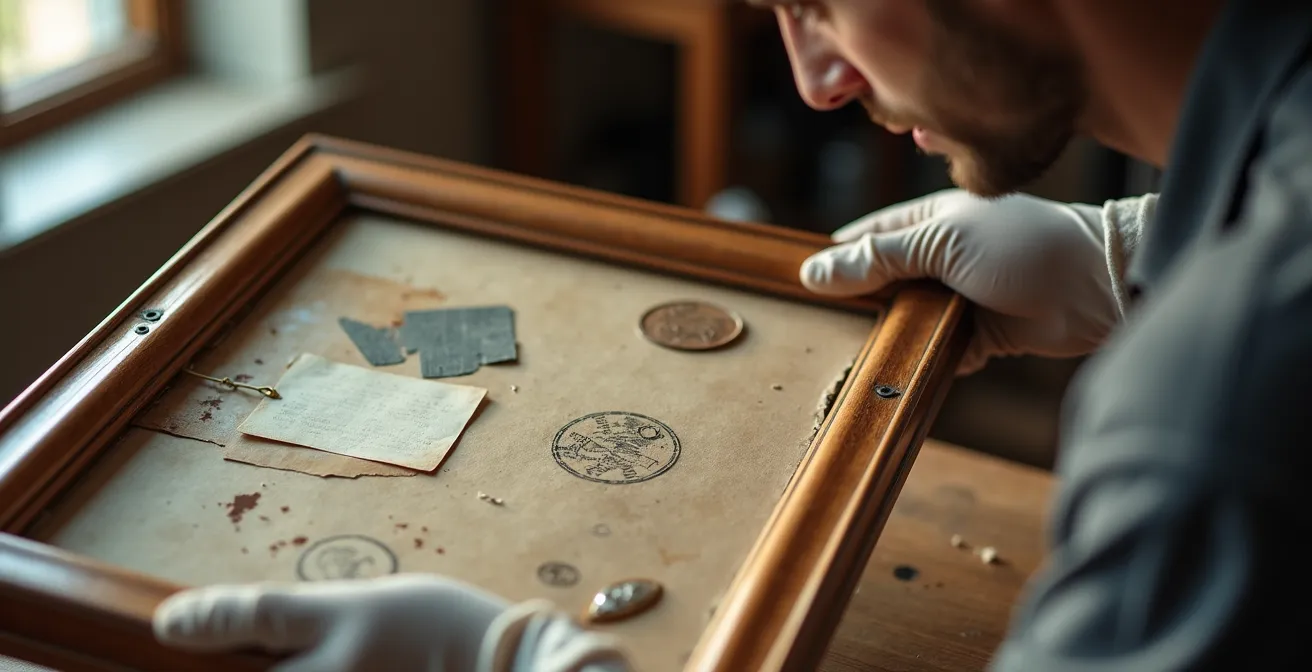
Ultimately, there is no universal rule for which evidence “wins.” The forensic art historian must weigh the credibility of each piece. Is the document specific and corroborated by other sources? Is the stylistic deviation explainable by a different period in the artist’s career? This is where the detective work moves from evidence collection to argument construction, building a case for the most plausible scenario based on the totality of the information available.
Why Certain “Great” Artists Were Ignored for Centuries
The history of art is not a clean, linear progression where genius is always immediately recognized. Many artists now considered masters were obscure in their time or forgotten for generations, only to be “rediscovered” centuries later. Solving the puzzle of their authorship often requires reopening an art historical cold case. The case of Johannes Vermeer is perhaps the most famous. A moderately successful painter in 17th-century Delft, he fell into almost complete obscurity after his death, with his works often misattributed to other artists.
It wasn’t until the 1860s that the French critic Théophile Thoré-Bürger, a political radical and art detective, began a systematic campaign to piece together Vermeer’s oeuvre. He traveled Europe, hunting for the artist’s signature style in different collections and publishing his findings, effectively creating the Vermeer we know today. This story reveals that an artist’s legacy is not a given; it is often constructed by the deliberate efforts of critics, scholars, and dealers who build both a market and a historical narrative simultaneously.
Several factors can lead to an artist’s historical neglect. Geographic bias has been a powerful force, with the art historical centers of France, Germany, and the Anglosphere long overlooking equally brilliant talents from places like Spain or Poland. Furthermore, aesthetic incompatibility plays a role; an artist’s style might be antithetical to the values of a later era, such as the emotionalism of Gothic art being dismissed during the height of Renaissance classicism. The rediscovery is then often driven by a new generation of collectors and scholars whose values align with the forgotten artist’s work, creating fertile ground for a revival.
How to Spot a Gap in Ownership History That Signals Looting
Provenance, the chain of ownership for an artwork, is the backbone of its identity and value. A complete, unbroken provenance is the ideal. However, a gap in this history is not just an academic problem; it can be a critical red flag signaling a dark past, particularly theft or forced sale. For a forensic art historian, scrutinizing the “paper trail” is akin to a detective searching for a missing person, and no period demands more scrutiny than the Nazi era in Europe.
An unexplained gap in a European painting’s ownership record is highly suspicious, but the most suspicious ownership gap spans the years 1933 to 1945. Works that were in Jewish collections before this period and suddenly reappear on the market in Switzerland or elsewhere after 1945 are considered major red flags for potential Nazi looting. Investigating these gaps is a moral and historical obligation. It requires specialized forensic tools and databases designed to track artworks confiscated by the Nazi regime. A diligent researcher must cross-reference auction records, exhibition catalogs, and the physical object itself for tell-tale clues.
The process of investigating a potential looting case involves a specific set of investigative steps. It is a meticulous search for clues that can connect an object back to its rightful owners. This requires navigating a complex web of international databases and historical records, a true demonstration of art historical detective work.
Action Plan: Investigating a Provenance Gap
- Consult Core Databases: Begin by searching comprehensive ownership databases like the Getty Provenance Index and specialized looting databases such as the German Lost Art Foundation and the ERR (Einsatzstab Reichsleiter Rosenberg) database.
- Examine the Physical Object: Look for physical clues on the frame or back of the artwork, such as pre-war Paul Rosenberg exhibition stickers or German collection inventory numbers, which can provide direct links to past ownership.
- Trace the Post-War Path: Investigate any sudden appearance of the artwork on the art market after 1945, particularly in neutral countries like Switzerland, which were common hubs for selling looted art.
- Identify Confiscation Records: Search for the artwork in Nazi confiscation records, which detail items seized by agencies like the ERR. This can provide definitive proof of looting.
- Connect to Pre-War Collections: Work backwards to establish the painting’s location and ownership before 1933, using pre-war exhibition catalogues and collection inventories to build a complete chain of custody.
Micro-Dots vs. Fluid Lines: Using a Loupe to Spot Decals
The most intimate form of forensic analysis happens at the microscopic level. When it comes to authentication, especially of signatures or fine details on decorative arts, the difference between an authentic mark and a forgery can be a matter of microns. A forger can replicate an image, but replicating the *process* and *pressure* of a master’s hand is nearly impossible. This is where the concept of “The Forger’s Tell” comes into play—the subtle, unconscious mistake that betrays the fake.
One of the clearest tells is found in the “psychology of the line.” An authentic signature or hand-painted line, executed by someone with decades of muscle memory, is typically fluid, dynamic, and shows variations in pressure. The artist’s hand moves quickly and confidently. A forger, however, must work slowly and deliberately, carefully copying a form. This results in a line that, under a jeweler’s loupe, appears hesitant, monotonous, and often has a uniform pressure. The difference, as forensic specialists at ArtDiscovery explain, is that a forger must not only use the right materials but also perfectly replicate the unique gesture of the artist, a feat that is exceptionally difficult.
This principle extends beyond signatures to decorative elements, especially on ceramics or furniture. With the advent of printing, decals became a common way to apply complex patterns quickly. Under magnification, a printed decal often reveals a pattern of tiny, uniform dots (a halftone or screen-print pattern). A hand-painted line from the same period, by contrast, will show the bristles of the brush, the pooling of the pigment, and the natural, imperfect flow of a human hand. Spotting these micro-dots versus a fluid, hand-drawn line is often the definitive test to distinguish a mass-produced item from a handcrafted original.
Real or Samson Copy: Decoding the Crossed Swords Mark
Not all copies are created equal, and not all are intended to deceive. The case of Edmé Samson et Cie, a Parisian porcelain firm founded in 1845, presents a unique challenge in attribution. Samson’s workshop specialized in producing high-quality reproductions of 18th-century ceramics from famous manufactories like Meissen, Sèvres, and Chelsea. They often used the original marks, such as Meissen’s famous “crossed swords.” For a novice collector, a Samson piece can be easily mistaken for an 18th-century original. For the forensic historian, distinguishing between them is a masterclass in material analysis.
The key is knowing the “modus operandi” of the Samson workshop and the material differences between 19th-century and 18th-century production. As the porcelain database Gotheborg notes, the telltale points are often in the materials themselves. Samson’s paste was different, and his underglaze blue was typically a darker, more uniform shade than on the originals. The company produced these items not for deception, but to satisfy a booming 19th-century bourgeois demand for Rococo Revival styles.
The following table, based on expert analysis, breaks down the key diagnostic features that separate an authentic 18th-century piece from a 19th-century Samson reproduction.
| Feature | Authentic 18th-century Meissen | 19th-century Samson Copy |
|---|---|---|
| Porcelain paste | Cold, slightly blue-grayish hard-paste | Glassier, creamier soft-paste body |
| Manufacturing flaws | Minor charming flaws (kiln dust, slight asymmetry) | Often ‘too perfect’ due to advanced technology |
| Underglaze blue | Specific period-appropriate tone | Usually darker than originals |
| Market context | Created for aristocracy | Made for 19th-century bourgeois Rococo Revival demand |
Ironically, the story has another twist. Because Samson et Cie’s production was of such high quality and continued until 1969, their mid-to-late 19th-century pieces are now considered valuable antiques in their own right. The investigation, therefore, is not simply about identifying a “fake,” but about correctly placing an object within its proper historical and manufacturing context.
Key Takeaways
- Evidence is Hierarchical, Not Equal: Scientific data (like dendrochronology) often provides a more objective baseline than subjective stylistic analysis.
- Beware of Contextual Blindness: Historical symbols and objects must be interpreted within their original cultural and material context, not through a modern lens.
- Gaps Are Evidence: An unexplained gap in an artwork’s ownership history, especially between 1933-1945, is a significant red flag that demands forensic investigation for potential looting.
Choosing vs. Making: When Selection Becomes the Artistic Act
The entire investigation of authorship is predicated on a simple-sounding question: who is the author? In the 20th and 21st centuries, that question has become profoundly more complex. The very definition of authorship has expanded beyond the traditional idea of the artist’s hand making the work. Today, the act of selecting, arranging, and recontextualizing can be an artistic act in itself, creating a new layer of authorship that the forensic historian must consider.
The world of curating provides a powerful example. When the legendary curator Harald Szeemann organized his seminal 1969 exhibition “When Attitudes Become Form,” his act of choosing and juxtaposing works by various artists became an authored intellectual statement. The exhibition as a whole was Szeemann’s creation, a critical argument made with other people’s art. In this context, Szeemann is an author, and the exhibition is his work. This concept challenges the traditional focus on the individual object and forces us to consider the intellectual framework as a form of creation.
This expansion of “authorship” brings the entire process of attribution full circle. It reminds us that while we have scientific tools and documentary evidence, the final decision of who “authored” a work is ultimately a human judgment, ratified by consensus. It is a conclusion built by recognized authorities who have dedicated their lives to a specific field. As one expert succinctly puts it:
In the art world, the only acceptable attributions are those made by known recognized authorities on the artists to whom those works are being attributed.
– Art Authentication Expert, Art Business authentication guidelines
This does not invalidate the forensic process. On the contrary, it elevates it. The authority’s opinion is valuable precisely because it is built upon a deep understanding of all the conflicting evidence—the science, the documents, the style, and the very philosophy of what it means to create.
The journey of attribution is a complex but rewarding one. It transforms the passive viewing of art into an active investigation. The next time you stand before an unsigned work, don’t just see a picture; see a puzzle. Begin your own inquiry, weigh the evidence, and appreciate the deep, detective-like process that allows us to connect a masterpiece back to its master.