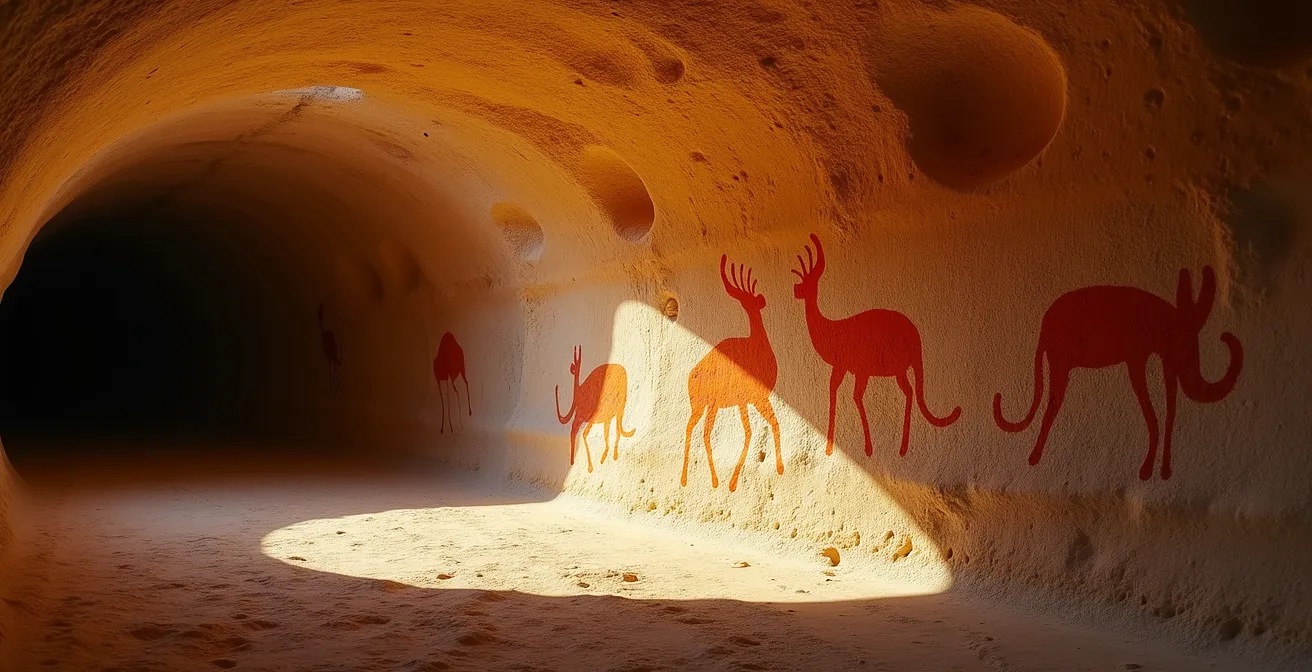
Paleolithic art’s genius lies not in the paintings themselves, but in how they were programmed to perform using the cave wall as a three-dimensional screen.
- Artists deliberately selected uneven surfaces, using bulges and cracks to create sculptural forms that imply movement and volume.
- Flickering light from fat lamps was a key tool, activating “superimposed” figures to create an illusion of animation.
Recommendation: Observe these works not as static images, but as kinetic installations waiting for light to bring them to life.
The enduring image of Paleolithic cave art is often one of stark, silent figures painted on flat stone walls. We marvel at their age and the skill of their depiction, but we tend to view them as static precursors to the history of painting. This perspective, however, misses the most profound innovation of these Ice Age masters. The common discourse focuses on the subjects—bison, horses, mammoths—and the pigments used, but rarely delves into the sophisticated technical relationship between the artist, the surface, and the observer. We discuss the what, but not the revolutionary how.
But what if the rock wall was never intended to be a passive, flat canvas? What if, instead, it was a dynamic partner in the creation, a three-dimensional stage? This is the core of a more revealing perspective: Paleolithic artists were not just painters, but choreographers of shadow, light, and stone. Their true genius lay in their ability to see the latent potential in a cavern’s uneven topography, using its natural contours to engineer movement, depth, and life. They were creating a form of proto-kinetic art, where the perception of animation was deliberately sculpted into the very fabric of the cave.
This article examines this technical mastery. We will explore how these ancient artists sourced their materials with geological savvy, harnessed the physics of light to create motion, and undertook immense physical risks to execute their vision. By analyzing their methods, we uncover a calculated artistic process that transformed inert rock into the world’s first animated screens.
For a visual exploration of these proto-cinematic techniques, the following video delves into the “prehistory of cinema,” complementing the technical analysis in this article.
To fully appreciate this ancient ingenuity, this guide breaks down the key technical and environmental factors that enabled these artists to give life to stone. From the chemistry of their paints to the physics of their light sources, each section reveals another layer of their sophisticated practice.
Summary: The Sculpted Canvas: Engineering Animation in Paleolithic Art
- Manganese and Ochre: Sourcing Colors Without a Supply Chain
- Painting by Fat Lamp: How Flickering Light Created Early Animation
- Male or Female: Decoding the Handprints of 30,000 Years Ago
- Climbing into the Abyss: The Physical Risk of Creating Cave Art
- Dots and Grids: The Undeciphered Code of the Ice Age
- How Human Breath Destroys 20,000-Year-Old Pigments in Minutes
- Mixing with the Eye: Why Placing Colors Side-by-Side Vibrates
- How Artisans Recreate Prehistoric Texture with Millimeter Precision
Manganese and Ochre: Sourcing Colors Without a Supply Chain
The vibrant reds, yellows, and blacks that define Paleolithic art were not mere colors, but a testament to a deep understanding of geology and chemistry. Far from being happenstance, the sourcing of pigments like ochre (for reds and yellows) and manganese oxide (for black) was a deliberate, often arduous, process. These were not materials simply found on the cave floor; they required prospection, extraction, and preparation. This indicates a system of resource management and knowledge transfer that operated entirely without a formal supply chain. The artist was also a geologist and a chemist, understanding which rocks would yield the desired hues and how to process them.
This long-standing relationship with pigments is deeply rooted in human history. In fact, archaeological evidence from South Africa indicates that ochre collection dates back to around 500,000 BC. The Blombos Cave, also in South Africa, provides a stunning glimpse into this ancient technology. There, archaeologists uncovered what can only be described as a 100,000-year-old paint-making workshop. It contained a complete toolkit: hundreds of pieces of ochre, specialized grinding stones crafted from animal bones, and even abalone shells that served as mixing vessels, their surfaces still bearing the residue of ancient paint. This was not primitive dabbling; it was a sophisticated and repeatable manufacturing process.
The final step was combining the ground pigment with a binder to make it adhere to the cave wall. The simplicity of the solution belies its effectiveness. As paleo-technologist Claude Couraud noted after an extensive study of Lascaux’s art:
The binder they used was simply cave water which was really effective because it was rich in calcium carbonate.
– Claude Couraud, 3-year study of Lascaux cave paintings
This calcium carbonate, dissolved in the water, would effectively calcify over the pigment as it dried, bonding it to the stone and ensuring its longevity for millennia. This choice demonstrates an intuitive grasp of local chemistry, turning the cave’s own environment into a key ingredient for preservation.
Painting by Fat Lamp: How Flickering Light Created Early Animation
The true genius of Paleolithic art is kinetic; it was designed to be seen in motion. This effect was not an accident but a deliberate “parietal choreography” engineered through the interplay of uneven surfaces and mobile, flickering light. The primary light source deep within the caves was the animal-fat lamp—a stone bowl filled with rendered fat and a wick. Unlike the static, even glow of a modern lightbulb, these lamps produced a dynamic, dancing flame. The artists understood this property and harnessed it as a primary tool for animation, transforming static figures into living entities.
To achieve this, artists often painted superimposed figures, such as a bison with eight legs instead of four. In the dim, stable light of a museum, this looks like a strange, abstract choice. But when viewed by the moving light of a fat lamp, the magic happens. As the flame flickers, different sets of legs are illuminated in rapid succession, creating a powerful illusion of galloping. The rock wall ceases to be a canvas and becomes a screen. This technique was remarkably common; research from 2003 calculated that nearly one in two animals in French parietal art are represented in movement. The discovery of over 100 stone lamps in the Lascaux cave complex is not a coincidence; it is the archaeological footprint of a full cinematic toolkit.
The image below conceptualizes how these overlapping forms would interact with a single, moving light source to bring the animal to life.
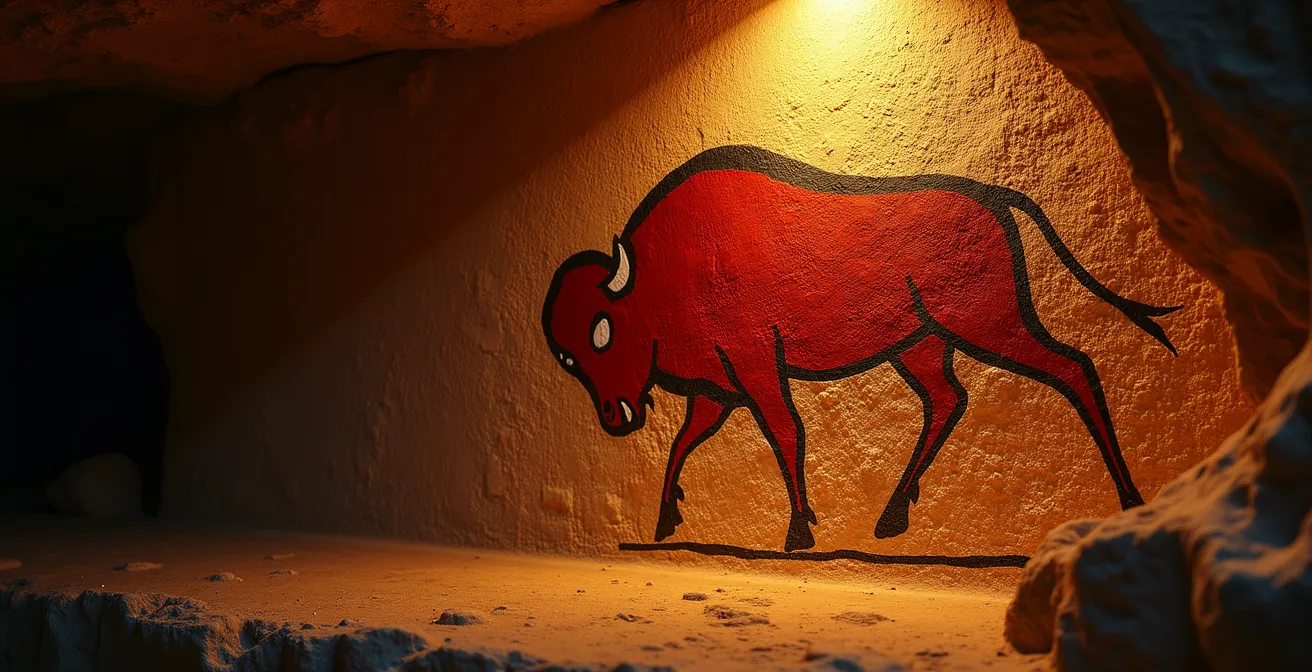
This sculptural painting technique, where the artist leverages the three-dimensional contours of the rock, was central to the animation. A bulge in the stone could be used to represent the powerful shoulder of a bison, making it appear to heave and breathe as shadows cast by the flickering lamp moved across its surface. The artist wasn’t just painting a bison; they were programming a performance that could only be activated by a specific type of illumination.
Male or Female: Decoding the Handprints of 30,000 Years Ago
Among the most evocative and personal images in Paleolithic caves are the hand stencils—outlines created by placing a hand on the wall and blowing pigment around it. For decades, these were assumed to be the marks of male hunters. However, recent analysis of hand morphology suggests that a significant portion, perhaps even the majority, of these handprints belong to women. This re-evaluation shifts our understanding of who these artists were and highlights a more intimate, human connection to the art. The handprint is a signature, a declaration of “I was here,” and its creation is deeply tied to the physical properties of the chosen pigment, ochre.
Ochre was far more than just a paint. Its utility stemmed from its unique physical characteristics. As paleo-anthropologist April Nowell explains, it was the perfect medium for direct human application:
Its vibrant color and ability to adhere to surfaces — including the human body — make it an ideal crayon or paint base.
– April Nowell, University of Victoria, Department of Anthropology
This adhesive quality made it perfect for the spray-painting technique used to create stencils, but it also points to its widespread use as a body paint for rituals, camouflage, or social signaling. The act of painting was not always mediated by a brush; it was often a direct interaction between the body, the pigment, and the stone. This deep symbolic connection between humans and ochre is further underscored by its use in funerary rites. The discovery of the “Red Lady of Paviland,” an ochre-stained ceremonial burial in South Wales, confirms that this profound relationship with red pigment dates back approximately 33,000 years. The hand on the wall is therefore not just a mark, but a symbol of a culture where pigment and human identity were inextricably linked.
Climbing into the Abyss: The Physical Risk of Creating Cave Art
The creation of cave art was not a comfortable studio practice; it was an act of extreme physical commitment, often bordering on mountaineering. Many of the most stunning galleries are located in the deepest, most inaccessible parts of cave systems, far from any natural light. Reaching these locations required navigating treacherous passages, squeezing through narrow constrictions, and descending into dark shafts. The art was not made for casual viewing. Its placement in such dangerous spots suggests it held a powerful ritualistic or shamanistic significance, its value enhanced by the very difficulty of its creation.
The Lascaux cave in France provides a dramatic example of this physical ordeal. To access certain galleries, the artists had to construct scaffolding from wood, which has long since rotted away, leaving only the holes in the walls where the beams were placed. In one instance, creating the images in the “Chamber of Felines” required a perilous journey. The artists had to negotiate the five-meter-deep Southern Shaft at the end of the chamber, likely using ropes, to reach the walls on the other side. This was not a casual undertaking; it was a planned expedition into the earth, undertaken in near-total darkness, with only the faint glow of an animal-fat lamp for guidance.
The effort extended beyond just navigating the caves. The materials themselves often required long-distance travel. For example, it is estimated that cave painters in the Lascaux area may have traveled as far as 25 miles to source specific high-quality manganese and ochre. This level of dedication—risking life and limb in the abyss and trekking for days to acquire the right tools—underscores that this art was a vital, non-negotiable part of their culture. The physical struggle was integral to the artistic process.
Action Plan: Auditing a Cave Surface for Artistic Potential
- Points of contact: Identify all key geological features (bulges, cracks, concavities) that could form part of a figure.
- Collecte: Inventory the way light from a moving source (a fat lamp) interacts with these features, noting shadows and highlights.
- Cohérence: Confront the chosen figure (e.g., a bison) with the rock’s form. Does the bulge suggest a shoulder? Does a crack imply a leg?
- Mémorabilité/émotion: Evaluate the location’s “power.” Is it in a deep, resonant chamber or a narrow, hidden passage? How does this affect a viewer’s experience?
- Plan d’intégration: Strategize the placement of pigment to either enhance or counteract the rock’s natural shape, finalizing the “choreography.”
Dots and Grids: The Undeciphered Code of the Ice Age
While the majestic animal figures capture the imagination, they are often accompanied by a more mysterious set of markings: dots, lines, grids, and other abstract symbols. For a long time, these were dismissed as decorative doodles or random additions. However, recent research suggests they may constitute a form of proto-writing or a sophisticated notation system, adding another layer to the intellectual prowess of these Paleolithic people. These symbols are not random; their placement is deliberate, often appearing in direct association with the animal figures, suggesting they provide context or additional information.
The purpose of this “code” is a subject of intense debate, but compelling theories are emerging. One of the most significant hypotheses, proposed by a research team led by Bennett Bacon, connects these symbols to the natural world. They argue that the marks function as a form of biological calendar.
Lines and dots (and a commonly seen ‘Y’ symbol, proposed to mean ‘to give birth’) on upper palaeolithic cave paintings correlated with the mating cycle of animals in a lunar calendar.
– Bennett Bacon et al., University of Durham research team, 2022
This suggests the artists were not just depicting an animal, but recording crucial information about its behavior—its mating seasons, its birthing periods—all tracked by the phases of the moon. If correct, this represents one of the earliest forms of complex information storage, a direct precursor to written language.
The illustration below shows a detail of such abstract markings, demonstrating their intentional arrangement and proximity to figurative art.
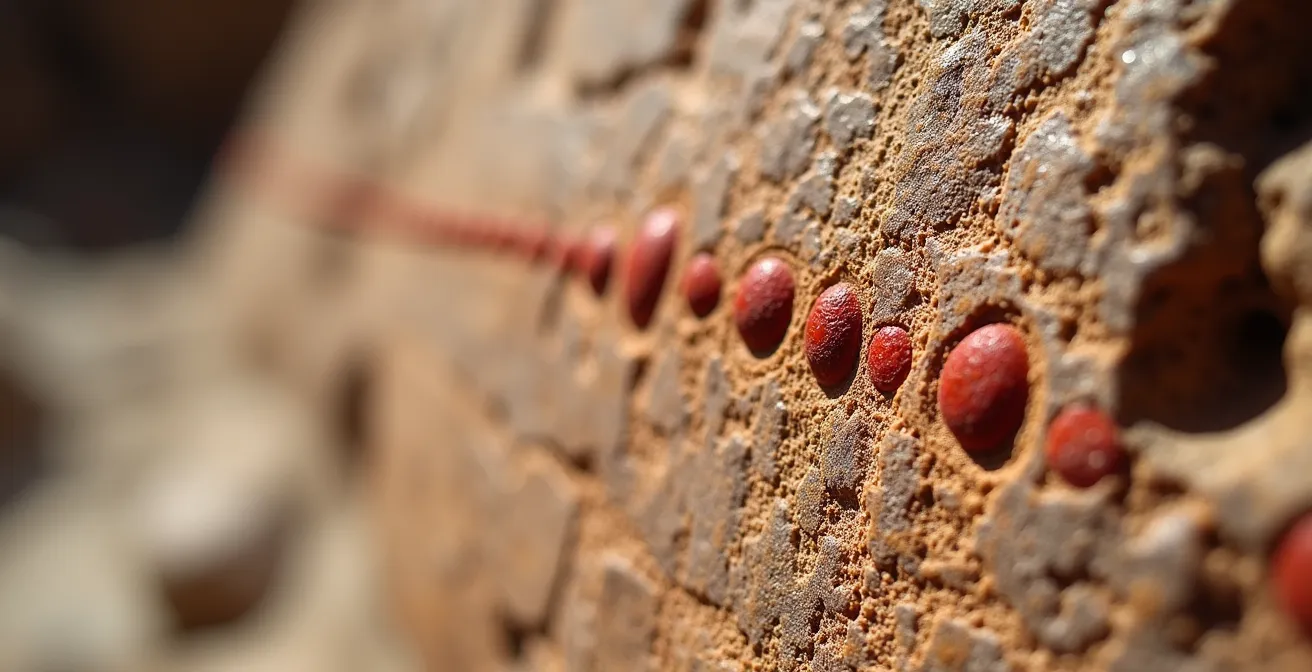
These abstract signs force us to reconsider the purpose of cave art. It may not have been purely representational or shamanistic, but also functional and informational. The artists were not only masters of form and light but also data analysts, observing their environment with scientific precision and creating a system to record and transmit that knowledge across generations. The cave walls may have been humanity’s first databases.
How Human Breath Destroys 20,000-Year-Old Pigments in Minutes
The survival of Paleolithic art for tens of thousands of years is a miracle of environmental stability. The deep caves provided a consistent, cool, and dark environment, free from the UV radiation, temperature fluctuations, and moisture that would have quickly erased them. This delicate equilibrium, however, is extraordinarily fragile. The very act of modern observation, of human presence, can initiate a rapid and irreversible process of decay. The simple act of breathing is one of the most potent agents of destruction.
The most famous and tragic example of this is the original Lascaux cave in France. Discovered in 1940, it was opened to the public in 1948. The daily influx of thousands of visitors introduced heat, humidity from their breath, and artificial lighting. This dramatically altered the cave’s stable atmosphere. The carbon dioxide exhaled by visitors created a corrosive environment, while the increased moisture led to a devastating bloom of algae and fungus. As described in a report on its closure, the caves have been closed to the general public since the 1960s, after over-exposure to carbon dioxide caused damage to the paintings. The “green sickness” and “black mould” that grew on the priceless artworks were a direct result of human presence.
LECACY-INSTRUCTION-FOLLOWING
This dilemma—the desire to see and study the art versus the need to preserve it—is the central challenge for modern paleo-anthropology. With nearly 350 caves containing prehistoric art now discovered in France and Spain alone, the pressure for access is immense. Yet, the lesson of Lascaux is stark: the paintings are a part of a sealed ecosystem. Once that seal is broken, the clock of decay accelerates from a geological timescale to a human one. The breath that signifies our life is a death sentence for these ancient pigments.
Mixing with the Eye: Why Placing Colors Side-by-Side Vibrates
The sophistication of Paleolithic artists extended beyond just form and motion; it also included an intuitive understanding of color theory that would not be formally articulated until the 19th century with the Pointillists. Instead of pre-mixing pigments to create a flat, uniform color, cave artists often employed a technique known as optical mixing. By placing small dots or lines of pure color directly next to each other on the rock surface, they relied on the viewer’s eye to blend them, creating a more vibrant and luminous visual effect than a physically mixed pigment ever could.
This technique is particularly evident in the rendering of animal hides, where artists would use adjacent patches of red, yellow, and black to suggest the complex, multi-tonal nature of fur. From a distance, these separate colors merge in the brain to form a single, richer hue. This “mixing with the eye” creates a sense of vibration and texture that makes the figure feel more alive and three-dimensional. It’s a trick of perception, another example of the artist engineering the viewer’s experience. This was not a limitation of their technology, but a deliberate artistic choice to achieve a specific, lively effect.
As confirmed by analyses of parietal art, the interaction of these optical effects with the three-dimensional rock surface and the dynamic lighting was a core component of the artist’s toolkit. Researchers note that when taking into account the mobile lighting and the use of the rock’s relief, it’s reasonable to assume the images were intentionally designed to appear animated. The use of optical mixing was another layer in this system of engineered perception, designed to activate the image in the mind of the observer. This demonstrates a level of artistic and psychological insight that is astonishingly modern.
Key Takeaways
- Rock surfaces were not flat canvases but active, three-dimensional partners in the creation of Paleolithic art, with their contours used to sculpt figures.
- Flickering light from fat lamps was a deliberate tool used to activate superimposed figures, creating an engineered illusion of movement.
- The creation of this art involved immense physical risk and detailed planning, from sourcing pigments across long distances to reaching dangerously inaccessible locations.
How Artisans Recreate Prehistoric Texture with Millimeter Precision
How can we ever hope to experience cave art as it was intended, now that the original sites like Lascaux are sealed for their own protection? The answer lies in an extraordinary fusion of cutting-edge technology and traditional craftsmanship. The creation of Lascaux IV, the most recent and faithful replica, is a monumental undertaking that reveals as much about our own technology as it does about Paleolithic mastery. The process begins with an incredibly high-resolution 3D laser scan of the original cave, capturing every nuance of the rock surface. This digital model then serves as the blueprint for recreating the cave’s topography.
The physical recreation is a marvel of precision. A team of 25 artists spent two years meticulously hand-painting over 900 meters of resin rock reproductions. To ensure absolute authenticity, these modern artisans used the very same pigments—ochre, manganese, and charcoal—that their counterparts used 20,000 years ago. This painstaking work is not just about copying images; it is about recreating the exact texture and feel of the original. The artists had to learn to replicate the gestures, the pressure, and the techniques of the Ice Age masters, essentially becoming Paleolithic painters themselves. The entire project was an exercise in reverse-engineering ancient genius.
The goal of this meticulous recreation is to allow visitors to experience the “sculptural painting” of the original. By faithfully reproducing the rock’s three-dimensional surface, the replica allows the interplay of light, shadow, and contour to be seen once more. It is the closest we can come to witnessing the “parietal choreography” without endangering the fragile originals. This process highlights a fundamental truth: to understand this art, one must understand the surface it was painted on. The replica’s success is measured not just in its visual similarity, but in its ability to reproduce the intended kinetic experience.
To fully appreciate this ancient ingenuity, the next step is to look at any reproduction or image of cave art not as a picture, but as a blueprint for a performance. Seek out the contours, imagine the moving light, and you will witness the birth of cinema, sculpted in stone.