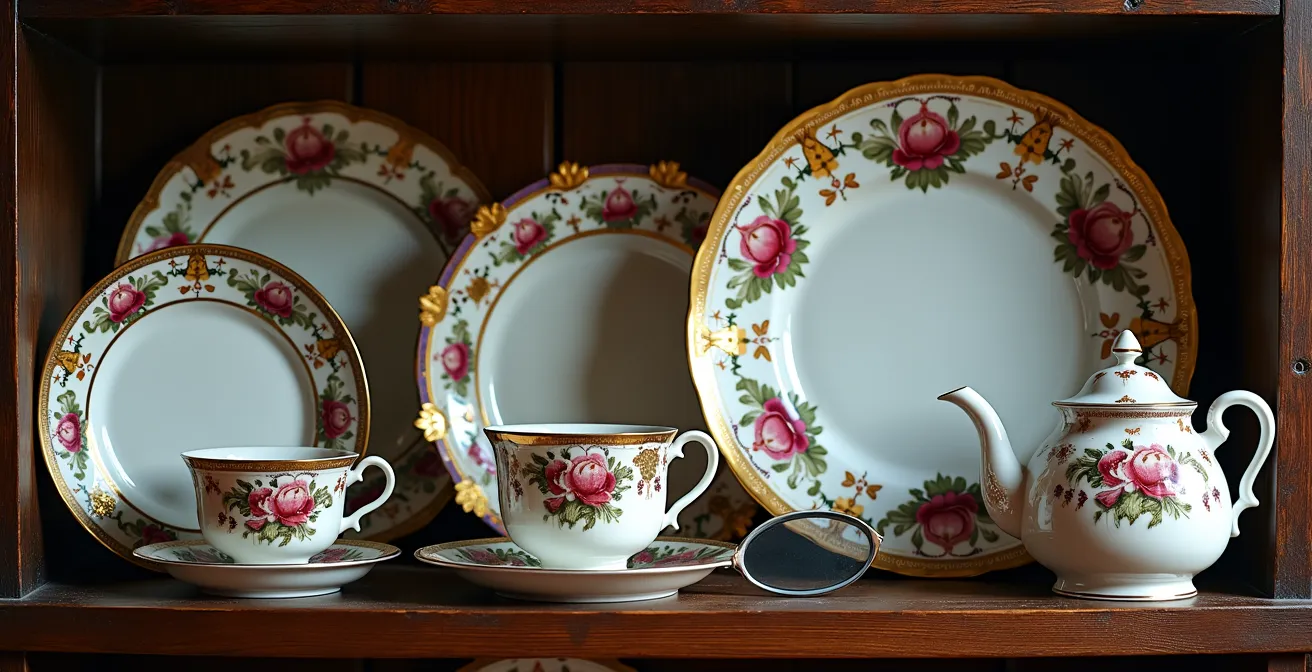
The safety of vintage dishware is not a simple yes/no question; it’s a complex risk assessment of hidden chemical and physical dangers that go far beyond lead.
- Acidic foods (like tomato sauce or citrus) can leach heavy metals from unstable, pre-regulation glazes.
- Thermal shock from modern appliances like microwaves can cause porous earthenware to shatter violently.
- Fine surface cracks, known as “crazing,” can become a breeding ground for harmful bacteria that washing cannot remove.
Recommendation: Treat any dish made before the 1980s, especially if brightly colored or showing wear, as a decorative item unless it has been professionally tested and proven food-safe.
That beautiful, patterned plate inherited from your grandmother is a tangible piece of family history. The temptation to use it for a special occasion is strong, but a nagging question often holds us back: is it actually safe? Most advice on this topic begins and ends with a single word: lead. While lead poisoning is a significant and valid concern, a toxicologist’s view reveals a more complex landscape of risk. The true measure of an antique plate’s safety lies not just in its composition, but in its glaze integrity and its reaction to the modern world.
Focusing solely on lead overlooks other critical dangers. The very chemistry of vintage glazes, the porosity of the ceramic body, and the presence of other heavy metals like arsenic and cadmium present a trifecta of concerns. These risks are not always visible to the naked eye and can be activated by seemingly innocent actions, such as serving a salad with a vinaigrette dressing or attempting to warm leftovers in the microwave. The question isn’t just “Does this plate contain lead?” but rather, “Under what conditions could this plate become hazardous?”
This article provides a fact-based framework for evaluating these risks. We will move beyond the common platitudes and dissect the specific chemical, physical, and biological dangers that may be hiding in your heirloom china. By understanding the science behind why these beautiful objects can be treacherous, you can make an informed decision about whether to use, display, or discard them, ensuring you protect both your health and your heritage.
To help you navigate these considerations, this guide breaks down the key risk factors. We will examine how everyday foods can become a chemical trigger, why modern appliances are incompatible with older materials, and what those tiny cracks in the glaze really mean for your health.
Summary: Evaluating the True Safety of Vintage Dinnerware
- The Acid Test: Why Lemon Juice Is Dangerous on Old Glazes
- Microwave or Ruin: Why Earthenware Explodes in Modern Appliances
- The Crackle Net: Is Bacteria Hiding in Your Vintage Teapot?
- Look for the Fork: Decoding Food Safety Symbols on Pottery
- Why Stacking Plates Wet Creates “Pottery Rot”
- Beautiful but Deadly: The Health Cost of 18th Century Gilding
- Arsenic and Lead: The Deadly Cost of Bright Colors
- Hoarder or Collector: When Does Ornamentation Become Clutter?
The Acid Test: Why Lemon Juice Is Dangerous on Old Glazes
The primary chemical risk associated with vintage dishware is the leaching of heavy metals from the glaze into food. This process is not constant; it is dramatically accelerated by acid. Foods like tomato sauce, citrus juices, coffee, and vinegar-based dressings act as solvents, breaking down the unstable chemical bonds in older, unregulated glazes. A plate that is relatively inert when holding dry bread can become a source of contamination when serving a caprese salad. This is because the glaze integrity on pre-1970s ceramics was not designed to withstand such chemical attacks.
The danger is not theoretical. In 2021, the New York Health Department investigated 15 cases of lead poisoning directly linked to the use of traditional imported ceramics. The lead levels found were thousands of times higher than what is considered acceptable. While modern, food-safe dishware is manufactured to be vitrified and non-reactive, older pieces may have glazes that are little more than a thin, decorative, and often toxic, coating. The FDA currently limits leachable lead in new dishes to 3.0 micrograms per milliliter, a standard most antique pieces were never designed to meet.
Assessing the risk requires understanding the acidity of your food. A simple framework can help guide your choices if you are considering using vintage pieces:
- High Risk (Avoid at all costs): Tomato sauce, citrus juices (lemon, orange), wine, coffee, and vinegar-based dressings.
- Medium Risk (Use with extreme caution): Tea, sodas, fruit preserves, and pickled foods.
- Lower Risk (Still not recommended): Dry foods such as bread, crackers, cookies, and nuts.
- Safest Use: For display purposes only, or as charger plates placed underneath modern, food-safe plates.
Ultimately, any food with a low pH poses a threat when placed on a compromised or unregulated glaze. The more acidic the food and the longer the contact time, the greater the amount of leachable metals that can migrate into your meal.
Microwave or Ruin: Why Earthenware Explodes in Modern Appliances
Beyond chemical dangers, antique ceramics present significant physical risks when introduced to modern kitchen technology, particularly the microwave. The iconic “not microwave safe” warning is not just a suggestion; it’s a matter of material science. Many older ceramics, especially porous types like earthenware, are prone to catastrophic failure due to thermal shock. This occurs when a material is subjected to a rapid and extreme change in temperature, causing it to expand and contract unevenly, leading to fractures or even explosions.
This phenomenon is primarily caused by the material porosity of the ceramic body. Over years of use and washing, tiny, invisible pores in the clay absorb moisture. When placed in a microwave, this trapped water rapidly heats up and turns into steam. The steam expands, creating immense internal pressure that the ceramic body cannot withstand. An analysis of ceramic failures shows that thermal shock occurs in pottery when exposed to rapid temperature changes of 100°C or more, a differential easily achieved in a microwave.
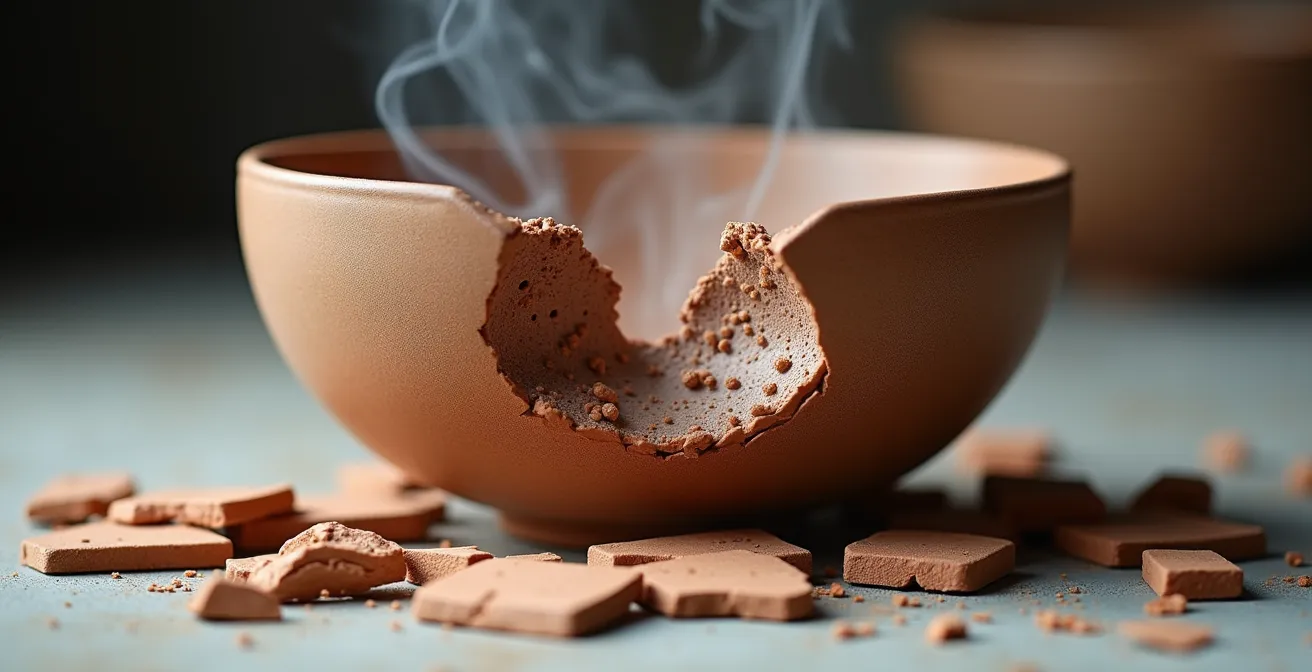
As the image clearly demonstrates, the result is not a clean break but a violent shattering that can damage your appliance and create a significant safety hazard. This risk is not limited to microwaves. Pouring boiling water into a cold vintage teapot or taking a ceramic casserole dish from the refrigerator directly to a hot oven can produce the same effect. Unlike modern stoneware or porcelain, which are fired at high temperatures to become vitrified (glass-like) and non-porous, older earthenware remains fundamentally absorbent and vulnerable.
The Crackle Net: Is Bacteria Hiding in Your Vintage Teapot?
A common feature on many antique ceramic pieces is a fine network of spiderweb-like lines across the surface. This is known as “crazing,” and while it can be aesthetically pleasing, it is a significant food safety concern. Crazing occurs when the glaze and the ceramic body shrink at different rates during cooling after being fired. These are not deep structural cracks, but a vast network of micro-fissures in the glaze layer itself. The primary danger here is not chemical, but biological: bacterial harboring.
These tiny cracks create a perfect, protected environment for bacteria to grow. Normal washing, even in a dishwasher, may not be sufficient to penetrate and sanitize this intricate network. Over time, a heavily crazed surface can accumulate a biofilm of potentially harmful bacteria from food residue. The U.S. Food and Drug Administration (FDA) takes a cautious stance on this. As they state in their official guidelines, “We do not recommend not using old ware unless it shows signs of deterioration such as cracking or pitting of the glaze. This could be a sign that the glaze is disintegrating and could allow lead to leach into food.” While their primary concern here is lead, the presence of these cracks is a clear indicator of compromised glaze integrity.
It is crucial to distinguish between cosmetic crazing and dangerous structural cracks. A simple tap can often reveal the difference. A plate with only surface crazing will typically produce a clear, ringing sound, whereas a structurally cracked plate will emit a dull thud. The following table helps outline the key distinctions:
| Feature | Crazing (Surface Only) | Structural Cracks (Dangerous) |
|---|---|---|
| Appearance | Fine network pattern, spider web-like | Single deep lines, often straight |
| Depth | Glaze only | Through the ceramic body |
| Sound when tapped | Clear ring | Dull thud |
| Food safety risk | Moderate (bacteria harbor) | High (structural failure + contamination) |
Look for the Fork: Decoding Food Safety Symbols on Pottery
When evaluating modern dishware, consumers can rely on standardized symbols to determine if a product is food-safe. The most common is the international “food safe” symbol, which depicts a wine glass and a fork. This mark certifies that the material is suitable for contact with food and will not release harmful substances. Other symbols indicate whether a piece is microwave-safe, dishwasher-safe, or freezer-safe. The problem with antique ceramics is simple: none of these symbols will be present, because the regulatory framework that created them did not exist when the items were made.
The turning point for dishware safety in the United States was 1971. It was then that the FDA began regulating lead levels in dishware, establishing the first-ever limits on leachable metals. Regulations were further strengthened in 1992, and states like California enacted even stricter rules with Proposition 65 in 1986. Any ceramic piece manufactured before these dates, especially before 1971, was made without any legal obligation to be food-safe. The focus was on aesthetics and durability, not toxicology.
This lack of regulation means that every vintage piece must be treated with suspicion. Since you cannot rely on symbols, you must become a detective, using visual and historical clues to assess risk. This involves looking for signs of wear, identifying the manufacturer and production era if possible, and understanding the inherent risks of certain colors and styles.
Your 5-Point Audit Checklist for a Vintage Plate
- Provenance Check: Identify the maker’s mark and approximate date of manufacture. Is it pre-1971? If the origin is unknown or from a region with lax regulations, assume it is not food-safe.
- Surface Integrity Scan: Under bright light, examine the entire surface for chips, deep cracks, and crazing. Pay special attention to the food-contact area. Any break in the glaze is a potential pathway for contamination.
- Color and Decoration Assessment: Note the presence of bright colors (especially red, orange, and yellow) or metallic gilding. These are high-risk indicators for lead, cadmium, or arsenic. Is the decoration on top of the glaze or under it? Over-glaze decorations are more likely to wear and leach.
- Material Type Identification: Tap the plate. Does it have the high, clear ring of porcelain/stoneware or the dull thud of porous earthenware? Earthenware is a higher risk for both bacterial growth and thermal shock.
- Final Use Decision: Based on the risks identified, make a clear decision. If any red flags are present (pre-1971, bright colors, damage), relegate the piece to decorative use only. The default position must always be “display, don’t serve.”
Why Stacking Plates Wet Creates “Pottery Rot”
Proper care and storage are paramount to preserving antique ceramics, not just for aesthetic reasons but also to prevent long-term degradation that can increase health risks. A common and destructive mistake is stacking plates, especially earthenware, while they are still slightly damp. This practice traps moisture between the pieces, creating an alkaline environment that can lead to a condition known as “pottery rot” or glaze sickness. This is a slow-moving chemical reaction that clouds, pits, and ultimately weakens the glaze.
This trapped moisture, combined with alkaline residues from detergents, slowly attacks the silica in the glaze. The result is a hazy, iridescent, or milky appearance that cannot be washed off. Once this process begins, it is irreversible. A compromised glaze is not only visually unappealing but is also more porous and more likely to leach heavy metals and harbor bacteria. The ideal storage method, therefore, is one that allows air to circulate freely around each piece.
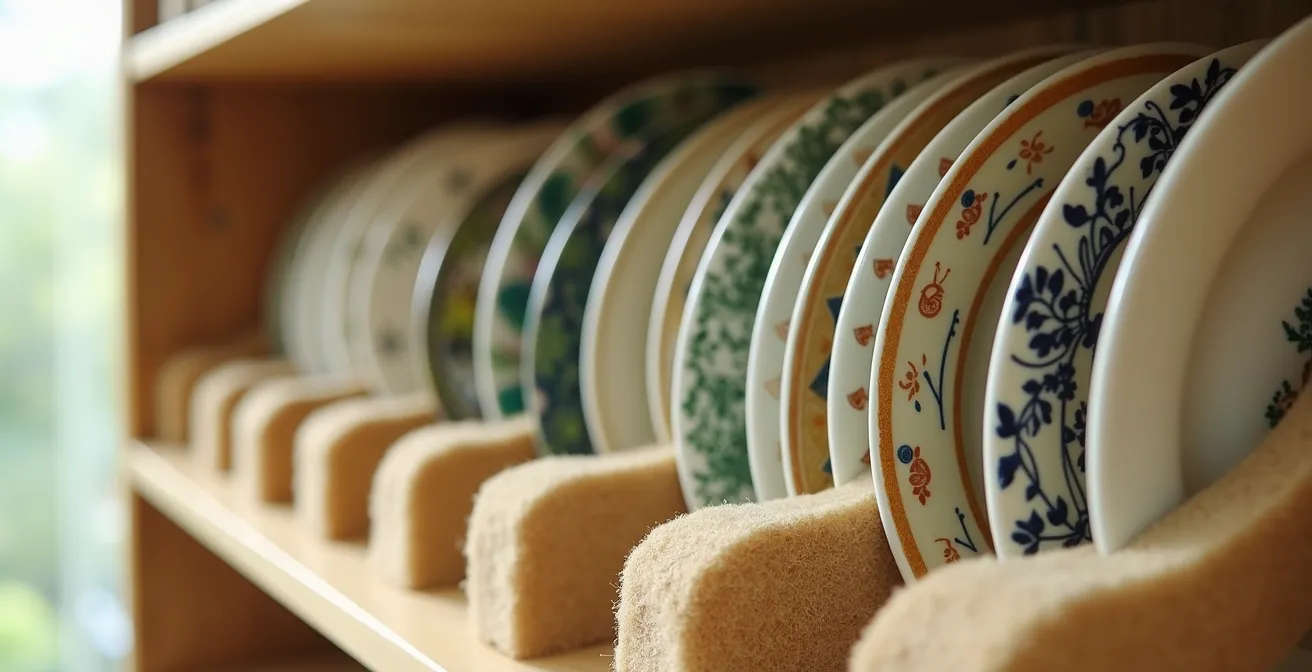
The gold standard for preservation can be found in museum practices. Museums are tasked with preserving ceramics for centuries and have developed precise protocols to prevent this type of decay.
Case Study: Professional Museum Storage Methods
To prevent glaze degradation, museums store ceramic artifacts in controlled environments with stable humidity levels (typically 45-55% RH). According to conservation experts, pieces are never stacked directly on top of one another. Instead, they are stored vertically in padded racks or, if stacked, are separated by acid-free felt or padding. This prevents moisture from being trapped and ensures that the weight of the collection does not put pressure on the pieces at the bottom, which could cause stress fractures over time.
For the home collector, this means always ensuring plates are bone dry before they are put away. Storing them vertically in a plate rack is the best option. If you must stack them, place a soft, breathable divider like a felt round or even a simple paper towel between each plate to absorb any residual moisture and prevent the glaze-on-glaze contact that accelerates wear.
Beautiful but Deadly: The Health Cost of 18th Century Gilding
The allure of antique china often lies in its ornate decoration, from delicate floral patterns to lavish gold or platinum trim. However, these decorative elements, particularly metallic gilding from the 18th and 19th centuries, are a significant source of heavy metal contamination. The gold trim on your great-grandmother’s teacups is likely not just gold; it’s often fixed to the ceramic with a lead-based flux to help it adhere during firing and to achieve a brilliant shine. As this gilding wears, chips, or is exposed to acidic substances, it can release lead directly onto the food-contact surface.
This risk is not confined to gilding. Brightly colored pigments used in over-glaze decorations are also major culprits. As Dr. Diane Calello, executive and medical director of the New Jersey Poison Control Center, explains, “Lead is typically found in highly pigmented paints and lacquers or sealants used in ceramic dishware.” These decorative layers are often the most vulnerable part of the plate, as they sit on top of the main glaze and are directly exposed to utensil scratches and chemical wear.
Lead is typically found in highly pigmented paints and lacquers or sealants used in ceramic dishware.
– Diane Calello, Executive and Medical Director, New Jersey Poison Control Center
The prevalence of lead in older items is staggering. In a parallel to old household paint, it’s estimated that a vast majority of ceramics made before modern regulations contained lead. One analysis suggests that, similar to pre-1940s homes, an estimated 87% of dishware made before 1940 contains lead. Any piece with visible wear on its metallic or brightly colored decorations should be considered a high-risk item and immediately retired from food service.
Arsenic and Lead: The Deadly Cost of Bright Colors
While lead is the most well-known toxin in vintage ceramics, it is far from the only one. The brilliant colors that make antique pottery so visually appealing were often created using a cocktail of highly toxic heavy metals. Before the advent of modern, stable pigments, potters used whatever minerals and chemical compounds were available to achieve vibrant hues. This means a plate’s color can be a direct indicator of its potential toxicity.
The iconic bright red-orange of early Fiestaware, for example, was produced using uranium oxide. While the company has been lead-free since 1986, the vintage “Radioactive Red” pieces (1936-1943) are a well-known collector’s item with measurable radioactivity. The EPA states no ceramic containing uranium should be used for food or drink. Other colors pose even more severe threats. Scheele’s Green, a popular bright green pigment in the 18th and 19th centuries, was made with copper arsenite—a compound of copper and highly toxic arsenic. Yellows and oranges were often created with lead and cadmium, another dangerous heavy metal.
Case Study: Fiestaware’s “Radioactive Red”
The Homer Laughlin China Company’s Fiesta line is famous for its bold, solid colors. Its most notorious color, the original “Fiesta Red,” produced from 1936 to 1943, derived its vibrant orange-red hue from uranium oxide in the glaze. While the radiation levels are low and generally considered safe for handling, the EPA explicitly advises against using any ceramics containing uranium to hold food or beverages due to the potential for particle ingestion. This serves as a stark reminder that a plate’s beauty can conceal invisible dangers.
The following table provides a general guide to the toxic elements historically associated with specific colors in ceramics made before the 1970s.
| Color | Toxic Element | Historical Period | Health Risk Level |
|---|---|---|---|
| Bright Red/Orange | Lead, Cadmium, Uranium | Pre-1970s | Very High |
| Yellow | Lead, Antimony | Pre-1970s | High |
| Green (e.g., Scheele’s) | Arsenic | 18th-19th century | Extreme |
| Cobalt Blue | Lead (in glaze flux) | Various periods | Moderate to High |
Key Takeaways
- Chemical Risk: Acidic foods can leach heavy metals like lead, cadmium, and arsenic from unstable, pre-regulation glazes. The older and more colorful the plate, the higher the risk.
- Physical Risk: Antique earthenware is often porous and cannot withstand the thermal shock of microwaves or extreme temperature changes, leading to shattering.
- Biological Risk: Surface crazing (fine cracks) can harbor harmful bacteria that regular washing cannot remove, posing a continuous risk of foodborne illness.
Hoarder or Collector: When Does Ornamentation Become Clutter?
After methodically evaluating the chemical, physical, and biological risks, a clear pattern emerges: the vast majority of antique or vintage ceramics are not suitable for serving food by modern safety standards. The potential for heavy metal leaching, bacterial growth, and catastrophic failure is simply too high to justify the risk. This shifts the owner’s role from that of a user to that of a custodian. The question is no longer “Can I eat off this?” but “How do I best preserve and appreciate this object?”
This is where the line between a curated collection and simple clutter is drawn. A collector understands the history and limitations of their pieces. They take deliberate steps to preserve them, using methods like vertical storage with padded dividers and displaying them safely behind glass or on walls, away from the risks of the kitchen. A hoarder, by contrast, might accumulate pieces without regard for their condition or proper care, leaving them stacked in dusty piles where they are at risk of damage and decay. True appreciation lies in honoring the object for what it is: a fragile artifact from another time.
Many antique experts share this preservation-first philosophy. The safest, and arguably most respectful, way to enjoy heirloom dishware is to incorporate it into your home’s decor.
Personally, I’d rather admire vintage dishware as a decorative item than use it for mealtime.
By treating these beautiful plates as art, you eliminate all health risks while ensuring that the piece of family history they represent can be safely enjoyed by generations to come. The final decision is a risk-benefit analysis, and from a toxicologist’s perspective, the benefits of using a potentially hazardous plate for a single meal rarely outweigh the potential for long-term harm.
Your beautiful heirloom china deserves to be cherished, but its place is on the wall, not on the dinner table. Applying this rigorous, science-based risk assessment to your collection is the most responsible way to honor your heritage while protecting your health.