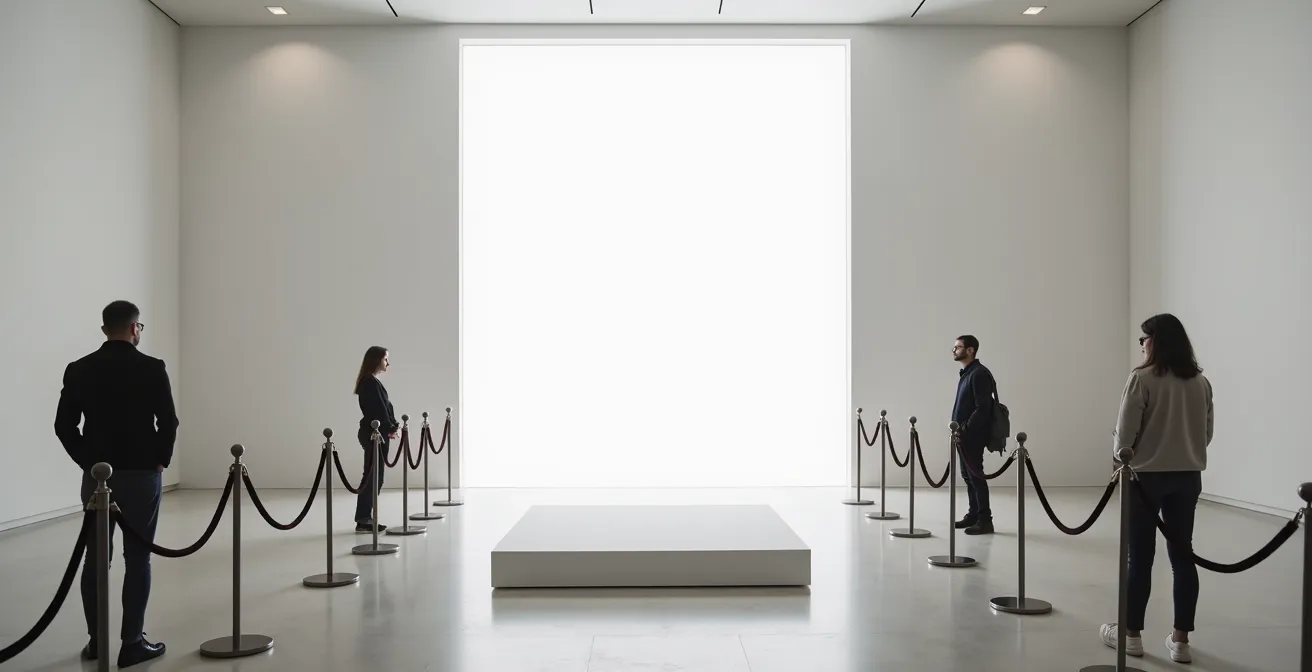
The artistic value of an object like Duchamp’s urinal lies not in its physical creation, but in the conceptual and institutional framework that validates it as art.
- The act of selecting and re-contextualizing an object can be a more powerful artistic statement than crafting it by hand.
- An object becomes “art” when it operates within a system of galleries, museums, and critical discourse that grants it that status.
Recommendation: Instead of asking “Is it well-made?”, ask “What idea does this object activate?” when you next encounter a challenging piece of modern art.
It can feel like an elaborate joke at your expense. You walk into a pristine gallery, past meticulously rendered oil paintings and elegant sculptures, only to be confronted by an ordinary, mass-produced object: a urinal, a pile of bricks, a simple bicycle wheel. The immediate, rational response for many is a mix of confusion and indignation. “I could have done that,” you might think. “This isn’t skill; it’s a scam.” This skepticism is not only common; it is a perfectly logical reaction to a century of art that has deliberately sought to dismantle the very definitions we rely on.
The conventional wisdom often retreats into vague platitudes: “art is subjective” or “it’s about the idea.” While not entirely false, these answers are unsatisfying because they fail to address the core of the skeptic’s complaint. They don’t explain the *mechanism* by which an everyday object is successfully transmuted into a priceless cultural artifact. The discomfort arises from a perceived violation of an unwritten contract: that art should demonstrate craft, beauty, and a unique vision born from the artist’s hand.
But what if the true revolution of modern art was not about creating new kinds of objects, but about creating a new system for seeing them? This article proposes a different framework for understanding. We will argue that art is not an intrinsic quality of an object, but an operational status conferred upon it by a system of belief, context, and language. Using Marcel Duchamp’s 1917 work, Fountain, as our guide, we will deconstruct how the act of choosing, the power of the institution, and even the controversy an object generates become the primary artistic media. We will move beyond the object itself to examine the invisible architecture that holds it up.
This exploration will provide you with a new set of tools for interpretation. By examining the roles of selection, context, and even non-physicality, you will gain a deeper understanding of the philosophical questions that have shaped the last century of art, allowing you to engage with challenging works not as a skeptic, but as an informed participant in the conversation.
Summary: Deconstructing the Rules of the Art Game
- Choosing vs. Making: When Selection Becomes the Artistic Act
- Why a Pile of Bricks Is Art in the Tate but Rubble Outside
- Art Without a Product: Buying an Experience or a Memory
- Brancusi’s Bird: When US Customs Taxed Art as Raw Metal
- Piss Christ to Sharks: Why Controversy Is a Medium
- When Does an Avant-Garde Become Kitsch?
- Writing About Your Work: Why “It Means Whatever You Want” Is a Bad Answer
- How to Collect Art That Doesn’t Exist in the Physical World
Choosing vs. Making: When Selection Becomes the Artistic Act
The fundamental objection to a work like Fountain is that the artist didn’t “make” it. This critique, however, presupposes that art is synonymous with manual craft. Duchamp’s radical proposition was to argue that the artist’s most crucial contribution is not physical labor but a conceptual decision. The “readymade,” as he termed these found objects, shifted the artistic act from fabrication to selection, from the hand to the mind. He forced the question: Is the art in the object itself, or in the thought that re-frames it?
This was not a gesture of laziness but a profound philosophical inquiry. In a statement defending the work, it was argued on Duchamp’s behalf that the choice itself was the creative act. As his supporters wrote in the journal The Blind Man in 1917, “Whether Mr Mutt with his own hands made the fountain or not has no importance. He CHOSE it.” This single act of selection performed a powerful transformation. By taking a urinal, stripping it of its utilitarian function, placing it on a pedestal, and giving it a new title, Duchamp “created a new thought for that object.” The art was not the porcelain but the conceptual transference from the world of plumbing to the world of aesthetics.
This elevation of choice over craft has found a powerful echo in the digital age. Contemporary debates around AI-generated imagery wrestle with the same philosophical problem. Is the artist the one who codes the algorithm, or the one who masterfully writes the prompt that guides it? When recent statistics show that nearly one-third of digital artists use AI tools, it highlights a broad acceptance of selection and direction as legitimate creative acts. In this light, Duchamp wasn’t just signing a urinal; he was writing the first “prompt” in a century-long conversation about where artistic value truly originates.
Why a Pile of Bricks Is Art in the Tate but Rubble Outside
If the artist’s choice initiates the process, it is the context that completes it. An object’s status as art is not inherent but is conferred upon it by the institutional framework in which it is presented. A urinal in a hardware store is plumbing. The same object in a museum, under gallery lighting and accompanied by a wall label, is Fountain. This power of context is precisely what Duchamp was testing. The Society of Independent Artists, which was supposed to accept any work submitted by an artist for a fee, famously rejected Fountain from their 1917 exhibition. This act of institutional rejection proved Duchamp’s point perfectly: the boundary between an ordinary object and an art object is policed by the very institutions that claim to be open.
This phenomenon is often called the “institutional theory of art.” It posits that an artwork is an artifact that a representative of the “art world” (a curator, collector, critic) has designated for appreciation. Carl Andre’s Equivalent VIII (1966), a minimalist arrangement of 120 firebricks, sparked public outrage when the Tate gallery acquired it. Outside the museum, it is a pile of bricks. Inside, it becomes a meditation on form, material, and industrial repetition. The object doesn’t change, but its function and meaning are entirely transformed by its environment. The gallery acts as a kind of secular church, sanctifying the objects within it and instructing us on how to perceive them.
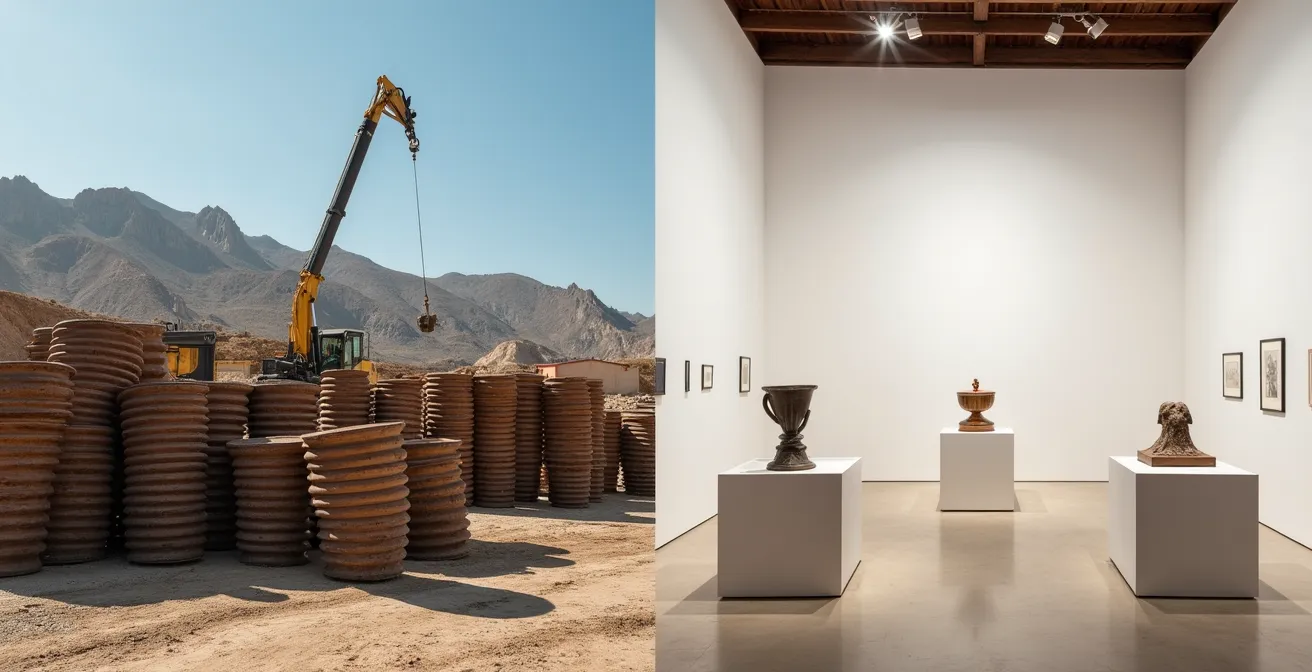
The journey of Fountain itself is the ultimate case study. After its rejection, the photographer Alfred Stieglitz displayed it in his studio and photographed it, and the image was published in the art journal The Blind Man. Through this sequence—selection by artist, rejection by one institution, and validation by another (a respected photographer and a publication)—a piece of plumbing was cemented as one of the most iconic artworks of the 20th century. The art world, even in its attempt to expel the object, ended up creating the very linguistic and contextual scaffolding needed to make it art.
Art Without a Product: Buying an Experience or a Memory
Duchamp’s readymades opened a Pandora’s box: if art is an idea more than an object, does it need to have a physical form at all? This question gave birth to Conceptual Art, a movement where the concept or instruction is the work itself. Artists began creating pieces that existed only as a set of directions, a fleeting performance, or a conversation. This is perhaps the most challenging frontier for a skeptic, as it asks us to value something that is entirely intangible.
The artist Tino Sehgal, for example, creates “constructed situations” that are enacted in galleries by trained interpreters. These works exist only in the moment of their performance and in the memory of the viewer. No photography or physical documentation is allowed. When a museum or collector “acquires” a Sehgal piece, they are not buying an object; they are buying a certificate of authenticity and the legal right to re-stage the work according to the artist’s precise instructions. The contract and the concept are the artwork. This model proves that the art market has developed sophisticated mechanisms for commodifying pure ideas, validating them through the same institutional frameworks that validate paintings and sculptures.
This logic is no longer as foreign as it once seemed. The rise of the digital art and NFT market operates on a nearly identical principle. A collector who purchases an NFT is not typically buying the sole copy of a digital file—which can be endlessly duplicated—but is buying a cryptographically secured token on a blockchain that serves as an unforgeable certificate of ownership. The value resides in this authenticated proof of ownership, not in the exclusivity of the image file. When the market for intangible art reached new heights when the highest-value AI-generated NFT sold for $1.1 million, it demonstrated a widespread acceptance of owning concepts. In both cases, value is derived from originality of the idea, the artist’s reputation, and the aesthetic agreement that the certificate represents a legitimate claim to the work.
Brancusi’s Bird: When US Customs Taxed Art as Raw Metal
The question of “what is art?” is not merely a philosophical debate; it has significant legal and financial consequences. The struggle to define art in the modern era was fought not just in galleries, but also in courtrooms. A pivotal case that paralleled the conceptual challenge of Fountain was the legal battle over Constantin Brancusi’s sculpture, Bird in Space. In 1926, the work was shipped to the United States for an exhibition, but customs officials refused to classify it as a duty-free work of art. Because the sleek, abstract bronze form bore no resemblance to a literal bird, they classified it as a “kitchen utensil or hospital supply” and imposed a 40% tariff based on the value of its raw metal.
The ensuing court case, Brancusi v. United States, became a landmark trial on the legal definition of art. The prosecution argued that for an object to be sculpture, it must be an “imitation of a natural object.” Brancusi’s defense brought in a parade of artists, critics, and collectors who testified that the art world had moved beyond such a narrow definition. They argued that the work’s aesthetic value, its formal purity, and the artist’s intent were what qualified it as art. Ultimately, the court sided with Brancusi, ruling that art did not need to be representational. The decision legally acknowledged that an object’s artistic status is determined by the standards and consensus of the art world, not by its likeness to the physical world.
This case and Duchamp’s gesture are two sides of the same coin. Both incidents revealed that the operational status of “art” is a negotiated settlement between an artist’s proposition and an institutional system’s acceptance. Fountain challenged the definition from within the art world, while Bird in Space forced the legal system to catch up with that definition. In both instances, the object’s claim to be art was not self-evident; it had to be established through discourse, expert testimony, and institutional recognition, proving that art is a category that is constantly being defined and redefined by the communities that engage with it.
Piss Christ to Sharks: Why Controversy Is a Medium
If an artwork’s meaning is activated by the conversation around it, then deliberately provoking a strong public reaction can be a powerful artistic strategy. For some artists, controversy is not an unfortunate side effect; it is the primary medium. The outrage, debate, media coverage, and political discourse generated by a piece become integral parts of the work itself. This approach leverages the entire social and media ecosystem as a canvas, forcing audiences to confront uncomfortable questions and revealing societal anxieties and fault lines.
Andres Serrano’s 1987 photograph, Piss Christ—a serene and beautifully lit image of a crucifix submerged in the artist’s own urine—is a quintessential example. The work caused a political firestorm, with religious groups and politicians decrying it as blasphemy. Yet, Serrano, a lifelong Catholic, stated, “I had no idea Piss Christ would get the attention it did, since I meant neither blasphemy nor offense by it.” The vast chasm between the artist’s stated intent and the public’s violent reaction became the true subject of the piece. It ceased to be just a photograph and transformed into a cultural event that exposed deep-seated tensions around religion, artistic freedom, and public funding for the arts in America. The controversy is what gives the work its enduring power and historical significance.
Similarly, Damien Hirst’s The Physical Impossibility of Death in the Mind of Someone Living (1991), a tiger shark preserved in a tank of formaldehyde, elicited responses ranging from awe to disgust. The controversy surrounding its cost, its subject matter, and its eventual decay became inseparable from the artwork. Far from diminishing their value, such controversies often amplify it. The notoriety creates a powerful cultural footprint, making the works landmarks in art history. The market often reflects this, as controversial artworks command premium prices, as evidenced when Piss Christ sold for £130,000 at a 2022 auction. By hijacking public discourse, these artists perform a kind of conceptual jujitsu, using the energy of their critics to fuel the work’s impact and secure its place in history.
When Does an Avant-Garde Become Kitsch?
Every radical artistic gesture, if successful, faces an inevitable fate: it becomes mainstream. The journey from avant-garde to kitsch is a natural life cycle. An idea that was once shocking, challenging, and understood by only a few is gradually absorbed by the culture, institutionalized, commercialized, and eventually diluted into a familiar, decorative trope. Fountain, once an object of pure conceptual provocation, is now an icon, its image adorning posters, postcards, and coffee mugs. The urinal that was too shocking for an exhibition in 1917 was voted the most influential artwork of the 20th century in a 2004 poll. What was once a question has become an answer—a piece of history to be revered rather than a puzzle to be solved.
This process of absorption can be seen in the evolution of many art movements. Impressionism, once derided as unfinished and messy, now represents a cozy, unchallenging ideal of beauty. Surrealism’s bizarre dreamscapes, which sought to unlock the subconscious, have been co-opted by advertising to sell everything from cars to perfume. When a radical idea becomes so familiar that its original disruptive power is lost and it is appreciated merely for its surface-level appeal, it has transitioned into kitsch. It becomes a symbol of “artiness” rather than an active artistic inquiry.
This cycle is visible today in the public’s reception of new, technology-driven art forms. While the art world debates the nuances of AI art, the broader public remains deeply skeptical. For instance, studies show that mainstreaming of radical art forms faces resistance, with 76% of people not believing that AI-generated works should be called ‘art’. This resistance is a hallmark of an early-stage avant-garde movement, before the process of institutional acceptance and commercialization has fully taken hold. It is in this moment of friction, before an idea becomes easy or comfortable, that its true radical potential is most potent.
| Stage | Characteristics | Duchamp’s Fountain Example |
|---|---|---|
| Radical Innovation | Challenges all conventions | 1917: Rejected from exhibition |
| Institutional Recognition | Museums acquire and display | 1950s-60s: Replicas commissioned |
| Commercialization | Mass reproduction begins | Posters and merchandise appear |
| Kitsch Transformation | Decorative value supersedes concept | 2004: Voted most influential 20th century artwork |
Writing About Your Work: Why “It Means Whatever You Want” Is a Bad Answer
Faced with a challenging piece of conceptual art, a viewer might ask the artist, “What does it mean?” A common, yet deeply unsatisfying, response is, “It means whatever you want it to mean.” While this answer appears generous and open, it is often an abdication of artistic responsibility. It abandons the viewer in a sea of infinite possibilities without a compass. If art is a conversation, this response is a refusal to speak first. While the theory of the “death of the author” suggests that a work’s meaning is created by the reader, not dictated by the writer, it doesn’t absolve the artist of having an initial intention.
A more robust and generous approach is for the artist to provide linguistic scaffolding—a framework of ideas, context, and starting points that invites interpretation rather than shutting it down. The artist statement, title, and related writings are not meant to provide a definitive answer but to offer an entry point. They are the beginning of the conversation, not the end of it. As philosopher Ruth Dillon-Mansfield notes in her analysis of Duchamp’s legacy, “The ‘death of the author’ frees the text, but doesn’t absolve the artist of their initial responsibility. A better approach is the ‘generous author,’ who opens a space for interpretation rather than abandoning the viewer in it.”
Duchamp himself, despite his cryptic persona, was a master of this. By titling his urinal Fountain and signing it “R. Mutt,” he provided a rich set of clues. “Fountain” evokes classical sculpture and water, a stark contrast to the object’s mundane function. “R. Mutt” was a pun on the plumbing company Mott Works and a popular comic strip, injecting a note of low-brow humor into the high-brow gallery space. These were not random choices; they were deliberate invitations to think about class, originality, and the function of art. An effective artist statement does the same: it clarifies intent, explains choices, and connects the work to a larger dialogue, empowering the viewer to build their own meaning on a solid foundation.
Checklist for Crafting a Compelling Artist Statement
- Provide clear context about the work’s creation and your initial intentions.
- Acknowledge the conceptual framework without closing off interpretation.
- Explain your choice of materials and methods as deliberate decisions.
- Connect your work to broader artistic or cultural conversations.
- Offer entry points for viewer engagement rather than definitive meanings.
Key Takeaways
- Art’s status is not intrinsic; it is conferred by a system of institutions, experts, and discourse.
- The act of selecting, re-contextualizing, and titling an object can be a more potent artistic act than its physical creation.
- Intangible art, from concepts to digital tokens, derives its value from authenticated ideas and collective agreement, not physical form.
How to Collect Art That Doesn’t Exist in the Physical World
The logical endpoint of art-as-idea is an artwork that you can own but never touch. For a skeptic, this may seem like the ultimate “emperor’s new clothes” scenario. Yet, collecting non-physical art is a practice with a surprisingly robust history, one that finds its precedent in the legacy of Duchamp himself. The original Fountain from 1917 was lost shortly after its creation. The versions that exist today in the world’s most prestigious museums—including the Tate Modern and the Centre Pompidou—are replicas authorized by Duchamp in the 1950s and 60s. These institutions knowingly collected a copy, establishing a crucial principle: for conceptual art, the value lies in the authenticated idea, not the original physical object. Collecting the instructions and the right to replicate can be as valid as collecting the original.
This model provides the historical foundation for collecting contemporary intangible art. As we’ve seen with the work of Tino Sehgal, a collector can purchase the rights to an experience. In the digital realm, this is even more pronounced. Owning a piece of generative art—code that creates an ever-changing visual output—or an NFT means owning the underlying algorithm or the blockchain token, not a static object. It is a claim on a process, a concept, or a unique piece of data. This market is not a fringe phenomenon; it is a rapidly expanding sector of the art world.

The hesitation to accept non-physical ownership is understandable, but the market’s trajectory suggests a major shift in our understanding of value. Driven by digital natives and new technologies, the market for intangible art is exploding, with projections showing it could reach $40.4 billion by 2033. This growth indicates a powerful and expanding aesthetic agreement that value can be successfully vested in concepts, certificates, and code. To collect non-physical art is to place ultimate faith in the institutional framework, believing that the certificate of authenticity—whether on paper or on a blockchain—is a durable and meaningful representation of the artwork itself. It is the purest expression of Duchamp’s original proposition: the idea is paramount, and the object is secondary.
The next time you encounter an artwork that challenges your definition of art, try applying this framework. Instead of asking if it’s “good,” ask what system it is operating in, what conversation it is starting, and what invisible structures it is making visible. You may find it is the beginning of a much more interesting dialogue.
Frequently Asked Questions about Is It Art If I Just Sign It? The Legacy of Duchamp’s Urinal
Can conceptual art exist without a physical object?
Yes, many conceptual works exist purely as ideas, instructions, or experiences. Artists like Tino Sehgal create ‘constructed situations’ that exist only in memory and oral tradition, with no physical documentation allowed.
How do collectors prove ownership of experiential art?
Collectors receive certificates of authenticity and detailed instructions for re-enacting the piece. These contracts function as the artwork itself, similar to how smart contracts work for NFTs.
What determines the value of art that doesn’t physically exist?
Value derives from the concept’s originality, the artist’s reputation, institutional recognition, and the exclusive right to execute or display the work according to the artist’s instructions.