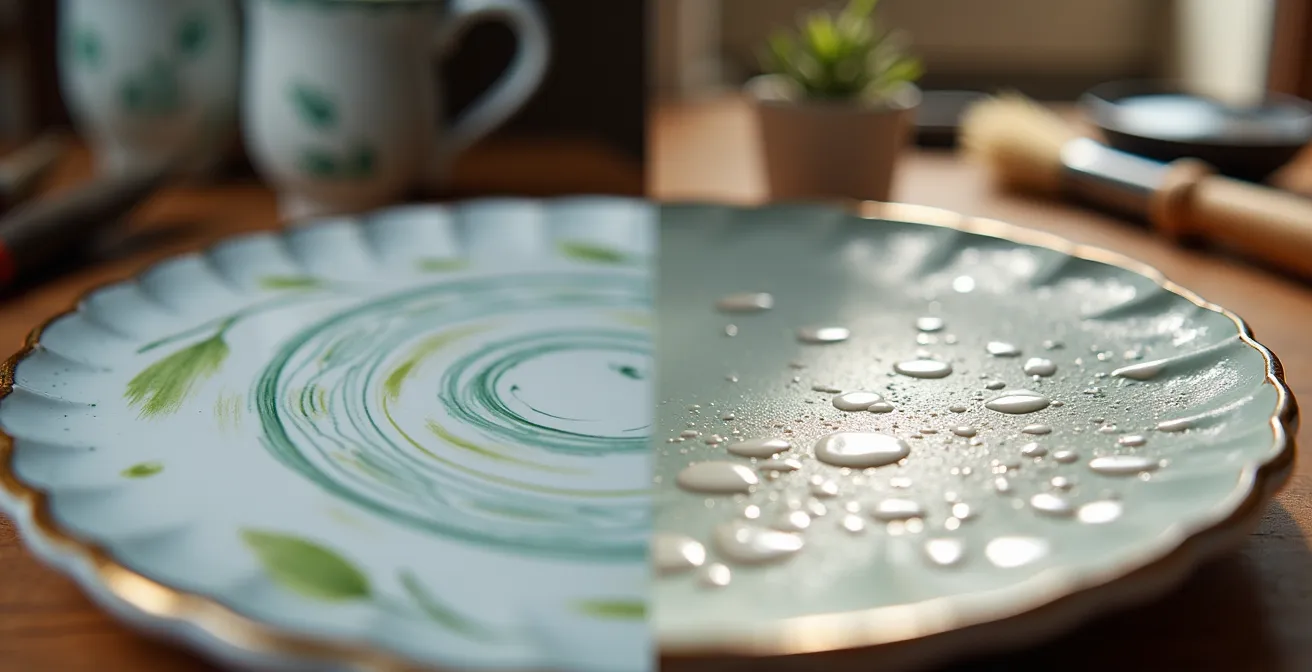
The key to distinguishing a transfer print from hand-painting is not just looking for imperfections, but knowing which imperfections are human and which are mechanical.
- Hand-painting reveals variations in line weight and color pooling, the “signature” of the artist’s hand.
- Transfer prints leave behind “mechanical fingerprints” like a uniform dot matrix (stippling), faint seams, and unnatural perfection.
Recommendation: Use a 10x jeweler’s loupe. It’s the single most important tool for turning suspicion into certainty by revealing the microscopic evidence.
At a bustling flea market, you spot it: a ceramic plate with a delicate floral pattern that seems to whisper stories of a bygone era. The seller, sensing your interest, leans in and says, “That one’s special, all hand-painted.” The price certainly reflects that claim. But is it true? In the world of antiques, the line between a unique, artist-rendered piece and a clever mass-produced decal is often blurred, and the financial difference is immense. Most advice boils down to looking for brushstrokes or checking for maker’s marks, but this is surface-level observation.
The real secret lies not in a casual glance, but in a forensic examination. To avoid paying a premium for a print, you must become a ceramic detective. But what if the key wasn’t simply looking for flaws, but understanding the story those flaws tell? A slight asymmetry in a flower petal might be the mark of a human hand, while a perfectly repeated pattern is the calling card of a machine. This guide moves beyond simple tips and equips you with a forensic mindset. We will deconstruct the evidence, analyze the ‘mechanical fingerprints’ left by industrial processes, and learn to recognize the vital, imperfect ‘signature’ of a human artist.
This article will guide you through the investigative process, from microscopic analysis to understanding the economic and social history that dictates an object’s true value. By the end, you will have the confidence to assess any piece, not just as a buyer, but as an informed examiner.
Summary: Ceramic Forensics: Distinguishing a Print from a Painting
- Micro-Dots vs. Fluid Lines: Using a Loupe to Spot Decals
- Perfectly Imperfect: Why Symmetry Is Suspicious in Antiques
- Paying for Time: Why Hand-Painted Dinnerware Costs 10x More
- Flower Painter or Gilder: Who Ranked Higher in the Atelier?
- From Canvas to Plate: Contemporary Artists Reinventing Ceramics
- Why Tree Rings Are More Reliable Than Stylistic Analysis
- The “C” Crown: Reading Stamps on French Bronze Mounts
- Hoarder or Collector: When Does Ornamentation Become Clutter?
Micro-Dots vs. Fluid Lines: Using a Loupe to Spot Decals
The single most definitive tool in your investigative kit is a 10x jeweler’s loupe. To the naked eye, a dense blue pattern might look like fluid brushwork. Under magnification, however, the machine reveals its secrets. A transfer print is not a continuous line of ink; it is composed of a fine matrix of dots, a pattern known as stippling or aquatinting. This is the primary mechanical fingerprint you are searching for. When an engraver created the original copper plate, they used a series of tiny dots to build up areas of tone and shading. This dot pattern was then transferred to the tissue, and ultimately, to the ceramic.
In contrast, a genuine hand-painted line will exhibit the natural characteristics of a brush loaded with pigment. You will see a beginning and an end to the stroke, often with a slight tapering. The density of the color will vary as the pressure of the artist’s hand changed or as the pigment was depleted from the brush. You might even find a microscopic stray brush hair trapped in the glaze—the ultimate evidence of human involvement. The Spode factory’s perfection of this process in the 18th century set the standard. In 1784, Josiah Spode I’s method of blue underglaze printing used hand-engraved copper plates where dot punching created soft shading, a distinctive look that is a key piece of evidence for today’s collectors.
Your Forensic Field Kit: 5 Steps to Identify a Transfer Print
- Establish a Baseline: Start your examination with cobalt blue pieces. As experts note, this was “the only color able to withstand the heat of the oven before 1820s technical advances,” making it a frequent subject for early transfers.
- Magnify the Evidence: Use a 10x magnification loupe to examine the decoration. Look for the tell-tale stippling patterns—a matrix of fine dots—that are a mechanical fingerprint of the printing process.
- Analyze the Line Quality: A hand-painted line shows variation in width and color density. A printed design is constructed from dots; sources advise to “look for stippling rather than line engraving,” which was the core technique for transfers.
- Search for Seams: On curved surfaces like a cup or the rim of a bowl, carefully check for slight misalignments, overlaps, or gaps in the pattern. These “seams” occur where different sections of the transfer paper were joined.
- Assess Color Consistency: Look for the “uniform appearance of transfer-printed cobalt blue.” Unlike hand-painting, where pigment density varies with each brushstroke, a transfer “maintains consistent color throughout” the design.
Perfectly Imperfect: Why Symmetry Is Suspicious in Antiques
The human hand is incapable of perfect repetition. This is a core principle of ceramic forensics. When you examine a piece that claims to be hand-painted, identical motifs should be your first point of suspicion. If a plate features a border of ten identical rosebuds, take a closer look. An artist painting the same flower repeatedly will introduce subtle variations: one petal may be slightly longer, a stem will curve at a different angle, or the placement of leaves will shift. These are not mistakes; they are the “signatures” of human creation and a sign of authenticity. This natural asymmetry is where the life and value of a hand-painted piece reside.
Conversely, a transfer print is born from mechanical reproduction. Its goal is uniformity. If the ten rosebuds are exact mirror images of each other, down to the last detail, you are almost certainly looking at a decal. The machine does not have a “good” or “bad” day; it executes its task with relentless precision. The adoption of this technology was swift across Europe precisely because it offered this consistency. According to historical documentation, transfer printing originated in England in the 1750s and was quickly imitated in Sweden, Germany, Switzerland, and France by 1790. This timeline is a crucial piece of contextual evidence when evaluating a piece’s likely production method.
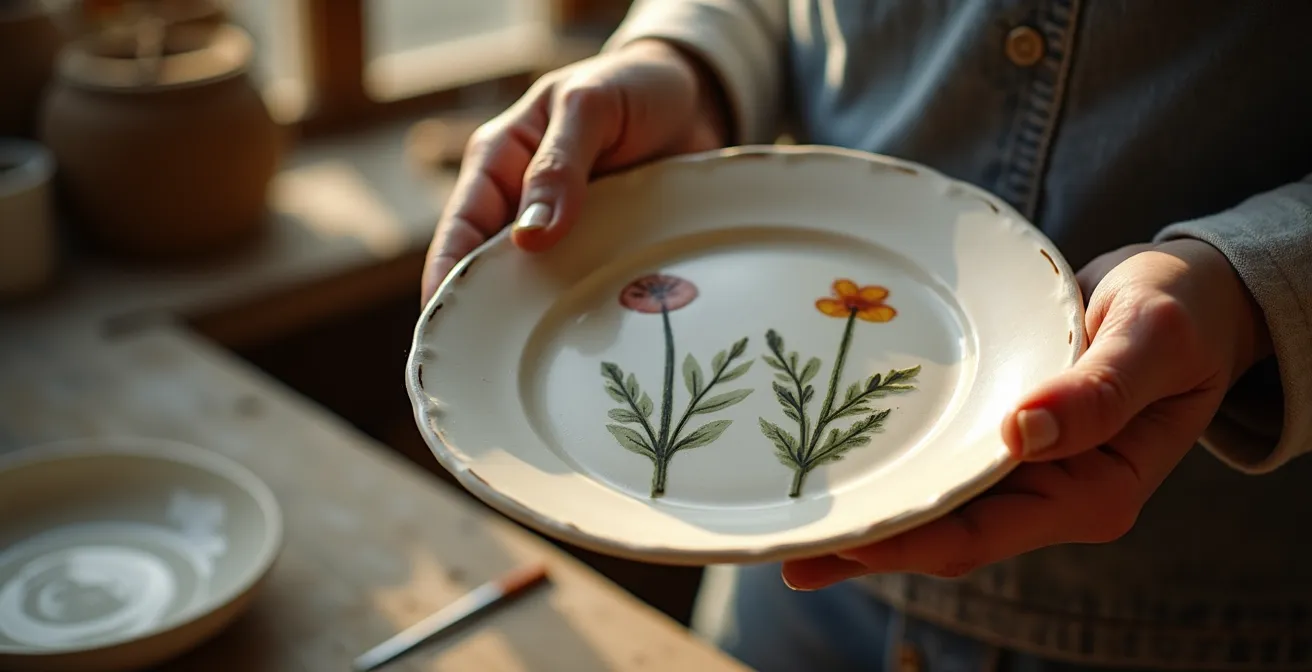
The image above perfectly illustrates this concept. While the two floral motifs are clearly related, they are not identical twins. Notice the subtle differences in the curvature of the stems and the unique form of each petal. This is the beautiful, valuable imperfection that a forensic eye is trained to spot. The machine’s perfection is a sign of mass production, while the artist’s imperfection is a mark of individuality and time.
Paying for Time: Why Hand-Painted Dinnerware Costs 10x More
The dramatic price difference between hand-painted ceramics and transferware is a direct reflection of one simple factor: time. Before the industrial revolution in pottery, every single piece of decorated tableware was a miniature canvas. An artist, often a specialist in a particular motif like flowers or landscapes, would spend hours, or even days, on a single plate or tureen. This was a “laborious and costly process.” The final price of the object was not just for the porcelain itself, but for the irreplaceable hours of skilled labor invested in its ornamentation.
Transfer printing completely upended this economic model. Once the initial engraved copper plate was created—a skilled task in itself—hundreds or even thousands of identical prints could be produced with remarkable speed. The process “enabled high quality representation to be done far more cheaply” and, as a consequence, “made large numbers of painters redundant.” The labor was reduced to applying the printed tissue to the ware, a task that could be done quickly and without the years of artistic training required for painting. This efficiency is precisely why transferware made decorative dinner services accessible to a much broader market.
This comparative analysis highlights the fundamental economic disparity between the two methods. While a plain porcelain vase might have a base value, the addition of intricate hand-painting exponentially increases its worth, whereas a transfer print adds minimal value beyond the base cost of the mass-produced item.
| Factor | Hand-Painted | Transfer-Printed |
|---|---|---|
| Base Value | A plain white vase valued at $25 becomes “much better” and more valuable with hand-painting. | Mass-produced, adding minimal value to the base object. |
| Production Method | While an appraisal of a Nippon vase notes most of Europe was using transfer-print, its value comes from being “all hand-painted.” | Enabled high-quality images to be applied far more cheaply. |
| Labor Impact | Requires a unique, skilled artist for every single piece produced. | Made large numbers of specialist ceramic painters redundant. |
| Time Investment | Can take hours or even days to complete a single complex piece. | Takes only minutes per piece once the master plate is created. |
Flower Painter or Gilder: Who Ranked Higher in the Atelier?
Understanding the production method also involves understanding the social structure of the workshop, or *atelier*. The move to transfer printing didn’t just change technology; it reshaped the hierarchy of labor within the pottery industry. In the era of hand-painting, the master painter was a highly respected and well-paid artisan. Specialists, such as flower painters, landscape artists, or figure painters, commanded significant prestige. At the very top of this hierarchy was often the gilder, the artisan entrusted with applying precious gold details, a task requiring immense skill and precision.
The introduction of transfer printing created new roles and devalued old ones. The case study of English pottery factories reveals a clear, often gendered, division of labor. The role of the “Transferrer,” who would “place pieces of printed tissue carefully into position on the ware,” was considered skilled but was often filled by women and girls who were paid less than their male artisan counterparts. While their work required dexterity, it was not seen as “artistic” in the same way as painting. This shift had a profound societal impact, as historical records demonstrate that prior to transfer printing, only the wealthiest English families could afford complete dinner services. The new technology democratized access to decorated wares.
Workshop Hierarchies in English Pottery Factories
The detailed process of transfer printing reveals a clear division of labor. The “Transferrer,” a role often held by skillful girls, was responsible for carefully placing the printed tissue onto the ceramic piece. This evidence highlights a gendered hierarchy within the workshops, where women performed crucial, skilled tasks but were typically in lower-paid positions compared to the master painters and gilders, who were almost exclusively male artisans commanding higher wages and status.
Therefore, when you’re examining a piece, you are also looking at a social document. A hand-painted plate is the product of a specific artistic hierarchy, while a transfer-printed one tells a story of industrialization, changing labor roles, and the rise of a new consumer class. The evidence is not just in the dots and lines, but in the social and economic system that created the object.
From Canvas to Plate: Contemporary Artists Reinventing Ceramics
While the 18th and 19th centuries established the battleground between hand-painting and transfer printing, contemporary artists are completely rewriting the rules. For many, the ceramic object is no longer just a decorative item but a three-dimensional canvas for social commentary, personal narrative, and conceptual exploration. These artists are not bound by the old hierarchies of “fine art” versus “craft.” They intentionally blur the lines, using both traditional techniques and modern technology to serve their vision.
Artists like Grayson Perry in the UK have been instrumental in elevating pottery to the level of Turner Prize-winning contemporary art. Perry uses the traditional forms of vases and plates but covers them with complex, often provocative, drawings and transfers that explore themes of identity, class, and politics. He subverts the comforting, domestic image of pottery to challenge the viewer. His work demonstrates that the technique—whether painted by hand, transferred, or even 3D printed—is secondary to the power of the idea being communicated. The value is in the artistic vision, not the method of application.
This reinvention forces us to reconsider our criteria for value. In a contemporary context, a transfer print is not necessarily “lesser” than a hand-painted work. An artist might choose to use transfers for their graphic quality, for their ability to repeat a symbolic image, or to evoke a sense of mass production as part of their message. The forensic question shifts from “Is it handmade?” to “What was the artist’s intent?” As the artist Grayson Perry himself has provocatively stated:
Perry believes that between cross dressing and the medium of pottery as contemporary art, contemporary pottery is more difficult for people to come to terms with. ‘It’s about time a transvestite potter won the Turner Prize’.
– Grayson Perry, Seattle Artist League
This bold stance champions the intellectual and artistic merit of ceramics, moving the conversation far beyond a simple dichotomy of hand versus machine. For the modern collector, understanding this context is as crucial as identifying stippling under a loupe.
Why Tree Rings Are More Reliable Than Stylistic Analysis
In dendrochronology, the rings of a tree provide an undeniable, scientific record of its age and history. In ceramic forensics, we have our own version of “tree rings”—objective, scientific markers that are more reliable than subjective stylistic analysis. While a trained eye can make an educated guess based on the style of a flower, that remains an opinion. Hard evidence, however, is irrefutable. This evidence is found in the chemistry of the pigments, the firing temperatures, and, most accessibly for the flea market detective, the manufacturing marks.
Makers’ marks, or backstamps, are a form of codified language. A thorough knowledge of these marks can date a piece with surprising accuracy. For instance, specific words included in the mark act as definitive timeline indicators. According to pottery marking conventions, the word ‘Limited’ or ‘Ltd’ indicates a date after 1860. The inclusion of ‘Trade Mark’ points to a post-1862 creation. The word ‘England’ was added to marks after 1891 to comply with American tariff laws, and ‘Made In England’ signifies a 20th-century origin. These are not stylistic guesses; they are hard data points.
For the professional authenticator, the investigation can go even deeper, into the realm of true scientific analysis. These methods provide the ultimate proof, leaving no room for doubt. Expert analysis might include:
- Pigment Chemistry: Examining the chemical makeup of pigments, such as the “inorganic metallic oxides mixed with oils” used for transfer printing.
- Firing Evidence: Analyzing the effects of firing temperatures. For example, the famous “Spode blue” was the result of a reaction between silica in the glaze and cobalt at temperatures of 1070 degrees centigrade.
- Thermoluminescence Dating: A scientific process that can determine the age of the ceramic body itself by measuring the accumulated radiation dose since it was last fired.
This hierarchy of evidence—from stylistic opinion to makers’ marks to chemical analysis—is the foundation of a sound appraisal. The closer you can get to objective “tree ring” data, the more confident your conclusion will be.
The “C” Crown: Reading Stamps on French Bronze Mounts
Just as the “C” Crown stamp (a tax mark used from 1745-1749) allows experts to precisely date French bronze mounts, the backstamps and marks on ceramics are a vital chapter in an object’s story. While the title refers to a specific metalwork mark, the principle is universal: these symbols are a direct line to the object’s origin, maker, and date. For the ceramic investigator, learning to read these marks is a non-negotiable skill. They can instantly confirm or deny a seller’s story and separate a valuable antique from a later reproduction.
The absence of a mark is also a clue. Many of the finest early pieces of blue and white transferware, from what collectors consider the “vintage years” of 1800-1835, were unmarked. A lack of a stamp on a piece from this era is not a red flag; it is period-appropriate. Conversely, a Victorian-era pattern like “Willow” or “Asiatic Pheasant” is so common that even a 150-year-old platter may have very little value. The mark provides the context needed to make that judgment.
The Value of a Small Factory: Caughley Porcelain
An appraisal of a Caughley porcelain toy service from around 1780 highlights the importance of origin. The pieces are described as “hand-painted… in the Chinese style.” Despite Caughley being a “tiny, rather insignificant factory,” it is “heavily romanticized” and has a strong collector following. This provenance, confirmed by its characteristics, gives a small set an insurance valuation of up to $3,000, a value derived entirely from its identity as a rare, hand-painted piece from a specific maker.
The following table provides a general guide for interpreting the characteristics of different periods, demonstrating how marks (or their absence) and design elements combine to indicate value.
| Period | Key Characteristics | Value Indicators |
|---|---|---|
| 1800-1835 | The “vintage years” for blue and white transfer printing. An analysis of the period notes most wares have no identifying marks. | Higher quality engraving and printing; holds particular appeal to collectors. |
| 1822-1840 | Spode introduced other colors (green, brown, black). Pink and two-color printing began soon after. | Variety in color is a key indicator; often produced in smaller quantities. |
| Victorian Era | Mass-produced, ubiquitous patterns like “Willow” or “Asiatic Pheasant.” | So numerous today as to have little value, with a large platter often under £30. |
Key Takeaways
- Embrace the Loupe: Your most powerful tool is 10x magnification. It reveals the core difference: the dot matrix of a print versus the fluid line of a brush.
- Suspicion of Symmetry: Perfect, identical repetition is a hallmark of the machine. The subtle variations and asymmetries in a design are the signature of the human hand.
- Follow the Marks: Makers’ marks are your “tree rings.” Words like ‘England’ (post-1891) or ‘Limited’ (post-1860) provide objective, undeniable evidence for dating a piece.
Hoarder or Collector: When Does Ornamentation Become Clutter?
The final step in our forensic journey is a philosophical one. After mastering the techniques to identify, date, and value these objects, a new question arises: what is their purpose? An attic full of undocumented, unloved objects is clutter. But a curated assemblage, rich with stories and understood through diligent research, is a collection. The difference between hoarding and collecting lies in one word: knowledge. It’s the knowledge of the object’s history, its creation, and its place in the wider cultural narrative.
The Transferware Collectors’ Club provides a perfect model. By systematically documenting their finds, members transformed a seemingly common category of ceramics into a profound historical archive. Their project has documented over 9,100 different designs, turning accumulation into a meaningful cultural endeavor. As the “Friends of Blue” group stated, these wares “put us in touch with a stratum of society that many of us can identify with” and form a “major and important part of our cultural, social and manufacturing heritage.” They are not just plates; they are artifacts of social history.
This is the true reward of becoming a ceramic detective. Each object, whether a priceless hand-painted tureen or a humble transfer-printed saucer, becomes a piece of a larger puzzle. The ornamentation is no longer just decoration; it is data. The collection is no longer clutter; it is a library. By applying the forensic principles of observation, contextualization, and research, you elevate your passion from a simple pursuit of pretty things to a sophisticated engagement with history, art, and technology.
Your journey as a ceramic detective begins now. Armed with this forensic mindset, approach your next flea market find not with uncertainty, but with a clear investigative method. Apply these principles to examine the pieces you already own and start building a collection that is rich in knowledge, not just in objects.