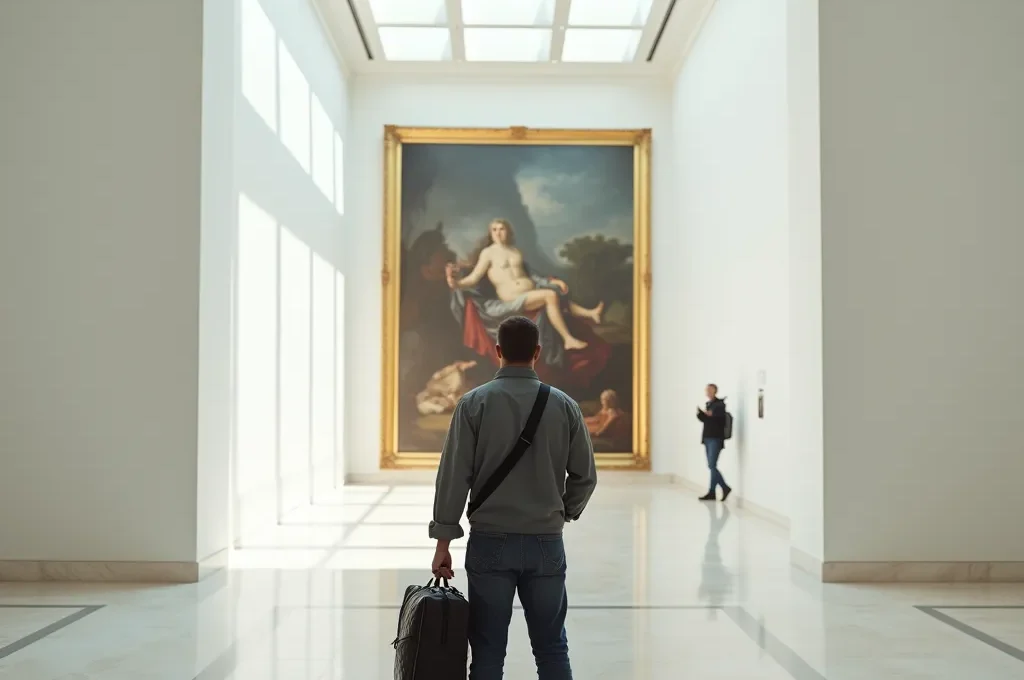
Contrary to popular belief, a meaningful art pilgrimage isn’t about seeing more, but about seeing deeper. This guide moves beyond crowded museums and generic itineraries to reveal a strategic approach. You’ll learn how to choreograph your journey for maximum context, manage your energy to avoid burnout, and engage with art in a way that neurologically changes your perception, turning a simple trip into a transformative experience.
You’ve felt it before: the sense of obligation in front of a world-famous painting, the mental exhaustion after just two hours in a cavernous museum, the nagging feeling that you’re just checking boxes off a cultural to-do list. You’ve booked tickets in advance, skimmed the highlights, and dutifully stood in the crowd, yet the profound connection you sought remains elusive. This is the paradox of modern art tourism—unprecedented access often leads to a surprisingly shallow experience.
But what if the goal wasn’t to conquer a museum, but to conspire with it? What if the key to a truly transformative art journey wasn’t found in a list of must-see masterpieces, but in a deliberate and strategic approach to the entire pilgrimage? The secret lies in shifting your focus from the *what* to the *how*. It requires a blend of art historical context and practical, logistical choreography designed to protect your energy, heighten your senses, and prime your brain for genuine discovery.
This guide is built on that principle. We will deconstruct the art pilgrimage into its essential components, moving beyond simple travel tips to explore the neurological impact of seeing art in person, the strategic models for planning a multi-city tour without burnout, and the subtle techniques for navigating museums that allow for quiet contemplation even on the busiest days. Prepare to move from a tourist to a true art pilgrim.
To guide you through this transformative process, this article is structured to build your expertise step-by-step. Below, the summary outlines each stage of planning your pilgrimage, from understanding the internal experience to mastering the external logistics.
Summary: How to Plan an Art Pilgrimage That Transcends Standard Tourism
- Why Seeing Art in Person Changes Your Brain Chemistry
- How to Organize a Multi-City Art Tour Without Burnout
- Private Guide or Solo Audio Tour: Which Fits Your Learning Style?
- The Crowd Management Mistake That Ruins 70% of Museum Visits
- Chronological vs. Geographical: Planning Your Route for Maximum Context
- Museum or Boutique Hotel: Which Save Strategy Fits Your Building?
- Ticket Sales vs. Education: The Museum’s Eternal Dilemma
- Why the Original Lascaux Caves Will Never Reopen to the Public
Why Seeing Art in Person Changes Your Brain Chemistry
The difference between viewing a masterpiece on a screen and standing before it in person is not merely a matter of resolution or scale; it’s a profound neurological event. Reproductions can convey information, but only the physical presence of an original work can trigger the full cascade of cognitive and emotional responses that define a pilgrimage. This isn’t romanticism; it’s brain science. The texture of paint, the subtle shifts in color under changing light, and the sheer fact of its survival through time create an “aura” that your brain registers as authentic and significant.
This physical encounter engages your brain in a unique way, moving beyond simple visual processing into a state of embodied cognition. As you walk through a gallery, your motor cortex is active, linking your physical movement to the act of seeing. This creates stronger, more integrated memories than the passive consumption of digital images. The experience becomes a dialogue between the artwork, the space it inhabits, and your own physical being.
The process of engaging with original art unfolds in distinct neurological stages, turning a simple viewing into a deeply meditative and memorable experience:
- Stage 1: Initial Arousal – Your amygdala activates within 0.2 seconds of seeing original art, triggering emotional responses impossible with reproductions.
- Stage 2: Embodied Cognition – Walking through galleries engages your motor cortex, linking physical movement to memory formation.
- Stage 3: Default Mode Activation – After 5-7 minutes of sustained looking, your brain shifts into an introspective mode similar to meditation.
- Stage 4: Aura Recognition – Your prefrontal cortex processes the authenticity of the original, creating reverence and presence unique to physical encounters.
Understanding these stages transforms how you approach a museum. It validates the need for slow, sustained looking and explains why rushing from one masterpiece to another feels so unfulfilling. You are not just seeing; you are allowing your brain to undergo a complex and rewarding process. This is the foundational “why” of any art pilgrimage: to give your mind the authentic stimulus it needs for a truly transformative connection.
How to Organize a Multi-City Art Tour Without Burnout
The ambition of a grand art tour across multiple cities often collapses under the weight of its own logistics. Constant packing, travel days, and the pressure to “see it all” lead to exhaustion, not enlightenment. A successful art pilgrimage requires a deliberate logistical choreography that prioritizes energy conservation and deep immersion over a sprawling itinerary. The most common mistake is the linear A-to-B-to-C approach, which maximizes travel time and minimizes contextual understanding.
A more strategic method is the “Anchor & Orbit” model. You establish a home base in a culturally rich city for an extended period (e.g., a week in Florence) and take targeted day trips to nearby towns (Siena, Pisa). This minimizes the disruption of changing hotels, reduces travel fatigue, and allows for deeper immersion in a specific region’s artistic ecosystem. You develop a daily rhythm, discover local cafes and restaurants, and begin to feel part of the place rather than just a transient visitor.
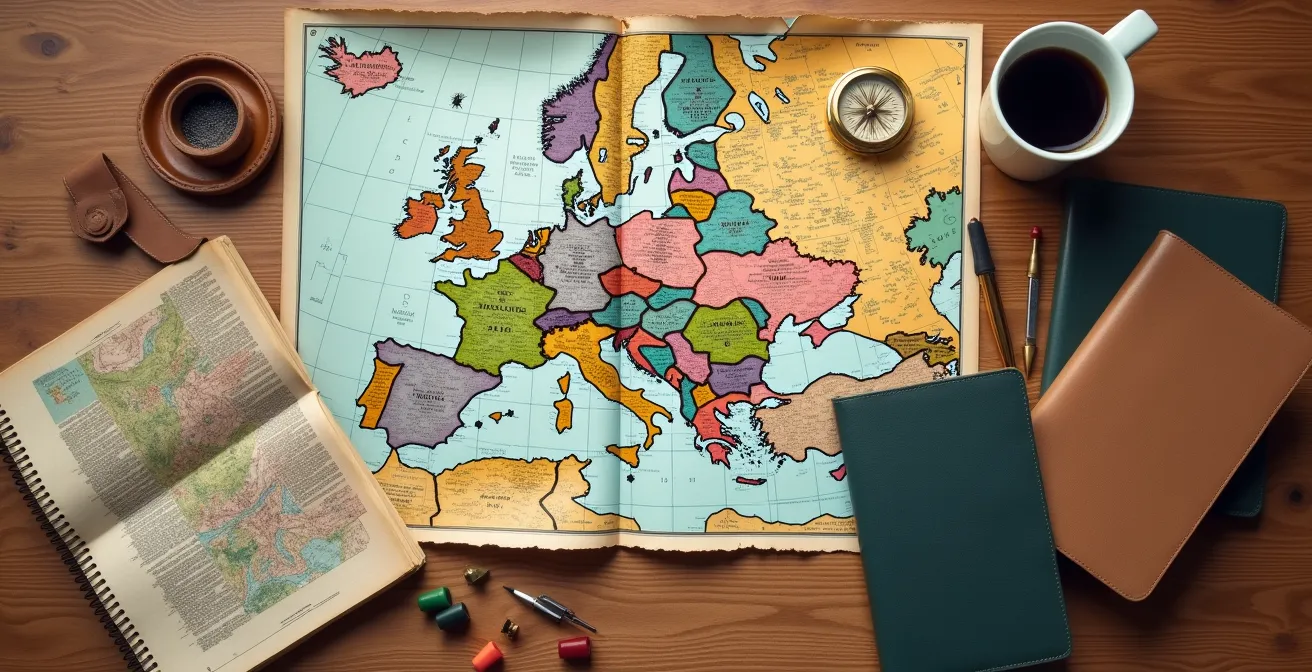
This approach allows for the crucial “sensory cleanse” day—a planned day with no museums or galleries. Instead, you might explore a local market, hike in the countryside, or simply read in a park. This isn’t a wasted day; it’s a vital part of the pilgrimage, allowing your visual cortex and cognitive functions to rest and integrate what you’ve seen. Without these resets, museum fatigue is inevitable, and your ability to engage deeply with art diminishes with each passing day. Comparing different planning models clearly shows why a strategic choice is so critical.
The following table, based on an analysis of different travel styles, breaks down the trade-offs of each approach, highlighting the superiority of the Anchor & Orbit model for a deep, sustainable art pilgrimage.
| Planning Model | Energy Conservation | Cost Efficiency | Depth of Experience | Best For |
|---|---|---|---|---|
| Linear A-B-C Route | Low (constant packing/moving) | Higher transport costs | Surface-level, rushed | First-time survey trips |
| Anchor & Orbit | High (stable base, day trips) | Lower (bulk accommodation) | Deep local immersion | Focused art pilgrims |
| Thematic Threading | Medium (motivated movement) | Variable | Intellectually coherent | Scholar-pilgrims |
A structured weekly plan can ensure you balance major immersions with necessary rest. A well-paced itinerary might look like this:
- Day 1-2: Arrive and acclimate. Visit one minor collection to adjust your visual cortex.
- Day 3: Major museum immersion. Schedule your most important venue when energy peaks.
- Day 4: Sensory cleanse day. No art; explore nature, markets, or local cuisine.
- Day 5: Secondary collections. Visit 2-3 smaller, specialized museums.
- Day 6: Artist studios or architecture walk. Engage with living creative spaces.
- Day 7: Reflection and integration. Journal, sketch, or revisit one meaningful piece.
Private Guide or Solo Audio Tour: Which Fits Your Learning Style?
Once inside the museum, the next critical choice is how you receive information. This decision dramatically shapes your experience, influencing your pace, focus, and cognitive load. There is no single “best” method; the ideal choice depends on your personal learning style, budget, and pilgrimage goals. The options range from complete autonomy to fully guided expertise, each with distinct advantages and disadvantages.
A private guide offers the highest level of tailored insight. A good guide can read your interests, adjust the tour in real-time, and answer nuanced questions that an audio guide cannot. They handle the navigation, allowing you to focus entirely on looking and listening. This is an excellent option for those who want to offload the cognitive burden of planning a route and absorb expert knowledge directly. However, it is the most expensive option and can limit time for personal, silent reflection in front of a work.
Conversely, a solo approach using an audio tour or a scholarly companion book offers maximum flexibility and autonomy. You control the pace, lingering for thirty minutes before one painting and skipping entire galleries that don’t align with your interests. This method is ideal for the self-directed learner who enjoys the process of discovery and desires ample time for quiet contemplation. The main drawback is the high cognitive load; you are responsible for navigation, information filtering, and maintaining your own narrative thread. A hybrid approach, the pre-visit scholar consultation, offers a compelling middle ground. You hire an art historian for an hour before your visit to help you map a personalized route and provide a list of key works and concepts to focus on, giving you an expert framework to execute with complete freedom.
Choosing your modality is a strategic decision. If your goal is a comprehensive overview with expert storytelling, a private guide is invaluable. If your pilgrimage is more about personal, contemplative encounters with specific works, a DIY approach with a good book or a pre-visit consultation will better serve your needs. The key is to consciously choose the method that aligns with your desired mental state within the museum, rather than simply defaulting to the provided audio guide.
The Crowd Management Mistake That Ruins 70% of Museum Visits
The single greatest obstacle to a meaningful art experience is not a lack of knowledge, but the presence of crowds. The pressure of the throng, the jostling for a view, and the constant ambient noise make the quiet contemplation necessary for deep engagement almost impossible. Most visitors make a critical mistake: they follow the prescribed path, moving with the herd from one famous masterpiece to the next. This guarantees a frustrating, surface-level experience. A true art pilgrim, however, treats crowd navigation as a strategic discipline.
The secret is to move against the current. This “counter-flow” approach involves consciously inverting the typical visitor’s journey. Instead of making a beeline for the *Mona Lisa*, start in the less popular galleries—perhaps 18th-century decorative arts or medieval manuscripts. You will often have these spaces to yourself, allowing your eyes and mind to adjust in peace. By the time you reach the blockbuster wings, you will be mentally fortified and better able to handle the crowds. Better yet, work backward from the exit of a special exhibition. The layout is often just as coherent in reverse, but you’ll be moving against a sea of people, not within it.

This strategy must be paired with disciplined breaks. The urge to “power through” is the enemy of satisfaction. Research from major museums shows that visitors who take breaks every 45-60 minutes report 73% higher satisfaction rates than those who don’t. A break doesn’t mean leaving; it means finding a quiet bench in a sculpture garden or courtyard, closing your eyes, and letting your mind process what it has seen. This periodic reset is non-negotiable for a multi-hour visit. By combining counter-flow navigation with strategic rests, you reclaim your autonomy and create pockets of solitude even in the world’s busiest institutions.
Your Action Plan: The Counter-Flow Museum Navigation System
- Start at the end: Enter through the exit of popular exhibitions and work your way backward against the main flow of traffic.
- Perimeter first: When entering a gallery, circle the edges of the room before approaching the central, famous masterpieces.
- Skip the stars (initially): Consciously bypass the top 3-5 tourist-magnet artworks on your first pass through a wing. Return to them later.
- Identify off-peak zones: Use the museum map to prioritize lesser-known wings (e.g., textiles, prints) during peak hours (11 am – 2 pm).
- Practice single-room immersion: Choose one gallery that interests you and commit to spending 45 minutes there, deeply engaging with just a few works rather than racing through many.
Chronological vs. Geographical: Planning Your Route for Maximum Context
A successful art pilgrimage tells a story. The route you take, whether within a single museum or across a continent, should be designed to build a coherent narrative. Simply moving from one famous artwork to another creates a disjointed collection of moments. To achieve true understanding, your itinerary must be structured around a unifying principle. The two most powerful organizing principles are the chronological and the geographical, each offering a different kind of contextual insight.
A chronological route is ideal for understanding the grand sweep of art history. You might plan a trip that starts with the Roman ruins in Italy, moves to the Gothic cathedrals of France, explores the Renaissance palaces of Florence, and ends in the modern art galleries of Berlin. This approach makes the evolution of style, technique, and ideas tangible. You physically experience the shift from the spiritual focus of the medieval era to the humanism of the Renaissance. This “time travel” approach provides a powerful framework for understanding how and why art changes over centuries.
A geographical cluster, or place-based, approach offers a different kind of depth. By focusing intensely on one city or region—like Andalusia in Spain or the Flanders region of Belgium—you uncover the unique cultural DNA of a place. You see how local politics, religion, and patronage shaped a distinct artistic identity. This method is perfect for the learner who wants to understand the intricate relationship between art and its specific environment. Other strategies can also be employed, such as following a thematic thread (like the depiction of light across centuries) or tracing a single artist’s journey.
Case Study: Following Caravaggio’s Journey
Art historian Sarah Chen’s 2023 Caravaggio pilgrimage traced the artist’s tumultuous life from Milan to Rome, Naples, and Malta. By following his physical and artistic evolution chronologically through space, she reported experiencing a “narrative coherence impossible in any single museum.” Her route, which included 14 churches and 6 museums, revealed how Caravaggio’s increasing desperation and flight from the law manifested in progressively darker, more urgent paintings. This thematic, artist-focused approach created what Chen called “a living biography told through place and paint,” proving the power of a well-structured narrative route.
The choice of routing strategy depends on your learning style. To decide, consider which question interests you more: “How did art evolve over time?” (chronological) or “How did this specific place create this unique art?” (geographical). By consciously choosing your narrative thread, you transform your itinerary from a simple list of destinations into a deeply meaningful intellectual journey.
Museum or Boutique Hotel: Which Save Strategy Fits Your Building?
The choice of accommodation on an art pilgrimage is not just a logistical detail; it is a critical part of the experience itself. Where you sleep, wake up, and reflect can either enhance or detract from your journey’s contemplative goals. The decision is a balance between budget, location, and, most importantly, the mental state you wish to cultivate. You are not just booking a room, but choosing a sanctuary, an extension of the pilgrimage, or a neutral space for mental cleansing.
Staying in an art-themed boutique hotel or a meticulously restored historic building can create a 24/7 immersive experience. You are surrounded by design, history, and aesthetics, making the entire day a continuous engagement with art. This can be wonderfully enriching, but it also carries the risk of sensory saturation. Without a neutral space to retreat to, you may find yourself overwhelmed, with no “off-switch” for your aesthetic sensibilities. As Daniel Anthonisen notes in a guide for the National Endowment for the Humanities, the setting is crucial. His words underscore the power of place in shaping our perception of art and history.
Setting, in general, is so important to the successful presentation of art and history. The rustic solid construction with a down-home casual quality seems perfectly harmonious with the artwork.
– Daniel Anthonisen, National Endowment for the Humanities Museum Guide
On the other hand, a standard, modern chain hotel provides a neutral sanctuary. Its very lack of character can be a virtue, offering a clean, quiet, and predictable environment that acts as a “mental palate cleanser” after a day of intense visual stimulation. This allows your mind to rest and process what you’ve seen without additional input. For the most spiritually-minded pilgrim, staying in a monastery or convent guest house can add another layer entirely, blending the artistic pilgrimage with a genuinely contemplative atmosphere at a very low cost.
| Accommodation Type | Mental State Impact | Budget Allocation | Pilgrimage Enhancement |
|---|---|---|---|
| Art-Themed Boutique | 24/7 immersion (risk of saturation) | High ($200-500/night) | Continuous aesthetic experience |
| Chain Hotel | Neutral sanctuary space | Moderate ($100-200/night) | Mental palate cleanser |
| Historic Building | Contextual enrichment | Variable ($150-400/night) | Living in art history |
| Monastery/Convent | Contemplative atmosphere | Low ($50-100/night) | Spiritual dimension added |
Ultimately, the right choice aligns with your personal tolerance for stimulation and your pilgrimage’s overall intensity. Consider whether you need a space that continues the aesthetic conversation or one that offers a quiet escape from it.
Key Takeaways
- A true art pilgrimage is a neurological event; plan for slow, sustained looking to allow your brain to engage fully.
- Avoid linear, multi-city itineraries. Adopt an “Anchor & Orbit” model to conserve energy and enable deep, regional immersion.
- Consciously navigate museums “counter-flow” to avoid crowds and take a sensory-cleanse break every 45-60 minutes to prevent fatigue.
Ticket Sales vs. Education: The Museum’s Eternal Dilemma
To the average visitor, a museum is a place to see art. To its administration, it is a complex organization balancing a dual, often conflicting, mission: generating revenue (largely through ticket sales and blockbuster exhibitions) and fulfilling its educational mandate. For the art pilgrim, understanding this internal tension is an incredible advantage. It allows you to look beyond the commercialized surface and tap into the deep well of scholarly resources that every major institution possesses.
The “front of house”—the main galleries, the special exhibitions, the gift shop—is designed for mass appeal and revenue. The “back of house”—the research libraries, archives, conservation labs, and education departments—is where the institution’s deep knowledge resides. Accessing this side of the museum is the key to transforming your visit from a passive viewing into an active research project. And surprisingly, much of it is accessible to the public.
Most museum research libraries and archives are open to serious learners by appointment. Attending a free weekly curator talk can provide more insight in one hour than a dozen audio guides. This shift in focus is not only intellectually rewarding but is also aligned with the museum’s own long-term goals. While blockbuster shows create buzz, it’s the educational engagement that builds a loyal audience. In fact, recent museum industry research indicates that museums dedicating 40% or more of space to educational programming see 28% higher visitor return rates. This proves that institutions have a vested interest in catering to dedicated learners like you.
By leveraging these resources, you partner with the museum in its educational mission. You are no longer just a consumer of culture but an active participant in its study. Here’s how you can leverage a museum’s educational mission for deeper access:
- Request library/archive access: Most museum research facilities are open to the public by appointment for specific research purposes.
- Attend free curator talks: These are usually held weekly or monthly and offer PhD-level insights at no cost.
- Join member preview days: An annual membership often costs less than two full-price visits and provides crowd-free access.
- Use scholarly databases: Many museums provide free on-site access to academic portals like JSTOR or the Artstor Digital Library.
- Schedule education department consultations: For focused projects, many departments offer free 30-minute sessions for serious learners.
Why the Original Lascaux Caves Will Never Reopen to the Public
The story of the Lascaux caves in France is perhaps the ultimate parable for the modern art pilgrim. Discovered in 1940, the cave, with its breathtaking 17,000-year-old Paleolithic paintings, was opened to the public in 1948. Within just 15 years, it had to be permanently sealed. The carbon dioxide from human breath, the heat from bodies, and the introduction of foreign microbes were creating irreparable damage, causing algae and calcite crystals to form over the ancient art. The very act of witnessing this sacred place was destroying it.
This closure in 1963 marked a watershed moment in conservation and poses a fundamental question for any art lover: What is more important, access or preservation? The answer, in the case of Lascaux, was clear. The French government, along with the international conservation community, chose to prioritize the longevity of the art over the fleeting desires of the public. This decision embodies the core tension of any pilgrimage: our deep-seated need to be in the presence of authenticity versus our responsibility to protect it for future generations.
The Lascaux Preservation Paradigm
The closure of the original cave led to an innovative solution: the creation of increasingly sophisticated replicas. Lascaux II, a meticulous facsimile of the main halls, opened in 1983. It was followed by Lascaux III, a traveling exhibition, and finally Lascaux IV in 2016. This state-of-the-art international center uses exact 3D digital scans, atmospheric controls, and interactive technology to recreate the experience of the original cave with stunning fidelity. It even offers visitors insights through virtual reality that would be impossible in the fragile original, challenging our traditional notions of what constitutes an authentic experience.
The Lascaux paradigm forces us to redefine “experiential access.” Does authenticity reside only in the original object, or can it be found in a perfectly rendered experience designed to evoke the same sense of wonder without causing harm? For the art pilgrim, the lesson is profound. Sometimes, the most respectful and wisest act is to embrace the replica, understanding that preservation itself is a sacred act. As the Smithsonian’s Museum Conservation Institute puts it, this is a conscious cultural choice.
The tension between access and preservation represents a culture choosing to prioritize the sacredness and longevity of art over the fleeting desires of the public.
– Museum Conservation Institute, Smithsonian National Museum of Asian Art
Now that you are equipped with the strategies to plan a truly transformative journey, the next step is to begin the process. Start by outlining your own pilgrimage, not as a list of places to see, but as a narrative to experience, keeping these principles of engagement and logistical choreography at the forefront of your mind.