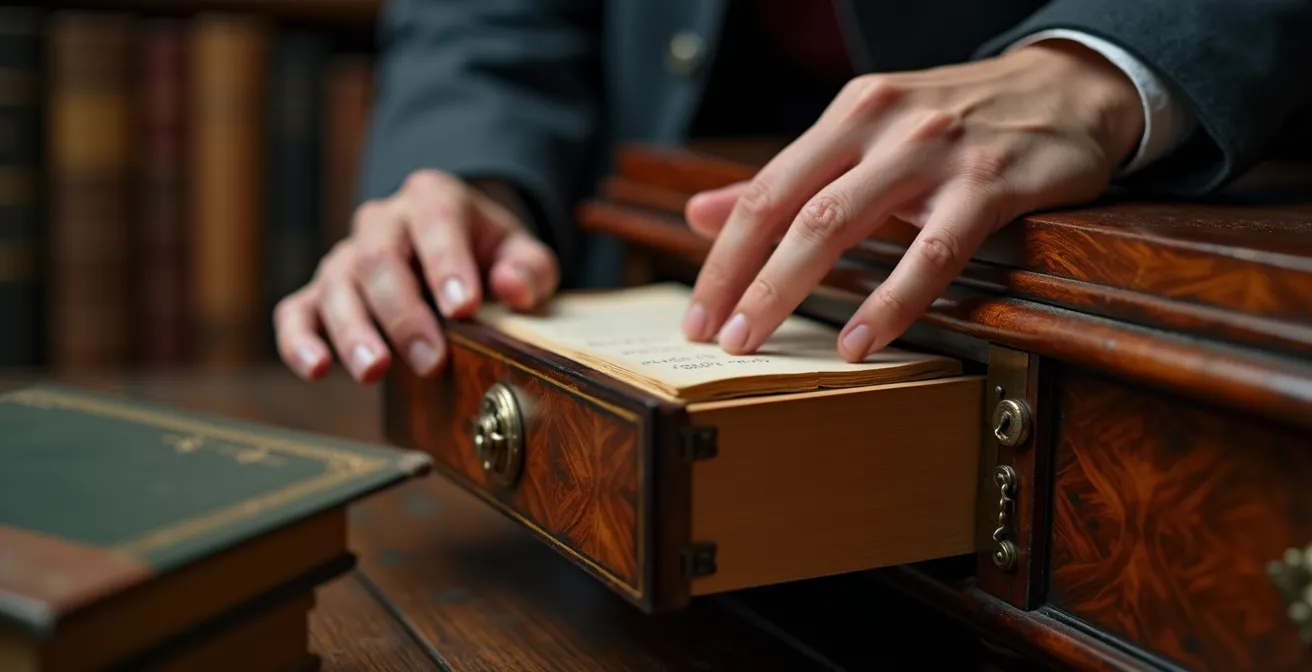
Finding a secret drawer isn’t about luck; it’s about decoding the mechanical philosophy of the craftsman who built it.
- Examine the piece not just for what you see, but for the “negative space”—the volume that seems unaccounted for.
- Treat the furniture as a mechanical puzzle, where every clue from wood grain to hinge design is part of the solution.
Recommendation: Begin with a patient, non-invasive examination using your fingertips and eyes, looking for inconsistencies in symmetry and patina before attempting any physical manipulation.
The allure of an antique secrétaire goes beyond its elegant lines and rich patina. It lies in the promise of the unknown: a hidden history tucked away in a secret compartment. For every owner of such a piece, the question lingers—what secrets does it hold? The common advice often involves tapping on panels, measuring drawer depths, or looking for mismatched wood grain. While these methods have their place, they treat the desk as a static box rather than what it truly is: a masterfully engineered puzzle.
True discovery requires a shift in perspective. To find a secret compartment, you must learn to think like the 18th-century cabinetmaker who designed it. These artisans were not just woodworkers; they were mechanical geniuses, spies’ confidants, and storytellers in marquetry. They built furniture with a mechanical philosophy, creating sequences of actions—a push, a slide, a turn—that formed a unique kinetic signature for each piece.
This guide moves beyond simple tips. We will delve into the forensic clues left in the joinery, understand the logic behind automated “robot desks,” and learn the language of the materials themselves. By embracing the mindset of the original creator, you can transition from a hopeful searcher to a skilled decoder, capable of coaxing the desk to reveal its secrets without force or damage. The goal is not just to find a hidden drawer, but to appreciate the ingenuity that concealed it for centuries.
This article will guide you through the intricate world of antique furniture secrets, from the historical context that created them to the practical steps for uncovering them. By following this structured approach, you will learn to read the object and reveal its hidden marvels.
Summary: A Guide to Uncovering Antique Secrets
- Spies and Love Letters: Why Everyone Wanted to Hide Things in 1780
- Oil or Wax: Lubricating 200-Year-Old Springs and Hinges
- Did It Start Life as a Desk? Spotting Altered Furniture
- The Robot Desks: Furniture That Unfolds Automatically
- Skeleton Keys: How to Open a Locked Antique Without Drilling
- Phrygian Caps on Plates: Secret Support for the Revolution
- The Puzzle in 3D: Cutting Stone to Fit Curves Perfectly
- How to Mix Louis XV Furniture with Modern Minimalism Without Chaos
Spies and Love Letters: Why Everyone Wanted to Hide Things in 1780
The 18th century was an age of intrigue, where political espionage, clandestine affairs, and personal fortunes demanded absolute discretion. Furniture became more than functional; it evolved into the silent guardian of secrets. A well-crafted secrétaire was a personal vault, its hidden compartments designed to protect everything from revolutionary pamphlets to forbidden love letters and wills. As noted in a study of historical furniture, these hidden spaces served practical—and sometimes political—purposes, transforming an ordinary piece into a bastion of privacy. The complexity of these mechanisms was a point of pride for the cabinetmaker and a critical security feature for the owner.
This need for concealment fostered a unique design philosophy. The challenge was not just to create a hidden space, but to make its very existence unthinkable. This principle of structural deception was key. As Edgar Allan Poe’s Chief of Police astutely observes in “The Purloined Letter,” the secret to finding something hidden is to account for all the physical space. This mindset is crucial for any modern-day treasure hunter.
Any man is a dolt who permits a ‘secret’ to escape him in a search of this kind. The thing is so plain. There is a certain amount of bulk of space to be accounted for in every cabinet.
– Edgar Allan Poe’s Chief of Police, The Purloined Letter
This idea—that a secret lies in the void, the unaccounted-for volume—is the first principle in your investigation. A drawer that seems too shallow for its casing, a panel that sounds hollow, or an ornament that seems slightly askew could all be invitations to look deeper. The cabinetmaker of 1780 was counting on the casual observer to see only the beautiful façade, while the true secrets were embedded in the very architecture of the piece.
Oil or Wax: Lubricating 200-Year-Old Springs and Hinges
Once you locate a potential mechanism, the greatest risk is damage. Two centuries of disuse can seize springs, hinges, and sliders. Applying force is the fastest way to break an irreplaceable component. The correct approach is patient and methodical, focusing on conservation-grade lubrication. Forget modern penetrating oils like WD-40, which can stain old wood and attract dust. The professional choice for antique mechanisms is a high-quality, microcrystalline wax.
Among conservators, one product stands out: Renaissance Wax. Developed by the British Museum in the 1950s, this polish is revered for its stability and protective qualities. It creates a barrier against moisture and oxygen without altering the original patina. Its use is widespread in the world’s most prestigious institutions; an industry report confirms it is used by the British Museum, Victoria and Albert Museum, and Windsor Castle, a testament to its safety and efficacy on priceless artifacts. It can be applied to metal mechanisms, wood, and even delicate materials like ivory.
The application process requires a delicate touch:
- Test First: Always apply a tiny amount to a discreet, hidden area to ensure there is no adverse reaction with the finish.
- Apply Sparingly: Use a lint-free cloth or a small, soft brush to apply a very thin, even layer of the wax directly onto the moving parts of the mechanism—the hinges, the tracks of a slider, or the coils of a spring lock.
- Work it In: Gently move the component back and forth to allow the wax to work its way into the mechanism. Do not force it. This may take several minutes or even multiple applications.
- Buff Lightly: Once the mechanism moves freely, use a clean cloth to lightly buff away any excess wax from the surrounding surfaces.
This gentle lubrication not only helps to release the mechanism but also provides a crucial layer of long-term protection, ensuring the ingenuity of the 18th-century craftsman can be appreciated for generations to come.
Did It Start Life as a Desk? Spotting Altered Furniture
Not all secrets are original. Over two centuries, furniture is often repaired, modified, or “married” to other pieces. A beautiful desk might have had its original, complex mechanisms removed or simplified. Part of your forensic examination is determining the piece’s authenticity and identifying any anachronistic alterations. This involves training your eye to spot inconsistencies that betray a later hand at work. Clues can be found in the wood, the hardware, and the very symmetry of the piece.
A master cabinetmaker worked with a deep understanding of his materials. The patina—the gentle sheen and color that wood develops with age, exposure to light, and human touch—should be consistent across the entire piece. A newer panel or a repaired section will lack this depth and character. Look closely at joints where different elements meet; this is where alterations are often most visible. The grain, color, and texture of the wood should flow harmoniously.
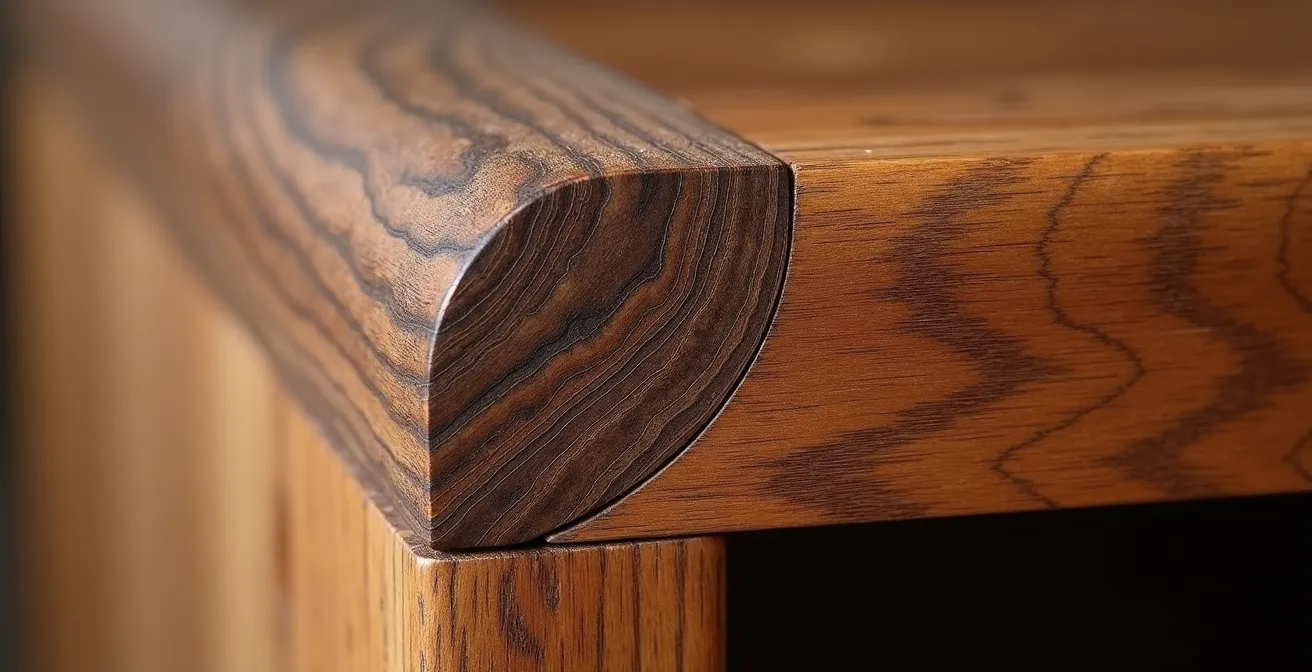
This macro view highlights the subtle yet crucial differences a restorer looks for. The original wood possesses a deep, complex patina, while an added or repaired section may appear flat or have a different grain structure. Likewise, tool marks from different periods tell a story. The fine, uniform cuts of an 18th-century hand plane are vastly different from the circular marks left by modern power sanders. By developing a feel for these details, you can begin to read the history of the object and identify areas that warrant closer inspection.
Your Forensic Checklist for Spotting Alterations
- Symmetry & Balance: Scrutinize the piece for architectural consistency. An element that feels “missing” or unbalanced compared to its counterpart might indicate a removed or altered mechanism.
- Patina Uniformity: Examine the wood’s surface under good, natural light. Check for patches that are too dark, too light, or lack the rich texture of the surrounding areas.
- Hardware & Tool Marks: Look for screws with modern threads, Phillips-head screws, or saw marks that seem out of place for the period. Original hardware often shows slight irregularities.
- Drawer Depth Analysis: As a recent guide notes, you should pull out a drawer and assess its depth relative to the cabinet’s frame. According to one source, if a drawer looks too shallow for the space it occupies, it could be masking a hidden compartment behind or below it.
- Construction Methods: Verify that the joinery (e.g., dovetails) matches the techniques of the stated period. Hand-cut dovetails are slightly irregular, unlike machine-cut ones.
The Robot Desks: Furniture That Unfolds Automatically
While many secret compartments rely on simple manual triggers, the pinnacle of 18th-century cabinetmaking involved breathtaking automation. These “robot desks” were the high-tech gadgets of their day, engineered to perform a mechanical ballet at the turn of a key or the push of a hidden button. The undisputed master of this craft was David Roentgen, whose creations for European royalty were as much magic shows as they were furniture. Understanding his work provides insight into the most complex mechanisms you might encounter.
Roentgen’s workshop was a hub of innovation, employing at its peak nearly two hundred specialized artisans who combined clockmaking, metalworking, and cabinetry to produce these marvels. His signature was the “surprise,” where a single action could trigger a cascade of movements. This concept of a kinetic signature—a specific, multi-step sequence—is crucial. Finding one hidden button may not be enough; it might only be the first step in unlocking the puzzle.
Case Study: David Roentgen’s Desk for King Frederick William II
A prime example of Roentgen’s genius is the secretary desk he crafted for the King of Prussia. A detailed analysis from a JSTOR Daily article reveals its intricate process. While a large, obvious keyhole is present on the front, the true sequence begins by sliding an inconspicuous piece of trim to reveal a second, secret keyhole. Turning the key in one direction causes a set of drawers to spring forward and swing aside, revealing another set beneath. Turning it in the other direction activates a similar mechanism on the opposite side. This desk was not just a container; it was an interactive performance.
While Roentgen represented the peak of mechanical complexity, his principles were influential. The table below places his work in the context of other masters of the era, showing how his focus on mechanics set him apart.
| Cabinetmaker | Specialty | Notable Clients | Innovation |
|---|---|---|---|
| David Roentgen | Mechanical furniture | Marie Antoinette, Catherine the Great | Automated drawers and musical mechanisms |
| Jean-François Oeben | Marquetry | Louis XV | Complex marquetry patterns |
| Jean Henri Riesener | Neoclassical style | Marie Antoinette | Refined proportions and ornamentation |
Skeleton Keys: How to Open a Locked Antique Without Drilling
Finding a locked drawer or door is a common frustration. The immediate temptation might be to force it or call a locksmith who might suggest drilling—a destructive and irreversible act. However, many antique locks, especially those guarding internal compartments, were not designed for high security but for simple privacy. They often use clever but relatively simple mechanisms that can be opened with patience and the right technique, no skeleton key required.
Before attempting any action, you must first identify the likely mechanism. Two common types found in period furniture are the spring lock and the sliding dovetail lock. A spring lock, or “Quaker lock,” often uses a flexible strip of wood or metal that catches on a stop. When the drawer is closed, the spring clicks into place. To release it, you often need to find a hidden pin to push or a small hole to insert a wire into, which depresses the spring and allows the drawer to open. These are frequently found securing the top drawers in a series or hidden within crown molding.
The sliding dovetail is a purely wooden mechanism. A small, precisely cut piece of wood slides in a dovetailed groove to block a drawer or panel from moving. The key is finding the “key” itself—the small piece of wood that initiates the slide. It may be disguised as a piece of decorative trim, a small inlay, or even a dowel. The most effective tool in these situations is often your own fingertips. By gently running your hands over every surface, you can feel for subtle irregularities, loose pieces, or slight gaps that betray the location of the trigger. When dealing with such delicate pieces, caution is paramount.
We strongly urge caution with any sharp objects near your exceedingly valuable Chippendale!
– Laurel Crown Furniture Experts, How to Find Hidden Compartments in Chippendale Furniture
Phrygian Caps on Plates: Secret Support for the Revolution
The secrets within antique furniture are not always physical. Sometimes, the most profound secrets are hidden in plain sight, encoded in the decorative elements of the piece. In the politically charged atmosphere of the late 18th century, particularly around the time of the French and American Revolutions, symbolism in art and furniture became a powerful form of clandestine communication. A piece of marquetry was not just a pretty picture; it could be a political statement or a declaration of allegiance.
Marquetry is the art of creating images and patterns using veneers of different colored woods. A master like David Roentgen could “paint” with wood, creating incredibly detailed scenes. This medium was perfect for embedding subtle symbols. The Phrygian cap, a soft conical cap, became an icon of liberty and freedom during the revolutionary period. While a direct depiction might have been dangerously overt, a craftsman could hide the shape within a floral arrangement, an architectural detail in a landscape, or the pattern on a piece of pottery in a still life. For a supporter of the revolution, owning such a piece was a way to quietly signal their sympathies to those “in the know.”
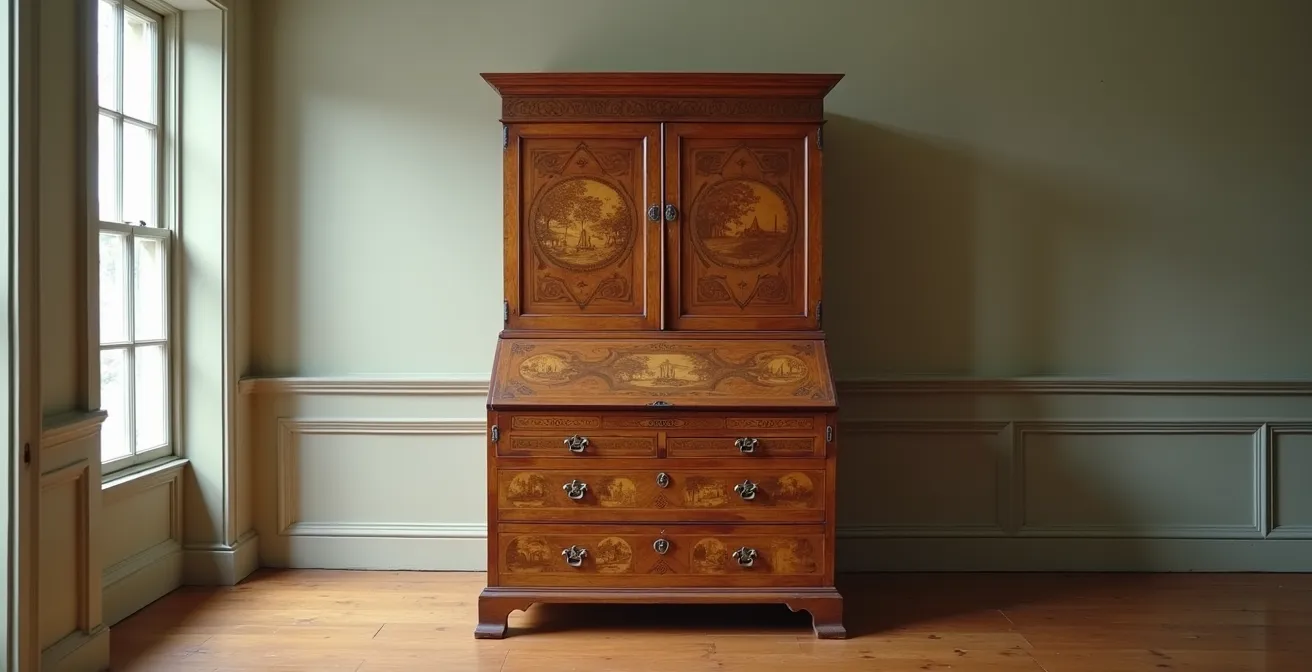
This approach extended beyond single symbols. The choice of woods, the depiction of certain mythological figures associated with freedom or rebellion, or the inclusion of Masonic symbols could all turn a piece of furniture into a layered narrative. When examining an antique desk, don’t just look for mechanical oddities. Study the artwork. Ask yourself if the decorative motifs have a second meaning. Is there a recurring element that seems unusual? This “material dialogue”—reading the story told by the decoration—is a vital part of a complete forensic examination, revealing the beliefs and affiliations of the original owner.
The Puzzle in 3D: Cutting Stone to Fit Curves Perfectly
The most ingenious hidden compartments are those that defy logic. They exist in spaces that your brain tells you shouldn’t be there. Cabinetmakers mastered the art of structural deception by playing with your perception of volume and depth. To defeat this illusion, you must stop looking at the desk as a collection of flat surfaces and start thinking of it as a three-dimensional puzzle, a solid block of space from which the known compartments have been carved out.
The first step is to establish the desk’s true external dimensions. Then, as you open each drawer and cabinet, mentally subtract its volume from the whole. This is where the concept of “unaccounted-for space” becomes a practical tool. Follow this systematic process:
- Gauge the Total Volume: Measure the desk’s height, width, and depth. Get a sense of the total 3D space it occupies.
- Assess Internal Space: Open a drawer. Feel inside. Does its depth match the external dimension of the cabinet? If a drawer is 18 inches deep but the cabinet is 24 inches deep, you have six inches of “unaccounted-for” space to investigate.
- Feel for Anomalies: With the drawer removed, put your hand inside the empty cavity. Feel the bottom, top, and side panels. Are they all solid? A false bottom may feel slightly raised or make a different sound when tapped. Some can only be opened by sliding a fingernail or a thin, flexible knife under an edge to lift them.
- Check Removable Elements: Many desks feature central cabinet sections or decorative pilasters (vertical columns). Gently test to see if these can be slid out or removed. They often conceal tall, narrow compartments perfect for storing documents.
This method requires you to trust your sense of touch and your spatial reasoning over what your eyes initially tell you. The craftsman designed the piece to fool your eyes. By thinking in three dimensions, you can bypass the visual trickery and locate the physical reality of the hidden space.
Key Takeaways
- The key to discovery is adopting the mindset of the 18th-century craftsman, focusing on mechanical philosophy and structural deception.
- Preservation is paramount. Always use non-invasive techniques and conservation-grade materials like microcrystalline wax for lubrication.
- A thorough examination involves forensics: checking for alterations, analyzing the 3D volume, and decoding symbolic marquetry.
How to Mix Louis XV Furniture with Modern Minimalism Without Chaos
Once you’ve uncovered the secrets of your antique secrétaire, its value transcends the purely historical. It becomes a dynamic, interactive piece of art and a powerful conversation starter. The question then becomes how to integrate such an ornate and storied object into a contemporary living space, particularly one guided by minimalist principles. The key is to avoid creating a museum-like atmosphere and instead foster a dialogue between the old and the new.
A Louis XV or Chippendale desk is a statement piece, defined by its rococo curves, fine marquetry, and luxurious veneers. In a minimalist setting, it should be treated as the room’s focal point. Allow it plenty of negative space, placing it against a clean, neutral-colored wall where its intricate details can be appreciated without competition. The “chaos” often arises from trying to match the antique with other period pieces. Instead, create contrast. Pair the ornate desk with simple, clean-lined modern furniture—a sleek chair, a simple metal floor lamp—that respects the desk’s form without trying to imitate it.
The secret compartments themselves add a layer of modern relevance. What once held political documents or gold coins can now serve contemporary needs, bridging the centuries. This table shows how the function of these hidden spaces has evolved.
| Period | Original Use | Modern Application |
|---|---|---|
| 18th Century | Hide wills, cash, political documents | USB drives, charging cables, valuables |
| 19th Century | Store personal letters, jewelry | Phone storage, modern electronics |
| Contemporary | N/A | Interactive art piece, conversation starter |
By giving the desk both a place of honor and a practical modern function, you transform it from a relic into a living part of your home. It becomes a testament to enduring craftsmanship and a piece that is both beautiful and useful, connecting the intrigue of the 18th century with the clean aesthetic of the 21st.
Now that you are equipped with the mindset of a master cabinetmaker, the next logical step is to begin your own patient, respectful investigation of the antique furniture in your life.