Collecting digital art is not a departure from tradition but its technical evolution, translating core principles of provenance, curation, and preservation into a new code-based framework.
- Provenance is no longer a paper trail but an immutable, publicly verifiable history recorded on a blockchain.
- Curation extends beyond selection to include the active management of digital display and robust long-term data preservation.
Recommendation: Approach your first digital acquisition by prioritizing the artist’s intent, the technical robustness of its on-chain provenance, and its long-term preservation strategy over speculative market hype.
For the traditional art collector, the world of physical objects—canvas, bronze, paper—is governed by tangible rules of scarcity, condition, and provenance. The shift to digital art, which exists only as data, can feel like a paradigm collapse. When you acquire a piece that has no physical form, what are you truly buying? The conversation is often dominated by talk of speculative bubbles and technical jargon, obscuring the fundamental questions of value and stewardship.
Many dismiss the medium as a fleeting trend, a market for ephemeral JPEGs. However, this perspective overlooks the profound structural changes that blockchain technology introduces to the very concepts that underpin art collecting. The challenge is not to abandon the principles honed over centuries of collecting physical works, but to understand how they are being translated and, in some cases, radically enhanced within a digital native environment. This is not about replacing your physical collection; it is about expanding the definition of what it means to collect.
But if the core of this new art form is code, how does one navigate the very real concerns of aesthetic integration, market volatility, and, most critically, permanence? The key lies in shifting focus from the object to the system. This guide deconstructs the world of non-physical art for the traditional collector, moving past the hype to explore the new mechanics of display, the realities of market dynamics, the cryptographic solution to forgery, and the essential new responsibilities of digital preservation.
This article provides a technical and forward-looking framework for navigating this new territory. We will dissect the practical challenges and conceptual shifts, enabling you to apply a collector’s discerning eye to an art form defined not by its material, but by its data.
Summary: How to Collect Art That Doesn’t Exist in the Physical World
- Black Screens: How to Live with Video Art Without Ruining Your Decor
- Carbon Heavy: The Ecological Cost of Minting Digital Art
- Who Is the Artist: The Coder or the Code?
- Boom and Bust: Why Digital Art Prices Fluctuate Wildly
- The Immutable Ledger: Solving Art Forgery with Code
- Blue Chip or Emerging Talent: Where to Put Your First €5,000?
- Choosing vs. Making: When Selection Becomes the Artistic Act
- Why Your Digital Art Collection Might Disappear in 10 Years
Black Screens: How to Live with Video Art Without Ruining Your Decor
The first practical hurdle for a collector of digital art is domestic integration. Unlike a painting, which has a constant physical presence, a video or generative artwork relies on a screen that, when turned off, becomes a void in your interior design. This “black screen problem” requires a curatorial approach to technology, transforming a display from a mere television into a dynamic canvas. The goal is to make the hardware disappear, allowing the art to integrate seamlessly with the physical space.
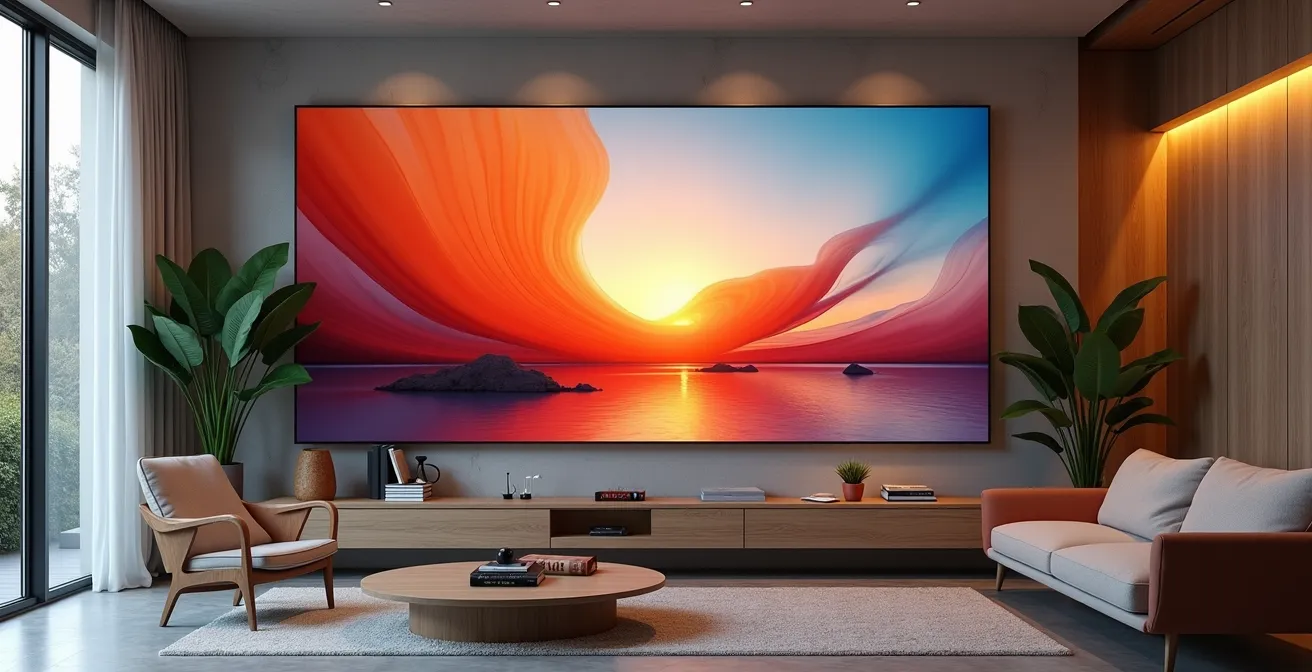
Successful integration involves choosing hardware that complements the home’s aesthetic, such as frame-like displays or custom-built recessed screens. More importantly, it requires programmatic curation. Using smart home systems, collectors can schedule artworks to appear at certain times of day, sync them with ambient lighting, or even create “off-state” visuals like minimalist screensavers. This transforms the display into a living part of the home’s atmosphere rather than an intrusive electronic device.
Case Study: Refik Anadol’s MoMA Installation
Refik Anadol’s Unsupervised (2022) at MoMA exemplifies the powerful bridge between digital and physical realms. The artwork, a machine-learning model’s interpretation of the museum’s 200-year collection, is not a static video loop. It is a living installation that reacts in real-time to its environment, responding to changes in light, movement, and even the weather outside. This demonstrates that sophisticated digital art is not just content for a screen, but a medium that can possess a dynamic relationship with its physical surroundings, much like a sculpture interacts with the space it occupies.
Ultimately, treating the display system as an integral part of the artwork itself is key. This involves careful consideration of lighting to avoid glare, creating multiple display zones for different moods, and designing a cohesive experience where the digital and physical coexist harmoniously. The technology becomes the frame, the wall, and the museum lighting, all in one.
Carbon Heavy: The Ecological Cost of Minting Digital Art
One of the most persistent criticisms leveled against the first wave of digital art was its significant environmental footprint. Early NFTs were primarily minted on the Ethereum blockchain, which used a Proof of Work (PoW) consensus mechanism—an energy-intensive process. For a collector concerned with ethical stewardship, this presented a major barrier to entry. However, the technological landscape has evolved dramatically, rendering this criticism largely obsolete for a majority of the market.
The most significant change was “The Merge” in 2022, when Ethereum transitioned to a Proof of Stake (PoS) mechanism. This single event reduced the network’s energy consumption by over 99.95%, effectively neutralizing the primary environmental argument against it. Furthermore, other blockchains popular for art, such as Tezos and Solana, were built from the ground up with energy efficiency in mind, using PoS or similar low-impact consensus models.
For today’s collector, the focus should shift from a blanket condemnation to a more nuanced evaluation of the specific technology an artist chooses to use. Understanding the different blockchains and their environmental impact is now a crucial part of the due diligence process, similar to understanding the materials used in a physical sculpture.
The following table, based on an analysis of the post-Merge blockchain landscape, compares the most common platforms for minting digital art.
| Blockchain | Consensus Mechanism | Market Share 2023 | Environmental Impact |
|---|---|---|---|
| Ethereum | Proof of Stake (Post-Merge) | 72.3% | 99.95% energy reduction since 2022 |
| Tezos | Liquid Proof of Stake | 8% | Eco-certified, minimal carbon footprint |
| Solana | Proof of History + PoS | 12% | Carbon neutral since 2021 |
| Polygon | Proof of Stake | 7.7% | 99% more efficient than pre-merge Ethereum |
This data demonstrates that the digital art ecosystem has actively addressed its energy consumption issues. While vigilance is still required, the narrative of “carbon-heavy” digital art is no longer an accurate reflection of the market’s leading platforms.
Who Is the Artist: The Coder or the Code?
In traditional art, authorship is typically clear. In the world of digital and generative art, the lines blur. Is the artist the person who wrote the code? Or is the artwork the unique output generated by that code at a specific moment? This conceptual challenge is at the heart of collecting in this new medium. It forces a re-evaluation of creativity, intent, and ownership.
The situation becomes even more complex with generative art platforms. Here, the artist creates an algorithm, but the final artwork is only “born” when a collector initiates a “mint.” The unique hash from that transaction becomes a variable in the code, resulting in a one-of-a-kind output. In this model, the collector is no longer a passive buyer but an active participant in the creation of the piece. This concept of generative co-creation is a fundamental departure from traditional art acquisition.
Case Study: Art Blocks and Generative Art
Platforms like Art Blocks are built on this model of collector participation. An artist uploads a script to the platform, and collectors mint outputs without knowing exactly what they will get. The transaction itself becomes the final “brushstroke,” determining the unique combination of traits in the resulting piece. This process transforms the act of collecting from mere acquisition into a form of collaboration, where the collector’s decision to mint directly influences the final aesthetic outcome. The significant market capitalization of these projects demonstrates the value the market places on this unique form of artistic partnership.
This ambiguity also has significant legal implications. As legal scholar Rebecca Tushnet notes, the purchase of an NFT does not automatically confer the copyright to the underlying work. The collector owns the token, which serves as a certificate of authenticity and ownership of a specific instance of the art, but not necessarily the intellectual property.
In one sense, the purchaser acquires whatever the art world thinks they have acquired. They definitely do not own the copyright to the underlying work unless it is explicitly transferred.
– Rebecca Tushnet, Legal Scholar on NFT Ownership
For a collector, this means due diligence must extend to the smart contract itself—the code that governs the NFT. Understanding what rights are being transferred is as crucial as authenticating a signature on a painting.
Boom and Bust: Why Digital Art Prices Fluctuate Wildly
The digital art market is notorious for its extreme volatility. A traditional collector, accustomed to the relatively stable and incremental price appreciation of blue-chip physical art, may find the violent price swings of the NFT market deeply unsettling. Understanding the mechanics behind this volatility is essential to navigating the space without being purely speculative.
The primary driver of this fluctuation is the market’s deep entanglement with the broader cryptocurrency ecosystem. Most high-value digital art is priced and transacted in cryptocurrencies like Ethereum (ETH). Consequently, the U.S. dollar value of an artwork is tied to two separate, volatile factors: the perceived artistic value of the piece and the current market price of the underlying cryptocurrency. When the price of ETH rises, the entire NFT market can appear to boom; when it falls, asset values can plummet in dollar terms, even if their ETH price remains stable.
This tight correlation was starkly illustrated during the market’s major correction. An in-depth market analysis reveals that Art NFT trading volume experienced a 93% collapse from its peak of $2.9 billion in 2021 to just $197 million in 2024. This “bust” was directly linked to the crash in cryptocurrency prices during the same period. For instance, Ethereum’s price fell from its highs to a low of around $994 in 2022 before rebounding, and the NFT market’s recovery has closely tracked ETH’s subsequent rise. Beyond crypto correlation, the market is also driven by hype cycles, influencer marketing, and a technology adoption curve that is still in its early, most volatile stages.
For the serious collector, the strategy is to look beyond short-term price movements. Value should be assessed based on the artist’s career, the historical significance of the work, its conceptual strength, and its on-chain provenance—metrics that are far more stable than the daily fluctuations of the crypto market.
The Immutable Ledger: Solving Art Forgery with Code
For centuries, the art world has battled with forgery and disputes over provenance. The paper trail for a physical artwork—gallery receipts, auction records, expert attestations—can be lost, damaged, or faked. This is arguably the single most important problem that blockchain technology solves for the art collector. It replaces the fragile paper trail with an immutable ledger.
A non-fungible token (NFT) is a unique digital identifier that is recorded on a blockchain. This token is cryptographically linked to a piece of metadata, which typically includes the artwork file, its title, and the creator’s wallet address. When an artist “mints” a work, they are creating the first entry in this digital ledger. Every time that NFT is sold or transferred, a new, permanent, and publicly verifiable entry is added to the chain. This creates a complete, unbroken, and unforgeable chain of ownership from the artist’s studio to the current owner.
This system of cryptographic provenance is radically transparent. Anyone can use a blockchain explorer to verify the entire history of a token. To authenticate a piece, a collector no longer needs to rely solely on the word of an expert; they can perform technical due diligence. This involves cross-referencing the minting wallet address with the artist’s officially announced address (often shared on their verified social media or website). It also means checking the smart contract address of the collection to ensure it is the legitimate one and not a copycat.
This transparency does not eliminate all fraud—malicious actors can still try to sell knockoffs or trick buyers into interacting with fake contracts. However, it shifts the power to the collector. With the right tools and knowledge, the collector can independently verify authenticity with a degree of certainty that is often impossible in the physical art world. The ledger itself cannot be faked; the key is learning how to read it correctly.
Blue Chip or Emerging Talent: Where to Put Your First €5,000?
Entering the digital art market requires a clear investment strategy, just like in the traditional art world. With a starting budget, a collector faces a classic dilemma: allocate funds to a small piece of a “blue-chip” work with established value, or take a higher risk on emerging artists with greater potential for appreciation? In the digital realm, this choice is further complicated by new investment vehicles like fractional ownership and Decentralized Autonomous Organizations (DAOs).

A balanced portfolio approach is often the most prudent strategy. This might involve allocating a majority of the budget to more stable assets, such as a fractional share of an iconic generative art piece (e.g., a Fidenza by Tyler Hobbs or a Chromie Squiggle by Snowfro). These are the “Warhols” or “Richters” of the digital art world, with proven market resilience. A smaller portion of the budget can then be used to acquire works from promising emerging artists, often found on more accessible blockchains like Tezos or Solana, where prices are lower but the risk—and potential reward—is higher.
This is not just a niche for crypto enthusiasts. Institutional confidence is growing, providing a stabilizing force in the market. As of early 2024, an estimated $300 million has been collectively invested by private banks, VCs, and family offices, signaling a maturation of the asset class. The following table outlines a sample strategy for a €5,000 entry-level investment.
| Strategy | Risk Level | Potential Return | Recommended Allocation |
|---|---|---|---|
| Blue-chip Fractional (Fidenza, Chromie Squiggles) | Low-Medium | Moderate (20-50% annually) | 60% (€3,000) |
| Emerging Artists on Tezos/Solana | High | High (100-500% potential) | 30% (€1,500) |
| DAO Membership (Fingerprints, PleasrDAO) | Medium | Variable + Network Access | 10% (€500) |
Joining a collecting DAO offers a third path, providing not just shared ownership of major works but also invaluable network access and collective expertise. This can be one of the most effective ways for a new collector to learn and gain access to curated opportunities.
Choosing vs. Making: When Selection Becomes the Artistic Act
In the digital art world, the act of collecting can transcend mere acquisition and become a form of curation—and in some cases, an artistic act in its own right. As traditional institutions like major galleries enter the space, they bring a curatorial rigor that emphasizes artistic merit over speculation. Their goal is to build an artist’s career in a new medium, not just to capitalize on a market trend.
Our goal is to support artists represented by Pace Gallery in their investigations of new media. We’re not trying to increase [price] speculation. We’re doing this because we believe in the artists and in the work they are creating.
– Ariel Hudes, Head of Pace Verso NFT Division
This ethos reinforces the idea that a collector’s choices matter. By selecting works with strong conceptual foundations and supporting artists with a long-term vision, a collector contributes to the historical canon of this nascent field. The collection itself becomes a statement, a reflection of a particular aesthetic and intellectual viewpoint.
This curatorial role finds its ultimate expression in the creation of virtual galleries. The metaverse and other browser-based virtual worlds provide collectors with the tools to not just own art, but to display it in a context of their own design. A collector can become an architect, a gallerist, and a curator, all at once.
Case Study: Virtual Gallery Platforms as Curatorial Expression
A collector can go beyond simply holding tokens in a wallet. By acquiring a parcel of virtual land in a blockchain world like Cryptovoxels or Decentraland, they can design and build their own AI art museum to display their collection. This virtual space can be visited by anyone with a web browser, transforming a static collection into a dynamic, living exhibition. The collector controls the architecture, the lighting, and the arrangement, making the presentation of the art as much a part of their creative expression as the selection of the pieces themselves.
In this context, the collector’s “eye”—their ability to identify important work and present it in a compelling way—becomes their most valuable asset. The act of choosing, contextualizing, and sharing becomes a critical contribution to the culture, elevating the collector from a mere buyer to a true patron and tastemaker.
Key Takeaways
- Display is Curation: Integrating digital art into a physical space is an active curatorial act that requires a blend of interior design and technical programming.
- Provenance is Code: The blockchain provides an unforgeable, transparent record of ownership, but it is the collector’s responsibility to learn how to read and verify this data.
- Preservation is an Active Duty: Unlike a physical painting, a digital file’s permanence is not guaranteed. The collector must take active, technical steps to ensure its long-term survival.
Why Your Digital Art Collection Might Disappear in 10 Years
The most critical and least understood risk for a digital art collector is that of permanence. The NFT token on the blockchain is typically just a pointer, a “certificate of ownership,” not the artwork itself. The actual media file (the image, video, or code) is often too large to store on-chain. This raises a terrifying question: if the server hosting your multi-million dollar artwork goes offline, what do you own? The answer might be nothing more than a broken link.
The storage problem is a systemic risk. A 2022 study reveals concerning storage practices, showing that only about 10% of NFTs have their data stored directly on-chain. Around 50% rely on the InterPlanetary File System (IPFS), a decentralized storage network, while the rest are at critical risk on centralized private servers or traditional web domains. If a company hosting a file goes bankrupt or simply decides to stop maintaining a server, the artwork can be lost forever. This concept is known as “rug pull” on a technical level, separate from market fraud.
For a collector, ensuring data permanence is the ultimate act of stewardship. It is a technical responsibility that does not exist in the physical art world. Relying on the minting platform or artist to maintain the data is a gamble. The serious collector must take proactive steps to secure their assets for the long term, using decentralized storage solutions and robust key management practices.
Your Action Plan: Essential Steps for Long-term NFT Preservation
- Decentralized Pinning: Pin your NFT’s data (the media file and metadata) to multiple IPFS pinning services like Pinata or Lighthouse. This creates redundant copies across a distributed network, ensuring the data remains available even if one node goes offline.
- Secure Key Management: Store the private keys to your crypto wallet in a hardware wallet (e.g., Ledger, Trezor). Never store them on a computer or online service. Document your seed phrase and store it in multiple secure, offline locations.
- Use Permanent URIs: Ensure your NFT’s metadata uses a direct IPFS URI (e.g., `ipfs://[CID]`) rather than an HTTP gateway URL (e.g., `https://gateway.ipfs.io/…`). The gateway can go down; the direct URI is permanent as long as the data is pinned.
- Monitor and Verify: Set up automated monitoring services to periodically check that your pinned data remains accessible across the IPFS network. Do not assume it will stay pinned forever without verification.
- Estate Planning: Document wallet access instructions, including private keys and seed phrases, and include clear provisions for your digital assets in your estate planning, just as you would for physical art.
Your journey into collecting non-physical art begins not with a purchase, but with an understanding of these new principles of stewardship. Start by evaluating the provenance and preservation strategy of any piece you consider. The future of your collection depends on the diligence you apply today.