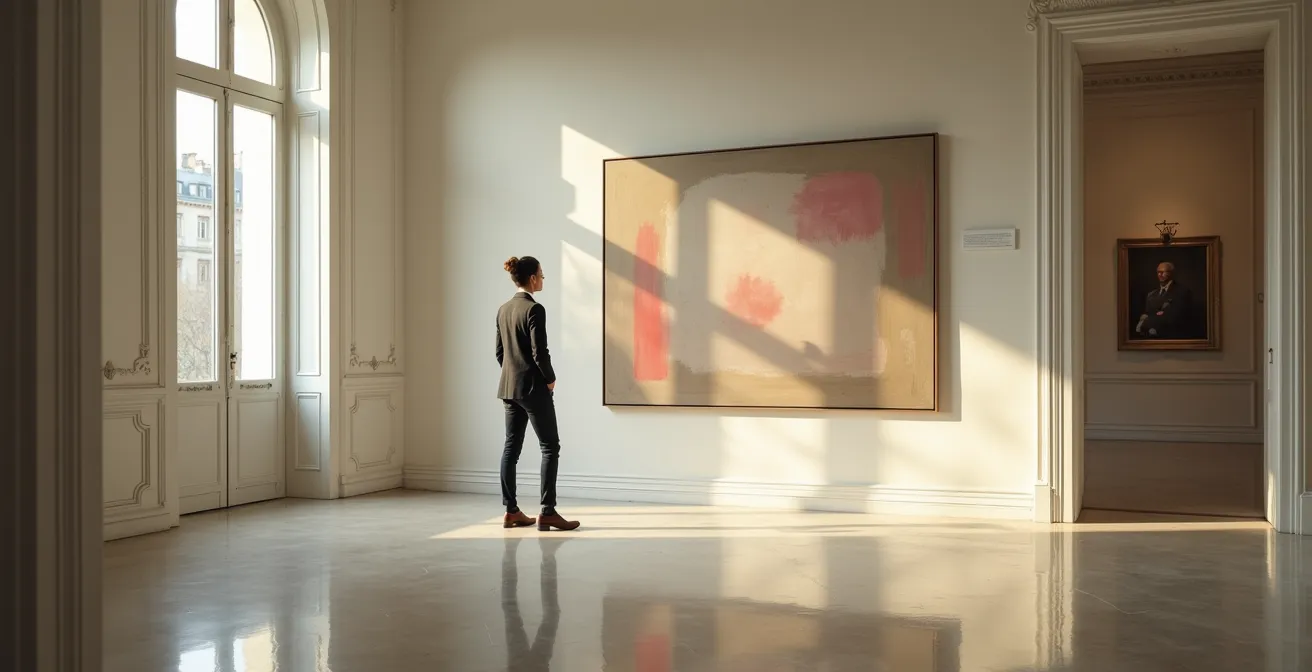
Contrary to popular belief, buying your first artwork in Paris has less to do with ‘innate taste’ and more to do with understanding the market’s hidden rulebook.
- Price is not determined by size, but by a ‘value stack’ of artist career stage, gallery tier, and market history.
- Access to exclusive viewings is not about wealth, but a result of a methodical relationship-building process.
Recommendation: Focus on an artist’s career trajectory (their ‘CV score’) and their gallery’s reputation, not just the aesthetic of the piece.
The Parisian art scene can feel like a fortress. You walk through the Marais or Saint-Germain-des-Prés, peering into minimalist, white-cube galleries where silence hangs as heavy as the price tags. For an aspiring collector, the experience is often more intimidating than inspiring. The common advice—”buy what you love”—feels hollow when you suspect you’re on the outside of a very exclusive game, unable to tell a future star from a fleeting trend. You fear overpaying, looking naive, or worse, buying into an artist with no future.
Many guides will point you to the big art fairs or tell you to simply “talk to the gallerists,” but they fail to explain the nuanced codes of this world. They don’t decode the hierarchy that dictates why one gallery’s backing can add 40% to an artist’s value, or how a polite, strategic conversation can open doors that money alone cannot. This world operates on unwritten rules, subtle signals, and a clear pecking order.
But what if you could learn the rules? What if that feeling of intimidation could be transformed into a tactical advantage? This guide is your key to that fortress. We will move beyond the platitudes and decode the Parisian primary art market. We will not teach you what to like; we will teach you how the game is played. You will learn to assess an artist’s potential like a pro, understand the real drivers of price, identify the traps, and navigate the system to acquire your first piece with intelligence and confidence.
This article breaks down the essential strategies for any new collector entering the Parisian art scene. From your initial investment decisions to understanding the power structures that shape an artist’s career, each section provides an insider’s perspective to help you navigate the market effectively.
Summary: An Insider’s Path to Your First Parisian Artwork
- Blue Chip or Emerging Talent: Where to Put Your First €5,000?
- The “By Appointment” Myth: How to Access VIP Viewing Rooms
- Why a Canvas of the Same Size Can Cost €500 or €50,000
- The Red Flags of Vanity Galleries That Exploit New Artists
- When to Buy: Negotiating Deals Before the FIAC Frenzy
- Supplier to the King: Does the Royal Warrant Still Drive Sales?
- When the State Lost Control of Taste: The Rise of Private Dealers
- Why Talent Is Only 50% of a Successful Art Career?
Blue Chip or Emerging Talent: Where to Put Your First €5,000?
Your first €5,000 is a strategic decision that defines your collecting journey. The choice isn’t just about aesthetics; it’s a calculated bet on risk versus stability. You can buy a print or a minor work by a “blue-chip” artist, where the value is 80% brand name and 20% physical object. It’s a safe, but often low-growth, play. The alternative is to invest in an emerging artist, a move that requires more research but holds far greater potential. For a new collector, this is where the real excitement—and opportunity—lies. And you are not alone; a recent Art Basel and UBS report noted that 38% of dealer sales went to first-time buyers in 2024, showing the market is actively courting new entrants.
For an emerging artist, the price is a “value stack”: roughly 20% for the physical object, 40% for the artist’s perceived potential, and a crucial 40% for the gallery’s support and validation. A top-tier gallery like Perrotin or Templon provides an immediate stamp of approval that significantly bolsters an artist’s market. Your goal with that first €5,000 is to find an artist whose “value stack” is solid and poised for growth. This means you aren’t just buying a canvas; you’re buying into a career trajectory.
To make this choice, you must first define your objective. Are you seeking wealth preservation, long-term growth, or a lifestyle benefit? A clear goal will guide your research. If growth is the priority, focus on artists with strong gallery representation and initial signs of institutional interest. Your initial investment is not just a purchase but the first move in building a collection with a coherent vision.
The “By Appointment” Myth: How to Access VIP Viewing Rooms
The phrase “by appointment only” on a gallery door is designed to intimidate. It’s a velvet rope that seems to separate the serious collectors from the casual observers. The myth is that you need to be a known millionaire to get past it. The reality is that access is earned through strategic engagement, not just wealth. Gallerists are business owners looking for passionate, long-term clients, regardless of their initial budget. Breaking into this inner circle is a methodical process.
It starts with genuine curiosity. As the My Private Paris guide notes, gallerists are there to help you discover new art. They state:
Gallerists will work with you to see what you’re looking for, provide suggestions, introduce you to new artists, and then walk you through the purchase which includes the coordination of international shipping.
– My Private Paris Guide, Where to Buy Art in Paris Ultimate Guide
This relationship begins with small, consistent steps. You are building a reputation as a serious, engaged, and respectful potential client. The gallery staff will remember a thoughtful question far longer than they will a boast about budget. Your goal is to transition from an anonymous face in the crowd to a familiar and welcome presence.
Here is a simple, five-step strategy to gain access:
- Visit the public exhibition: Go during a quiet time and ask one intelligent, specific question about the artwork or the artist’s technique.
- Join the mailing list: This is a simple but crucial step. It signals your interest and keeps you informed about future events.
- Attend the next opening: Show up. Be seen. Try to have a brief, polite exchange with the gallerist or a gallery assistant, referencing your previous visit or the email you received.
- Send a follow-up email: A day or two later, send a short email thanking them for the event and mentioning a specific work that caught your eye. This demonstrates serious interest.
- Build the relationship: After this consistent engagement, requesting a private viewing of a particular work is no longer a cold call but the natural next step in a budding relationship.
Why a Canvas of the Same Size Can Cost €500 or €50,000
One of the most confusing aspects for a new collector is the seemingly arbitrary nature of pricing. Two canvases, identical in size and material, can have prices that differ by a factor of one hundred. This isn’t magic; it’s a reflection of a complex set of market-driven factors that have little to do with the physical object itself. The price is primarily determined by the artist’s career trajectory, or what insiders call their “CV score,” and the power of the ecosystem supporting them.
An emerging artist selling a piece for €500 is valued on potential. They may have a few group shows and local recognition, but no significant auction history. The buyer is taking a speculative risk. In contrast, an artist whose work commands €50,000 has a proven track record. Their CV includes museum exhibitions, inclusion in major private collections, and a strong secondary market presence at auction houses. This history provides a baseline value and a predictable, albeit slower, rate of appreciation, often around 5-15% annually. The market can be volatile; a 2024 report noted that contemporary art auction sales dropped significantly, reinforcing that established artists offer more stability in uncertain times.
The following table, based on common art market valuation principles, breaks down the key determinants of an artwork’s price. It clarifies how an artist’s affiliations and market history create the vast price differential. The data is sourced from an analysis of artwork pricing factors.
| Factor | Emerging Artist (€500-5,000) | Established Artist (€50,000+) |
|---|---|---|
| Gallery Tier | Independent/Small galleries | Blue-chip galleries (Gagosian, Zwirner) |
| CV Score | Few group shows, local recognition | Museum exhibitions, major collections |
| Market History | No auction record | Strong secondary market presence |
| Collector Base | Regional, emerging collectors | International, institutional buyers |
| Price Appreciation | Speculative, 0-500% potential | Stable, 5-15% annual growth |
The Red Flags of Vanity Galleries That Exploit New Artists
As you begin your search, you will inevitably encounter “galleries” that seem incredibly eager for your business. These are often vanity galleries, a major trap for both new artists and new collectors. Unlike legitimate galleries that invest in an artist’s career and take a commission (typically 50%) on sales, vanity galleries operate on a different model: they charge artists exorbitant fees for “exposure” or to be included in a show. This fundamental conflict of interest means their goal is not to sell art but to sell wall space to artists.
For a collector, buying from a vanity gallery is a dead end. The art has no market validation and is highly unlikely to appreciate in value. The gallery has no incentive to build the artist’s career, leading to high artist turnover and a lack of curatorial vision. The language they use is a key giveaway. A legitimate gallerist will discuss an artist’s “practice,” their “conceptual framework,” and their career development. A vanity gallerist will talk vaguely about “getting your name out there” and “great exposure.” While the old adage “buy what you like” holds true, you don’t want to love something that was created as part of an exploitative business model.
Protecting your investment and supporting a healthy art ecosystem means learning to spot these predatory operations from a mile away. The following checklist provides concrete points to verify before ever considering a purchase.
Checklist for Identifying Vanity Galleries
- Check the business model: Legitimate galleries earn a 50% commission on sales, not upfront fees from artists. Ask about their model.
- Examine artist turnover: A constant rotation of new artists and large group shows with 20+ unconnected artists are major red flags.
- Listen to the language: Good gallerists discuss an artist’s ‘practice’ and ‘conceptual framework,’ not just ‘exposure.’
- Research the gallery’s track record: Look for the career progression of artists they’ve represented in the past. Have they moved on to better galleries or museum shows?
- Verify curatorial vision: Each exhibition in a reputable gallery should have a clear thematic coherence, not just be a collection of random works.
When to Buy: Negotiating Deals Before the FIAC Frenzy
In the art world, timing is a strategic advantage. The biggest mistake new collectors make is waiting for the peak frenzy of a major art fair like FIAC (now Paris+ par Art Basel) to make a move. While fairs are excellent for discovery, they are high-pressure, competitive environments. According to the UBS Art Market Report, 31% of dealers find new buyers at fairs, meaning they are in sales mode, not relationship-building mode. The best works are often pre-sold to established clients before the fair even opens to the public.
The savvy collector operates on a different timeline. The real work is done in the weeks and months leading up to the fairs. This is when galleries are finalizing their booth selections and are more open to discussions. By visiting galleries during this preparation period, you can see what they are planning to show, express your interest early, and potentially secure a work before it enters the competitive fair environment. This is also the time when you have the gallerist’s full attention, allowing for deeper conversations about the artist’s work and career.

Negotiation is also more feasible during this pre-fair window. While significant discounts are rare on the primary market for in-demand artists, a 5-10% “collector’s discount” can sometimes be extended to new, serious buyers as a gesture of goodwill to build a long-term relationship. This is almost impossible to achieve in the heat of a fair. By engaging early, you are not just a customer; you are a strategic partner in the gallery’s success. You are demonstrating foresight and a serious commitment that gallerists value highly.
Supplier to the King: Does the Royal Warrant Still Drive Sales?
Historically, royal patronage was the ultimate validation for an artist. Being “Supplier to the King” guaranteed not just sales but a legacy. In modern-day Paris, the “king” is no longer a monarch but a new set of powerful institutions. The old-world concept of a royal warrant has been replaced by a more complex system of institutional validation that serves the same purpose: it separates promising artists from the pack and provides a powerful endorsement that drives market value.
Today, the ultimate arbiters of taste and value in Paris are private foundations like the Fondation Louis Vuitton, the Pinault Collection, and the Fondation Cartier. When one of these institutions acquires an artist’s work, it is the 21st-century equivalent of a royal commission. This act sends a ripple through the market, creating immediate validation and signaling to other collectors that the artist is a significant cultural figure. This institutional stamp of approval can dramatically increase an artist’s prices overnight and solidifies their position in art history.
The French state also continues to play a role, albeit a different one. France’s “1% Artistique” law, which requires 1% of the budget for public construction projects to be dedicated to commissioning artwork, provides another form of state-sanctioned endorsement. While less glamorous than a Pinault acquisition, it establishes a baseline value and provides crucial support for emerging and mid-career artists. These mechanisms are a testament to France’s central role in the art world; as Artprice’s 2024 report confirmed, France ranked 2nd globally in transaction volume, making it a powerhouse of the European market.
When the State Lost Control of Taste: The Rise of Private Dealers
For centuries, the French state, through its academies and salons, dictated artistic taste. That era is long gone. Today, power lies in the hands of a tiered ecosystem of private dealers and galleries, each occupying a specific niche in the Parisian landscape. Understanding this map is essential for a new collector. You wouldn’t go to a haute couture atelier for a t-shirt, and you shouldn’t go to a global mega-gallery with a €5,000 budget. Navigating Paris requires knowing the territory.
Clare McAndrew, in the Art Basel and UBS Global Art Market Report, pointed to a challenge in this new landscape: “Several dealers spoke of a lack of curiosity among clients… The appetite for the unknown isn’t there anymore.” This creates an opportunity for a curious new collector. By exploring beyond the obvious, you can discover immense talent in galleries that are more accessible. The key is to match your budget and collecting goals to the right gallery tier.
The Parisian gallery scene can be roughly divided into four key districts, each with its own identity and player roster. This map, based on analysis from art advisory Ocula, provides a clear guide to the city’s art ecosystem.
| District | Gallery Type | Key Players | Buyer Profile |
|---|---|---|---|
| 8th Arrondissement | Global Mega-galleries | Gagosian, David Zwirner, White Cube | Ultra-high-net-worth, institutional |
| Le Marais | Established French Powers | Perrotin, Templon, Galleria Continua | Serious collectors, €10K-100K budget |
| Belleville | Emerging Project Spaces | Chapelle XIV, Independent galleries | Young collectors, trend-seekers |
| Saint-Germain | Historical Prestige | Galerie Lelong, Mennour | Traditional collectors, connoisseurs |
Key Takeaways
- The price of an artwork is a ‘value stack’: 20% object, 40% artist potential, and 40% gallery support for emerging talent.
- Access is earned through strategic engagement, not wealth. Start by asking intelligent questions and attending openings.
- Avoid ‘vanity galleries’ that charge artists fees; a legitimate gallery’s income is based on a 50% sales commission.
Why Talent Is Only 50% of a Successful Art Career?
The final and most crucial lesson for a new collector is this: you are not just buying a beautiful object. You are investing in a career. Raw artistic talent is a prerequisite, but it only accounts for about half of what makes an artist successful in the long run. The other 50% is a combination of professionalism, strategic networking, and a compelling narrative. An artist who creates brilliant work but is difficult to work with, misses deadlines, or lacks a coherent intellectual framework will almost always see their market potential stall.
As a collector, your due diligence must extend beyond the canvas. You must evaluate the artist as a professional entity. Are they building a strong network? Is their output consistent? Is their representing gallery a powerful and committed partner? A great artist supported by a great gallery is a formidable combination. Your role as a collector is also part of this equation. By buying their work, loaning it for exhibitions, and acting as an ambassador, you become part of the support system that fuels their career.
To help structure this evaluation, you can use a framework like the CARE Model. It forces you to look beyond pure aesthetics and assess the four pillars of a successful art career. This simple model is an invaluable tool for making an informed investment decision.
- C – Context: Assess the artist’s compelling story and the intellectual rigor behind their work. Is there a unique and defensible point of view?
- A – Affiliation: Evaluate the quality of their representing gallery and their professional network. Who is backing them?
- R – Record: Review their CV for institutional shows, prestigious residencies, and inclusions in respected collections. Is their ‘CV score’ rising?
- E – Execution: Judge their professionalism, consistency of output, and communication skills. Are they a reliable partner?
By shifting your mindset from a passive buyer to a strategic investor in talent, you complete your transformation from an intimidated outsider to a savvy participant in the Parisian art world. You now have the tools to read the market, identify true potential, and build a collection that is not only beautiful but also intelligent and full of promise.