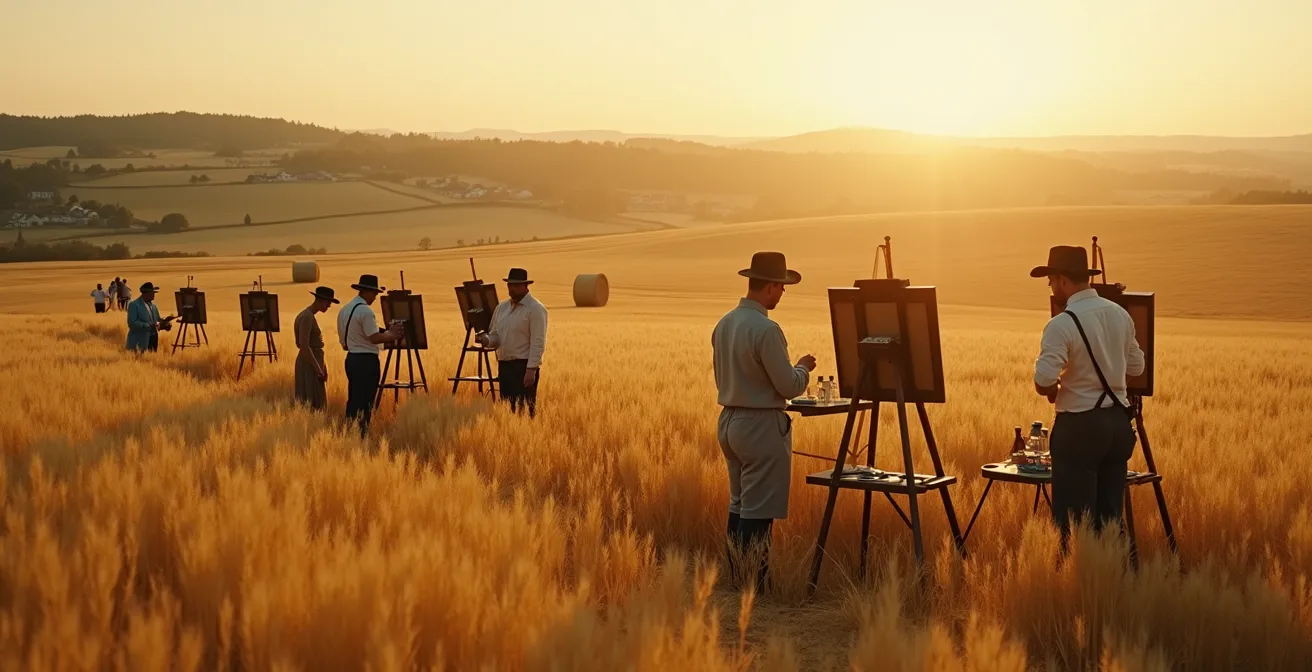
The “look” of Impressionism was not just an artistic choice, but a direct consequence of the technology that enabled it: the collapsible paint tube.
- Working outdoors forced artists to paint faster to capture fleeting light, resulting in visible, rapid brushstrokes.
- The physical challenges of “en plein air” painting—wind, sand, and unstable conditions—are literally embedded in the texture of the canvases.
Recommendation: When viewing an Impressionist work, look beyond the subject and see the story of its creation—a race against time and a battle with the elements made possible by a simple metal tube.
When we picture Impressionism, we often conjure romantic images: Monet’s serene water lilies or Renoir’s lively riverside parties. The standard explanation is that this art movement was born from a desire to escape the studio and capture the fleeting, light-filled moments of everyday life. This is true, but it misses the most crucial part of the story. The Impressionist revolution was not primarily an ideological one; it was a technological one, sparked by a humble invention that we now take for granted.
The real catalyst was the portable, pre-packaged, collapsible paint tube. Before its invention, painting outdoors on a large scale was a logistical nightmare. Artists were chemists as much as painters, grinding pigments and mixing them with oil in their studios. But what if the accepted narrative—that tubes simply made it *easier* to paint outside—is incomplete? What if the technology itself dictated the very aesthetics we associate with the movement? This article delves into the practical, material reality of how this simple tool didn’t just facilitate Impressionism, but actively forged it. We’ll explore how the physical constraints and new possibilities of this “workflow revolution” directly led to the visible brushstrokes, vibrant colors, and “unfinished” look that so shocked the 19th-century art world.
This exploration will show how a change in material fundamentally rewired the artist’s entire process, from perception to execution. The following sections break down this technological cascade, revealing how each iconic trait of Impressionism has its roots in the practical consequences of painting with tubes in the wild.
Summary: How the Invention of the Paint Tube Created Impressionism
- Chasing the Sun: Why Monet Painted the Same Haystack 25 Times
- Mixing with the Eye: Why Placing Colors Side-by-Side Vibrates
- Sand in the Paint: The Gritty Reality of Painting on the Beach
- When a Sketch Becomes the Final Work: Redefining Quality
- Cropping and Asymmetry: How Imports Changed European Framing
- Smooth Surface or Visible Brushstroke: The Battle for “Finished” Art
- Red for Danger or Hunger: Contextualizing Color in Design
- Acceptance or Starvation: The Life-or-Death Power of the Salon Jury
Chasing the Sun: Why Monet Painted the Same Haystack 25 Times
The ability to work outdoors created a new, formidable opponent for the painter: time. The sun’s constant movement meant that a specific light effect—the “impression”—lasted only for a few minutes. This sensory overload of changing information forced a radical shift in workflow. Instead of meticulously finishing one canvas over days, artists had to work with unprecedented speed. Claude Monet epitomized this new method. His famous Haystacks series wasn’t an obsessive study of a single object; it was a frantic attempt to document the passage of time through light. To do this, he developed a system that was only possible with portable paints.
He would set up multiple easels, working on “as many as ten or twelve paintings a day,” as one account notes. When the light changed on one canvas, he would immediately switch to another that matched the new conditions. This led to an almost industrial scale of production; for his Haystacks, Monet created an unprecedented series of 25 canvases between 1890 and 1891. He himself described the struggle in a letter, stating, “I am struggling with a series of different effects [haystacks]… but at this season, the sun sets so fast I cannot follow it.” The final canvases were then harmonized back in the studio, but their essence was born from this rapid-response process. The series as a whole became the true work of art, a testament to a workflow revolution driven by the need to outrun the sun.
Mixing with the Eye: Why Placing Colors Side-by-Side Vibrates
The time pressure of plein air painting didn’t just affect workflow; it fundamentally changed how color was applied to the canvas. In the traditional studio, an artist had ample time to meticulously blend pigments on a palette to create smooth tonal gradations. Outdoors, this was a luxury no one could afford. The solution was a technique called optical mixing. Instead of blending colors on the palette, Impressionists applied strokes of pure, unmixed color directly onto the canvas, side-by-side. When viewed from a distance, the human eye blends these colors together, creating a more vibrant and luminous effect than pre-mixed paint ever could.
This technique was supercharged by another technological advance running in parallel with the paint tube: industrial chemistry. The 19th century saw an explosion of new, brilliant, and stable synthetic pigments. In fact, industrial chemistry revolutionized the artist’s palette with over 20 intense new pigments appearing between 1800 and 1870. Colors like chrome yellow, cobalt blue, and viridian green, previously unavailable or prohibitively expensive, could now be loaded into tubes and carried anywhere. The combination of a portable palette of intense colors and the speed required by outdoor work made optical mixing the logical, necessary technique.
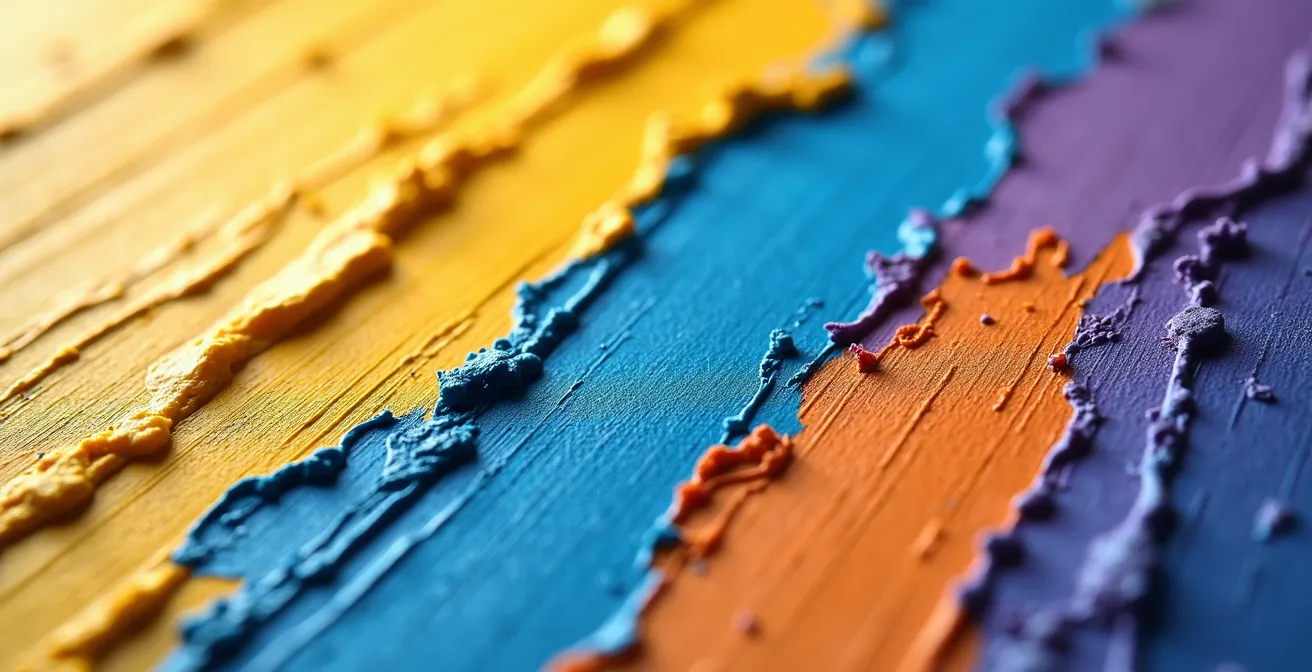
As the close-up image reveals, the surface of an Impressionist painting is a chaotic field of individual color dabs. It is this very separation of strokes that creates the shimmering, light-filled effect that defines the movement. It wasn’t an abstract choice; it was a practical solution to a material problem.
Sand in the Paint: The Gritty Reality of Painting on the Beach
The romantic image of an artist peacefully dabbing at a canvas on a sunny beach belies a much harsher truth. Painting “en plein air” was a physical struggle, a battle against the elements that left its mark directly on the artwork. This concept of material friction—the resistance of the real world—is a key, often overlooked aspect of Impressionism. The wind would threaten to topple easels, changing light would frustrate the eye, and the environment would literally become part of the painting. Conservators today often find grains of sand, dirt, and plant matter embedded in the thick impasto of Impressionist works.
The challenges were so profound that they underscore the importance of the paint tube. As Pierre-Auguste Renoir famously remarked, it was a non-negotiable piece of technology. He stated:
Without colors in tubes, there would be no Cézanne, no Monet, no Pissarro, and no Impressionism.
– Pierre-Auguste Renoir, Smithsonian Magazine
This wasn’t hyperbole. Imagine trying to grind pigments or manage leaky pig-bladder pouches in the middle of a gust of wind. The sheer physicality of the endeavor is perfectly illustrated by an incident involving Monet. While working on his 1885 canvas *Waves at the Manneporte*, he was so focused on capturing the tumultuous sea that he and his easel were nearly swept off the beach by a large wave. This gritty reality is a world away from the quiet, controlled environment of the studio. The energy and chaos of the outdoors were transferred directly onto the canvas through hurried, thick brushstrokes.
When a Sketch Becomes the Final Work: Redefining Quality
The result of this rapid, on-location, friction-filled process was a canvas that looked, to the 19th-century eye, glaringly unfinished. The academic standard of the time demanded a smooth, “licked” surface where the artist’s hand was invisible. Impressionist paintings were the exact opposite: they celebrated the visible brushstroke, the thick application of paint (impasto), and the raw energy of a sketch. What began as a practical necessity—painting quickly to capture a fleeting moment—evolved into a new aesthetic philosophy. The impression became the final product.
This was a radical departure. A sketch (esquisse) was traditionally a preparatory step, not the main event. By exhibiting these “sketches” as complete works, the Impressionists were challenging the very definition of artistic quality and finish. They argued that the authenticity of a captured moment and the emotional truth of the artist’s perception were more valuable than the polished, artificial perfection demanded by the official Salon. The painting was no longer just a window onto a scene; it was a record of the experience of seeing that scene.
Initially met with ridicule, this new aesthetic eventually found its audience and, crucially, its market. The commercial success of Monet’s Haystacks series was a turning point. At his 1891 exhibition at the Galerie Durand-Ruel, the commercial success was immediate when most paintings sold for up to 1,000 francs. This financial validation proved that the public was beginning to understand and appreciate this new visual language. The “unfinished” look was no longer a flaw; it was the signature of modernity.
Cropping and Asymmetry: How Imports Changed European Framing
As artists moved out of the studio and into the bustling streets, cafes, and landscapes of modern life, their compositions began to change dramatically. The formal, balanced, and centered compositions of academic painting gave way to something that felt more immediate and spontaneous: the snapshot. Figures were cropped at the edge of the frame, viewpoints were often high or low, and compositions were strikingly asymmetrical. This new way of seeing was heavily influenced by two parallel innovations: the rise of photography and the influx of Japanese woodblock prints (Japonisme).
Japanese prints, in particular, offered a completely different compositional language. They embraced empty space, flattened perspectives, and a decorative approach to form that felt revolutionary to European artists. Similarly, photography captured fleeting moments with an unposed, candid quality, often resulting in “accidental” cropping. The Impressionists, enabled by the mobility of their paint tubes, were perfectly positioned to absorb these influences. They were out in the world, observing the very type of dynamic, chaotic scenes that this new compositional logic could best represent.
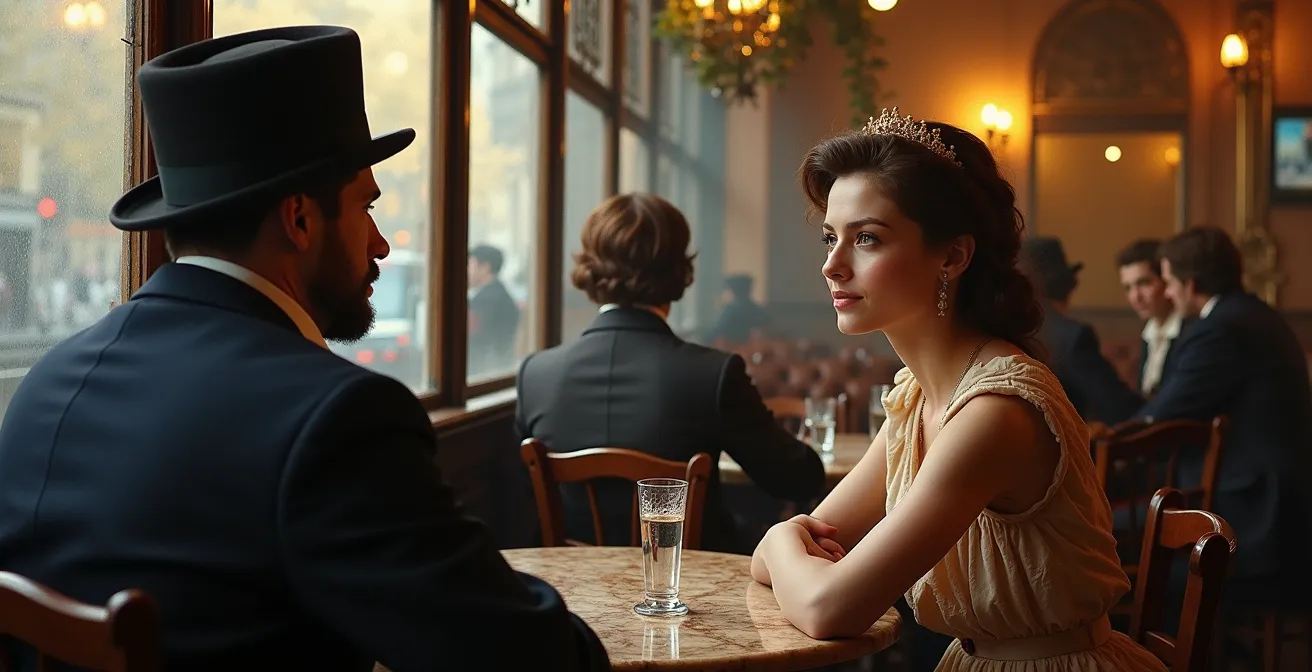
The painting of a cafe scene above is a perfect example. The figures are not formally posed; they are caught in a moment, with individuals cut off by the frame as if captured by a quick glance. This is not the timeless, staged world of historical painting. It is the transient, fragmented experience of modern life, a perspective made paintable by the fusion of portable technology and new visual ideas from abroad.
Smooth Surface or Visible Brushstroke: The Battle for “Finished” Art
The most visible battle fought by the Impressionists was over the surface of the painting itself. The official art establishment, championed by the Académie des Beaux-Arts, prized a technique known as “le fini.” This meant that all traces of the artist’s brushwork had to be smoothed away, creating a pristine, enamel-like surface. This slick finish was considered the hallmark of a skilled and disciplined artist. The Impressionists’ embrace of the visible, energetic brushstroke was therefore seen not as a stylistic choice, but as a sign of incompetence and laziness.
However, this technique was a direct and logical outcome of the new plein air workflow. Working wet-on-wet (*alla prima*) to capture a scene in a single session meant there was no time for layers of paint to dry. The paint was applied quickly and thickly. The brushstroke became the basic unit of expression, conveying not just color and form, but also the speed and emotion of the artist’s hand. This entire process was underpinned by the singular invention that made it all possible.
The Technical Revolution of Portable Paint
The modern paint tube was invented in 1841 by the American portrait painter John Goffe Rand. His innovation was essentially a small tin syringe, a vast improvement over the previous method of storing paint in fragile pig’s bladders. According to a history by Winsor & Newton, the company that later patented and perfected the device, the real breakthrough was the addition of a screw cap. This simple mechanism finally made paint a truly stable and portable medium, protecting it from air and allowing artists to work anywhere with a full, reliable palette.
The paint tube was more than a container; it was an enabler of a completely new artistic philosophy. The raw, textured surface of an Impressionist painting is the most direct evidence of this technological shift, a rebellion against “the finished” that was fueled by a tube of tin.
Action Plan: Understanding the Paint Tube’s Impact
- On-location Work: The ability for artists to create finished exhibition pieces, not just sketches, entirely “en plein air.”
- Capturing Fleeting Moments: The efficiency of tubes allowed painters to record transient effects of light and atmosphere with a full color palette.
- Increased Productivity: The convenience of pre-mixed paints enabled artists to produce work faster, allowing for serial painting and greater experimentation.
- Access to New Colors: The stable, sealed tube was the perfect vehicle for delivering new, vibrant synthetic pigments like chrome yellow and emerald green to the canvas.
- Focus on Observation: By eliminating the time-consuming chore of paint preparation, the tube freed the artist to concentrate purely on the act of seeing.
Red for Danger or Hunger: Contextualizing Color in Design
To the 19th-century public, an apple was supposed to be red, the sky blue, and a shadow gray. The Impressionists shattered this convention of “local color.” They argued that the color of an object is not fixed but is entirely dependent on the light that illuminates it. A haystack in the morning sun was not the same color as the same haystack at dusk. A shadow on snow was not gray, but filled with reflected blues and purples. This was a radical way of seeing, and the new range of vibrant pigments in their portable tubes gave them the arsenal to express it.
When Monet exhibited his Haystacks, he wasn’t just showing pictures of farm equipment. He was forcing the public to confront this new theory of color and light. The subject matter was deliberately mundane; the true subject was the “envelope” of light and atmosphere surrounding it. By presenting multiple canvases of the same subject side-by-side, he was demonstrating that reality is not a single, static image but an infinite series of fleeting impressions. This was a masterclass in re-contextualizing color.
The impact of this approach was solidified at his 1891 show at the Galerie Durand-Ruel in Paris. According to art historians, the revolutionary presentation included 15 of the Haystack paintings shown together, an act which overwhelmed critics and the public with its singular focus on the subtleties of light. The art critic Octave Mirbeau, a champion of the Impressionists, recognized the profundity of this achievement, writing that the canvases represented “what lies beyond progress itself.” They had untethered color from the object and attached it to the transient, subjective experience of perception.
Key takeaways
- The invention of the collapsible paint tube was the key technological driver behind the Impressionist movement.
- The aesthetics of Impressionism (visible brushstrokes, “unfinished” look) are a direct result of the practical challenges of painting outdoors.
- Material constraints and new technologies do not just facilitate art; they actively shape and define artistic styles.
Acceptance or Starvation: The Life-or-Death Power of the Salon Jury
In the 19th century, the path to a successful artistic career in France led through one place: the official Paris Salon. This annual exhibition, run by the Académie des Beaux-Arts, was controlled by a conservative jury that upheld traditional artistic values. They favored historical, mythological, and religious subjects rendered with a flawless, polished technique. To be accepted into the Salon meant recognition and sales; to be rejected meant obscurity and, for many, financial ruin. The jury held the life-or-death power over an artist’s livelihood.
The Impressionists, with their “unfinished” canvases, modern subjects, and shocking use of color, were consistently rejected by the Salon jury. They were not the first to challenge the system; as PBS notes in its history of the movement, “The so-called realists had already challenged the Academy’s values by painting scenes from contemporary life, sometimes admitted to the salon and sometimes denied.” But the Impressionists’ rebellion was more fundamental. Armed with the new workflow enabled by paint tubes, they created an entire body of work that was aesthetically incompatible with the Salon’s standards.
Faced with constant rejection, they made a daring choice: if the establishment wouldn’t show their work, they would create their own establishment. In 1874, they organized their own independent exhibition, an act of defiance that marked the official birth of the movement. It was a massive financial and critical risk, but it was the only way for their new, technology-driven vision of art to be seen. This break from the Salon system ultimately paved the way for the modern art market, where artists could appeal directly to collectors and the public without the approval of a state-sponsored jury.
To truly appreciate art, therefore, we must look beyond the canvas and understand the material conditions that made it possible. The next time you see an Impressionist painting, look closely for the grains of sand, the rapid brushstrokes, and the vibrant, unmixed colors. You are not just seeing a beautiful image; you are seeing the story of a technological revolution, a testament to how a simple tool can change the way we see the world.