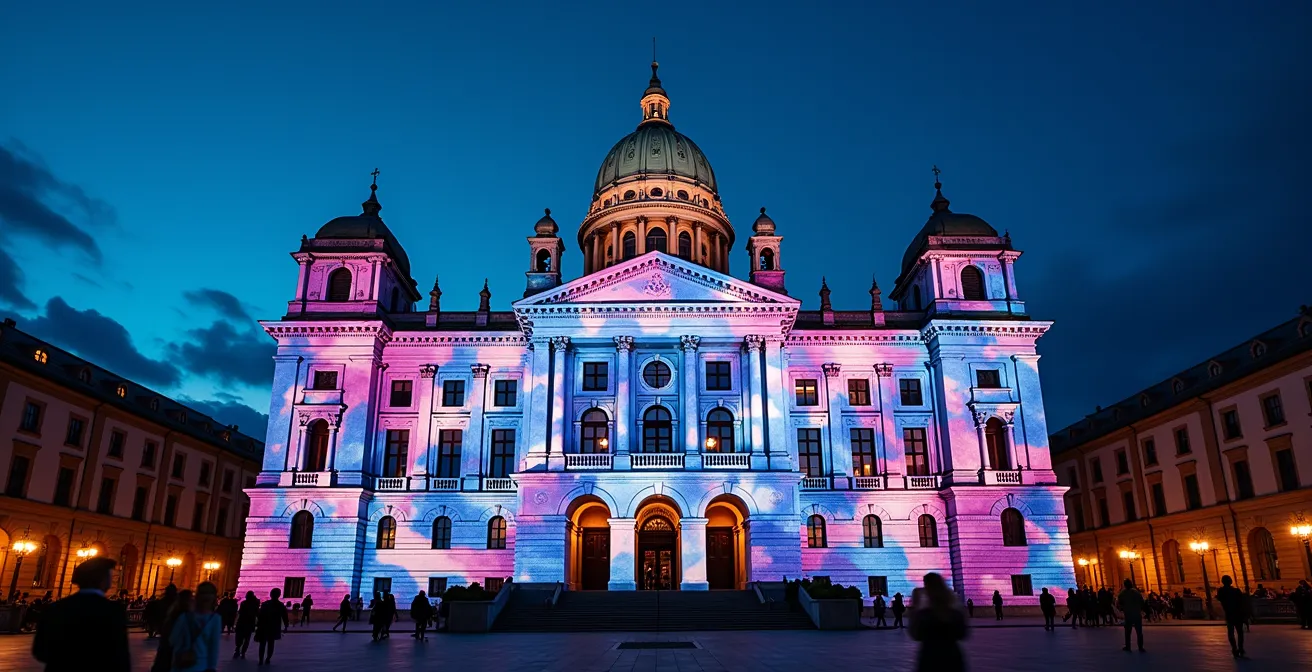
Turning a skyscraper into a canvas is less about the power of the projector and more about mastering the complex engineering of geometry, safety, and human perception.
- Precision mapping requires creating a digital twin of the architecture, treating every window and ledge as a critical variable.
- Effective crowd control in darkness is not just about barriers, but about using light and sound to guide flow and mitigate risk.
Recommendation: Look beyond the spectacle and start analyzing these events as complex, multi-layered systems of engineering and art.
Standing before a historic façade that melts, shatters, and reforms in a cascade of light is a uniquely modern form of magic. We watch, mesmerized, as solid stone becomes a fluid, living story. The immediate conclusion is one of technological might—that with a powerful enough projector, anything is possible. This is the common understanding, the surface-level appreciation of projection mapping as a large-scale light show. It’s an industry growing at a phenomenal rate, with the global projection mapping market expected to grow from $6.66 billion to $17.82 billion by 2030, but the numbers don’t tell the real story.
As a technical director, the first problem you solve isn’t creative; it’s a battle against reality itself. The conventional wisdom focuses on the projector’s brightness or the animation’s vibrancy. But what if the true artistry lies not in the light itself, but in the meticulous, often invisible, engineering that precedes it? The real work is a complex act of engineering empathy—a constant negotiation between the digital ideal and the physical world, between the narrative you want to tell and the way a human brain perceives it in a chaotic, open-air environment. It involves complex geometry, sensory psychology, crowd logistics, and even thorny legal questions.
This article will deconstruct that magic. We will move past the “wow” factor to reveal the underlying engineering principles. We’ll explore how artists and technicians meticulously mask a building’s features, guide an audience’s attention without a screen, build worlds with sound, and navigate the very real risks of public safety and cognitive overload. We will uncover the hidden framework that makes a building feel truly alive.
To fully grasp the intricate layers involved in these immersive experiences, this guide breaks down the core challenges and creative solutions that define modern projection mapping. The following sections will walk you through the entire process, from the fundamental geometry to the complex psychology of the audience.
Summary: The Art and Science of Architectural Projection
- Masking the Windows: The Geometry of Projecting on 3D Surfaces
- Darkness and Crowds: The The Safety Risks of Light Festivals
- Storytelling Without a Screen: Guiding Attention in 360 Degrees
- Sound That Moves: Creating 3D Audio in Open Spaces
- Who Owns the Façade: The Copyright of Light on Architecture
- The Tiny Human: Designing Spaces to Intimidate the Public
- Brain Overload: How Strobe Lights and Soundscapes Affect Memory
- Brain Overload: How Strobe Lights and Soundscapes Affect Memory
Masking the Windows: The Geometry of Projecting on 3D Surfaces
The first and most fundamental challenge in projection mapping is not about light, but about geometry. A building is not a flat cinema screen; it’s a complex 3D object with recesses, protrusions, varying textures, and windows that absorb or reflect light unpredictably. The process of making an image “stick” to this surface is a meticulous act of geometric negotiation. It begins by creating a perfect digital twin of the building using techniques like photogrammetry or 3D laser scanning. This model becomes the virtual canvas.
Every single architectural element must be accounted for. Windows, cornices, and brickwork are digitally “masked” or integrated into the creative content. The goal is to correct for keystoning—the distortion that occurs when a projector isn’t perfectly perpendicular to the surface. But on a building, every surface has a different angle. Advanced software calculates the precise distortion (or “UV map”) needed for each pixel of the animation, ensuring that a projected square looks like a square on the wall, not a trapezoid. The required projector brightness is also a key factor, with large-scale outdoor projects on skyscrapers demanding units of 20,000 lumens or more to overcome ambient light pollution.
The pinnacle of this discipline is mapping onto moving objects. The groundbreaking ‘Box’ project by Bot & Dolly demonstrated this by using high-speed motion-tracking cameras and robotic arms to project with millimeter accuracy onto moving panels. This required a system that could recalibrate the projection in real-time, effectively creating a live dialogue between the physical object and the light hitting it. This is the essence of 3D mapping: not just throwing an image at a wall, but creating a content-aware illusion that respects and responds to the physical form it inhabits.
Darkness and Crowds: The The Safety Risks of Light Festivals
Once the technical projection is solved, the human element introduces a far more unpredictable set of risks. Light festivals operate in near-total darkness, punctuated by bright, attention-grabbing installations. This environment, while magical, is inherently hazardous for large crowds. Navigating uneven terrain, avoiding unseen obstacles, and managing the flow of thousands of people focused on the sky, not the ground, is a monumental safety challenge. The logistics and security market for such events is significant, with the Crowd Management and Event Security Market projected to exceed $9.7 billion by 2036, underscoring the critical need for robust planning.
Effective crowd management in this context is a science. It’s not about erecting crude barriers, but about subtly guiding behavior. The placement of installations itself is a crowd control tool, creating natural gathering points and dispersal zones. Lighting is used not just for art, but for wayfinding, with pathways illuminated to guide flow and emergency exits marked with distinct colors or patterns. The goal is to maintain a safe crowd density without creating bottlenecks or a sense of being herded, which can lead to panic.
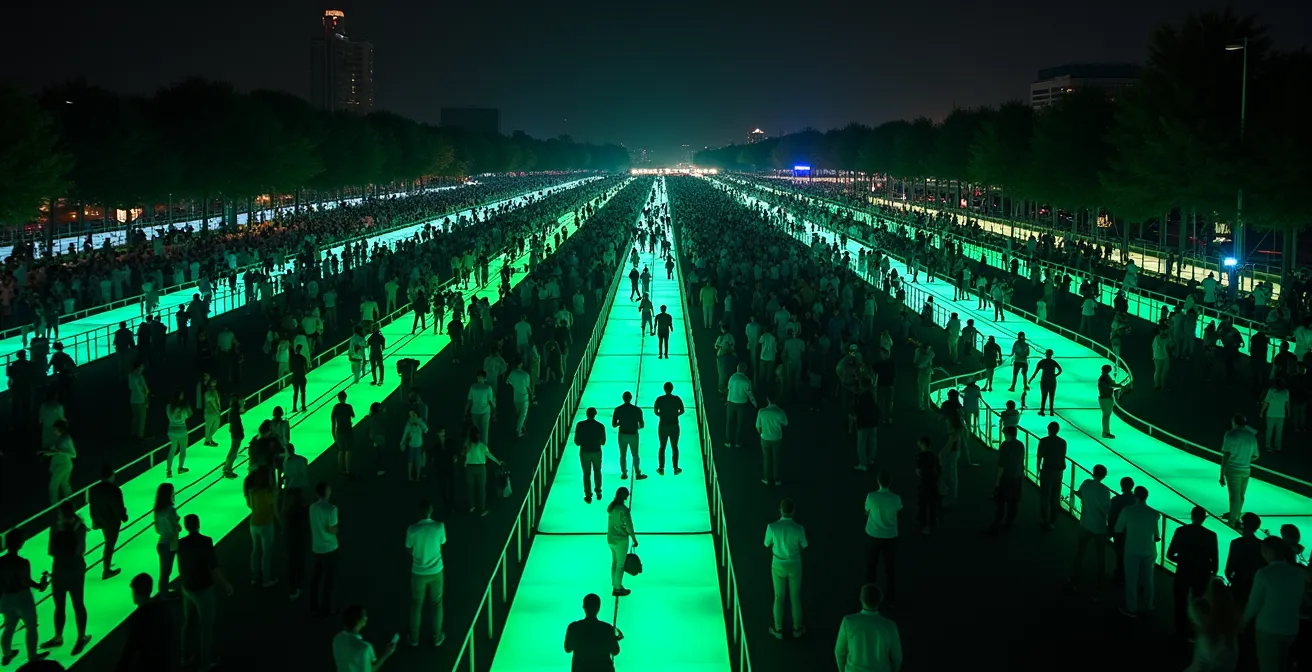
Modern events deploy sophisticated tools to manage these risks proactively. Real-time heat mapping software can identify areas where crowd density is approaching dangerous levels, allowing operators to redirect foot traffic or use sound and light cues to encourage dispersal. Contingency planning is also non-negotiable, with detailed protocols developed in partnership with local emergency services for everything from medical incidents to power failures. A successful event is one where the audience feels free and unconstrained, entirely unaware of the intricate safety choreography happening around them.
Action Plan: Key Points for Light Festival Crowd Safety
- Map Exits and Access: Clearly map out all emergency exits and first-aid access points, ensuring signage is illuminated and pathways are wide and unobstructed to prevent congestion during an evacuation.
- Develop Contingency Plans: Work directly with local authorities and emergency services to create comprehensive plans for various scenarios, including medical emergencies, security threats, or severe weather.
- Monitor Crowd Density: Deploy real-time crowd density monitoring tools, such as software with heat mapping and predictive analytics, to identify and proactively manage high-risk zones before they become dangerous.
- Coordinate and Comply: Ensure all necessary permits are obtained from local authorities and that the event setup is in full compliance with all public safety standards and regulations.
Storytelling Without a Screen: Guiding Attention in 360 Degrees
In a cinema, the director has total control over the audience’s gaze. The frame dictates what is seen. In a 360-degree immersive environment like a light festival, there is no frame. The audience can look anywhere. This freedom presents a profound narrative challenge: how do you tell a coherent story? The answer lies in attention choreography, using light, motion, and sound as cues to guide the viewer’s focus from one point to another. This is where the art of filmmaking and theater design merges with software engineering, a field where the software segment alone is advancing at a staggering 30.12% CAGR.
Instead of a single focal point, the entire environment becomes a stage. A story might begin on the building to your left, with a sudden flash of light or a directional sound cue drawing your eyes to a new development on the right. The narrative unfolds spatially, rewarding viewers for turning their heads and exploring the scene. Pacing is critical; moments of intense, focused action must be balanced with slower, more ambient periods that allow for personal discovery. The most common software tools for this, like TouchDesigner, Resolume Arena, or MadMapper, are essentially real-time visual performance engines, allowing artists to mix and trigger content across a complex array of projectors.
A masterful example of this is the work of teamLab. In their Digital Art Museum, they used projection mapping to create a ‘borderless’ world. As noted in a review by Creative Bloq, their artworks move freely out of rooms, form connections with people, and intermix with other works. A flock of digital birds might fly off one wall, across the ceiling, and onto another, leading the audience on a journey through the space. This approach transforms the passive viewer into an active participant, whose movement through the space is part of the experience. It’s storytelling that is discovered, not just watched.
Sound That Moves: Creating 3D Audio in Open Spaces
Visuals may capture the attention, but sound creates the immersion. In an open-air light festival, traditional stereo sound is inadequate. It creates a flat “wall of sound” that feels disconnected from the 3D visuals unfolding on the architecture. The solution is sensory engineering through spatial or 3D audio. This involves placing dozens, sometimes hundreds, of speakers throughout the event space, each with its own dedicated channel. This allows sound designers to treat sound as an object that can be moved through space in perfect synchronization with the visuals.
Imagine a projected comet streaking across a building’s facade. With spatial audio, the sound of the comet doesn’t just get louder; it travels across the speaker array, perfectly matching the comet’s visual path. This creates a powerful synesthetic link between what you see and what you hear, dramatically enhancing the illusion of reality. A whisper can be made to emanate from a specific window, or the sound of crumbling stone can appear to come from the actual base of the building. This technique is essential for attention choreography, as a sound originating from behind can prompt the audience to turn around and discover a new visual element.
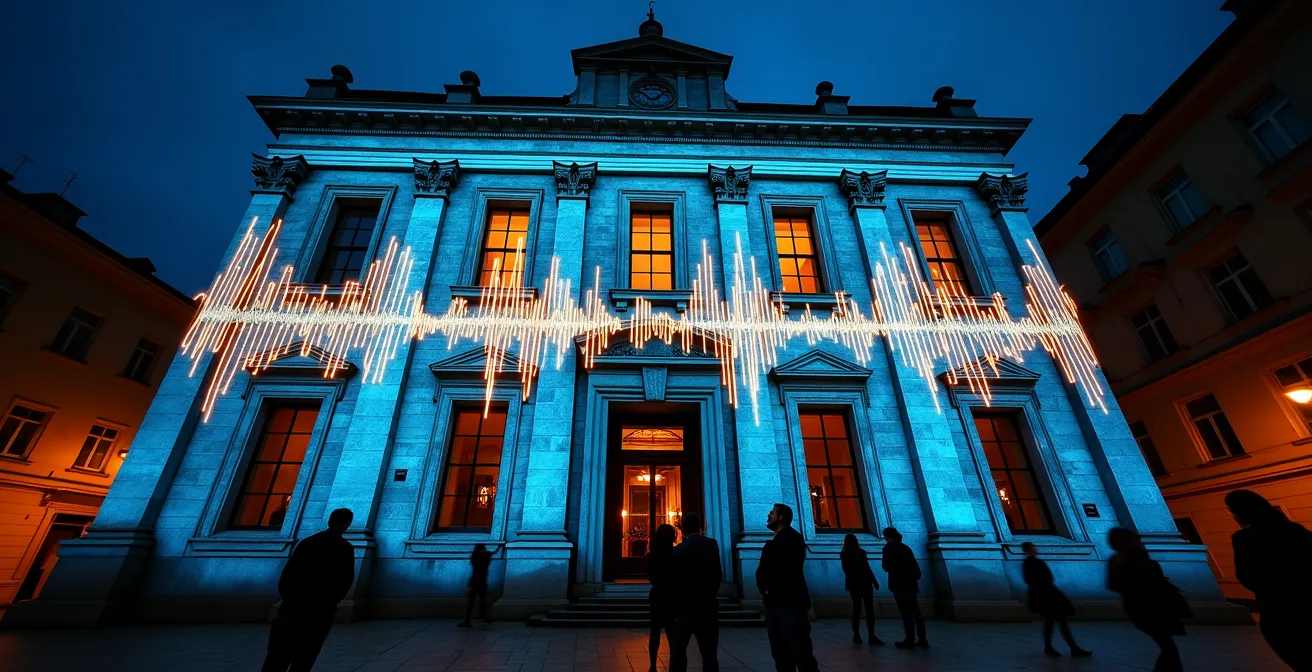
Creating this effect in a large, outdoor space is technically demanding. Sound is affected by weather, crowd density (bodies absorb sound), and reflective surfaces. Engineers must create an acoustic model of the space, much like the visual 3D model, to predict how sound will behave. They use advanced audio processors to manage delays and equalization for each individual speaker, ensuring that a person standing on the left side of the plaza has the same cohesive 3D audio experience as someone on the right. It is this fusion of technologies that elevates the experience beyond a simple light show. As the designers behind the ‘Box’ project stated, the goal is to “create magic-like illusions through the different technologies they master.”
Who Owns the Façade: The Copyright of Light on Architecture
When a team projects a stunning work of art onto a building, who owns what? The artist owns the copyright to the projected content, and the building owner owns the physical structure. But what about the ephemeral combination of the two? This question of spatial ownership is a legal and ethical gray area, particularly as projection mapping becomes a dominant tool in advertising. Indeed, with the commercial segment holding a 76% market share, these questions have significant financial implications.
In most cases, projecting onto a building requires a contract and permission from the owner. However, the rise of “guerrilla projection mapping”—projecting without permission for activism or viral marketing—complicates the matter. Is it a form of trespassing? Is it a public nuisance? Or is it a form of protected speech? The law is often years behind the technology. While the light itself is transient and causes no physical damage, projecting a commercial logo onto a historic landmark could be argued to alter its character or create an unauthorized association.
This legal ambiguity is a tightrope walk for artists and brands. As the marketing and technology firm Lumen & Forge notes, there are complex considerations at play. Their take on the practice highlights this very tension:
Guerrilla projection mapping pushes the boundaries of advertising, transforming ordinary surfaces into captivating visual displays.
– Lumen and Forge, Guerrilla Projection Mapping & the Law
The central question is one of temporary use versus permanent alteration. While a projection is temporary, its digital recording on social media is permanent. This creates a lasting connection between the art and the building, whether the owner consented or not. As the technology becomes more accessible, these legal frontiers will continue to be tested, forcing society to define the rights associated with the temporary, luminous skin of our shared architectural spaces.
The Tiny Human: Designing Spaces to Intimidate the Public
Projection mapping’s power is not just in its beauty, but in its scale. When a 48-story skyscraper becomes a canvas, it triggers a primal human response: awe. This feeling, a mix of wonder and intimidation, comes from the cognitive dissonance of seeing something impossibly large behave in impossible ways. This is engineered awe, a deliberate design choice that leverages monumental architecture to dwarf the individual and create an unforgettable emotional impact. The Asia Pacific region, which dominates the global market with a 30% share, is a leader in these massive urban-scale projects.
The experience is designed to make the viewer feel small, not in a negative way, but in a way that forces them to surrender to the spectacle. The sheer verticality of the image and the deep, resonant bass of the spatial audio create a powerful physiological response. It taps into the historical use of scale in architecture—from cathedrals to pyramids—to evoke feelings of reverence and transcendence. In this modern context, technology becomes the medium for that ancient human experience of encountering the sublime.
A prime example is the “TOKYO RINKAI FUKUTOSHIN” project, where the Tokyo Metropolitan Government building is transformed by nightly projections. The display covers a staggering 14,000 square meters of the facade, spanning 28 floors. By turning a symbol of civic administration into a dynamic art piece, the project doesn’t just entertain; it fundamentally alters the public’s relationship with the urban environment. The building is no longer just a place of work; it is a source of shared wonder, a landmark reborn every night. This use of scale redefines public space, turning the cold, impersonal surfaces of a megacity into a stage for collective emotional experience.
Key Takeaways
- Projection mapping is not just about projectors; it’s a multidisciplinary field blending 3D modeling, safety engineering, and narrative design.
- The biggest challenges are often invisible: correcting for geometric distortion, managing crowd flow in darkness, and guiding audience attention in a 360° environment.
- The most effective experiences use both light and spatial audio to create a powerful, cohesive illusion that plays on human psychology and scale.
Brain Overload: How Strobe Lights and Soundscapes Affect Memory
The same tools that create awe can also induce anxiety and sensory overload. The human brain has a finite capacity to process information. The rapid flashing of strobe lights, the disorienting motion of large-scale visuals, and the intense, complex layers of a 3D soundscape can overwhelm this capacity. This is not just a matter of comfort; it can have real neurological and psychological consequences. For a small percentage of the population, it can trigger photosensitive epileptic seizures. For many others, it can lead to feelings of disorientation, anxiety, or even motion sickness.
From an engineering perspective, this is a critical design constraint. The creative desire for an intense, high-impact show must be balanced against the responsibility for audience well-being. This involves careful management of frequencies in flashing lights, avoiding patterns known to be high-risk. It also means pacing the experience, building moments of sensory calm and quiet into the narrative to give the audience’s cognitive systems a chance to “reset.” Clear and prominent warnings about the use of strobe effects are a non-negotiable ethical and legal requirement for any public event.
Furthermore, intense sensory input can affect memory formation. While a spectacular moment might be emotionally impactful, the sheer volume of information can make it difficult for the brain to encode details. Viewers might leave with a general feeling of “wow” but be unable to recall specific narrative beats or visual elements. The most sophisticated shows are designed with this in mind, using repetition of key visual motifs and aligning the most critical story points with moments of relative sensory calm to ensure they are not just seen, but remembered.
Brain Overload: How Strobe Lights and Soundscapes Affect Memory
While the previous section focused on the dangers of sensory overload, a master technical director understands that controlled intensity is a powerful tool for narrative effect. Just as a film director uses a jarring cut or a sudden crescendo to create tension, a projection artist can harness the principles of brain overload to evoke specific emotions. The strategic, deliberate use of strobing lights, overwhelming sound, and rapid visual cuts can create a climax, simulate chaos, or induce a state of heightened arousal that makes the subsequent return to calm all the more profound.
This is a high-risk, high-reward technique. It is the art of pushing the audience to the very edge of their sensory tolerance without pushing them over. For example, a scene depicting a building’s collapse would be ineffective if it were slow and gentle. It demands a chaotic, overwhelming barrage of fractured visuals and explosive, dissonant audio to feel authentic. The resulting feeling of anxiety in the audience is not a design flaw; it is the intended emotional response, a testament to the power of the sensory engineering at play.
Ultimately, turning a building into a living canvas is a holistic discipline. It is a synthesis of the rigid mathematics of geometry, the fluid dynamics of crowd psychology, the abstract art of storytelling, and the raw neuroscience of perception. It requires an artist’s vision and an engineer’s pragmatism. The magic is not in the light itself, but in the perfect orchestration of all these disparate elements into a single, cohesive, and unforgettable experience that redefines our relationship with the spaces we inhabit.
To fully appreciate the next light festival you attend, try to look at it through this lens. See not just the final image, but the invisible framework of engineering and artistry that holds it together. Your next step is to analyze these public spectacles as complex systems, deconstructing the magic to understand the mastery behind it.