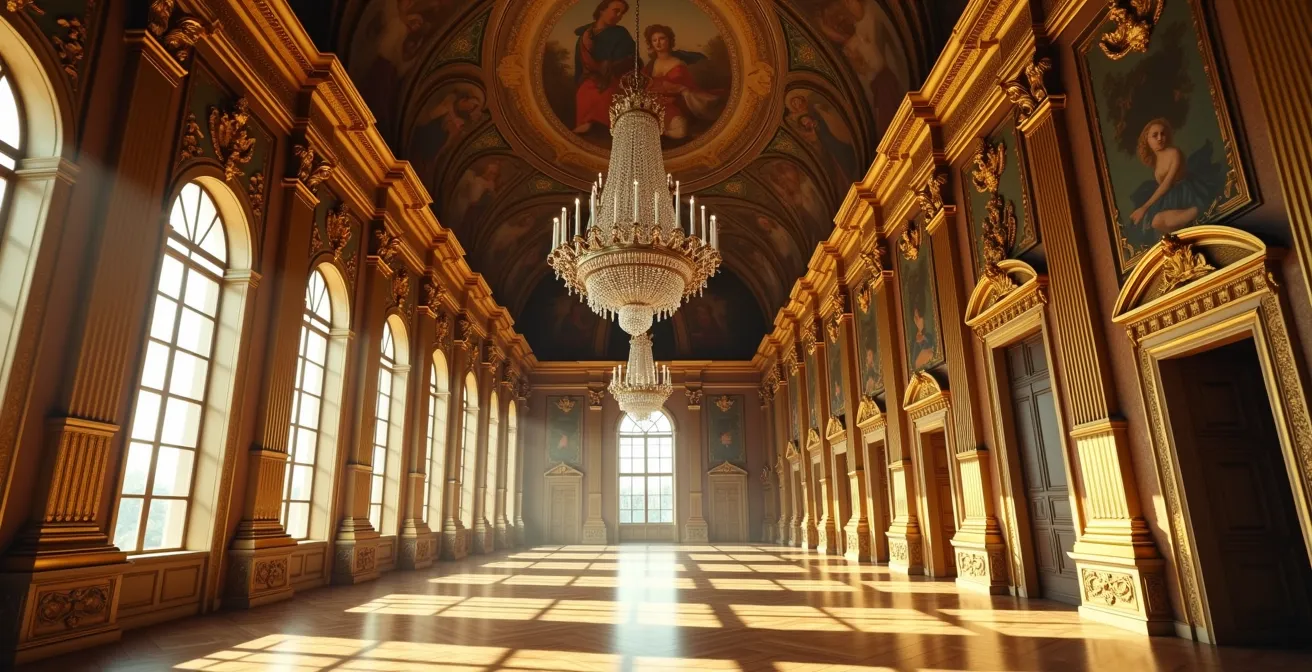
Louis XIV’s legendary art collection was not a matter of taste; it was a calculated instrument of political warfare designed for the sole purpose of subjugating the French aristocracy.
- He monopolized luxury production and artistic commissions to control the national economy and dictate cultural value.
- He used state-controlled portraiture and media as sophisticated propaganda to manufacture an invincible, semi-divine image.
- He built Versailles as a “gilded cage,” a magnificent prison of etiquette and surveillance that forced the nobility into debt and obedience.
Recommendation: To understand the true nature of power, analyze state-sponsored culture not for its beauty, but for its strategic intent to consolidate control and neutralize internal threats.
To view Louis XIV as a mere patron of the arts is to fundamentally misunderstand the man and his reign. It is an interpretation that mistakes the weapon for a decoration. The common narrative celebrates the Sun King’s lavish spending on palaces and paintings as a flourishing of culture. Yet, beneath the veneer of gold leaf and intricate tapestries lay a cold, Machiavellian stratagem. The entire artistic and cultural apparatus of 17th-century France was not simply sponsored by the state; it was forged into an instrument of absolute power, a sophisticated system of aesthetic warfare aimed at a single target: the French nobility.
The aristocracy, with its independent wealth, private armies, and history of rebellion—the Fronde rebellion during the king’s childhood being a particularly searing memory—represented the single greatest threat to monarchical authority. Physical force could quell a revolt, but it could not eradicate the ambition that fueled it. Louis’s genius was to realize that what could not be defeated on the battlefield could be systematically dismantled in the salon, the workshop, and the ballroom. He would not outlaw the nobility; he would render them obsolete, dependent, and politically impotent.
But what if the key to this absolute control was not just edicts and armies, but the very definition of taste and beauty? This was Louis’s masterstroke. By seizing the means of cultural production, he turned art into a dual-edged sword. On one side, it projected an image of untouchable, god-like power for the monarchy. On the other, it created a vortex of compulsory spending and psychological submission that bled the aristocracy of its wealth, its independence, and ultimately, its will to resist. This article will deconstruct this strategy, revealing how every portrait, every building, and every piece of silverware was a calculated move in a grand political chess game.
This analysis will explore the calculated deception behind royal portraits, the economic strangulation enacted through state-owned manufactories, and the psychological trap of Versailles itself. We will examine how the very bureaucracy of art and the symbols it deployed were all part of this master plan to consolidate power.
Summary: The Art of Absolute Power: Louis XIV’s Strategic Agenda
- Tall, Strong, and Young: The Lies Behind Royal Portraits
- Gobelins and Sèvres: When the State Owns the Means of Luxury
- Versailles: The Golden Prison Designed to Watch Everyone
- Did the Building of Versailles Cause the French Revolution?
- From Patron to Minister: The Bureaucratization of Artistic Funding
- Supplier to the King: Does the Royal Warrant Still Drive Sales?
- Letting the Sun In: How Glass Changed the French Lifestyle
- Why Every Government Building Looks Like a Greek Temple
Tall, Strong, and Young: The Lies Behind Royal Portraits
The first front in Louis XIV’s aesthetic warfare was his own image. In an era without mass media, the royal portrait was not art; it was state propaganda, meticulously crafted to project an aura of unwavering strength, divine right, and perpetual youth. The king understood a fundamental principle of power: perception is reality. As he himself noted, it was essential for the monarch to be constantly visible and accessible to his subjects, but only in a form he completely controlled. The image had to be one of an idealized, semi-divine ruler, not a mortal man susceptible to age or weakness.
Artists like Hyacinthe Rigaud were not just painters; they were instruments of state policy. His famous 1701 portrait depicts a 63-year-old king, who had lost most of his teeth and suffered from numerous ailments, as a commanding, virile figure. The posture, the opulent robes, the confident gaze—every detail was a deliberate fiction designed to reinforce the concept of the king’s two bodies: the fallible physical body and the infallible, eternal body of the monarchy. This was not vanity; it was a political necessity to ensure the stability of the realm rested on an image of permanence.
This propaganda was disseminated on an industrial scale. Rigaud’s workshop was, in effect, a factory. Historical accounts reveal that Rigaud employed a stable of aides to mass-produce royal portraits, often painting only the face himself while assistants completed the costuming and background. These images were then reproduced in prints and engravings, ensuring the King’s manufactured likeness saturated the kingdom and its courts abroad. This mass production was a conscious strategy to make his idealized image ubiquitous, a constant, visual reminder of his absolute authority. By controlling his own representation so completely, Louis established the visual vocabulary of his power, a foundation upon which his entire system of control was built.
Gobelins and Sèvres: When the State Owns the Means of Luxury
Controlling the royal image was only the beginning. Louis XIV’s master plan required a far more profound intervention: seizing control of the very means of luxury production. Through his finance minister, Jean-Baptiste Colbert, the King initiated a sweeping policy of mercantilism that centralized the French economy. The crown established state-owned manufactories like the Gobelins for tapestries and furniture and, later, Sèvres for porcelain. This was not merely an effort to promote French craftsmanship; it was a strategic move to monopolize the definition of “value” and “taste.”
By nationalizing the production of the most desirable goods in Europe, Louis achieved several Machiavellian objectives. Firstly, he made the state the sole arbiter of high culture. The “Style Louis XIV,” a grandiose and ornate Baroque aesthetic, became the official style. Any aristocrat wishing to display status and refinement had no choice but to purchase these state-sanctioned goods, directing their wealth into the king’s coffers. The spending was immense; Voltaire estimated that the king’s annual budget for arts and luxury manufactories reached an astronomical 800,000 livres annually at its peak.
This economic dominance was reinforced through symbolic subjugation. The state’s control was a spectacle in itself, a message broadcast through art.
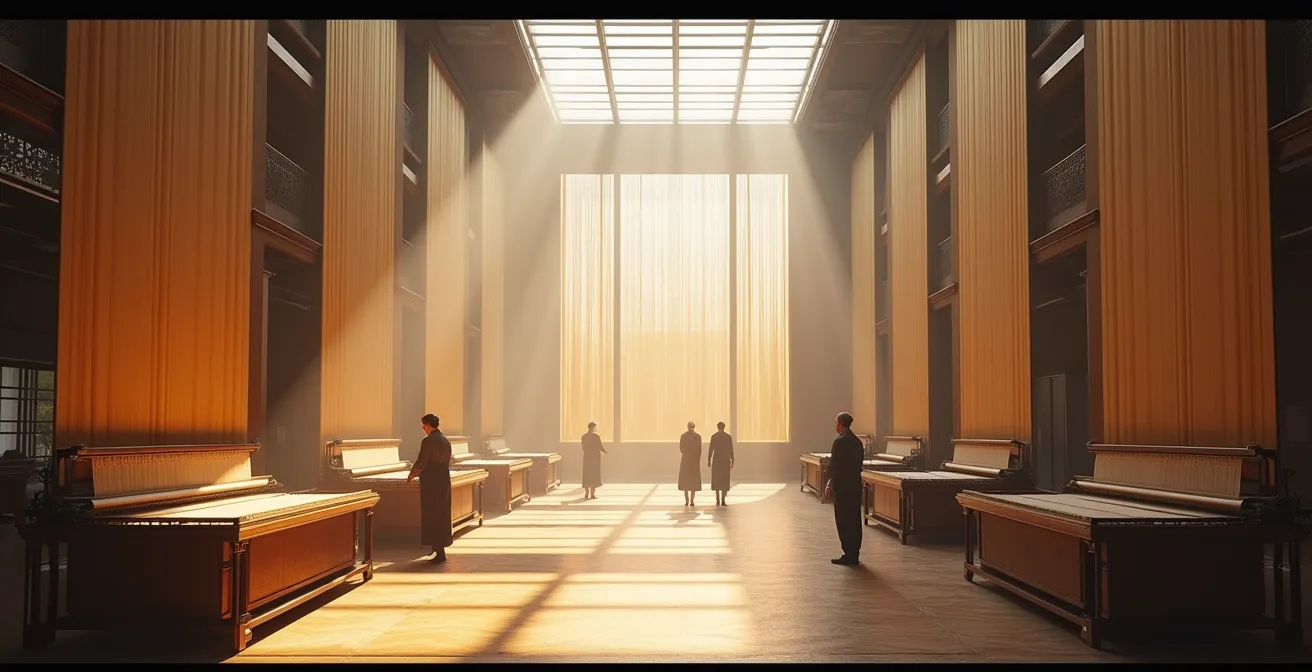
This strategy is perfectly illustrated by the case of the Gobelins factory. A 1673 tapestry, “Visit of the King to the Gobelins,” depicts Louis XIV inspecting the workshops. He is shown physically elevated above his ministers and the artisans, a clear visual metaphor for his absolute authority over both the production and the producers. The artist, Charles Le Brun, who was also the director of the factory, is seen mirroring the king’s pose, signifying that even artistic genius served the state’s agenda. The message was unmistakable: all value, economic and artistic, flowed directly from the King.
Versailles: The Golden Prison Designed to Watch Everyone
If state manufactories were the economic weapon, the Palace of Versailles was the psychological one. Far more than a home or a seat of government, Versailles was a masterfully designed “gilded cage,” a golden prison built to domesticate the French nobility. By mandating that the most powerful aristocrats abandon their regional strongholds to live at court, Louis XIV physically detached them from their bases of power—their lands, their wealth, and their private armies. They were transformed from powerful feudal lords into mere courtiers, their existence revolving entirely around the king’s favor.
Life at Versailles was a relentless performance of complex and ruinously expensive etiquette. Status was determined not by birthright or military prowess, but by one’s proximity to the monarch. The privilege of holding the king’s shirt during his morning `lever` ceremony was more coveted than a battlefield command. This system forced the nobility into a cutthroat competition for royal attention, a contest fought with extravagant clothing, lavish parties, and constant gambling. This lifestyle was deliberately designed to be unsustainable. Nobles plunged into debt to maintain their standing, making them financially dependent on the king’s pensions and appointments, which he could grant or revoke at will.
Under the sovereign’s watchful eye, the nobility could no longer plot against the throne; the great lords were kept in their place in the army or at court, eager to serve and please the King.
– Palace of Versailles historians, Official Palace documentation
Above all, Versailles was a theatre of surveillance. The palace architecture, with its endless corridors and interconnected rooms, offered no privacy. The court, a teeming population that could swell to between 3,000 and 10,000 people daily, was a web of spies and informants. Every conversation, every alliance, and every misstep was observed and reported. Isolated from their power bases and under constant scrutiny, the nobility was effectively neutralized. The gilded cage had served its purpose: the once-proud lions of the aristocracy had been defanged and turned into decorative pets of the crown.
Did the Building of Versailles Cause the French Revolution?
While Louis XIV’s system of control was brutally effective in subjugating the nobility, its very success sowed the seeds of its eventual destruction a century later. The construction and maintenance of Versailles represented an economic black hole, a colossal expenditure that, combined with constant warfare, placed an unsustainable burden on the French state. The astronomical costs were borne almost entirely by the Third Estate—the common people—through oppressive taxation. This created a deep and lasting resentment, transforming the palace from a symbol of national glory into the ultimate emblem of aristocratic parasitism and royal extravagance.
The political consequences were just as severe. By relocating the center of power away from Paris and enclosing it within the bubble of Versailles, the monarchy became physically and psychologically isolated from the French populace. The court was absorbed in its own intricate rituals and power games, utterly blind to the growing desperation and anger in the country. The king and his advisors, surrounded only by sycophantic courtiers, were incapable of understanding the depth of the people’s grievances. This created a fatal disconnect that would have dire consequences for Louis XVI.
When the crises of the late 18th century erupted—famine, bankruptcy, and calls for political reform—the monarchy was woefully unprepared. Its miscalculations, rooted in decades of isolation at Versailles, directly precipitated the explosion of 1789. For the revolutionaries, the palace was the primary symbol of everything wrong with the Ancien Régime. The “gilded cage” that had so effectively imprisoned the nobility had also trapped the monarchy itself in a state of ignorance. In this sense, while not the sole cause, the strategic decision to build Versailles as a tool of control created the very conditions of isolation and public resentment that made the French Revolution not just possible, but inevitable.
From Patron to Minister: The Bureaucratization of Artistic Funding
To ensure his aesthetic warfare was sustainable and systematic, Louis XIV did not simply throw money at artists. He institutionalized artistic production by creating a powerful state bureaucracy. He established a series of Royal Academies—for Painting and Sculpture (1648), Dance (1661), and Architecture (1671), among others. These were not simply schools; they were governing bodies that controlled artistic training, dictated official doctrine, and, most importantly, managed all major royal commissions. An artist’s career was no longer dependent on a network of private patrons, but on their successful navigation of this state-run system.

The academies enforced a rigid hierarchy of genres and a strict adherence to classical principles, ensuring all state-sponsored art served the monarchy’s ideological goals. This “bureaucracy of taste” centralized control and stifled artistic deviation. The King and his ministers, like Colbert and the artist-administrator Charles Le Brun, became the ultimate arbiters of artistic merit. By replacing the chaotic system of private patronage with a centralized, meritocratic-seeming bureaucracy, Louis made himself the sole fount of artistic legitimacy. The King famously elevated his top artists, granting them noble status and immense wealth, valuing their utility to the state above hereditary rank. His remark about his architect, “I can make twenty dukes or peers in a quarter of an hour, but it takes centuries to make a Mansard,” reveals this strategic calculation.
This system transformed artists from independent creators into high-ranking civil servants. Their purpose was to glorify the king and the state. This bureaucratization was the engine of Louis’s propaganda machine, ensuring a consistent and high-quality output of art that was always on-message. It was a system that rewarded loyalty and conformity while marginalizing any voice that did not serve the interests of the crown, perfecting the state’s control over its own narrative.
Action Plan: Deconstructing State-Sponsored Artistic Propaganda
- Identify the Messengers: List all state-controlled or state-favored cultural channels (e.g., national museums, official architecture, public monuments, state-funded film).
- Inventory the Symbols: Collect examples of recurring imagery, color palettes, and stylistic choices. What is consistently shown? What is conspicuously absent?
- Analyze for Coherence: Compare the messaging in the art with the government’s stated political and social values. Does the art reinforce or contradict official policy?
- Gauge Emotional Impact: Assess the intended emotional response. Is the art meant to inspire awe, patriotism, fear, or a sense of unity? Differentiate unique expressions from generic nationalist tropes.
- Map the Economic Levers: Identify how funding, commissions, and awards are distributed. Trace the flow of money to understand who is being rewarded for promoting the state’s narrative.
Supplier to the King: Does the Royal Warrant Still Drive Sales?
The bureaucratization of art extended into the commercial realm through the strategic use of royal warrants, or `Fournisseur Breveté du Roi`. While the concept of a royal supplier was not new, Louis XIV and Colbert transformed it from a simple honor into a key instrument of economic control and state branding. Being appointed an official supplier to the court was the ultimate seal of approval, a mark of unparalleled quality that effectively functioned as the most powerful marketing tool of the 17th century. This system created an intense desire among craftsmen and merchants to win the king’s favor, aligning their commercial ambitions with the interests of the state.
This was another facet of economic warfare against the aristocracy. A noble might have his own local suppliers, but their products could never compete with the prestige of an item bearing the royal warrant. The system created a powerful “halo effect,” where the perceived glory and quality of the monarchy were transferred directly onto the approved products. This forced nobles who wished to appear fashionable and powerful to patronize the king’s chosen suppliers, further centralizing the economy around the crown and away from regional aristocratic spheres of influence. The desire for these goods became another lever for indebting the nobility, who spent lavishly to acquire items deemed essential for court life.
Case Study: The Royal Warrant as Economic Centralization
As detailed in analyses of Louis XIV’s patronage, the “Fournisseur Breveté du Roi” system was a deliberate tool for economic consolidation. By granting these warrants, the state didn’t just endorse a product; it integrated that producer into the national economic project. It incentivized merchants to align their quality and production with state standards, creating a virtuous cycle where commercial success was directly tied to serving the monarchy. This effectively marginalized independent producers who operated outside the crown’s ecosystem, ensuring that economic power, like cultural capital, flowed towards the center: the King.
Today, the Royal Warrant system persists in monarchies like the United Kingdom, though its function is now primarily one of prestige and marketing rather than overt economic control. However, its origins under Louis XIV reveal its true, Machiavellian purpose: to co-opt commerce into the machinery of the state and use consumer desire as a tool to dominate the elite. It was another brilliant move to ensure all roads—and all revenue—led to the king.
Letting the Sun In: How Glass Changed the French Lifestyle
Even the materials used in Louis XIV’s grand project were weapons in his arsenal. The unprecedented use of glass and mirrors at Versailles, most famously in the Hall of Mirrors, was a deliberate demonstration of technological, economic, and symbolic dominance. In the 17th century, large, clear panes of glass and high-quality mirrors were an extraordinary luxury, incredibly difficult and expensive to produce. The Venetian Republic held a near-monopoly on the technology. Colbert, in a move of industrial espionage, lured Venetian glassmakers to France to establish a domestic industry, the `Manufacture royale de glaces de miroirs`.
Breaking the Venetian monopoly and producing vast quantities of mirrors was a statement of French self-sufficiency and technological superiority. The Hall of Mirrors, with its breathtaking array of 357 mirrors arranged opposite seventeen massive arched windows, was the ultimate spectacle. During the day, it flooded the space with light, a physical manifestation of the Sun King’s radiance. At night, lit by thousands of candles, the reflections created an otherworldly, dazzling effect that stunned foreign dignitaries and reinforced the king’s immense wealth and power. It was a space designed to overwhelm and intimidate.
Beyond the spectacle, the proliferation of glass and mirrors fundamentally changed the lifestyle at court and the nature of surveillance. The light-filled interiors and reflective surfaces meant there were fewer shadows in which to hide. The mirrors not only reflected the opulence of the room but also the courtiers themselves, making them both spectators and part of the spectacle. It created a heightened sense of being watched, amplifying the psychological pressure of the “gilded cage.” The technology of glass was not merely decorative; it was an active agent in the king’s system of social control, an instrument for letting the sun—and the king’s gaze—into every corner of aristocratic life.
Key Takeaways
- Symbolic Domination: Louis XIV used art and architecture to construct an unassailable image of divine, absolute power, replacing religious iconography with a classical, secular mythology centered on himself.
- Economic Warfare: By monopolizing luxury production through state manufactories and royal warrants, he dictated taste and forced the nobility to channel their wealth into the state’s coffers, indebting them into submission.
- Psychological Control: The Palace of Versailles was a “gilded cage,” a system of constant surveillance and ruinously expensive etiquette designed to physically isolate, financially ruin, and politically neutralize the aristocracy.
Why Every Government Building Looks Like a Greek Temple
The final piece of Louis XIV’s strategic puzzle was ideological: the deliberate replacement of traditional religious symbolism with a new state mythology based on Greco-Roman classicism. Before Louis, the legitimacy of the French monarchy was inextricably tied to the Catholic Church. Kings were rulers by “the grace of God,” and art and architecture reflected this with Gothic cathedrals and religious iconography. Louis, in a radical shift, sought to build a new foundation for his authority—one that was personal, secular, and absolute. He would be the source of his own legitimacy.
He achieved this by co-opting the visual language of the Roman Empire. He presented himself not as a humble servant of God, but as the reincarnation of Apollo, the sun god, or Hercules, the powerful demigod. Versailles is not a cathedral; it is a classical palace filled with fountains, statues, and paintings depicting tales from Ovid, not the Bible. As art historians have noted, Louis XIV largely abandoned medieval religious iconography in favor of classical themes to legitimize his personal, secular power. This aesthetic choice was a profound political statement: the King’s authority did not derive from the Pope in Rome, but from the same source as the Roman Emperors—inherent greatness and military might.
This neo-classical style became the official language of the state, synonymous with power, order, and rational governance. Its influence was so profound that it became the default architectural style for government buildings and symbols of state power across the Western world for centuries to come, from the White House in Washington to the British Museum in London. The reason so many government buildings look like Greek temples is a direct legacy of Louis XIV’s decision to use classical architecture as a tool to express the rational and absolute power of the secular state. It was the final and most enduring element of his aesthetic warfare: the creation of a universal visual language for absolute authority.
The intricate system of control Louis XIV built through art and culture was a masterpiece of political statecraft. It demonstrates that soft power, when wielded with strategic genius, can be as effective as any army in breaking the will of an opponent. To apply this level of strategic analysis to your own context, the next step is to deconstruct the cultural instruments of power at play around you.