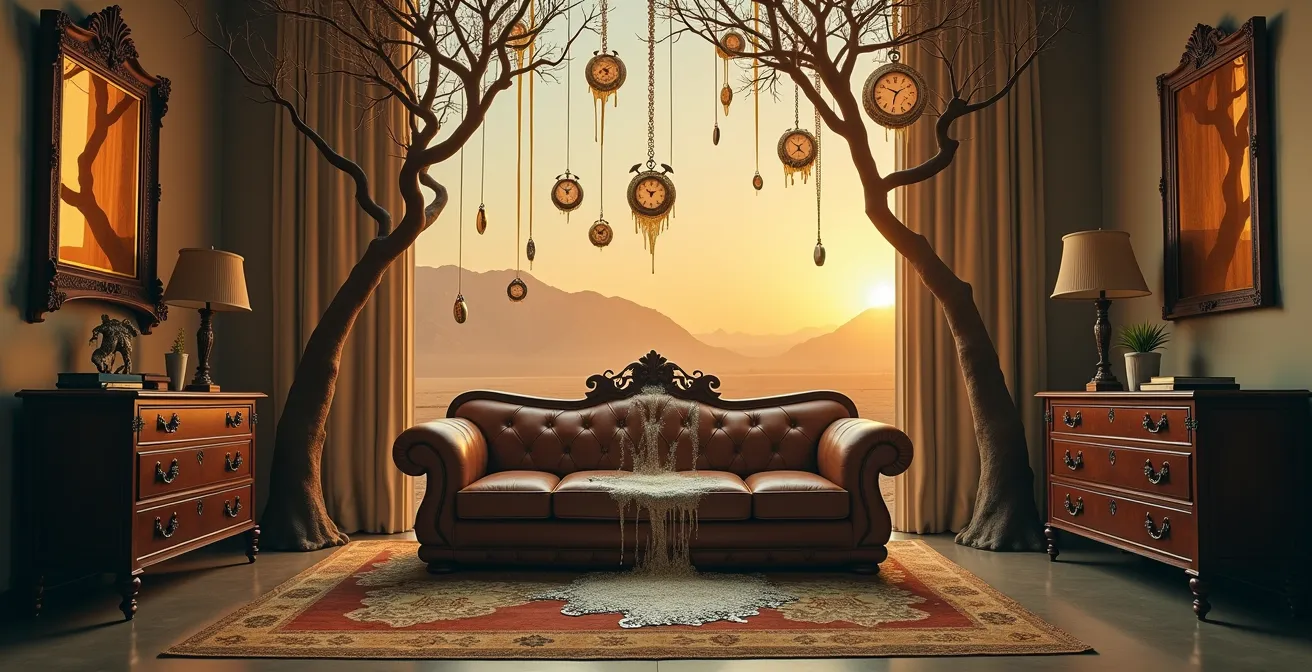
Surrealist art is not a collection of random dream images, but the direct visual output of artists using Freudian psychoanalysis as a practical creative toolkit.
- Artists systematically employed techniques like automatism and the paranoiac-critical method to bypass the rational mind and access repressed thoughts.
- The movement’s origin is deeply tied to processing the collective trauma of World War I, using non-verbal creation to explore what words could not express.
Recommendation: To understand Surrealism, view the canvas not as a picture, but as a documented psychological experiment into the depths of the subconscious mind.
When confronted with the bizarre landscapes of Surrealism—the melting clocks of Salvador Dalí or the floating, bowler-hatted men of René Magritte—the common explanation defaults to dreams. It’s an easy answer, but a superficial one. It misses the rigorous, almost scientific, methodology that powered the movement. The Surrealists were not passive dreamers; they were active explorers of the mind, and their primary mapmaker was Sigmund Freud. They delved into his theories of the subconscious, repression, and free association not for academic curiosity, but to forge a set of practical tools for creation.
This approach moves beyond simply painting what one remembers from sleep. It involves a deliberate effort to short-circuit the ego, the rational gatekeeper of the mind, to allow the raw, uncensored imagery of the id to spill onto the canvas. This was a psychic revolution, an attempt to liberate the mind from the constraints of logic, morality, and aesthetic convention. The goal was not to create beautiful objects, but to manifest a more authentic reality—a “sur-reality”—where the hidden truths of the psyche could be seen. This article dissects that psychoanalytic toolkit, revealing how Freud’s abstract theories were transformed into concrete artistic techniques that forever changed the face of art.
For those who prefer a condensed visual format, the following video provides an excellent overview of the core tenets and impact of the Surrealist movement, perfectly complementing the deep dive into its psychoanalytic roots explored below.
To fully grasp how these psychological theories were put into practice, this analysis will deconstruct the core methods and motivations of the Surrealist artists. The following sections explore the specific techniques, the internal conflicts, and the lasting legacy of this audacious attempt to paint the human mind.
Summary: From the Couch to the Canvas
- Drawing Without Thinking: How to Bypass the Rational Brain
- Umbrella and Sewing Machine: The Logic of Absurdity
- Communism and Dreams: The Uneasy Politics of the Surrealists
- Object or Creator: The Struggle of Women Artists in the Surrealist Circle
- Self-Inducing Delusion: How Dalí Saw Double Images
- Beyond Words: Processing PTSD Through Non-Verbal Creation
- Painting Time: How to Show Movement on a Static Canvas
- Suffering for Art: Do You Need to Be Miserable to Be Creative?
Drawing Without Thinking: How to Bypass the Rational Brain
The foundational technique in the Surrealist psychic toolkit is automatism. This is the artistic equivalent of Freud’s free association, a method designed to circumvent the conscious mind—the ego—and tap directly into the subconscious. The goal is to let the hand move without rational intent, allowing repressed thoughts and desires to manifest as lines and shapes. Artists like André Masson would enter a trance-like state, sometimes induced by fasting or sleep deprivation, to produce a flurry of uncontrolled drawings that would later be interpreted for hidden forms.
This wasn’t merely doodling. It was a disciplined practice of un-learning control. Modern neuroscience research reveals how such states of undirected thought correlate with increased activity in the brain’s Default Mode Network, a system now linked to creative thinking. The Surrealists intuitively understood that the most original imagery wasn’t to be found in careful planning, but in the psychic static that emerged when the rational brain was silenced. Max Ernst further developed this with techniques like frottage (pencil rubbings over textured surfaces) and grattage (scraping away layers of paint), introducing an element of chance to provoke the subconscious into seeing things that were not deliberately placed.
Action Plan: 5 Modern Techniques for Automatic Creation
- Practice ‘digital frottage’ by using texture brushes with randomized patterns in a digital art program.
- Engage in AI-prompt chaining, where one generated image or text becomes the seed for the next, acting as a modern ‘exquisite corpse’ exercise.
- Set a 5-minute timer and draw continuously with your non-dominant hand, focusing on movement rather than representation.
- Apply aleatoric (chance-based) composition techniques to sound design, using random generators to sequence audio clips.
- Use the ‘cut-up’ technique, popularized by William S. Burroughs, for breaking creative blocks in writing by physically cutting up and rearranging text.
These methods all serve the same Freudian principle: to weaken the ego’s censorship and allow the unvarnished content of the id to surface. They are practical tools for tricking the mind into revealing itself.
Umbrella and Sewing Machine: The Logic of Absurdity
Once automatism unlocks a flood of raw imagery, how is it organized? The Surrealists found their answer in a line from the 19th-century writer Comte de Lautréamont: “as beautiful as the chance encounter of a sewing machine and an umbrella on a dissecting table.” This became the guiding principle for Surrealist juxtaposition—the placement of two or more unrelated objects together to create a new, unsettling reality. From a psychoanalytic perspective, this technique mirrors the logic of dreams.
In a dream, a telephone might be made of lobster, or a train might emerge from a fireplace, as in Magritte’s *Time Transfixed*. These combinations are not random nonsense. Freud argued that dream-work operates through processes of condensation (fusing multiple ideas into one image) and displacement (shifting emotional significance from one object to another). The chance encounter on the dissecting table creates a “spark” of new meaning precisely because it bypasses our rational categories. It forces the viewer’s subconscious to forge a new, poetic connection between disparate elements, triggering a sense of the “uncanny”—something strangely familiar yet alien.
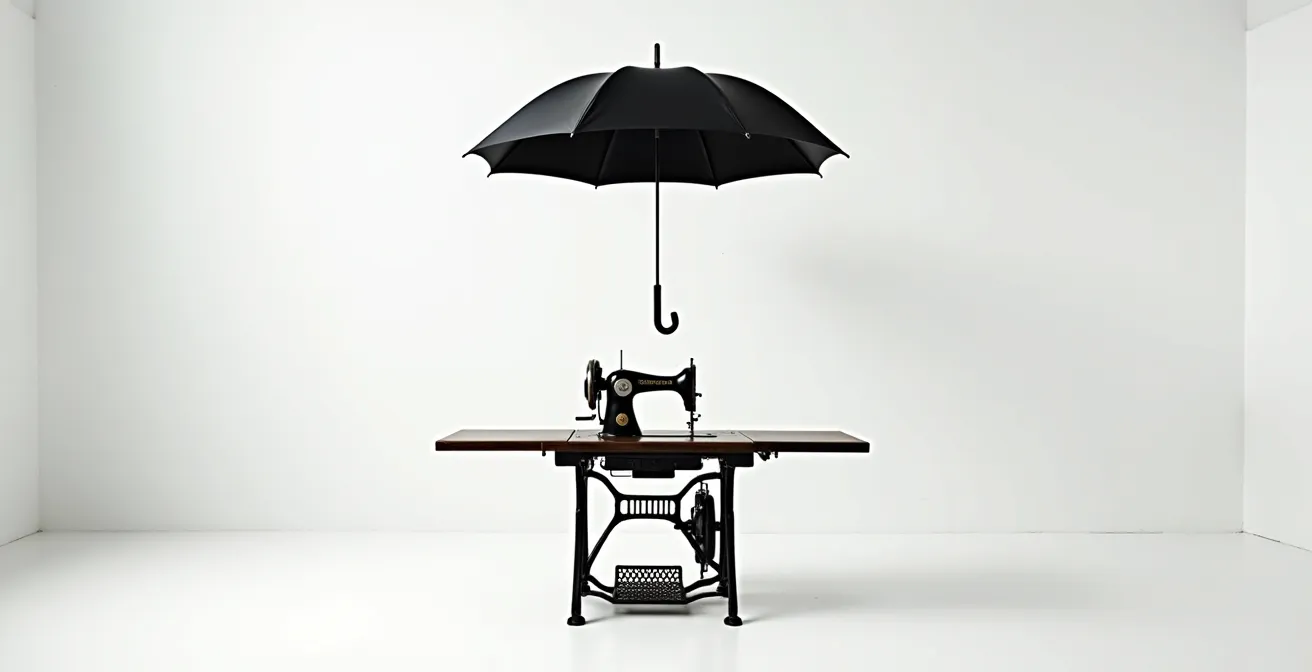
This approach elevates absurdity to a form of logic. It’s a method for revealing the hidden relationships between things, governed not by physical reality but by the associative pathways of the psyche. The power of this method was central to the movement’s philosophy. As the MoMA’s education department notes, it was driven by a core conviction.
The Surrealists borrowed many of the same techniques to stimulate their writing and art, with the belief that creativity from deep within a person’s subconscious could be more powerful than any product of conscious thought.
– MoMA Education Department, Surrealism and Dreams
Communism and Dreams: The Uneasy Politics of the Surrealists
The Surrealist project was never intended to be purely aesthetic; it was fundamentally revolutionary. The movement’s leader, André Breton, famously declared their goal was to reconcile the directives of Marx (“Transform the world”) and Rimbaud (“Change life”). For the Surrealists, these two ambitions were inseparable. They believed that a revolution of the mind—liberating it from the chains of bourgeois logic and repression—was a necessary precondition for a social and political revolution.
However, this attempt to merge Freudian psychoanalysis with Marxist materialism was fraught with contradiction. The Communist Party, which many Surrealists joined, demanded collective action and a focus on external, economic reality. Surrealism, by contrast, championed radical individualism and the exploration of the internal, psychic landscape. This ideological tension created a major rift. The Party viewed Freudianism as a self-indulgent, bourgeois preoccupation, while the Surrealists saw the Party’s rigid doctrine as another form of rationalist oppression.
The Surrealist Movement’s Political Fractures
André Breton’s attempts to merge Marxist revolution with Freudian psychoanalysis created fundamental contradictions. An analysis of the period highlights that Breton did not abandon Freud despite adopting Marxist beliefs, but the Communist Party reproached him for his Freudianism, leading to his eventual departure from the party. This ideological clash between a collective, external revolution and an individual, internal exploration ultimately fractured the movement, forcing many members to choose between political allegiance and artistic freedom.
This conflict reveals the core of the Surrealist dilemma: can true liberation be achieved from within the individual psyche, or must it be imposed on the external world? While the formal alliance with Communism failed, the revolutionary impulse remained. The act of creating Surrealist art was, in itself, a political act—a refusal of the status quo and a testament to the power of the liberated imagination.
Object or Creator: The Struggle of Women Artists in the Surrealist Circle
The Surrealist movement, for all its revolutionary fervor, was a deeply patriarchal environment. The male-dominated circle often positioned women not as creative agents, but as objects of desire, muses, or embodiments of the mysterious “other”—the very subconscious they sought to explore. Woman was frequently represented as the “femme-enfant” (woman-child), an idealized figure of pure, irrational creativity, but rarely as a peer with her own psychic depths to plumb.
Despite this, many women artists like Leonora Carrington, Remedios Varo, Dorothea Tanning, and Meret Oppenheim carved out their own spaces within the movement. They adopted the Surrealist toolkit but turned it inward, using it not to objectify an external muse, but for radical self-exploration. Their work often focuses on themes of metamorphosis, mythology, and domestic alchemy, transforming the very symbols of female confinement into sites of power. They challenged the male gaze by creating imagery from a distinctly female subconscious, one concerned with its own agency and identity.
Subversive Self-Portraiture: The Case of Claude Cahun
Claude Cahun, working with her partner Marcel Moore, used Surrealist principles of doubling and fragmented identity in a series of radical self-portraits. As documentation of her work shows, Cahun’s photos engaged in uncanny doubling while exploring the performance and fluidity of gender identity, decades ahead of contemporary theory. This artistic practice of disguise and multiple selves proved critically useful during World War II, when Cahun and Moore used their skills to create and distribute anti-Nazi propaganda. Their work is a powerful example of how female Surrealists used the movement’s techniques for both profound personal exploration and potent political resistance.
These artists were not just participating in Surrealism; they were actively correcting and expanding it, proving that the subconscious was not a monolithic entity to be explored by men, but a diverse and personal landscape for all.
Self-Inducing Delusion: How Dalí Saw Double Images
No artist is more synonymous with Surrealism than Salvador Dalí, and no method is more uniquely his than the paranoiac-critical method. This technique goes a step beyond the passive reception of automatism. It is an active, willed simulation of a paranoid state. Dalí would stare intently at an object—a rock, a stain on a wall, a photograph—until its form began to dissolve and suggest other images. He was, in effect, inducing a hallucination, but with a crucial difference: he remained a critical observer, ready to capture the “delirious phenomena” with academic precision.
Dalí himself defined it as a “spontaneous method of irrational knowledge.” This process is what allowed him to create his famous “double images,” where a single painted form can be read as multiple things simultaneously. A group of figures might also be a portrait of a face; a bowl of fruit might also be a landscape. From a Freudian standpoint, this is a masterful manipulation of psychic projection. Dalí was projecting his own obsessions and libidinal energies onto the external world, and then “discovering” them there as if they were objective fact.
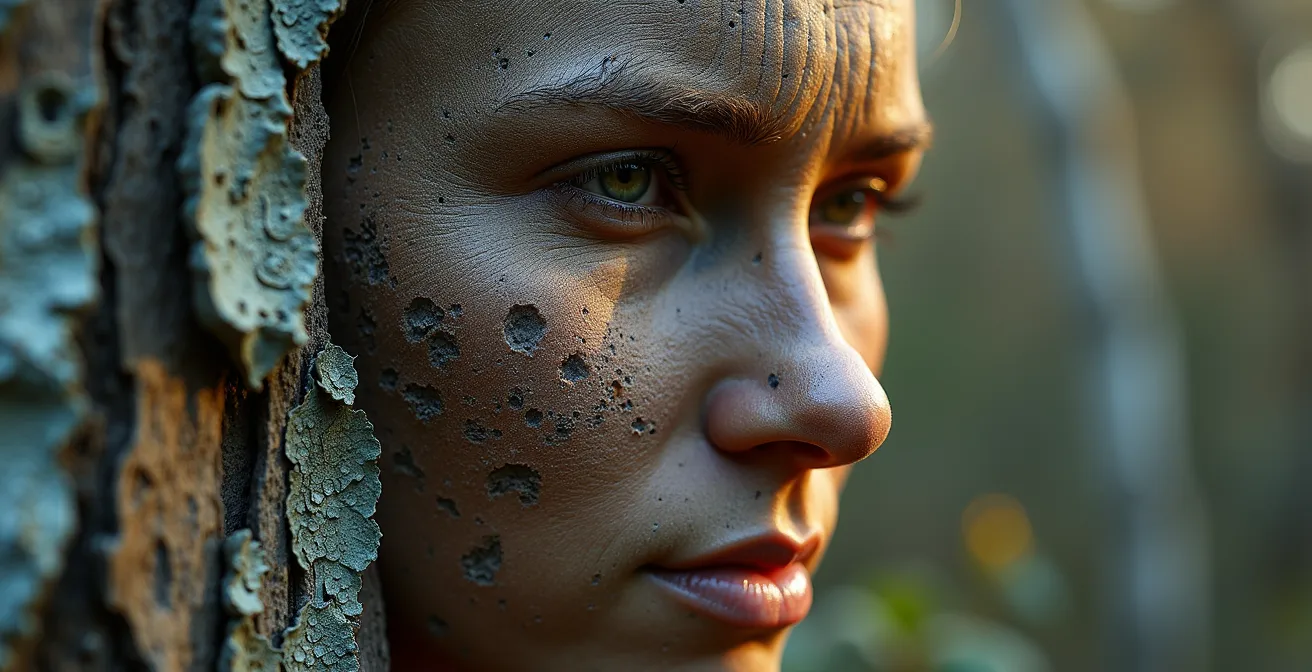
To practice this, one must cultivate a state of receptive ambiguity, allowing the mind to find patterns where none are intended. It involves staring at random textures like clouds, wood grain, or peeling paint and actively encouraging the brain to form recognizable objects. As Dalí explained his theories, it was about systematizing confusion to create a new, hyper-lucid reality. This was not madness, but a controlled delirium—a deliberate weaponization of paranoia for creative ends.
Beyond Words: Processing PTSD Through Non-Verbal Creation
The birth of Surrealism cannot be understood without the context of World War I. The unprecedented scale of industrial slaughter left a generation of young men, including many future Surrealists, grappling with profound psychological trauma, then known as “shell shock.” André Breton, the movement’s founder, worked in a neurological hospital during the war, where he administered Freud’s “talking cure” to soldiers. This experience was formative. He saw firsthand the limits of language in expressing the horrors of the trenches.
The turn to the subconscious was, in many ways, a search for a new language. If rational discourse had led to global war, and if words failed to capture its traumatic aftermath, then perhaps truth resided in the non-verbal, pre-rational realm of the psyche. As historical records show that André Breton served in a mental hospital during World War I, his direct exposure to trauma victims deeply informed his belief in psychoanalysis as a tool for healing and expression. The techniques of automatism and frottage were not just games; they were ways to access and process somatic memories held in the body, beyond the reach of conscious narration.
Max Ernst’s Frottage as a Precursor to Art Therapy
Haunted by his experiences in the German army, Max Ernst developed techniques like frottage (rubbings) and assemblage. He would combine these with automatic, stream-of-consciousness “writing” on the canvas. These methods, which integrate chance, bodily movement, and free association, are now recognized by contemporary art therapists as early forms of somatic processing—a way to engage with trauma held in the body without needing to verbalize it directly. Ernst was, in essence, inventing his own form of therapy through art-making.
Surrealism offered a form of catharsis. By giving form to the monstrous, the illogical, and the terrifying images bubbling up from the collective trauma, the artists could gain a measure of control over them. The art became a container for the unutterable.
Painting Time: How to Show Movement on a Static Canvas
One of the most radical aspects of the Surrealist project was its attempt to represent the mind’s subjective experience of reality, and this included the experience of time. In the conscious, rational world, time is linear and sequential. In the subconscious, however, it is fluid and chaotic. Memories of the past, sensations of the present, and premonitions of the future can all coexist in a single moment. This is the temporal logic of a dream, where you can be both a child and an adult simultaneously.
Surrealist painting visualizes this collapse of linear time. Dalí’s *The Persistence of Memory* is the most famous example, with its soft, melting clocks symbolizing the irrelevance of rigid, objective time in the psychic landscape. The artists achieved this effect by superimposing temporalities within a single frame. A painting might depict a scene that seems to contain both its own history and its own future. As one analysis of Surrealism explains, in the subconscious, temporal logic collapses, which is why paintings often superimpose memories, premonitions, and present sensations within one static image.
Juan Miró’s Constellations: Mapping a Network in Time
As World War II began and he was forced to flee Paris, Joan Miró started his famous *Constellations* series. These intricate paintings are not static images but maps of energy and movement. They depict complex networks of lines, nodes, and biomorphic forms that seem to be simultaneously coalescing and dispersing. They represent a system in constant flux, a network of connections that exists across time, testifying to a life force that persists even in the face of destruction and absence.
By rejecting the single-moment perspective of traditional art, the Surrealists were able to paint a more psychologically accurate picture of how we experience existence: not as a neat sequence of events, but as a dense, overlapping web of psychic data.
Key Takeaways
- Surrealist techniques like automatism, frottage, and juxtaposition are practical methods for bypassing the rational ego to access subconscious imagery.
- Salvador Dalí’s paranoiac-critical method was a form of “controlled delirium,” an active and willed process of inducing double images, not a sign of madness.
- The movement was deeply shaped by the trauma of WWI, using non-verbal art as a form of catharsis and a way to process experiences that language could not capture.
Suffering for Art: Do You Need to Be Miserable to Be Creative?
The Surrealists’ deep dive into the psyche raises a persistent and troubling question: is there a necessary link between psychological suffering and great creativity? The movement is populated by figures who battled severe mental health crises; historical documentation reveals that several prominent Surrealists, including Antonin Artaud, experienced profound psychological breakdowns. This has fed the romantic and dangerous myth of the “tortured artist,” suggesting that misery is a prerequisite for profound insight.
From a psychoanalytic viewpoint, the relationship is more nuanced. It is not suffering itself that fuels creativity, but the libidinal energy mobilized in the *struggle against* suffering. Creativity can be a powerful defense mechanism, a way of sublimating traumatic or repressed material into a new, symbolic form. The act of creation is a form of self-healing, an attempt to impose order on psychic chaos and to transform pain into meaning. The Surrealist toolkit provided a direct method for this process of transformation.
Therefore, it’s not misery that is required, but a willingness to confront the contents of one’s own mind, both light and dark. The Surrealists were courageous in this regard. They did not turn away from the monstrous or the absurd within themselves. They embraced it, studied it, and used it as the raw material for a new kind of art—one that sought not to escape reality, but to build a more complete and liberated one. It’s a powerful and enduring legacy.
By understanding this psychoanalytic framework, you can begin to see Surrealist art not as a gallery of oddities, but as a profound and ongoing exploration of the human mind. The next step is to apply this lens to the art you encounter, looking past the surface to see the psychological mechanisms at play.