Contrary to the belief that museums simply display objects, a curator’s primary role is that of an emotional architect. This article reveals that every element of an exhibition—from the lighting and wall color to the length of a label—is a deliberate choice in a larger strategy of narrative stagecraft, designed to guide your feelings and construct meaning long before you consciously engage with the art itself.
When you step into a museum gallery, a shift occurs. The outside world fades, replaced by hushed tones, carefully controlled light, and a palpable sense of reverence. Have you ever felt a sudden wave of melancholy in front of a somber portrait, or a jolt of excitement in a room full of vibrant modern art, and wondered about the source of that feeling? The artwork itself is only part of the answer. The experience is meticulously constructed, and you are the lead actor in a play you didn’t know you were cast in.
Most visitors assume the curator’s job is academic: to select important objects, place them at eye level, and write informative labels. This functional view positions the museum as a passive container for history and beauty, a place for quiet learning. But this perspective misses the most critical and compelling aspect of the work. The true craft of curatorship is not just in what is shown, but in how it is framed, paced, and revealed.
What if the layout of a gallery was designed to make you feel disoriented, then relieved? What if the story of an artwork’s perilous journey was told to heighten its aura before you even laid eyes on it? This is the core of modern curatorial practice: a form of emotional choreography. It is a strategic and often invisible manipulation of space, time, and information to create a powerful, resonant, and unforgettable visitor experience. This article pulls back the curtain on these techniques, exploring how curators move from being keepers of objects to being directors of feeling.
From the tension between commerce and education to the very words on the wall, we will deconstruct the tools used to shape your journey. Understanding this unseen architecture will fundamentally change the way you walk through a museum.
Summary: The Curator’s Playbook for Emotional Design
- Ticket Sales vs. Education: The Museum’s Eternal Dilemma
- The Courier’s Journey: Escorting a Van Gogh Across the Atlantic
- The 150-Word Rule: Writing Labels That People Actually Read
- Wallboard Waste: Making Blockbuster Shows Sustainable
- Clicking vs. Walking: Can Online Viewing Replace the Gallery?
- Private Guide or Solo Audio Tour: Which Fits Your Learning Style?
- Story or Timeline: Which Way Should You Walk Through History?
- Heavy and Expensive: Why Art Catalogs Lose Money but Build Prestige
Ticket Sales vs. Education: The Museum’s Eternal Dilemma
Every curatorial decision begins with a fundamental, often unspoken, tension: the balance between the museum’s educational mission and its financial survival. While our goal is to enlighten and provoke thought, we operate in a competitive attention economy. The pressure to generate revenue through ticket sales increasingly shapes the very content and design of exhibitions. This is not a modern phenomenon; as historian Charlotte Klonk notes, there has long been an “intermingling of the commercial and the institutional,” borrowing strategies from the world of advertising.
The museum relied on a didactic strategy of ‘winning people over’—the same way the booming advertisement industry of the time did. This intermingling of the commercial and the institutional is still evident today.
– Charlotte Klonk, Curation and the Visitor Experience – Stedelijk Studies
Today, this manifests as the “blockbuster” show, often built around a famous name or an “Instagrammable” concept. The drive for this is fueled by hard data: a reported 170% spike in attendance for museums with highly shareable, AI-powered experiences. This commercial pressure forces curators to think like marketers. We must ask: will this exhibition concept translate to a compelling social media campaign? Can we create a single, iconic room that will drive user-generated content? As the National Gallery in London demonstrated by gaining 240,000 TikTok followers, digital engagement metrics can sometimes feel more critical than physical attendance, influencing which stories get told and how.
This dilemma is the strategic backdrop for all emotional manipulation. An exhibition must first draw a crowd before it can deliver its message, forcing a constant negotiation between intellectual depth and popular appeal. The most successful exhibitions manage to serve both masters, using commercial appeal as a Trojan horse for a deeper, more challenging narrative.
The Courier’s Journey: Escorting a Van Gogh Across the Atlantic
Once an exhibition’s theme is set, the process of aura manufacturing begins. This is the deliberate strategy of emotionally priming the visitor, building a sense of reverence and tension before an artwork is even seen. A masterpiece doesn’t just appear on the wall; its journey to the gallery is a powerful narrative tool. The story of a fragile, priceless object traveling across the world—escorted by a dedicated courier, tracked by GPS, and handled with near-surgical precision—is not just a logistical footnote. It is the first act of the exhibition’s story.

This process transforms the object from a mere painting into a precious relic that has undertaken a perilous quest to be with you. As scholar Marjolein Varutti describes it, this is a key part of “affective curatorship,” where the goal is to shape feeling. The marketing materials, the introductory wall text, and even news reports about the loan are all part of this carefully orchestrated buildup. We are not just showing you a Van Gogh; we are presenting the survivor of a transatlantic voyage, an object of immense cultural and financial weight that requires extraordinary care.
The enduring power of artists like Van Gogh validates this strategy. The public’s fascination is unwavering, and exhibitions centered on his work consistently break records. For instance, even with post-pandemic challenges, the Van Gogh Museum saw a 9% increase to 1.8 million visitors in 2024. By the time you stand before the painting, you are not just looking at brushstrokes; you are engaging with the culmination of a story of value, risk, and anticipation that the curatorial team began telling months earlier.
The 150-Word Rule: Writing Labels That People Actually Read
The most direct form of communication between a curator and a visitor is the exhibition label. Yet, it is also one of the most misunderstood. The common assumption is that labels exist to provide factual information. In reality, their primary function is informational pacing—a tool to control the flow of the narrative and manage visitor attention. We know that long, dense blocks of text are rarely read. In our field, this has led to unofficial but widely adopted guidelines on length.
Research and professional practice recommend limiting introductory wall text to 150-250 words, with individual object labels often kept under 120 words. This brevity is not about “dumbing down” the content; it is a strategic choice to ensure the core message is actually absorbed. A label is an interruption in the visual experience. If it’s too demanding, the visitor will simply skip it, breaking the narrative thread we’ve carefully woven. The goal is to provide just enough context to enrich the viewing of the artwork, not to replace it with a reading exercise.
The Harvard Art Museums offer a compelling model for this strategy. They deliberately limit their interpretive texts, or “chats,” to around 150 words. Their metric for success is not whether visitors can pass a quiz on the content, but whether the labels spark conversation between visitors. The text becomes a social catalyst, an invitation to engage with the art and with each other. This reframes the label from a one-way lecture into a two-way prompt for emotional and social engagement.
By using accessible language and focusing on a single, compelling idea, the label guides the visitor’s eye and mind. It might point out a hidden detail, pose a provocative question, or offer a poignant quote. It is a precisely aimed narrative nudge, designed for maximum impact with minimal friction, ensuring the visitor remains immersed in the overall emotional arc of the exhibition.
Wallboard Waste: Making Blockbuster Shows Sustainable
The physical environment of an exhibition is a powerful, if subliminal, storyteller. The color of the walls, the quality of the light, and the materials used for displays all contribute to the emotional atmosphere. In the era of the blockbuster, this often led to spectacular but profoundly wasteful designs, with tons of temporary walls, custom-built vitrines, and single-use graphics ending up in landfills. This creates a critical emotional problem: narrative dissonance. As curator Rachel Mackay points out, the “visible wastefulness of a temporary exhibition’s design can create cynicism and undermine the intended emotional message,” especially for shows about nature or social justice.
Imagine an exhibition about climate change that generates several tons of non-recyclable waste. The hypocrisy is not lost on the modern visitor. It shatters the carefully constructed emotional world of the exhibition and damages the institution’s credibility. This has led to a significant shift in exhibition design, with sustainability becoming a core tenet of effective storytelling. The new ideal is to create powerful experiences with a lighter touch, using the museum’s existing architecture and more sustainable materials.

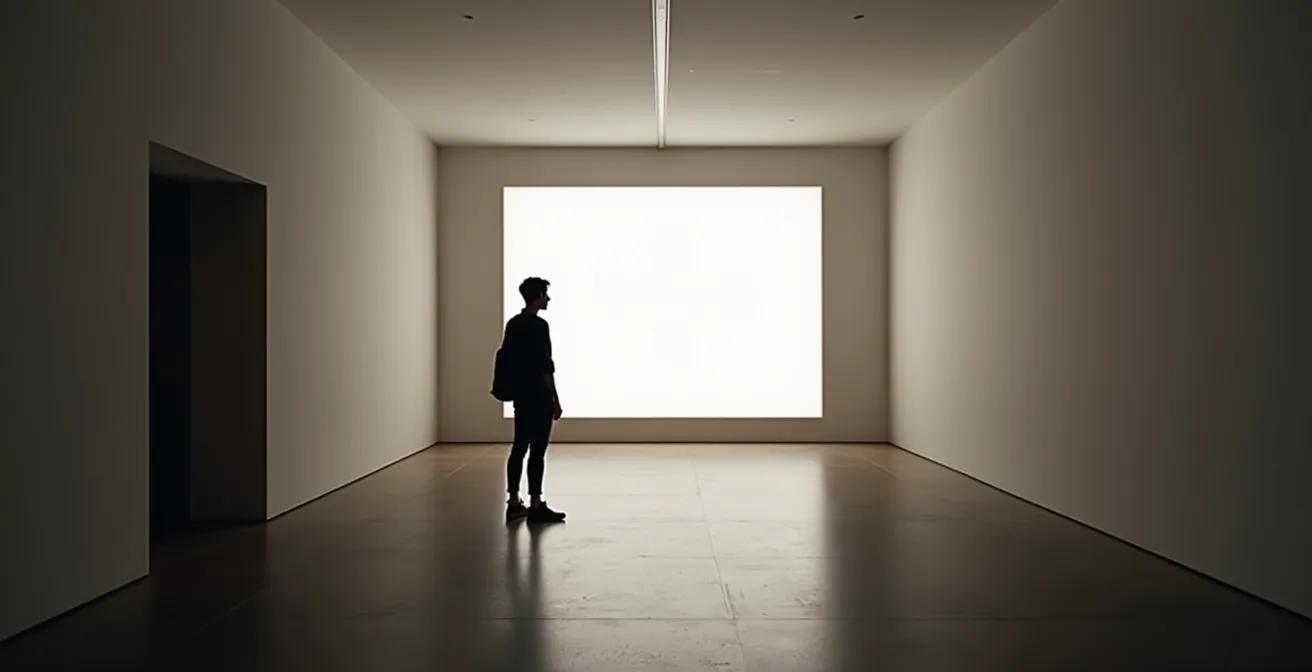
This “bare walls” aesthetic is not just about being green; it’s an emotional strategy in its own right. By stripping away temporary constructions, we focus the visitor’s attention on the artworks and the architectural space itself. Polished concrete floors, exposed beams, and dramatic natural light can create a sense of honesty, minimalism, and contemplation that a heavily decorated space cannot. The message becomes one of permanence and thoughtful resourcefulness, which can powerfully align with the themes of the art on display. The design’s sustainability becomes part of its emotional integrity.
Clicking vs. Walking: Can Online Viewing Replace the Gallery?
The digital revolution, accelerated by the pandemic, has forced every museum to question the very nature of the exhibition. When artworks can be viewed in high resolution online, what is the purpose of the physical gallery? Digital transformation data shows that nearly all museums now recognize the urgency of a robust online presence. However, the data also reveals a crucial distinction: digital engagement is a different beast, not a replacement. It serves to broaden reach, but it cannot replicate the core emotional experience of a physical visit.
The Metropolitan Museum of Art provides a clear case study. In Fiscal Year 2024, The Met’s website attracted an incredible 34 million visits. Yet, this massive digital footprint coexisted with a strong return of in-person visitors. While still below pre-pandemic levels, physical attendance reached 5.5 million. More telling is the success of spaces like the 81st Street Studio, an interactive art space that attracted 170,000 visitors. These numbers highlight what digital cannot offer: the social dimension and the embodied experience of moving through a physical space.
A key curatorial tool is narrative architecture—using the physical layout of the museum to tell a story. This involves choreographing the visitor’s journey through a sequence of spaces, controlling sightlines, creating moments of compression and release, and orchestrating encounters with objects. You might be led down a narrow, dark corridor that opens into a vast, brightly lit hall, an architectural trick designed to elicit a feeling of awe or relief. You might turn a corner and be confronted with a single, powerful object isolated on a wall. This physical, sensory manipulation is impossible to replicate through a screen.
The online gallery is a valuable tool for access and information, a catalog of objects. The physical exhibition, however, remains the primary medium for crafting a holistic emotional journey. It is an experience for the whole body, not just the eyes.
Private Guide or Solo Audio Tour: Which Fits Your Learning Style?
Within the carefully constructed environment of the exhibition, the final layer of narrative delivery often comes down to a choice: the pre-recorded audio tour or the live human guide. While both provide information, their method of emotional influence is profoundly different. The audio tour is a static, one-way broadcast. It delivers the official script, paced and toned for a generic listener. It is a tool of control, ensuring every visitor receives the exact same information in the exact same way.
The live guide, however, is a dynamic and adaptive instrument of emotional manipulation. As classicist Angelos Chaniotis describes it, a great guide acts as an “emotional proxy.” They are not just reciting facts; they are reading the room. They notice a flicker of interest, a moment of confusion, or a shared gasp from the group. In real-time, they can adjust their storytelling—lowering their voice to create intimacy, pausing for dramatic effect, or shifting their focus to an object that has unexpectedly captivated their audience.
A live guide acts as an ’emotional proxy,’ reading the group’s non-verbal cues and adjusting their tone, pacing, and storytelling to amplify or shape a collective emotional response—a dynamic manipulation impossible for a pre-recorded tour.
– Angelos Chaniotis, A World of Emotions: The Making of an Exhibition
This ability to customize the narrative is what allows a guide to exceed visitor expectations, a key factor in creating a memorable experience. Research on visitor engagement shows that the potential for a lasting impact is high, but only if the experience is exceptional. A live guide can forge a collective emotional response, making a group of strangers feel like they are part of a shared discovery. They can answer unexpected questions, connecting the art to a visitor’s personal experience. This transforms the tour from a passive lecture into an active, social, and emotionally resonant event, something an audio file can never achieve.
Story or Timeline: Which Way Should You Walk Through History?
Perhaps the most powerful tool in the curator’s arsenal is the complete control over narrative structure. We decide whether to guide you through an exhibition chronologically, thematically, or by some other, less obvious logic. A simple timeline is often the most straightforward way to present history, but it is rarely the most emotionally effective. The real work of affective curatorship lies in abandoning linear history in favor of an emotional arc, using the very architecture of the space to create a story with a beginning, middle, and end.
The Jewish Museum Berlin, designed by Daniel Libeskind, is a masterclass in this form of narrative architecture. The visitor’s journey is not dictated by dates, but by feeling. The building’s layout, with its intersecting “Axes,” forces choices and creates specific physical and emotional sensations. You are led through spaces that are intentionally disorienting, with slanted floors and dead ends. The experience of being in the “Holocaust Tower”—a cold, dark, concrete silo with only a sliver of light high above—evokes feelings of isolation and despair far more powerfully than any wall text could. This is not about learning facts; it is about embodying a historical experience through sensory manipulation.
This approach requires the curator to think like a filmmaker or a novelist, sequencing encounters to build tension, create moments of reflection, and deliver an emotional climax. The choice of which artwork to place at the end of a long sightline, or which small, quiet room to tuck away after a large, chaotic gallery, is paramount. Each transition is a narrative beat.
Checklist: Key Curatorial Approaches to Emotional Design
- Explicit Emotional Theming: Designing exhibitions that directly reference emotions (like ‘Love,’ ‘Rage,’ or ‘Melancholy’) in their core subject matter.
- Design-Driven Affect: Using architecture, color, and spatial design to implicitly guide or elicit specific emotional responses from visitors.
- Activity-Based Engagement: Creating participatory elements or interactive installations that generate emotional investment through action and contribution.
- Sensory Manipulation: Leveraging lighting, soundscapes, and even scent to create an atmospheric and immersive emotional context for the artworks.
Key Takeaways
- Exhibition design is a form of intentional emotional choreography, not a passive display of objects.
- Every element, from an artwork’s transport to the wall text, is a tool for narrative building and the manufacturing of aura.
- The physical space itself—its architecture, flow, and even its sustainability—is a primary vehicle for conveying the exhibition’s emotional message.
Heavy and Expensive: Why Art Catalogs Lose Money but Build Prestige
The curator’s influence does not end when the visitor leaves the gallery. The final, and perhaps most permanent, act of emotional and intellectual framing is the exhibition catalog. On the surface, these heavy, expensive, glossy books seem like a financial folly. They are costly to produce and rarely turn a profit. Yet, nearly every major exhibition produces one. Why? Because the catalog is not primarily a retail product; it is a tool for cementing legacy and controlling the historical narrative.
As museum director Susan Vogel explains, the catalog “solidifies the curator’s intended emotional and intellectual interpretation as the ‘official record.'” It captures the exhibition’s argument, presents the definitive research, and shapes how the show will be remembered and cited by scholars for decades to come. While the physical exhibition is ephemeral, the catalog is permanent. It ensures the curator’s thesis outlives the temporary walls of the gallery, influencing future research and public understanding long after the show has closed. It is the ultimate act of intellectual prestige.
The catalog solidifies the curator’s intended emotional and intellectual interpretation as the ‘official record,’ shaping the academic and historical reception of the show long after it has closed.
– Susan Vogel, Expanding Understandings of Curatorial Practice Through Virtual Exhibition Building
While catalogs themselves may lose money, they are part of a larger commercial ecosystem that is vital to museums. Broader retail and hospitality ventures are now a cornerstone of museum finance. At major institutions, retail can contribute over 20% of annual revenue. In this context, the catalog functions as a high-end “souvenir” that validates the visitor’s experience and a halo product that elevates the museum’s brand. It is a physical artifact of the intellectual and emotional journey the curator has designed, a take-home piece of the institution’s authority.
The next time you walk through an exhibition, you are armed with a new lens. Look beyond the art on the walls and see the unseen architecture that frames it. Notice the flow from one room to the next, the carefully chosen words on the labels, the quality of the light. Ask yourself: what story is being told here, and how am I being guided to feel? You now have the tools to decode the experience and appreciate the deep, strategic artistry of the curator.