Heritage & Monuments
Heritage sites and monuments represent far more than picturesque landmarks or tourist destinations. They are physical repositories of human ingenuity, cultural memory, and social identity—tangible links connecting contemporary societies to the knowledge, aspirations, and struggles of previous generations. From prehistoric cave paintings threatened by microbial growth to Renaissance châteaux grappling with modern climate realities, each heritage site presents unique preservation challenges that demand specialized expertise.
Understanding heritage conservation requires examining multiple interconnected dimensions: the technical science of preserving fragile materials, the economic frameworks that justify significant public investment, the political symbolism embedded in monumental architecture, the survival strategies of traditional craft communities, and the engineering principles that allowed structures to endure for centuries. This comprehensive exploration provides the foundational knowledge needed to appreciate why heritage preservation matters and how diverse stakeholders balance competing priorities of access, authenticity, economic viability, and long-term survival.
Preserving the Most Fragile: Cave Art and Underground Heritage
Prehistoric cave sites represent one of the most challenging preservation dilemmas in heritage conservation. Unlike surface monuments that can be reinforced or cleaned, cave ecosystems exist in delicate equilibrium that human presence fundamentally disrupts.
The Biological Threat of Human Visitation
Every visitor introduces moisture through respiration, raises ambient temperature, and carries microorganisms on clothing and skin. Ancient pigments—some created from iron oxides, charcoal, or manganese dioxide over 30,000 years ago—become substrates for bacterial and fungal colonies when environmental conditions shift. The growth of green algae on cave walls, accelerated by artificial lighting installed for tourists, can obscure imagery within decades. Carbon dioxide from human breath alters the cave atmosphere’s chemical composition, potentially triggering calcite dissolution or deposition that damages underlying artwork.
The Facsimile Solution and Its Trade-offs
Hyper-realistic replicas created through laser scanning, photogrammetry, and artisan painting techniques offer a compelling alternative. These facsimiles capture surface texture down to millimeter-scale detail while providing controlled environments with proper lighting and climate management. However, visitors face a philosophical choice: experience an exact replica in comfort or visit a lesser-known original site with authentic materiality but fewer amenities. Digital preservation technologies now allow three-dimensional documentation of sites too fragile for any public access, creating virtual archives that may represent the only future “visitation” option for humanity’s most vulnerable heritage.
The Economics That Make Preservation Possible
Heritage conservation competes for public funding against healthcare, education, and infrastructure—a competition that requires demonstrating tangible returns beyond cultural sentiment. The economic case for preservation rests on multiple pillars that extend far beyond admission ticket revenue.
Property values surrounding well-maintained heritage districts consistently show significant premiums, sometimes exceeding 20% compared to similar properties elsewhere. This phenomenon creates a tax base expansion that can partially offset conservation expenditures. Heritage sites anchor tourism ecosystems supporting hospitality, retail, and transportation sectors—economic activity that multiplies the initial investment many times over. Conversely, deferred maintenance creates exponential cost increases: a roof leak ignored for several years can necessitate complete structural timber replacement rather than simple slate tile repair, transforming a modest expense into a catastrophic one.
Community engagement in preservation projects generates social capital alongside economic benefits. Local volunteers trained in traditional building techniques develop marketable skills while fostering collective ownership of heritage assets. This participatory approach transforms conservation from an elite concern into a community-driven economic development strategy with broad stakeholder buy-in.
Restoration Versus Adaptation: Finding the Right Approach
Heritage conservation philosophy navigates a fundamental tension between faithful restoration—returning a structure to a specific historical moment—and adaptive reuse that modifies buildings for contemporary functions while resping their character. Neither approach is inherently superior; the choice depends on the structure’s condition, historical significance, and community needs.
Cleaning techniques illustrate this complexity perfectly. Stone monuments accumulate centuries of pollution: sulfur dioxide from coal combustion, particulate matter from industrial processes, and biological growth. Hidden techniques such as laser ablation, poultice applications, and controlled water nebulization can remove contamination without damaging underlying surfaces—but determining the appropriate “cleaned” state requires judgment. Should Victorian-era buildings be returned to their original pale stone color, or does a century of patina constitute legitimate historical layering worth preserving?
Adaptive reuse projects—converting monasteries into hotels or warehouses into residential lofts—face different challenges. These interventions must balance modern building codes, accessibility requirements, and energy efficiency standards against the preservation of character-defining features. Successfully executed adaptive reuse extends building lifespans while maintaining economic viability, preventing abandonment and demolition.
How Monuments Express and Maintain Power
Monumental architecture has always served as a three-dimensional language communicating authority, permanence, and cosmic order. Understanding this architectural vocabulary of power reveals how built environments shape social behavior and political consciousness.
Scale, Symbolism, and Psychological Impact
The psychological effect of monumental scale on individual citizens is profound and intentional. Cathedral naves soaring 40 meters overhead, palace facades extending hundreds of meters, and government buildings approached by grand staircases all create visceral experiences of smallness and humility. This spatial manipulation reinforces hierarchical social structures—the architecture physically enacts the relationship between governing authority and individual subject.
Domes carry particularly rich symbolic weight as representations of cosmic authority. Whether crowning legislative buildings, religious structures, or mausoleums, the dome’s geometry references celestial perfection and divine order. Its structural prominence on skylines and visibility from multiple vantage points throughout a city ensures continuous visual reinforcement of the institution it represents.
Urban Planning as Control Mechanism
The control of sightlines through urban planning extends monumental power beyond individual buildings. Radial boulevards focusing on central monuments, height restrictions preserving landmark visibility, and ceremonial axes connecting symbolic structures create choreographed urban experiences that continuously reference authority. Material choices for state monuments—granite, marble, bronze—communicate durability and permanence, suggesting the eternal nature of the represented power.
The fate of monuments after regime collapse reveals their political function. Toppled statues, dynamited palaces, and recontextualized buildings through added explanatory signage all demonstrate how successive generations renegotiate their relationship with inherited monumental landscapes.
Safeguarding Traditional Craftsmanship and Living Heritage
While monuments represent tangible heritage, the artisan knowledge required to create and maintain them constitutes equally valuable intangible cultural heritage. Historic craft houses face existential challenges in contemporary economic contexts.
The Apprenticeship Crisis and Knowledge Transfer
Traditional crafts depend on tacit knowledge—embodied skills learned through years of observation and practice that resist codification in manuals. A master stone carver understands grain direction through touch, a traditional tanner judges leather readiness by smell, and a woodworker selects timber based on subtle visual cues. The crisis of apprenticeship stems from economic realities: young artisans cannot afford years of low-wage training when alternative careers offer immediate income, while master craftspeople lack resources to support apprentices.
The “Living Human Treasures” concept, adopted by numerous countries, provides official recognition and financial support to master artisans maintaining endangered techniques. However, recognition alone cannot solve underlying economic viability questions. Documenting tacit knowledge before it disappears requires video archives, detailed process photography, and written protocols—but even comprehensive documentation cannot fully replace hands-on transmission.
Heritage Branding and Economic Survival
Historic artisan houses balance heritage branding with modern manufacturing demands. Royal warrants and state protection mechanisms provide prestige and market differentiation, but survival often requires diversification strategies. Single-product ateliers face particular vulnerability; broadening product lines while maintaining quality standards presents ongoing challenges. Luxury tourism impact offers opportunities—workshop visits, demonstration sales, and custom commissions—but risks transforming productive ateliers into performative museums where heritage becomes spectacle rather than living practice.
Legal protection through geographical indications helps preserve traditional production methods and regional identities, though these protections can also restrict innovation. Recruiting the next generation requires demonstrating viable career paths, not merely romanticizing traditional craft.
Engineering Genius: Learning From Historic Construction
Pre-industrial builders achieved structural feats that continue to challenge modern understanding. Analyzing their techniques reveals sophisticated empirical knowledge that contemporary conservation efforts must respect and preserve.
Structural Innovation Through Material Understanding
The flying buttress exemplifies how medieval masons channeled forces through space using stone’s compressive strength while acknowledging its tensile weakness. These external supports transfer lateral thrust from vaulted ceilings to ground-level foundations, allowing walls to become screens of glass rather than load-bearing mass. The physics underlying this innovation—vector force resolution, load distribution, and structural redundancy—demonstrate advanced empirical engineering developed without mathematical formalization.
Foundation stabilization in wetlands required equally sophisticated approaches. Builders drove wooden piles into saturated soils until reaching load-bearing strata, creating artificial “rafts” that distributed structural weight. When permanently submerged, these timber foundations remain preserved by anaerobic conditions; problems arise when water table changes expose wood to oxygen and decay organisms.
Lost Techniques Worth Recovering
Stereotomy—the geometric art of cutting stone for complex three-dimensional structures—enabled the creation of helical staircases, ribbed vaults, and interlocking arches without modern calculation tools. Master masons worked from full-scale floor tracings, translating geometric projections into individual stone templates. The double-helix staircase at Château de Chambord, where two intertwined spirals share a central axis without meeting, represents stereotomy’s apex.
The acoustics of stone vaults produce effects that modern concert halls struggle to replicate. Romanesque and Gothic builders empirically discovered how curved surfaces, material density, and spatial geometry interact to create resonance, clarity, and sound distribution—knowledge encoded in built form rather than written treatises.
Even mortar recipes that allowed structures to survive centuries merit study. Hydraulic limes, pozzolanic additives, and carefully calibrated aggregate ratios created binding materials with flexibility, permeability, and longevity often superior to modern Portland cement formulations. Understanding these traditional materials proves essential for compatible conservation interventions that respect original structural behavior.
Heritage preservation ultimately represents an investment in continuity—maintaining physical connections to human creativity, struggle, and achievement across generations. Whether protecting fragile cave paintings, revitalizing traditional crafts, or decoding the engineering embedded in historic structures, conservation work requires balancing competing values of authenticity, access, economic sustainability, and long-term survival. The challenges are substantial, but the alternative—allowing irreplaceable heritage to decay through neglect or incompatible intervention—represents an impoverishment of human culture that affects everyone.
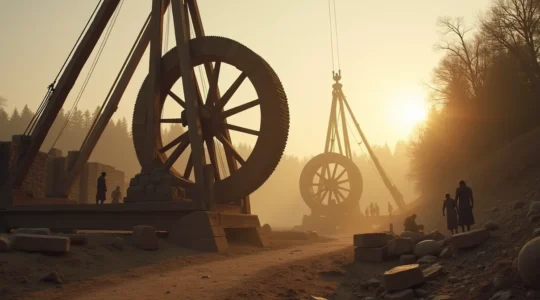
How Did They Lift Stones That Heavy Without Cranes?
The secret to ancient construction was not brute force, but an intuitive mastery of physics, treating materials as living elements in a grand structural harmony. External arches and buttresses turned walls into skeletons of stone and light, redirecting immense weight…
Read more
Why Castles Stopped Having Thick Walls in the 16th Century?
Contrary to the popular belief that gunpowder alone made stone walls obsolete, the transformation of 16th-century castles was a calculated strategic pivot. Power was no longer projected through physical defense but through theatrical architecture. Fortresses evolved into palaces, replacing military…
Read more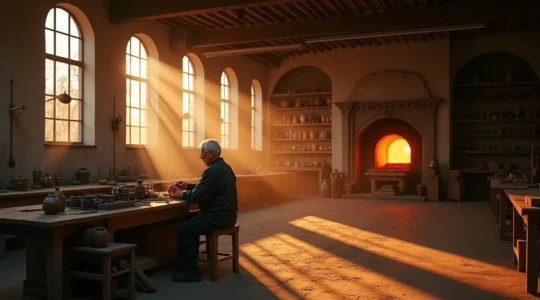
What Happens When the Last Master Glassblower Retires?
The disappearance of a master artisan is not a cultural loss, but a critical policy failure. State-level recognition is insufficient without robust systems for knowledge codification and economic viability. Modern technology and market strategies are not threats to tradition, but…
Read more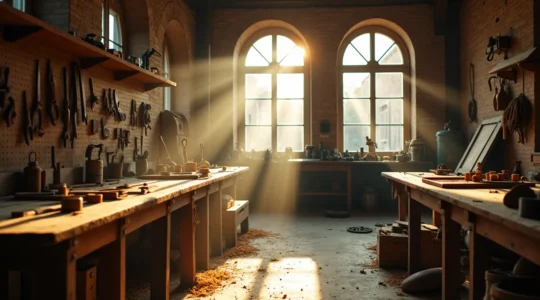
How Historic Workshops Survive in the Age of Mass Production?
Historic workshops are not just surviving; they are strategically transforming their business models to lead in the luxury economy by monetizing their expertise. They are pivoting from being product-makers to becoming indispensable B2B knowledge suppliers for other industries. They are…
Read more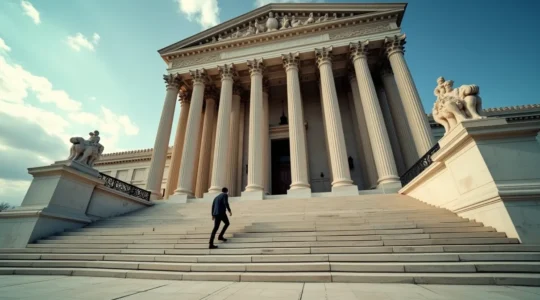
Why Every Government Building Looks Like a Greek Temple
Contrary to the simple explanation of ‘tradition,’ the persistent use of Greco-Roman forms in government architecture is a deliberate semiotic strategy. This article decodes the visual language of power, revealing how scale, materials, and urban planning are engineered not just…
Read more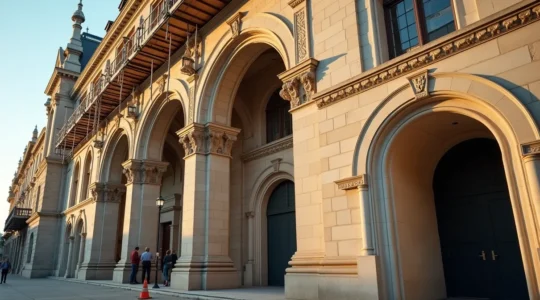
Why Restoring Old Stones Is an Economic Engine, Not a Cost
Viewing heritage restoration as a line-item expense is a fundamental strategic error; it is a capital investment with a quantifiable, multi-layered return. Restoring a historic site directly increases surrounding property values by a measurable percentage, creating a positive tax-base ripple…
Read more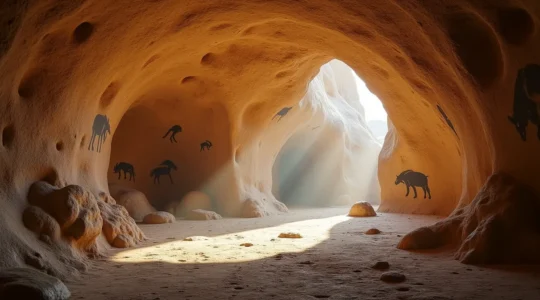
Why the Original Lascaux Caves Will Never Reopen to the Public
Contrary to the simple notion that Lascaux is closed just to “protect the paintings,” the truth is a stark scientific reality. The cave is under a permanent conservation quarantine, fighting an ongoing biochemical assault triggered by human presence. The carbon…
Read more