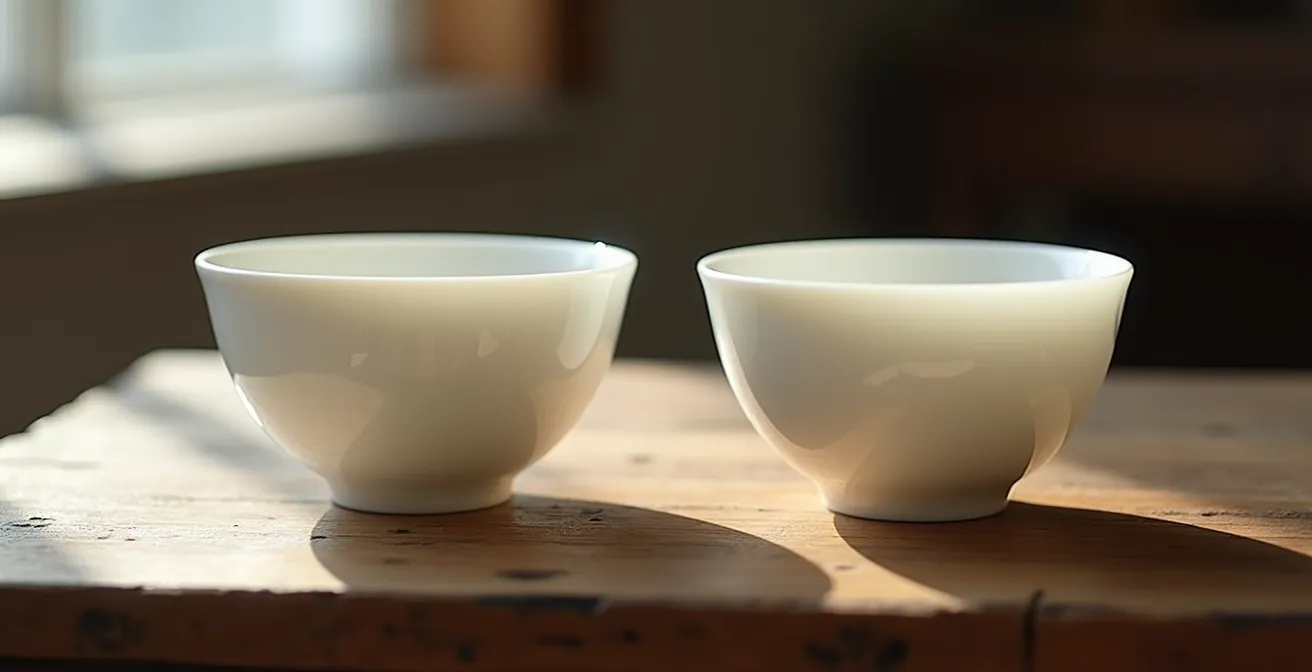
The value of porcelain is not merely a matter of its mark or age; it is chemically bonded to its very molecular structure and the physics of its creation.
- Hard-paste porcelain’s strength comes from the complete vitrification of kaolin and feldspar at extreme temperatures (around 1400°C), creating a single, glass-like body.
- Soft-paste, an artificial porcelain using glassy frits, fires at a lower temperature (around 1200°C), resulting in a less integrated, softer body prone to thermal shock and a glaze that can be physically scratched.
Recommendation: Evaluate a piece first by its material properties—translucency, sound, and glaze hardness—before ever considering the maker’s mark as the primary indicator of quality.
For any serious collector, the debate between hard-paste and soft-paste porcelain can be a source of confusion. One holds a piece of Meissen, cool, brilliant, and resonant; another holds a Sèvres, with its deep, creamy glaze and luscious colors. The common wisdom attributes the difference to geography or secret recipes, but this only scratches the surface. Is Sèvres truly more “artistic”? Is Meissen inherently “superior”? These questions often lead collectors down a path of brand names and auction records, missing the fundamental truth of the material itself.
The distinction between these two legendary materials is not a matter of subjective taste but of fundamental chemistry and thermodynamics. The perceived value, the aesthetic qualities, and the very durability of a piece are direct consequences of its molecular composition and the high-risk, transformative journey it undergoes in the kiln. Understanding this science is the key to moving beyond brand lore and becoming a true connoisseur of the material.
This guide will deconstruct the science behind “white gold.” We will explore the atomic-level differences that define each type of porcelain, from the high-stakes firing process to the chemical makeup of their glazes. By examining the material first, you will learn to identify the inherent qualities of a piece, empowering you to assess its true character and value, regardless of the mark on its base.
To navigate this exploration of ceramic chemistry, the following sections will break down the key scientific and historical factors that differentiate hard-paste and soft-paste porcelain, providing a clear framework for any collector.
Summary: A Material Science Guide to Porcelain Value
- The White Gold Race: How Spies Stole the Secret of Porcelain
- 1400 Degrees: The Risk of Firing Grand Feu Porcelain
- Real or Samson Copy: Decoding the Crossed Swords Mark
- The “Ring” Test: Detecting Hairline Cracks by Sound
- Lead to Feldspar: How Glaze Chemistry Changed Durability
- Gobelins and Sèvres: When the State Owns the Means of Luxury
- Micro-Dots vs. Fluid Lines: Using a Loupe to Spot Decals
- Why Faience Chips So Easily Compared to Porcelain?
The White Gold Race: How Spies Stole the Secret of Porcelain
The story of European porcelain is one of industrial espionage, driven by an obsessive quest to replicate the translucent, resilient ceramics imported from China. For centuries, the formula for true, or hard-paste, porcelain was a closely guarded secret. The key ingredient, kaolin clay, was unknown in Europe, forcing potters to experiment with substitutes. This led to the development of soft-paste porcelain in factories like Saint-Cloud and Chantilly in France, a beautiful but flawed imitation.
The breakthrough came in Germany. In the early 18th century, the alchemist Johann Friedrich Böttger, under the patronage of Augustus the Strong, Elector of Saxony, finally unlocked the secret. He identified the essential combination of kaolin with feldspathic rock (petuntse) and the extreme firing temperatures required. The Meissen factory was established in 1710 to protect and exploit this discovery, effectively holding a monopoly on “white gold.”
However, such a valuable secret could not be contained. The intense demand and potential for profit fueled a continent-wide “porcelain race.” Arcanists—the keepers of the secret formula—were bribed and poached. As Wikipedia contributors note in an article on Meissen porcelain, a pivotal moment occurred when Samuel Stöltzel, a head craftsman at Meissen, sold the secret recipe. This act of corporate treason shattered Meissen’s monopoly. As a result, by 1760, about thirty porcelain manufacturers were operating in Europe, each trying to perfect their own version of hard-paste porcelain, fundamentally changing the landscape of luxury goods.
1400 Degrees: The Risk of Firing Grand Feu Porcelain
The fundamental difference between hard-paste and soft-paste porcelain lies in a process called vitrification—the transformation of a substance into a glass. True hard-paste porcelain achieves full vitrification in a single, perilous firing known as the grand feu or “great fire.” This process subjects the mixture of kaolin and feldspar to immense heat, bonding the body and glaze into a single, unified, and non-porous material.
This transformation is a high-risk endeavor. The key difference lies in the firing temperature: hard-paste porcelain requires around 1400°C to vitrify, while soft-paste formulas would collapse at such heat and are fired at a comparatively lower 1200°C. At these extreme temperatures, the porcelain body becomes soft and is susceptible to pyroplastic deformation, causing pieces to sag, warp, or even collapse under their own weight. The kiln master’s skill was paramount in managing this volatile process, where a slight miscalculation could result in the loss of an entire batch.
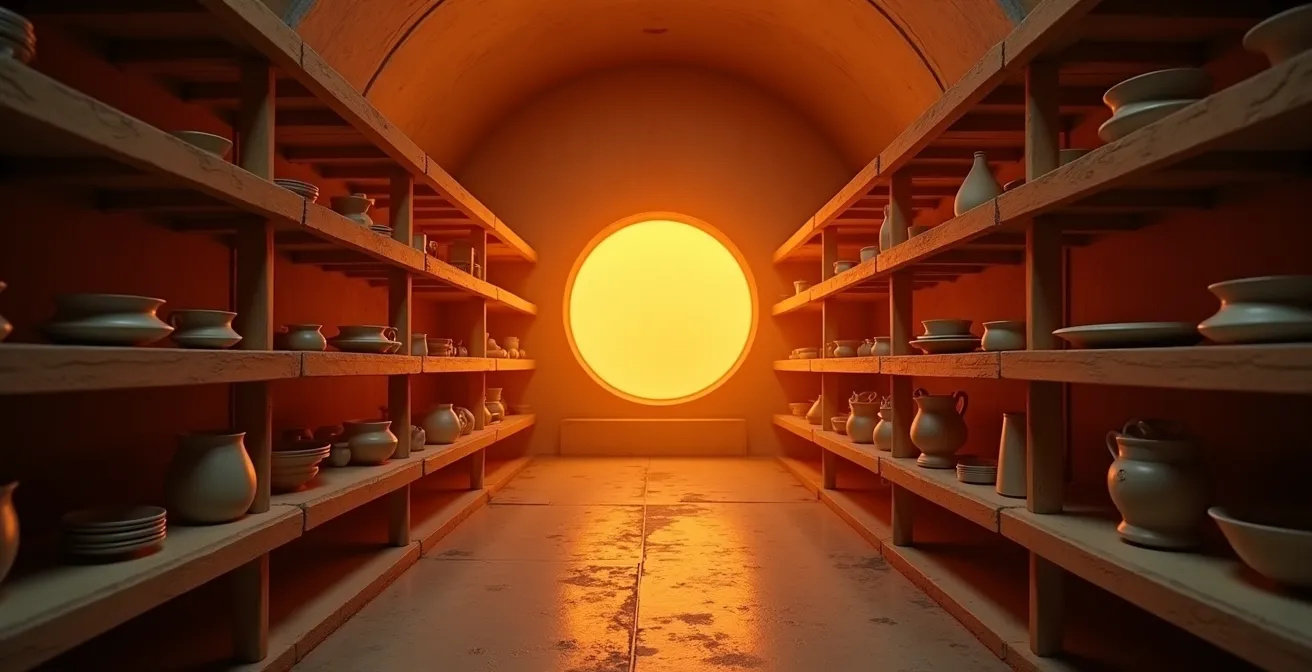
The challenges were particularly acute for soft-paste manufacturers. As noted by the French Porcelain Society, the production of soft-paste at Sèvres was an expensive process with significant losses from firing cracks and blemishes. This inherent instability is why Sèvres eventually abandoned soft-paste production in 1804 in favor of the more chemically stable, albeit risky, hard-paste method. The grand feu firing is what gives hard-paste its superior strength, translucency, and impermeability, but it is a testament to the immense technical and financial risks manufacturers were willing to take.
Real or Samson Copy: Decoding the Crossed Swords Mark
For many collectors, the maker’s mark—such as the famous Meissen crossed swords or the Sèvres interlaced L’s—is the first point of inspection. These marks are indeed powerful indicators of origin and period. However, relying on them exclusively is a critical error, especially given the long history of forgeries and reproductions by factories like Samson, Edmé et Cie of Paris, which specialized in creating convincing copies of earlier, more valuable pieces.
A true expert understands that the mark is secondary to the material itself. The body, glaze, and decoration hold the real secrets. A scientific approach prioritizes physical evidence over branding. The most skilled forger might replicate a mark perfectly, but replicating the precise chemistry and firing behavior of 18th-century hard-paste porcelain is nearly impossible. This principle is best summarized in a quote from American Collector magazine.
The expert studies the texture of the body or paste and examines the glaze. The mark serves only as a check on his findings.
– American Collector magazine, Identifying China By Its Paste
Therefore, when faced with a piece bearing the crossed swords, a collector should first assess the material. Is the body cold to the touch and highly resonant? Is the glaze hard, brilliant, and fully integrated with the paste? Does the piece exhibit a slightly greyish or bluish translucency when held to the light? These are the intrinsic characteristics of authentic Meissen hard-paste porcelain. If these qualities are present, the mark serves as confirmation. If they are absent, the mark—no matter how convincing—should be viewed with extreme suspicion. The material does not lie.
The “Ring” Test: Detecting Hairline Cracks by Sound
One of the most immediate, tangible differences between hard-paste and soft-paste porcelain is revealed through sound. Because hard-paste porcelain is fully vitrified into a dense, glass-like substance, it produces a clear, high-pitched ring when gently tapped. Soft-paste, being less dense and more granular in its molecular structure, emits a duller, lower-pitched thud. This simple “ring test” is a powerful diagnostic tool for a collector, not only for distinguishing between paste types but also for detecting hidden damage.
A hairline crack, even one invisible to the naked eye, will disrupt the molecular integrity of the piece and dampen its resonance. A true hard-paste piece that should ring clearly but instead produces a dull thud is almost certainly damaged. This heightened vulnerability to cracking, especially from sudden temperature changes, is a known weakness of soft-paste. This fragility is rooted in its chemical composition and firing process; its lower biscuit firing temperature of around 900°C makes it particularly susceptible to thermal shock. Pouring hot liquid into a cold soft-paste cup was a risky proposition, often resulting in the very cracks that the ring test can detect.
Performing this test requires care and precision to avoid causing damage. It provides immediate feedback on the material’s integrity.
Your Action Plan: Performing the Ring Test Safely
- Hold the piece correctly: Carefully suspend the item by its base or handle, allowing the body to vibrate freely. Do not cradle it in your palm.
- Tap gently: Use a light instrument like a wooden pencil or your fingernail to gently tap the rim of the piece, away from any handles or spouts.
- Listen to the sound: A high, clear, and sustained ring suggests intact hard-paste porcelain. A duller, shorter “thud” is characteristic of soft-paste or earthenware.
- Interpret a dull sound: If a piece you believe to be hard-paste produces a dull sound, it is a strong indicator of a hairline crack, a previous repair, or other structural damage.
- Note the limitations: Avoid testing pieces with metal mounts (ormolu), as the metal will absorb the vibration and deaden the sound, giving a false negative.
Lead to Feldspar: How Glaze Chemistry Changed Durability
The glaze is not just a decorative coating; it is a crucial component that defines porcelain’s durability, texture, and interaction with light. The chemical differences between the glazes used for hard-paste and soft-paste are profound. Soft-paste porcelain is typically coated with a lead-based glaze, which melts at a relatively low temperature. This glaze was fixed during a second firing at approximately 1000°C, a process known as petit feu. Because it is fired separately and at a lower temperature, the glaze sits on top of the body as a distinct layer rather than fusing with it completely.
In contrast, hard-paste porcelain uses a feldspathic glaze, which has a composition similar to the porcelain body itself. Both body and glaze are fired together at the extreme heat of the grand feu (around 1400°C). This causes the glaze to fuse entirely with the body, creating a single, incredibly hard, and integrated material. This difference in chemistry and application has a very practical consequence for durability, as noted by the ceramic resource CERAMICA CH.
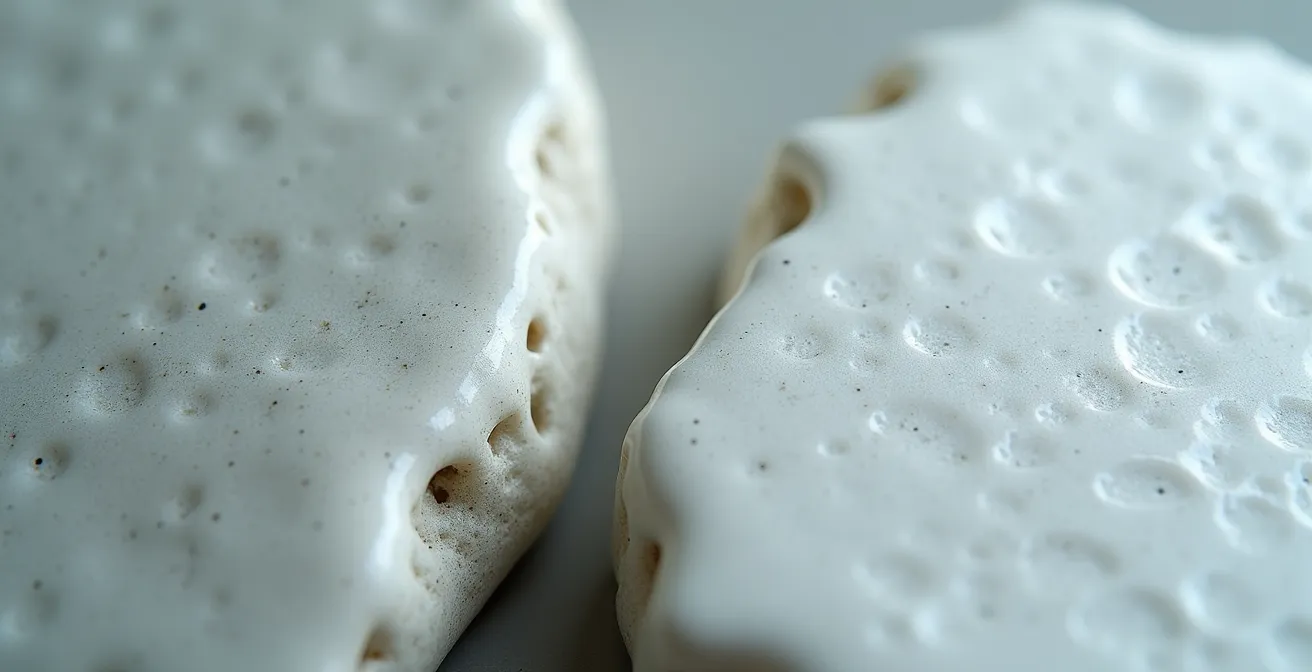
The glaze on soft-paste porcelain can be scratched with a knife, as it is considerably softer than the feldspar glaze on hard-paste porcelain.
– CERAMICA CH, Soft-paste porcelain technical specifications
This simple “knife test” (though not recommended on valuable pieces) highlights the superior hardness of feldspathic glaze. The softness of lead glaze also makes it more prone to showing wear, utensil marks, and a network of fine cracks known as “crazing” over time. While the deep, pooling quality of Sèvres’ soft-paste lead glaze allowed for uniquely rich color effects, it came at the cost of chemical and physical resilience.
Gobelins and Sèvres: When the State Owns the Means of Luxury
The development of porcelain in France cannot be understood without acknowledging the role of the state. Unlike Meissen, which began as a private enterprise for Augustus the Strong, the Sèvres manufactory was a direct instrument of the French Crown. Originally established at Vincennes, it was moved to Sèvres in 1756 under the patronage of King Louis XV and his mistress, Madame de Pompadour. This royal ownership fundamentally shaped its production philosophy, transforming it from a commercial venture into a national symbol of artistic and technical supremacy.
State funding insulated Sèvres from the commercial pressures that other factories faced. It could afford to operate as a modern research and development laboratory, dedicated to perfecting the beautiful but notoriously difficult and unprofitable soft-paste porcelain. According to the French Porcelain Society, Sèvres was able to conduct years of costly chemical experiments to create its iconic colors, such as bleu céleste and rose Pompadour. These unique effects were only possible on a soft-paste body, and the factory’s losses from sagging and firing cracks were absorbed by the royal treasury.
This model of state-sponsored luxury, also seen at the Gobelins tapestry works, prioritized innovation and prestige over profit. Sèvres continued to produce both soft-paste and the newly mastered hard-paste from 1769 onward, but its heart remained with the artistic potential of its original material. The decision to finally abandon soft-paste in 1804 was a pragmatic one, but it marked the end of an era where chemistry was pursued for purely aesthetic ends, backed by the unlimited resources of a monarchy. The most celebrated Sèvres pieces are, therefore, not just luxury objects but artifacts of a state-controlled economic and artistic system.
Micro-Dots vs. Fluid Lines: Using a Loupe to Spot Decals
After assessing the paste and glaze, a collector’s attention turns to the decoration. The method of decoration can be a strong clue to a piece’s age and authenticity. Early porcelain from the 18th century was almost exclusively hand-painted. This technique is characterized by fluid, organic brushstrokes with natural variations in line thickness and color density. Even in the most meticulous work, the artist’s hand is visible.
As production scaled up in the late 18th and 19th centuries, transfer printing and, later, decalcomania (decals) were introduced to speed up the process. Transferware can often be identified by tell-tale gaps or smudges where the paper transfer was applied. Decals, a 19th-century invention, are even more revealing under magnification. When viewed with a jeweler’s loupe, the decoration resolves into a clear dot matrix pattern, similar to a modern printed image. This is a definitive sign that the piece is not 18th-century hand-painted work. The perfection of the pattern is its giveaway.
A detailed examination of these techniques provides a reliable timeline for dating a piece. This table, based on information from collector resources, outlines the key visual characteristics.
| Period | Technique | Visual Characteristics |
|---|---|---|
| 18th century | Hand-painted | Fluid brushstrokes with organic variation and visible texture |
| Late 18th century | Transferware | Fine printed lines, occasional gaps, and smudges at joins |
| 19th century & later | Decals | Uniform dot matrix visible under magnification; lacks brushstroke texture |
| Modern | Laser/Digital Printing | Extremely uniform, perfectly registered dots with no variation |
This careful analysis of the decoration method, as this comparative overview suggests, is another critical layer in the authentication process. An anachronistic decoration technique—like a dot-matrix decal on a piece purported to be from 1760—is an immediate red flag. The loupe becomes a time machine, revealing the technological context in which the piece was created.
Key Takeaways
- The core difference is chemical: hard-paste is a fully vitrified, single material, while soft-paste is a less-integrated composite of clay and glassy frit.
- Firing temperature dictates everything: hard-paste’s strength comes from the ~1400°C grand feu; soft-paste’s fragility is linked to its lower ~1200°C firing.
- Trust the material over the mark: Physical properties like resonance (the “ring test”), glaze hardness, and translucency are more reliable indicators of authenticity than a maker’s mark alone.
Why Faience Chips So Easily Compared to Porcelain?
To fully appreciate the technical marvel of porcelain, it is useful to compare it to its less resilient cousin: faience, or tin-glazed earthenware. Collectors of Delftware or other faience are all too familiar with its tendency to chip, revealing the coarse, colored clay body beneath the white glaze. This chipping is not a sign of poor craftsmanship but an inherent property of the material’s chemistry.
Faience is a type of earthenware, meaning its clay body is porous and fired at a much lower temperature than porcelain. As an authentication guide from Homes & Antiques explains regarding delftware, the objects were typically fired at around 1,000°C. This temperature is not high enough to achieve vitrification. The clay body does not fuse with the glaze; instead, the opaque tin glaze simply forms a separate, brittle shell around the porous earthenware core. Because the two layers are not chemically bonded and expand and contract at different rates, the glaze is prone to flaking and chipping with even minor impacts, exposing the yellow or red clay underneath.
In stark contrast, porcelain—especially hard-paste—is a unified, non-porous body. During the grand feu firing, the feldspathic glaze and the kaolin-based body vitrify together, becoming one single, monolithic material. There is no distinct boundary between glaze and body. An impact on porcelain is an impact on the entire structure, which is why it is far more resistant to chipping. When it does break, it tends to be a clean, conchoidal fracture, much like glass, rather than a flaking of the surface layer. This superior integration is the fundamental reason for porcelain’s celebrated durability and why it commanded such a high status over common earthenware.
By shifting your focus from brand names to material science, you can approach any piece of porcelain with newfound confidence. Applying this chemical and physical understanding is the final step in transforming from a buyer into a true connoisseur, capable of building a collection based on intrinsic quality and informed judgment.