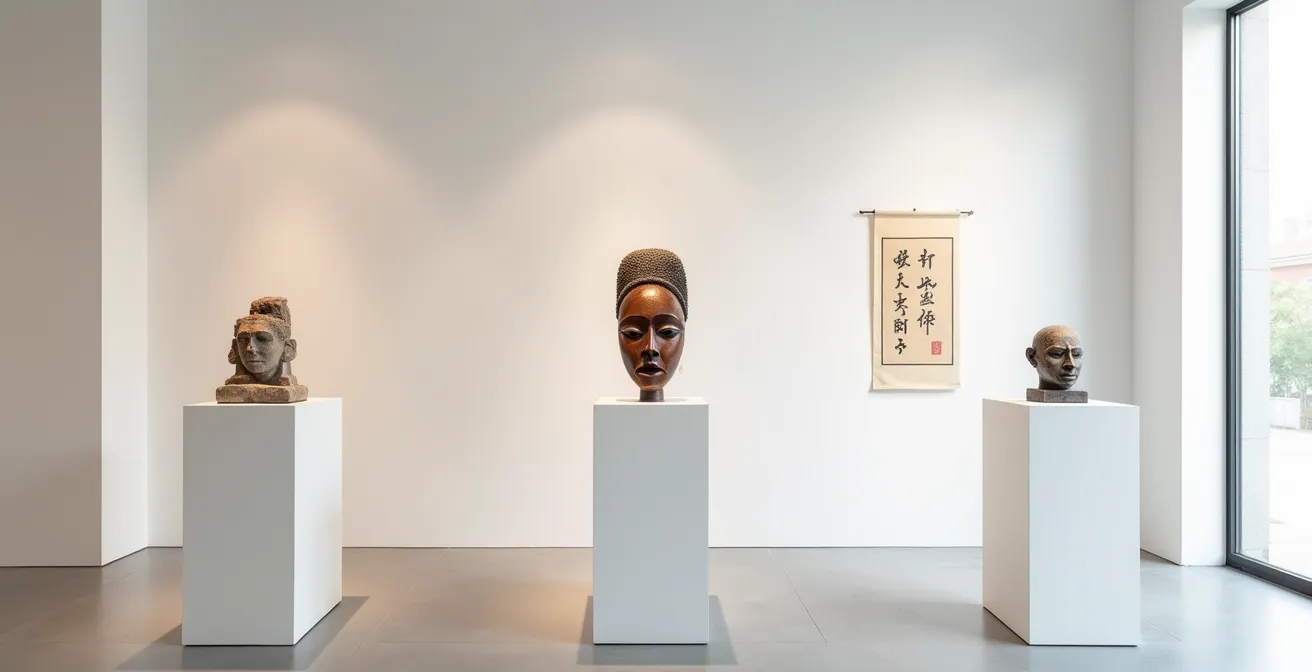
Contrary to the belief that beauty standards like the Golden Ratio are universal truths, they are in fact a cultural construct. This article deconstructs the dominance of Western aesthetics, revealing how the European art historical canon was deliberately built by figures like Vasari, exported as a tool of empire, and institutionalized by museums. It exposes this framework not as objective, but as an ideology that systematically marginalized other valid, and often more profound, artistic philosophies from around the globe.
As an art student, you are often presented with a seemingly linear history of artistic genius. It starts in Greece, is “reborn” in Renaissance Italy with masters like Michelangelo, and culminates in the modern movements of Europe. Central to this narrative is the idea of universal beauty, a perfect harmony often quantified by the “Golden Ratio.” This mathematical ideal is held up as objective proof that certain forms—from the Parthenon to the Mona Lisa—possess an inherent, superior aesthetic quality. We are taught to see perspective, realism, and anatomical precision as the ultimate goals of artistic expression.
The standard curriculum reinforces this by celebrating the technical mastery of the Renaissance and framing non-Western art as “stylized,” “primitive,” or “decorative.” But what if this entire framework is not an objective history, but a story written by the victors? What if the “universal” standards you’re taught are, in fact, the highly specific, regional values of Western Europe, elevated to a global benchmark through centuries of cultural and political dominance? This is the core of our deconstruction: to challenge the very premise of a single, authoritative standard for beauty and artistic merit.
This analysis will dismantle the pillars of that Eurocentric canon. We will investigate who first crowned European masters as the undisputed champions of art, how their aesthetic ideals were weaponized as tools of empire, and why entire continents developed sophisticated artistic systems that consciously rejected concepts like linear perspective. By exploring the philosophical divergences behind these choices, we will reveal a richer, more pluralistic world of art history, one where a Japanese vase is not “lesser” than an Italian painting, but the product of a different, equally valid worldview.
Summary: Beyond the Golden Ratio: A Critical Look at Art History
- Who Decided Michelangelo Was Better Than Non-Western Masters?
- Exporting Columns: How Neoclassicism Became a Tool of Empire
- Flat vs. Depth: Why Asian Art Rejected the Vanishing Point
- Why a Vase is “Craft” but a Painting is “Art” in Europe
- The Labeling Problem: How Museums Are Rewriting Object Descriptions
- The Shock of the Other: How Ethnographic Museums Sparked Modernism
- Imagined Pagodas: How Europe Invented a Fake Asia via Decor
- Why Cubism Was the Most Radical Break in 500 Years of Art
Who Decided Michelangelo Was Better Than Non-Western Masters?
The notion that Renaissance artists like Michelangelo represent a pinnacle of human achievement wasn’t a universal consensus; it was an argument, powerfully made and brilliantly marketed by one man: Giorgio Vasari. In his 1550 book, *Lives of the Most Excellent Painters, Sculptors, and Architects*, Vasari didn’t just document artists’ lives; he constructed a narrative of progress. This story positioned classical antiquity as the apex of art, followed by a “dark” medieval decline and, crucially, a glorious “rebirth” (Rinascita) in his contemporary Italy. This was not objective history, but a masterful act of canon formation.
Vasari’s framework created a value system where art’s purpose was to imitate nature as realistically as possible, a trajectory culminating in the work of his hero, Michelangelo. As art history scholar Andrew Ladis notes, “Vasari introduced the term ‘Rinascita’ (rebirth) and essentially gave birth to a populist art history that decreed his era as the ‘rebirth’ of art after the fall of Rome.” By defining the rules of the game, Vasari automatically disqualified artistic traditions that valued abstraction, spirituality, or community function over mimesis. His narrative was so compelling that, according to scholarly consensus at Britannica, the canon of Italian Renaissance artists he established endures as the standard to this day.
This deliberate framing established a hierarchy with Florentine and Roman art at the top. The artistic traditions of Africa, Asia, and the Americas were not even on the playing field; they were rendered invisible or, when later “discovered,” judged against Vasari’s biased criteria and inevitably found wanting. The “greatness” of Michelangelo was therefore not a self-evident truth but the result of a highly successful, culturally specific marketing campaign that has shaped art history for 500 years.
Exporting Columns: How Neoclassicism Became a Tool of Empire
The aesthetic values cemented by Vasari did not remain confined to Italy. During the 18th and 19th centuries, as European powers expanded their empires across the globe, they brought their architecture with them. The chosen style was overwhelmingly Neoclassicism, a revival of the very Greek and Roman forms that Vasari had canonized as the ideal. This was not a neutral aesthetic choice; it was a form of aesthetic imperialism, a conscious projection of power and cultural superiority onto colonized lands.
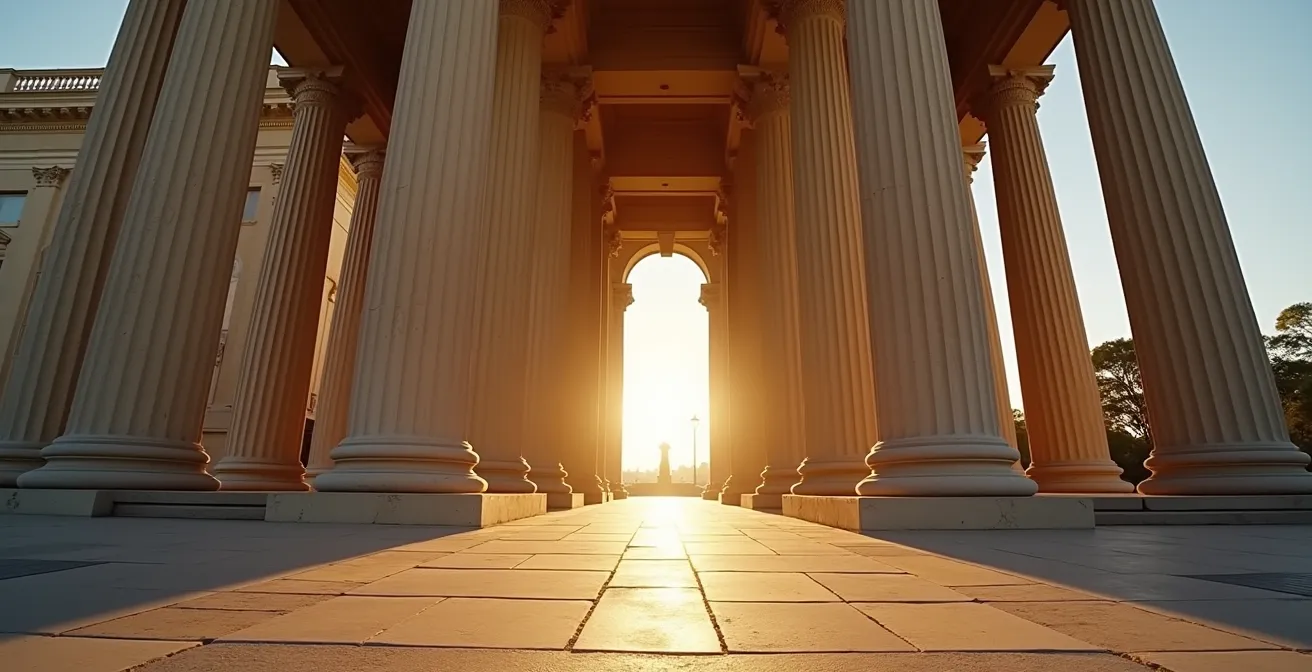
Grand, symmetrical facades with Doric, Ionic, or Corinthian columns were erected from Kolkata to Nairobi, housing administrative offices, courthouses, and governor’s residences. These buildings were tangible, daily reminders of the empire’s authority and its “civilizing” mission. As Carla Bocchetti states in her study on the subject, ” Classical elements have long been recognised internationally as symbolic of state power.” In a colonial context, this symbolism was amplified, creating a stark visual contrast with indigenous architectural styles, which were implicitly framed as less orderly, less permanent, and less civilized.
A prime example is the Victoria Memorial in Kolkata, designed by British architects. Its soaring marble dome, classical statues, and formal gardens were intended to evoke the grandeur of ancient Rome and, by extension, the perceived legitimacy and permanence of the British Raj. These structures were not designed to harmonize with their surroundings but to dominate them. They physically imposed a Western aesthetic order, teaching a clear lesson: power looked like this—it was rational, monumental, and rooted in a European classical tradition. Local building practices and aesthetic philosophies were overwritten by an imported standard of beauty that was inextricably linked to colonial rule.
Flat vs. Depth: Why Asian Art Rejected the Vanishing Point
While Renaissance Europe obsessed over creating the illusion of three-dimensional depth on a two-dimensional surface through linear perspective, artistic traditions across Asia were pursuing a radically different, and arguably more profound, aesthetic goal. The rejection of the vanishing point was not a technical failure but a philosophical divergence. In Japanese art, for example, a central concept is Ma (間), often translated as negative space, interval, or void. This is not empty space, but an active and essential component of the composition.
According to Japanese art philosophy, ” Ma refers to the interval or void between things, and is considered an integral part of the artwork, contributing to the overall balance and interpretation.” Where a Western artist might fill a canvas to its edges to create a “window onto the world,” an artist embracing Ma understands that what is left unpainted is as important as what is painted. This philosophy is deeply rooted in Zen Buddhist and Daoist thought. The Heart Sutra’s famous paradox, “form is emptiness, emptiness is form,” finds direct expression in this aesthetic. The vacant space around a single branch in a scroll painting is not nothing; it is the potential, the silence, the atmosphere that gives the branch its meaning.
This principle extends beyond painting. In traditional practices like bonsai and ikebana (flower arranging), the contours of the space between branches or stems are as carefully considered as the living elements themselves. The goal is not to replicate reality, but to evoke a deeper truth about the nature of existence—its impermanence, its interconnectedness, and the resonance of emptiness. From a Eurocentric viewpoint, this might be misinterpreted as “flat” or “lacking depth.” From the perspective of Ma, the Western obsession with filling the void seems cluttered and superficial, missing the profound beauty found in stillness and absence.
Why a Vase is “Craft” but a Painting is “Art” in Europe
Another powerful legacy of the Vasarian canon is the creation of a rigid hierarchy between “high art” and “craft.” This distinction, which seems natural to many in the West, is almost entirely a European invention. In this system, painting and sculpture—the preferred media of the Renaissance masters—were elevated to the realm of “fine art,” a product of intellectual and creative genius. Meanwhile, functional or decorative objects like ceramics, textiles, and metalwork were relegated to the lower status of “craft,” seen as the product of manual skill rather than intellectual prowess.
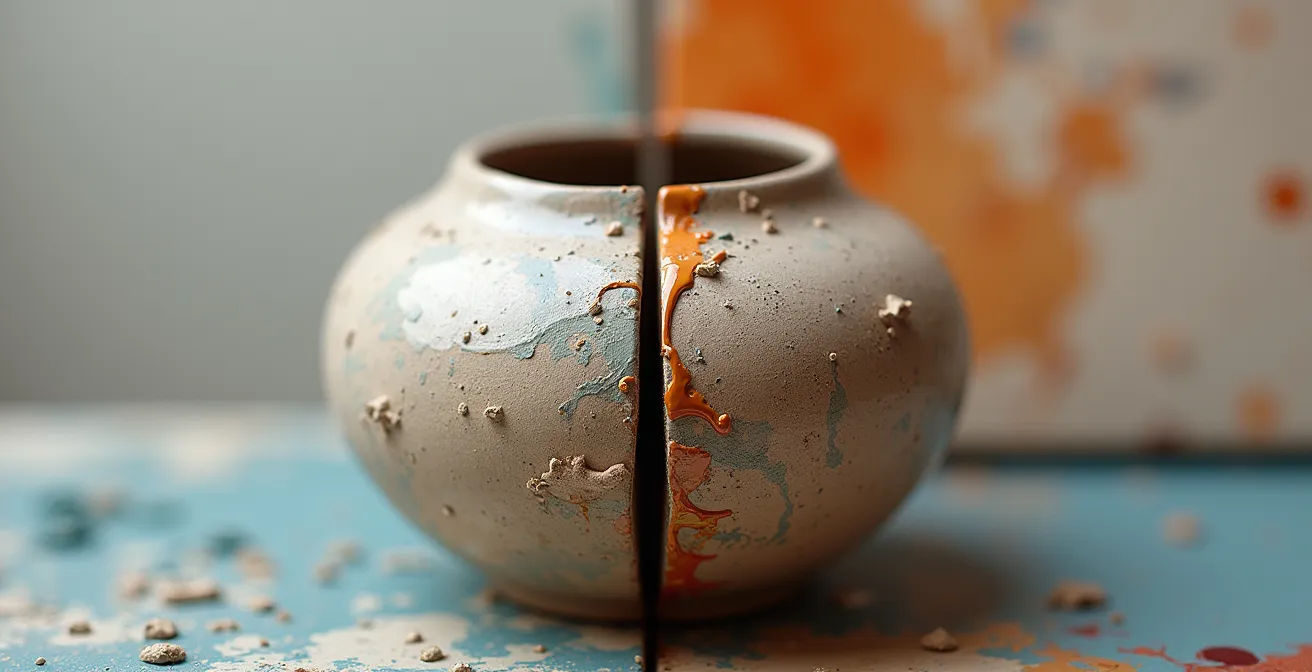
This “art” versus “craft” hierarchy was directly promoted by Vasari’s narrative. As The Art Story Foundation explains, “Vasari’s position helped initiate a shift in thinking that saw painters… occupy a higher status than mere artisan.” This had profound consequences, as it created a framework that inherently devalued the primary artistic outputs of many non-Western cultures. In Japan, the creation of a ceramic tea bowl for a tea ceremony was considered a high spiritual and aesthetic pursuit. In many African and Indigenous American cultures, textile weaving carried complex iconographic and cosmological meaning. In the Islamic world, geometric tilework was a sophisticated expression of mathematical and divine principles.
By imposing the art/craft divide, the European institutional gaze dismissed these rich traditions. A Ming dynasty vase, an object of immense cultural and aesthetic importance, was categorized as “decorative art” in a Western museum, while a minor contemporary European painting would be displayed as “fine art.” This wasn’t a neutral act of classification; it was a value judgment that reinforced the idea of European cultural superiority. It implied that cultures focusing on mediums other than painting and sculpture were incapable of producing “true” art, a deeply colonialist and inaccurate assumption that many institutions are only now beginning to dismantle.
The Labeling Problem: How Museums Are Rewriting Object Descriptions
The biases of the Western canon are nowhere more evident than on the small labels next to objects in a museum. For centuries, the institutional gaze of the curator was the sole authority. Objects were often labeled with generic, geographically vague terms like “African Mask” or “Asiatic Vessel,” stripping them of their specific cultural context, creator, and function. The acquisition history—often rooted in colonial exploitation—was almost always omitted. This presentation reinforced the idea of these objects as anonymous, “primitive” artifacts rather than sophisticated works of art.
However, a significant shift is underway. Confronted by post-colonial critique, many major museums are now engaged in a process of decolonization, starting with the labels. A recent analysis shows that since 2023, major museums are increasingly adopting co-curation practices with source communities. This means working directly with the descendants of the people who created these objects to write new, more accurate, and more respectful descriptions. The goal is to move from a single, authoritative curatorial voice to a polyvocal presentation that includes multiple perspectives.
This process of rewriting history involves tangible and innovative practices. As a source on decolonization practices explains, museums are now implementing multi-layered approaches to provide richer context to visitors who wish to learn more. This work is slow and fraught with challenges, but it represents a fundamental rethinking of the museum’s role—from a temple of colonial trophies to a space for cross-cultural dialogue and a more honest reckoning with history.
Action Plan: A Checklist for Decolonizing Museum Narratives
- Community Co-authorship: Work directly with source communities to co-author object labels and exhibition texts, ensuring their voice is central.
- Layered Digital Narratives: Use digital tools like QR codes to provide multiple perspectives on an object—from the curator, a historian, and a source community member.
- Acquisition Transparency: Acknowledge problematic acquisition histories directly in the display text, including details of colonial-era collection practices.
- Repatriation Dialogue: Actively engage in discussions about the repatriation of objects following the recognition of their colonial acquisition context.
- Contested Interpretations: Utilize technologies like augmented reality to present multiple, and sometimes conflicting, interpretations of a single object, embracing complexity over a single “truth.”
The Shock of the Other: How Ethnographic Museums Sparked Modernism
The story of Modernism is often told as a purely internal European affair—a rebellion of the avant-garde against the stale academic traditions of their own continent. This narrative conveniently overlooks a crucial catalyst: the “discovery” of non-Western art by European artists in the late 19th and early 20th centuries. Objects from Africa, Oceania, and the Americas, often looted during colonial expansion, were being displayed in new ethnographic museums in Paris, London, and Berlin. For artists like Picasso, Matisse, and Modigliani, encountering these works was a profound shock.
These objects represented a radical break from the Greco-Roman and Renaissance traditions that had dominated European art for 500 years. The abstracted forms of an African mask or the flattened planes of an Iberian sculpture offered a powerful new artistic language, one that prioritized expressive and spiritual power over realistic imitation. Picasso’s revolutionary 1907 painting, *Les Demoiselles d’Avignon*, which famously shattered the conventions of single-point perspective, was directly inspired by African and Iberian art he saw at the Trocadéro ethnographic museum in Paris. This was not a simple “influence” but a fundamental appropriation that became a cornerstone of Modernism.
This history is complex and problematic. While European artists saw liberation in these forms, they often stripped them of their original context and meaning, a phenomenon known as Primitivism. Yet, it undeniably proves that the break from tradition was not solely a European invention. As Afnan Ashraf notes, “Modernism was not simply imported into colonial contexts but was instead forged within them.” Ironically, the colonial project that devalued and plundered these cultures also brought their art to Europe, where it provided the very aesthetic tools needed to dismantle the West’s own artistic canon. Modernism, therefore, was not born in a vacuum but in the complicated, often exploitative, encounter between Europe and its “other.”
Imagined Pagodas: How Europe Invented a Fake Asia via Decor
While some European artists engaged directly (if problematically) with non-Western art, a far more common phenomenon was the creation of a fantasy version of it. In the 18th century, a craze for “Chinoiserie” swept across Europe. This decorative style sought to imitate Chinese and other East Asian aesthetics in art, architecture, and design. However, it was not based on a genuine understanding of Asian philosophy or design principles. Instead, it was an imagined, romanticized, and often cartoonish caricature—an Asia invented by and for Europeans.
This “Oriental” fantasy was characterized by a superficial borrowing of motifs: graceful pagodas, long-moustached figures in conical hats, and delicate lattice-work, all jumbled together without regard for their original meaning or context. It was a style of surface and excess, completely at odds with the profound minimalism and philosophical depth of actual Asian design principles like Ma. The following table highlights this stark contrast between the European fantasy and the Asian reality.
| European ‘Oriental’ Fantasy | Actual Asian Design Philosophy |
|---|---|
| Decorative excess, ornamentation | Ma (negative space) as an essential element |
| Exotic, mysterious symbolism | Form following philosophical principles (Buddhism/Daoism) |
| Static, decorative pagodas | Dynamic spatial relationships and flow |
| Chinoiserie surface patterns | Deep integration of nature and impermanence |
Chinoiserie demonstrates how a dominant culture can consume and neutralize another by turning it into a fashionable commodity. It reduces a complex civilization to a set of decorative tropes, reinforcing its “otherness” while ignoring its intellectual substance. As one journal notes in its discussion of Ma, “In art, design, and daily life, Ma offers a way to reconnect with the beauty of stillness and the richness of what is unsaid or unseen.” This contemplative depth is precisely what was lost in the European translation, replaced by a frivolous and ultimately condescending fantasy.
Key Takeaways
- The Western art canon is not a neutral history but a narrative constructed by figures like Vasari to privilege Renaissance ideals.
- Aesthetic standards, such as Neoclassicism, were actively used as tools of colonial power to assert cultural dominance.
- Fundamental philosophical differences, like the concept of Ma (negative space) in Asian art, explain why not all traditions pursued Western-style realism.
Why Cubism Was the Most Radical Break in 500 Years of Art
The arrival of Cubism in the early 20th century, spearheaded by Picasso and Braque, was more than just a new style; it was the definitive shattering of the 500-year-old window. It represented the most radical break from the single-point perspective that had defined Western art since the Renaissance. By depicting subjects from multiple viewpoints simultaneously, Cubism dismantled the very idea of a painting as a single, fixed view of reality. It acknowledged that our perception is fragmented, mobile, and subjective—a direct assault on the “objective” realism of the old masters.

This movement was the culmination of the forces we have discussed. It was enabled by the “shock of the other”—the encounter with African and Iberian art that showed a different way of seeing. It was a rejection of the academic dogma that had been exported globally as a universal standard. Cubism proposed that the truth of an object was not in its perfect, singular imitation, but in the synthesis of its many facets. In doing so, it implicitly validated other ways of seeing the world that had long been dismissed by the European canon.
Ultimately, Cubism’s legacy is its declaration that there is no single, “correct” way to represent the world. This opens the door to a more pluralistic understanding of art and beauty. The Golden Ratio may be a fascinating mathematical concept, but it is just one tool, one idea, from one culture. As researchers from the Centre for Surgery acknowledge, even in the context of facial beauty, “While the Phi Ratio serves as a fascinating guide to facial proportions, it’s essential to recognise that beauty’s true essence lies in its diverse interpretations.” This is the ultimate lesson for the critical art student: beauty is not a formula to be measured, but a conversation to be had, one that includes voices from every corner of the globe.
Apply this deconstructive lens to the art you study. Question the labels in museums, challenge the hierarchies presented in your textbooks, and seek out the philosophical traditions that have been written out of the main narrative. This is how you move from being a passive recipient of art history to an active participant in its rewriting.