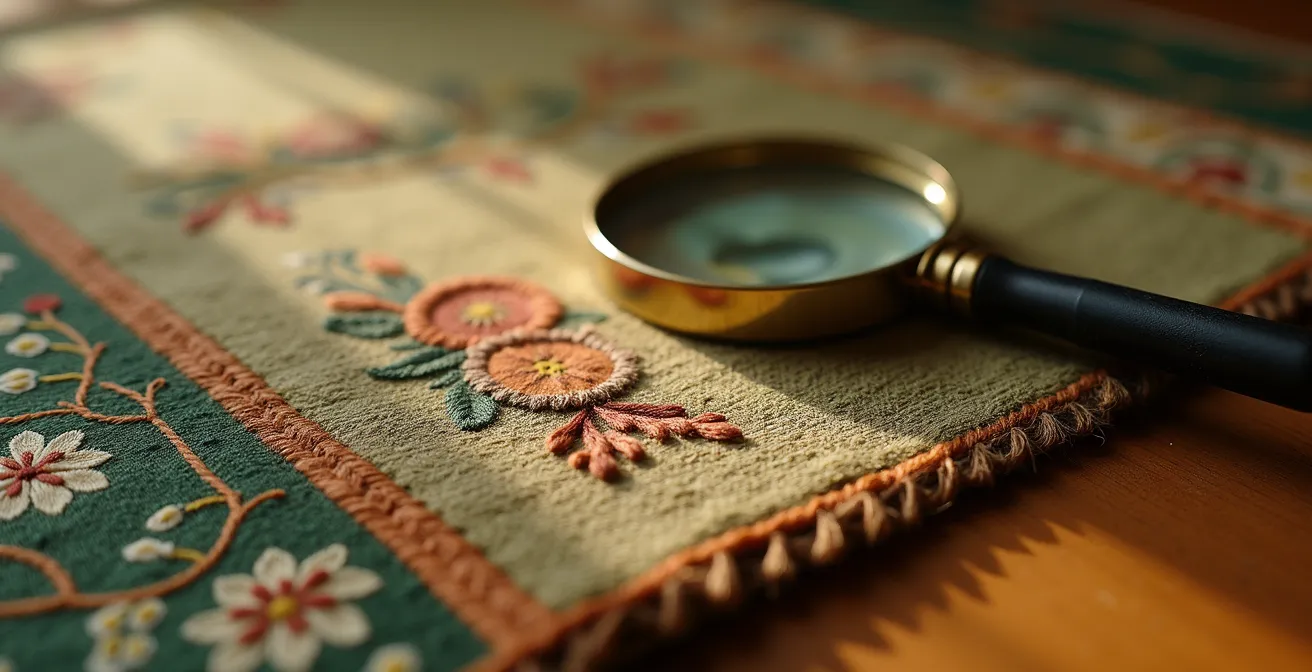
The real value of an Aubusson tapestry for an investor is determined less by its age and more by its commercial viability: a blend of artistic fame, manageable size, and market desirability.
- A tapestry’s worth is magnified when linked to a famous painter-cartoonist like Boucher or a modern icon like Calder, often outweighing the weaver’s identity.
- Monumental size, once a sign of prestige, is now a major hurdle for resale in modern homes, significantly impacting liquidity.
Recommendation: Prioritize tapestries with documented artistic provenance and practical dimensions over sheer historical authenticity to ensure a sound investment.
For the discerning decorator or collector, acquiring an Aubusson tapestry is an entry into a storied world of French artistry. The allure of these woven masterpieces, with their rich textures and historical depth, is undeniable. However, navigating this market is fraught with complexity. Many buyers focus solely on the elementary signs of authenticity—the hand-woven texture, the tell-tale slits on the reverse—believing this is the primary determinant of value. This approach, while not wrong, is dangerously incomplete.
The common wisdom stops at “is it real?”, but the crucial question for any serious investor should be “is it a valuable asset?”. The market for antique textiles does not operate like the market for paintings. Factors like size, subject matter, and the artist who designed the “cartoon” can dramatically alter a piece’s liquidity and long-term worth. A perfectly authentic 18th-century tapestry can be a far poorer investment than a mid-20th-century piece designed by a celebrated artist.
But what if the key to a smart acquisition wasn’t just authenticating the weave, but decoding its market potential? This guide moves beyond the basics to provide an expert’s perspective. We will dissect the critical factors that separate a beautiful wall hanging from a true investment-grade statement piece. We will explore why the painter’s name can eclipse the weaver’s, how modern artists saved the industry, and why a tapestry’s sheer size can be its greatest liability. This is the commercial and discerning framework required to invest with confidence.
For those who prefer a visual format, the following video offers a beautiful immersion into the meticulous craft of tapestry making, providing a foundational appreciation for the labor and artistry involved in every piece.
This article is structured to guide you through the nuanced layers of appraising an Aubusson tapestry, from its artistic origins to its market realities. The following summary outlines the key areas we will explore to build your expertise.
Summary: A Buyer’s Framework for Valuing Aubusson Tapestries
- The Painter Behind the Weaver: Who Actually Designed the Tapestry?
- Too Big for the Apartment: The Challenge of Reselling Giant Tapestries
- Counting the Warps: How Thread Count Defines Value
- Hard to Sell: Why Tapestries Are Less Liquid Than Canvas
- Pixels to Wool: How Modern Art Saved the Aubusson Industry
- Gobelins and Sèvres: When the State Owns the Means of Luxury
- Gravity Risks: Hanging Heavy Platters Without Metal Clips
- Why Bronze Mounts Break Wood: The Physics of Antique Furniture?
The Painter Behind the Weaver: Who Actually Designed the Tapestry?
A fundamental mistake in valuing an Aubusson is focusing exclusively on the weaver’s workshop mark. The true artistic and commercial value often lies with the “peintre-cartonnier”—the artist who created the original design, or cartoon, from which the weavers worked. While the weaver’s skill is crucial, the design’s artistic provenance is a primary driver of price. A tapestry based on a cartoon by a famous painter like François Boucher or Jean-Baptiste Oudry will command a significant premium. These artists brought their signature styles to the medium, with Boucher known for his pastoral Rococo scenes and Oudry for his masterful animal portraits.
This distinction became even more critical during the 20th-century revival of the art form. The value of a modern Aubusson is almost entirely tied to the fame of the designer. This shift was powerfully demonstrated by Jean Lurçat in the 1940s.
Jean Lurçat’s Revolutionary Approach to Tapestry Design
Jean Lurçat argued for a bold, graphic style with a limited color palette and a visible weave. He championed the idea that tapestry was a unique medium, not a mere reproduction of a painting. This philosophy liberated the form and attracted a new generation of artists. Following UNESCO’s recognition of Aubusson’s craft, workshops like Maison PINTON forged relationships with leading contemporary artists, cementing the designer’s name as the key to a tapestry’s modern value and appeal.
An investor must therefore learn to identify the designer’s hand, looking for stylistic coherence and known motifs. A genuine period piece will show a consistent artistic vision, whereas a later copy or fantasy piece often betrays itself by mixing incompatible elements from different eras or artists. Distinguishing the mind of the painter from the hands of the weaver is the first step toward a sophisticated appraisal.
Too Big for the Apartment: The Challenge of Reselling Giant Tapestries
In the 17th and 18th centuries, the monumental scale of an Aubusson tapestry was a direct expression of the owner’s wealth and status. Commissioned for the vast stone walls of châteaux and palaces, these immense “verdures” and mythological scenes were designed to dominate a room. Today, this very grandeur presents a significant commercial challenge, a concept we can call scale mismatch. A twelve-foot-wide tapestry, however beautiful and authentic, has a very limited pool of potential buyers who possess the architectural space to display it properly.
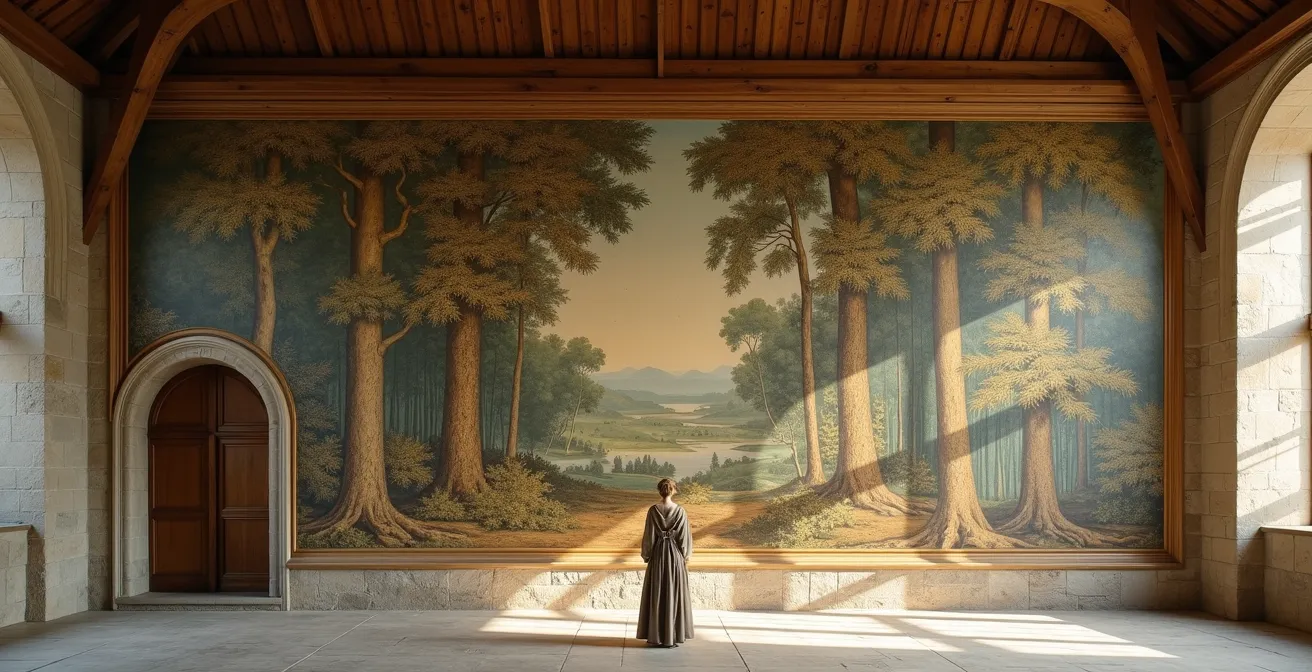
As the illustration above demonstrates, these pieces were created for environments fundamentally different from the modern luxury apartment or suburban home. For a decorator or investor, size is a primary filter for liquidity. A smaller, well-composed piece under six or seven feet wide is exponentially more marketable than a sprawling, historically important but domestically impractical giant. While the Aubusson museum’s collection rightly celebrates these historic behemoths, and is expected to attract 40,000 visitors a year, private collectors must think on a different scale. The investment-grade “sweet spot” often lies in fragments, smaller panels, or purpose-woven pieces like screen panels or upholstery that retain their artistry in a manageable format.
Therefore, when presented with a large tapestry, your first question shouldn’t be about its beauty, but about its practicality. Where could this hang? Who is the end buyer? Acknowledging the challenge of scale is a crucial act of commercial discernment that protects you from acquiring a magnificent but unsellable asset.
Counting the Warps: How Thread Count Defines Value
Once you’ve considered the artist and the scale, the physical object itself demands close inspection. A key differentiator between a genuine hand-woven Aubusson and a machine-made copy lies in the texture and density of the weave. The value is often discussed in terms of its fineness, determined by the number of warp threads per inch. A finer weave allows for greater detail and subtlety, approaching the quality of a painting. However, this is not a simple case of “more is better.”
Authentic Aubusson tapestries were produced on a “basse-lisse” (low-warp) loom, a horizontal setup that required the weaver to work from the back, viewing their progress through a mirror. This manual process inevitably introduces subtle irregularities. These are not flaws; they are the signature of the human hand. A machine-made Jacquard tapestry, by contrast, will exhibit a cold, mechanical perfection and a flat, lifeless texture. The back of a machine-made piece is often neat and tidy, whereas the back of a real Aubusson is a “messy” landscape of tied-off threads.
An expert’s eye is trained to find the life in the weave, as noted by leading specialists.
To authenticate a piece, it’s important to examine the regularity of the weave. Old tapestries often show subtle variations due to handwork. A magnifying glass can help to observe the structure of the threads and the precision of the weave.
– Galerie Hadjer Experts, Authenticating an Aubusson tapestry guide
The crucial feature to look for are the small vertical slits, known as “reprises,” where two color blocks meet. In a hand-woven tapestry, these are stitched up from the back, but they remain a characteristic feature. In a machine-woven copy, these do not exist. Feeling the texture, observing the subtle shifts in tension, and identifying these structural hallmarks are non-negotiable steps in authentication.
Hard to Sell: Why Tapestries Are Less Liquid Than Canvas
An investor must accept a hard truth: tapestries are an illiquid asset compared to paintings. The market is smaller, more specialized, and subject to the whims of interior design trends. A canvas by a known artist can be sold at major auction houses worldwide, but a tapestry, even a fine one, often requires a specialist dealer or a niche auction. Understanding this lack of market liquidity is essential for managing your investment expectations.
Several factors contribute to this. The “scale mismatch” discussed earlier is a primary one. Subject matter is another; classical mythological scenes or dense allegories can be harder to place in a contemporary interior than a decorative “verdure” (landscape) or a bold abstract piece. Furthermore, the very nature of the craft contributes to its niche status. At the time of UNESCO inscription in 2009, the industry supported three workshops and ten or so freelance weavers. This tiny number highlights the artisanal, low-volume nature of production, which creates rarity but also limits broad market recognition compared to more prolific art forms.
The condition and conservation history also play an outsized role. A tapestry that has been improperly stored, has suffered color fading from sunlight, or has significant structural damage is immensely difficult to sell. Conversely, a piece with a documented history of professional cleaning and archival backing is far more attractive. Provenance is paramount; a tapestry from a known historic collection will always have a stronger market position. For an investor, this means due diligence is not just about authenticity, but about building a complete “dossier” for the piece that proves its desirability beyond its intrinsic beauty.
Pixels to Wool: How Modern Art Saved the Aubusson Industry
After falling out of fashion, the Aubusson industry was revitalized in the 20th century not by looking to its past, but by embracing the most forward-thinking artists of the day. This fusion of ancient craft and modern vision created a new, dynamic market for tapestries and fundamentally cemented the concept of design-centric value. The weaver’s role, while still immensely skilled, became one of translation—transforming the unique vision of a contemporary master into wool and silk.
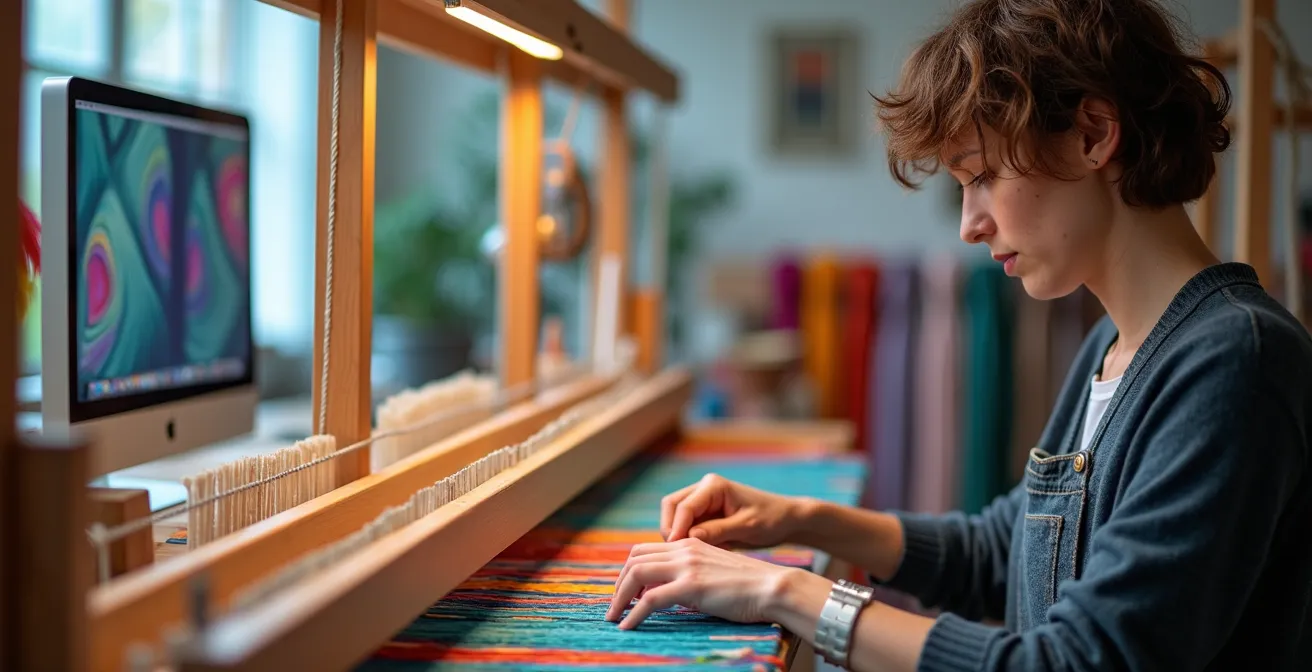
This shift means that a mid-century or even a contemporary Aubusson can be a more significant and valuable asset than a mediocre 18th-century piece. Today, weavers work from digital files (“pixels”) to create the cartoons, but the weaving process remains painstakingly manual, preserving the soul of the craft while executing a modern aesthetic.
Contemporary Artists Reviving Aubusson Tradition
In the 20th century, now-iconic artists such as Alexander Calder and Joan Miró worked with Aubusson weavers on pieces, lending their global fame to the medium. Following their lead, workshops like Maison PINTON have become instrumental in reviving relationships with a diverse new wave of creators: painters, designers, and even street artists. These collaborations result in limited-edition works, typically in editions of eight, with the artist’s signature, issue number, and workshop logo woven directly into the fabric, creating instant collectibles for the international contemporary art market.
For a buyer today, this is an exciting and accessible entry point. Investing in a piece by a recognized contemporary artist offers clearer provenance, documented edition sizes, and an aesthetic that integrates seamlessly with modern interiors. It demonstrates that Aubusson is not a dead art form, but a living tradition that continues to evolve, offering new opportunities for the discerning collector.
Gobelins and Sèvres: When the State Owns the Means of Luxury
To fully appreciate the commercial position of Aubusson, a buyer must understand its historical context relative to its main rival: the Manufacture des Gobelins. While both produced world-class tapestries, their business models were polar opposites, a difference that remains relevant for authentication today. Gobelins, established in Paris, was a state-run royal manufacture. Its entire output was destined for the French Crown and was not available for commercial sale. Aubusson, by contrast, consisted of numerous independent, private workshops in the Creuse region, operating on a commercial basis for a clientele of aristocrats and wealthy bourgeois across Europe.
This fundamental difference in structure and market is visible in the tapestries themselves. Gobelins tapestries, produced on “haute-lisse” (high-warp) looms, were often marked with a ‘G’ and a fleur-de-lys. Aubusson pieces, from “basse-lisse” looms, might bear the mark of the royal manufacture (MRDA for Manufacture Royale d’Aubusson) or, more commonly, the specific signature of the private workshop that wove it. Today, this legacy of commercial independence is protected with the force of law.
Today, only tapestries woven within the Creuse region can bear the ‘Aubusson’ trademark, similar to the controlled designation of origin (‘appellation d’origine contrôlée’) used in the wine industry. This ensures that the tapestries adhere to traditional standards of quality and craftsmanship.
– The French House York, The Making of Aubusson Tapestries
This “appellation” is a powerful guarantee of authenticity and quality for an investor. The following table summarizes the key distinctions a discerning eye must recognize.
| Characteristic | Gobelins | Aubusson |
|---|---|---|
| Manufacturing Type | State-run royal manufacture | Private commercial workshops |
| Weaving Technique | Haute-lisse (high-warp vertical loom) | Basse-lisse (low-warp horizontal loom) |
| Typical Mark | ‘G’ with fleur-de-lys | MRDA or individual workshop marks |
| Primary Market | Royal commissions only | Commercial and aristocratic buyers |
| Production Location | Paris | Creuse region (Aubusson & Felletin) |
Gravity Risks: Hanging Heavy Platters Without Metal Clips
A tapestry is a textile, and over centuries, it behaves like one. Its worst enemy is its own weight. The constant, relentless pull of gravity is both a risk to be managed and a key source of authentication tells. The section title is a metaphor: just as hanging a heavy ceramic platter without proper support invites disaster, hanging a heavy tapestry incorrectly will cause damage. But the signs of this long, slow battle with gravity are precisely what you should look for to distinguish a genuinely old piece from a modern fake.
A machine-made copy maintains a perfect, board-like tension throughout its life. An authentic, hand-woven tapestry, however, will show subtle distortions that bear witness to its history. The top edge, where it was hung for centuries, often develops a gentle wave-like pattern known as “scalloping.” The tension across the piece will show slight variations, a natural consequence of the hand-weaving process that a machine cannot replicate. These are not flaws; they are proof of age and authenticity. The incredible time investment required, where it takes approximately 3 months to weave each square meter, results in a dense, heavy fabric that is uniquely susceptible to these graceful signs of aging.
Learning to read these signs is a critical skill for any buyer. It allows you to see beyond the surface image and understand the object’s physical history. The following checklist outlines the primary indicators of natural aging caused by gravity and time.
Your Checklist: Identifying the Signs of Natural Aging in a Tapestry
- Check for Scalloping: Look for gentle, wave-like patterns along the top edge, a natural result of centuries of hanging.
- Assess Tension Variations: Examine the surface for subtle, non-uniform areas of tension, a hallmark of hand-weaving that evolves over time.
- Inspect Reprise Slits: Look for slight widening or signs of stress in the vertical slits where color blocks meet, caused by gravitational pull.
- Identify Old Hanging Damage: Search for evidence of past mounting methods, such as small rust marks from old nails or tiny holes along the top border.
- Look for Modern Conservation: The presence of a hand-sewn Velcro strip on a separate linen backing indicates professional care and is a positive sign for preservation.
Key Takeaways
- Artist Over Artisan: The fame of the painter-cartoonist is often a greater driver of value than the workshop that wove the tapestry.
- Size is Liquidity: Monumental tapestries are hard to resell. Smaller, high-quality pieces are better suited for modern interiors and represent a more liquid investment.
- Modern is Valuable: Collaborations with 20th-century and contemporary artists (Lurçat, Calder, etc.) created a new, highly sought-after market for Aubusson.
Why Bronze Mounts Break Wood: The Physics of Antique Furniture?
An expert’s vision extends beyond the object in isolation to its context. The title of this section serves as an analogy: in antique furniture, the disparate materials of bronze mounts and wood expand and contract at different rates, causing stress and eventual damage. Similarly, in the world of collectibles, a lack of harmony between an object and its story—or between different elements of an assembled piece—is a major red flag. This is especially true when authenticating tapestry-upholstered furniture, a significant and valuable subset of the Aubusson market.
A set of 18th-century chairs adorned with what appears to be Aubusson upholstery can be a magnificent find, or a costly fabrication. The key is to look for harmonious aging. The wooden frames and the textile should show a comparable degree of wear, patina, and age. If the wood is heavily worn but the tapestry is pristine, it is almost certainly a later addition. Furthermore, authentic tapestry upholstery was often purpose-woven, with the designs specifically created to fit the shapes of the seat, back, and armrests. A piece that has clearly been cut down from a larger tapestry, with the design awkwardly cropped, is of significantly lower value.
Authenticating Tapestry-Upholstered Period Furniture
Expert authentication requires cross-referencing multiple signs. For instance, authentic 18th-century chairs with their original Aubusson upholstery will exhibit designs specifically woven to the shape of the seat and back panels. Repurposed pieces cut from larger wall hangings often show abrupt or illogical cropping of the scene. As demonstrated by the rigorous approach of specialists like Galerie Jabert in Paris, true expertise lies in evaluating the symbiotic relationship between the woodwork and the textile, ensuring both elements tell the same historical story.
This principle of contextual and harmonious evaluation is the final layer of a discerning buyer’s strategy. You are not just buying a tapestry; you are buying a story. Your job is to ensure that all the pieces of that story—the artist, the weave, the age, the condition, and the context—are consistent and true. This holistic view is what separates a mere enthusiast from a savvy investor.
Now that you are equipped with this framework, the final and most crucial step in any significant acquisition is to seek independent, professional appraisal. An expert can confirm your findings, provide a formal valuation, and give you the ultimate confidence to make your investment.