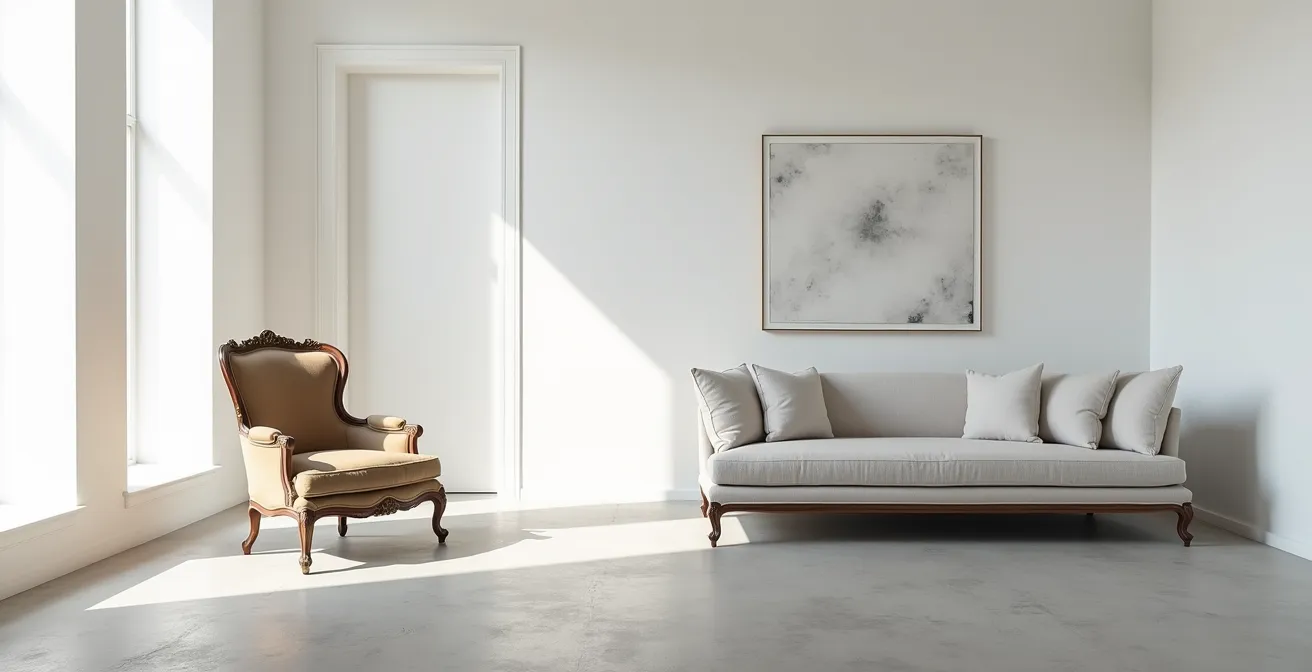
Successfully marrying Louis XV opulence with minimalist design isn’t about following simplistic rules like ’80/20′; it’s about mastering the physical dialogue between 18th-century craftsmanship and 21st-century environments.
- The integrity of an antique is dictated by its physical limits—its structural strength, its reaction to modern heating, and the physics of its combined materials.
- Authentic craftsmanship is identifiable through specific, non-obvious details, and its value must be protected with specialized, not standard, insurance.
Recommendation: Shift your focus from mere visual pairing to a curatorial approach that respects the antique’s material science, functional limits, and historical DNA to achieve a truly sophisticated and livable space.
The fear is palpable. You acquire a magnificent Louis XV commode, its gilt-bronze mounts gleaming, its marquetry a testament to a lost art. The intention is to make it the soul of your minimalist living room, a point of tension and beauty. Yet, the reality you dread is a space that feels less like a bold design statement and more like a cluttered, disjointed museum annex. The internet is filled with superficial advice: maintain a neutral color palette, create a “statement piece,” or follow the tired 80/20 rule. This advice is not wrong, but it is dangerously incomplete. It treats an antique as a mere silhouette, a decorative object to be color-matched and balanced.
This approach ignores the fundamental truth of historic furniture: it is a complex physical object with its own history, vulnerabilities, and material demands. It is not a static prop. It lives, breathes, expands, and contracts. Ignoring this reality is the fastest path to failure—not just aesthetic failure, but the potential physical ruin of the piece itself. True integration is not a game of visual matching; it is a negotiation between eras, a dialogue between materials, and an act of architectural respect. It requires you to think less like a decorator and more like a curator and a physicist.
This guide abandons platitudes to give you a practical, bold framework. We will move beyond aesthetics to confront the tangible realities of living with functional historic art. We will explore the structural limits of these pieces, the silent damage inflicted by modern environments, how to truly see and authenticate craftsmanship, and how to use light not just to illuminate, but to celebrate texture and patina. This is your manual for creating a space that is not just beautiful, but intelligent, respectful, and fearlessly executed.
This article provides a structured approach to mastering this design challenge. Below is a summary of the key areas we will dissect to ensure your integration is a success, not a source of chaos.
Summary: A Curatorial Framework for Integrating Antiques and Minimalism
- Sit or Stare: Which Antique Chairs Can Actually Hold Weight?
- Why Your Central Heating Is Killing Your 18th-Century Commode
- The Appraisal Gap: Why Your Home Insurance Won’t Cover Your Antiques
- Dovetails and Veneers: Spotting Craftsmanship Without a Signature
- Glare vs. Glow: Lighting Bronze and Varnish in a Modern Room
- The Pompeii Effect: How One Excavation Changed European Furniture
- Eye Level or Below: Choosing the Right Height for a Pedestal
- Why Bronze Mounts Break Wood: The Physics of Antique Furniture?
Sit or Stare: Which Antique Chairs Can Actually Hold Weight?
Before you consider aesthetics, you must address the most fundamental question: what is the piece’s function? An antique chair is not merely a sculptural object; it was designed to be used. The first step in successful integration is a brutal, honest assessment of its structural integrity. A Louis XV fauteuil that collapses under a dinner guest is not a charming quirk; it’s a failure of design and a tragedy for the object. Differentiating between a usable artifact and a “display only” piece is a non-negotiable skill.
The construction of 18th-century seating reveals its intended durability. The presence and type of stretchers—the horizontal supports connecting the legs—are your primary clue. An H-stretcher system provides a robust four-point bracing that distributes weight far more effectively than a chair with only elegant cabriole legs. The wood itself is also a critical factor. Pieces crafted from dense hardwoods like beech or walnut possess inherently greater structural integrity than those of softer woods. Finally, inspect the joints. Are there gaps in the mortise and tenon connections? Is there evidence of shoddy, modern epoxy repairs that compromise future restoration? These are not romantic signs of age; they are red flags signaling functional retirement.
To quantify this assessment, refer to this professional hierarchy of 18th-century seating. This analysis, based on common structural designs, provides a clear guide to which pieces can endure daily life and which should be admired from a distance.
| Chair Type | Structural Design | Daily Use Rating | Weight Capacity |
|---|---|---|---|
| Fauteuil with H-stretcher | Four-point bracing system | Excellent | 250+ lbs |
| Bergère (upholstered) | Reinforced frame, wider seat | Very Good | 200-250 lbs |
| Caned seat chairs | Original caning often fragile | Display Only | 100 lbs max |
| Cabriole leg only | No stretcher support | Light Use | 150 lbs |
Why Your Central Heating Is Killing Your 18th-Century Commode
You’ve acquired a masterpiece of marquetry, its surface a mosaic of precious woods. You place it in your climate-controlled, minimalist home. Unseen, a war has just begun. The single greatest threat to 18th-century furniture in a modern home is not accidental damage, but the dry, stable heat of central heating and air conditioning. These pieces were created in an era of drafty chateaux, where ambient humidity fluctuated gently with the seasons. Your HVAC system creates an arid desert in comparison, sucking the essential moisture from the wood.
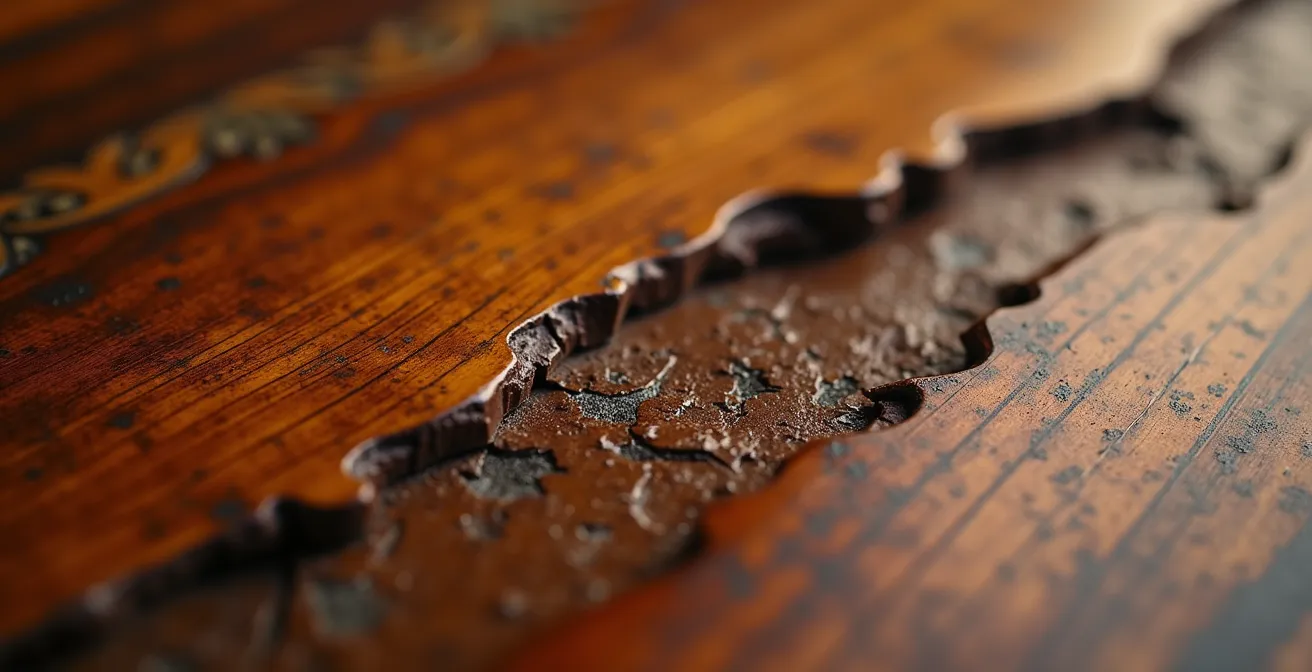
Wood is a hygroscopic material; it constantly exchanges moisture with the air. When the relative humidity (RH) drops, the wood shrinks. This movement is not uniform. The delicate veneer, the solid carcass, and the intricate marquetry inlays all shrink and expand at different rates. According to conservation experts, these dramatic humidity changes can cause wood to expand up to 0.25 inches per 12 inches of width as RH swings. When the veneer’s grain runs perpendicular to the substrate grain, this conflicting movement creates immense stress, causing veneers to lift, crack, or even tear the decoration apart. This is the “telegraphing” effect, where the internal war of materials becomes tragically visible on the surface.
Therefore, placement is a strategic act of preservation. Never place an antique near a radiator, a heating vent, or in direct, prolonged sunlight. These create “microclimates” of intense dryness. Ideally, the room should be kept between 45-55% relative humidity, a level that requires active humidification in most modern homes during winter. This isn’t just fussy advice; it is the fundamental price of admission for living with historic, wood-based art. Protecting the piece from your environment is as important as integrating it aesthetically.
The Appraisal Gap: Why Your Home Insurance Won’t Cover Your Antiques
Treating your Louis XV piece as just another piece of furniture is a critical error, and nowhere is this more financially apparent than in insurance. A common, and potentially catastrophic, assumption is that your standard homeowner’s policy will cover the true value of your antique in the event of damage or loss. It will not. Standard policies are designed to cover “functional replacement value”—the cost of buying a new, modern equivalent from a retail store. This fails to account for the factors that constitute an antique’s real worth: its provenance, age, rarity, and artistic merit.
This discrepancy is known as the appraisal gap. Insurance industry data reveals that standard policies typically cover only 10-20% of an antique’s auction value. To protect your investment, you must secure a separate Fine Arts rider or policy. This requires a certified appraisal that establishes the piece’s “market value.” This is not a casual estimate. It is a formal, documented valuation from a qualified appraiser who specializes in the specific period and style—in this case, 18th-century French decorative arts.
The appraiser will look for documentation that builds value: original receipts, auction records showing previous hammer prices, and expert authentications. Without this specialized coverage, a water leak that damages your commode’s veneer could result in an insurance payout barely sufficient to buy a particleboard replacement. Protecting the piece is not just about humidity and placement; it’s about securing its financial existence within your home. This is a practical, non-negotiable step for any serious collector or designer integrating high-value historic art.
Dovetails and Veneers: Spotting Craftsmanship Without a Signature
In a minimalist space, the antique’s power comes from its authenticity. Its hand-worked nature creates a sublime tension with the machine-made precision of modern design. But how do you verify that authenticity, especially on an unsigned piece? The answer lies not in a signature, but in the wood itself. You must learn to read the “tells” of pre-industrial craftsmanship. These are the subtle, imperfect, and beautiful marks left by an 18th-century ébéniste’s hands and tools.
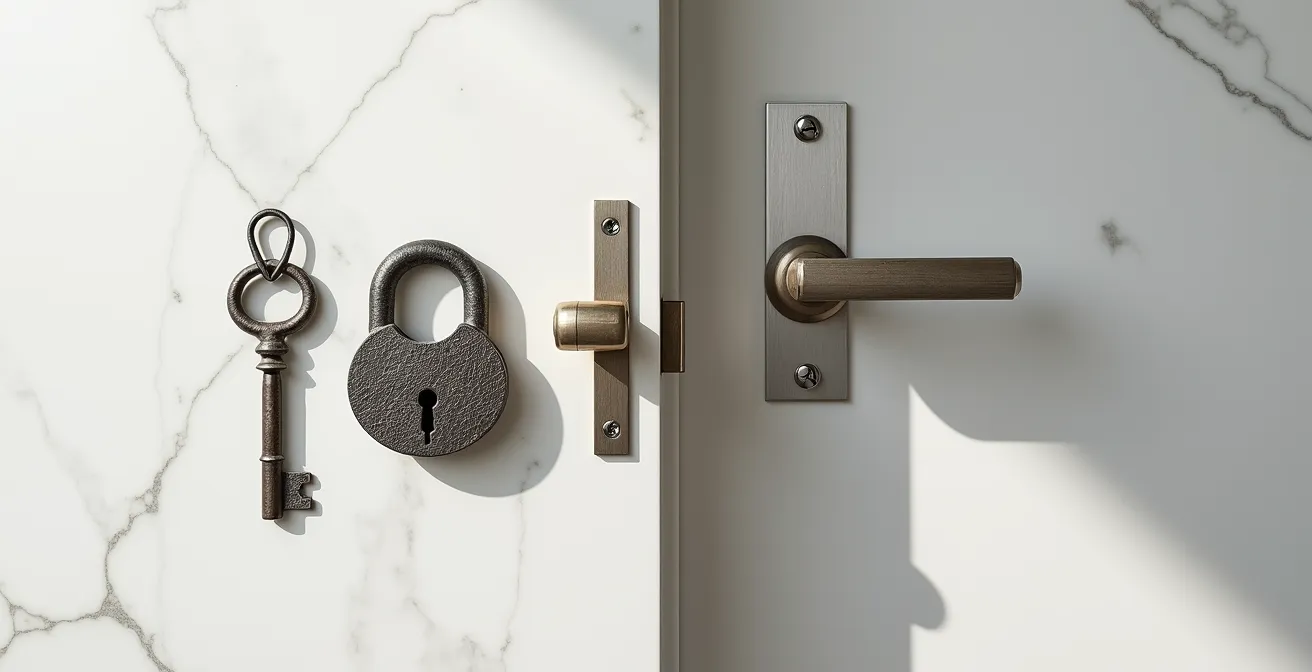
Begin by examining the unseen parts of the furniture. Look at the underside of drawers or the back of the carcass for irregular pit saw marks—the slightly uneven grooves left by a blade pulled by hand, starkly different from the uniform pattern of a modern circular saw. The most famous tell is the dovetail joint. Hand-cut dovetails are always slightly irregular, with visible scribe lines where the craftsman marked his cuts. Machine-cut joints are perfectly uniform and sterile. The choice of “secondary woods” (the wood used for drawer linings and internal structures) is also a clue; French pieces of the period typically used local oak or pine, not the imported woods or composite materials of later eras.
Veneer thickness is another dead giveaway. Period sciage, or saw-cut, veneers are robust, measuring 2-3mm thick. Modern, peel-cut veneers are paper-thin, often less than 0.6mm. This is a difference you can feel and, with practice, see. By training your eye to spot these markers of authentic craftsmanship, you move beyond the surface aesthetics and connect with the piece’s very DNA, ensuring the “statement” you’re making is a genuine one.
Your Action Plan: Authentication Checklist for Unsigned Period Pieces
- Examine drawer undersides for irregular pit saw marks indicating pre-industrial cutting methods.
- Look for slightly uneven hand-cut dovetails with visible scribe lines, contrasting with machine-perfect joints.
- Identify secondary woods (oak or pine) typical of 18th-century construction beneath primary veneers.
- Check for oxidation ‘ghosts’ where original hardware left distinct aging patterns on the wood.
- Inspect veneer thickness—period saw-cut veneers measure 2-3mm versus modern 0.6mm sheets.
Glare vs. Glow: Lighting Bronze and Varnish in a Modern Room
In a minimalist interior, light is a material. How you use it will determine whether your antique feels integrated or alienated. Lighting 18th-century furniture is fundamentally different from lighting modern pieces. You are not just illuminating a form; you are interacting with aged materials—gilt bronze, patinated wood, and delicate, often-crackled shellac or varnish finishes. The wrong light can flatten these complex surfaces into a dull caricature; the right light can make them sing.
The primary consideration is color temperature, measured in Kelvin (K). Cool, blue-toned light (4000K and above), popular in ultra-modern spaces, is a disaster for antiques. It makes rich wood patinas look flat and artificial, and can even give gilt bronze a tarnished, greyish cast. Your goal is to create a “glow,” not a “glare.” This is achieved with warm light, specifically in the 2700K range. This temperature mimics candlelight and enhances the amber and golden tones in both wood and metal, creating depth and richness. A slightly more neutral 3000K can be used for adjacent task lighting, but the primary ambient and accent light on the piece itself should be warm.
Equally important is the unseen threat of Ultraviolet (UV) radiation. As expert conservator Mike Podmanickzky states in the Building Conservation Journal, preservation is paramount:
Low UV emission is non-negotiable for preserving both wood patinas and delicate shellac finishes – even LED sources should be specifically UV-filtered.
– Mike Podmanickzky, Building Conservation Journal
This means using only UV-filtered LED bulbs in any fixture directed at or near the antique. This prevents the irreversible degradation of the finish and slows the oxidation of bronze. The dialogue between your antique and your modern space is brokered by light; choose your negotiator wisely.
The following table breaks down the specific effects of different light temperatures on antique surfaces, providing a clear guide for your lighting plan.
| Light Temperature | Effect on Wood/Varnish | Effect on Gilt Bronze | Recommended Use |
|---|---|---|---|
| 2700K (Warm) | Enhances amber tones, creates depth | Rich golden glow | Primary ambient lighting |
| 3000K (Neutral) | Natural wood appearance | True metal color | Task lighting nearby |
| 4000K+ (Cool) | Flattens patina, looks artificial | Appears tarnished/grey | Avoid completely |
| UV-filtered LED | Prevents shellac degradation | No oxidation acceleration | Essential for all fixtures |
The Pompeii Effect: How One Excavation Changed European Furniture
To masterfully integrate a Louis XV piece, you must understand its context—and what came next. The sinuous, nature-inspired curves of the Rococo style embodied by Louis XV furniture were not an endpoint. They were a reaction against the formality of a previous era, and were themselves overthrown by a powerful wave of change sparked by archaeology: the rediscovery and excavation of Pompeii and Herculaneum in the mid-18th century. This event triggered a seismic shift in European taste, a “return to order” that birthed the Neoclassical style.
The Neoclassical Revolution: From Rocaille to Roman Lines
The mid-1750s saw a growing intellectual fatigue with the perceived frivolity of the Rococo, or rocaille, style. Critics, buoyed by the thrilling discoveries of perfectly preserved Roman cities, published manifestos calling for a return to the “noble simplicity and quiet grandeur” of classicism. The engravings of ancient Roman furniture and architectural motifs found at Herculaneum spread like wildfire across European courts. This began the transition to what we now call the Louis XVI style, even though it started during Louis XV’s reign. Initially, the flowing lines of furniture remained, but the decorative themes shifted dramatically, presaging the revolution to come.
This “Pompeii Effect” represents a fascinating bridge between 18th-century aesthetics and modern minimalism. The core principles of the resulting Neoclassical style—clean lines, geometric symmetry, and rational forms—are the very same principles that underpin much of modern design. Understanding this transition is your key to smarter pairings. Key transformations included:
- The replacement of sinuous, asymmetrical curves with straight lines and right angles.
- A shift in motifs from shells, flowers, and rockwork to laurel wreaths, Greek key patterns, and classical urns.
- A move from playful asymmetry to rigid, geometric symmetry that reflected the rationalism of the Enlightenment.
A transitional piece, one that still has Rococo curves but features Neoclassical straight legs or geometric marquetry, can be the perfect “translator” in a modern room. It contains the DNA of both worlds, making it a natural bridge between the opulence of the past and the clean lines of the present.
Eye Level or Below: Choosing the Right Height for a Pedestal
When an antique is too fragile or precious for daily use, its function shifts from utility to art. At this point, you must adopt the mindset of a museum curator. In a minimalist setting, this often means elevating the object on a pedestal, transforming it into a piece of sculpture. However, the success of this move hinges on a single, often-ignored variable: height. The wrong height can make a piece feel awkward and disconnected; the right height commands attention and dictates the viewer’s relationship with the object.

The professional standard is a useful starting point. Conservation professionals and museum designers recommend that the center of the object should be placed between 57-60 inches from the floor. This “eye level” standard is designed for optimal, comfortable viewing in a gallery setting. However, in a domestic space, you have more freedom to be bold. The guiding principle should be the intended emotional effect. Placing an object significantly *below* eye level, for instance on a low, robust plinth, forces the viewer to look down upon it, encouraging a more intimate, detailed inspection of its surface and craftsmanship. It becomes a private discovery.
p>Conversely, a slightly higher placement can give a smaller object more presence and grandeur, but be wary of going too high, which can feel pompous and alienating. The pedestal itself should be a “quiet” partner. A simple, block-like form in a neutral material like plaster, concrete, or even clear acrylic allows the antique’s complex form and rich materials to dominate the dialogue. By carefully considering height, you are not just placing an object; you are curating an experience and defining the viewer’s interaction with a piece of history.
Key Takeaways
- Assess for Function First: Before considering aesthetics, determine if an antique’s structure (joints, stretchers, wood type) can withstand modern use. If not, its function is purely sculptural.
- Control the Environment: Modern central heating is the primary enemy of antique wood. Maintain 45-55% relative humidity and keep pieces away from heat sources and direct sun to prevent cracking and warping.
- Light with Intention: Use warm (2700K), UV-filtered LED light to enhance patina and prevent damage. Avoid cool, harsh light which flattens complex, aged surfaces.
- Think Like a Curator: Value authenticity over signatures by learning to spot hand-craftsmanship, protect financial value with a Fine Arts insurance policy, and use placement and height to dictate the viewer’s experience.
Why Bronze Mounts Break Wood: The Physics of Antique Furniture?
The ultimate expression of the dialogue between materials in a Louis XV piece is the relationship between its wood structure and its gilt-bronze mounts (bronzes d’ameublement). This is not just a decorative pairing; it is a delicate physical system. And when that system is stressed by a modern environment, it can fail catastrophically. The reason lies in a fundamental principle of physics: differential thermal expansion. Simply put, metal and wood expand and contract at vastly different rates in response to changes in temperature and humidity.
According to thermal expansion research, in a warm, humid environment, wood can expand approximately ¼ inch for every 12 inches of width. Bronze, a metal alloy, expands at a much smaller, more linear rate. The 18th-century ébéniste understood this and accounted for it, but the extreme, rapid fluctuations in a centrally heated modern home push this system beyond its limits. As the wood swells with any increase in humidity, it pushes against the rigid, unyielding bronze mount. As it shrinks in the dry air, it pulls away, stressing the screws and the surrounding wood fibers.
This constant, invisible tug-of-war is the root cause of many common condition issues. As the conservation firm Bernacki & Associates explains, this is a universal problem for multi-material objects:
Materials expand and contract at different rates, leading to delaminating layers and loosened joints. Different parts vary in expansion rates – joints loosen, wood warps, veneers pop off.
– Bernacki & Associates Conservation, Safe Environment for Art and Antiques
This same stress can crack the delicate veneer around a mount, loosen the mount itself, or even split the underlying wood of a drawer front or table leg. This micro-physical battle is the perfect metaphor for the entire challenge of integrating old and new. Success requires acknowledging and respecting these unseen forces. Your role is not to force a visual harmony, but to create an environment where this delicate physical harmony can continue to exist.
By shifting your perspective from simple decoration to a deep respect for the material science and history of each piece, you can move beyond fear and execute a bold, intelligent, and truly timeless interior.
Frequently Asked Questions about Insuring and Valuing Louis XV Furniture
What’s the difference between ‘functional value’ and ‘market value’ in insurance terms?
Standard homeowner’s policies cover functional replacement value (a new dresser from a furniture store), while market value includes provenance, age, and artistic merit, requiring a Fine Arts rider. This specialized coverage is essential to protect the true financial worth of your antique, which is based on its unique historical and artistic qualities, not just its utility.
Which documents actually build insurance value for antiques?
To establish market value for a Fine Arts policy, you need a portfolio of evidence. The most critical documents are: original purchase receipts, previous auction house records with hammer prices, formal expert authentications from certified appraisers, and detailed condition reports that include high-quality photographs. This paper trail substantiates the piece’s history and value.
How do I verify an appraiser specializes in 18th-century European furniture?
Look for professional credentials such as AAA (Appraisers Association of America) or ISA (International Society of Appraisers), and ensure their specialization explicitly mentions French decorative arts. Request to see examples of previous appraisals they have conducted for Louis XV or Louis XVI pieces and verify that they have a working relationship with major auction houses. A generalist appraiser is not sufficient for this specialized task.