Art History
Art history is far more than memorizing dates and artist names. It’s a complex field that combines detective work, scientific analysis, cultural criticism, and philosophical inquiry. Every painting, sculpture, or decorative object carries layers of meaning—technical, political, economic, and personal—that require specific tools and approaches to decode.
Whether you’re standing before a 30,000-year-old cave painting or a contemporary installation, understanding art history means learning to ask the right questions. How was this made? Who decided it mattered? What did it mean in its original context, and how has that meaning shifted over time? This article introduces the foundational concepts, methodologies, and ongoing debates that shape how we study, interpret, and value visual culture across centuries and continents.
Understanding How We Study Art
Art historians employ a diverse toolkit of analytical methods, each revealing different aspects of an artwork’s significance. The choice of approach can dramatically alter what we see and understand.
Primary Sources Versus Visual Analysis
Historians often debate the relative value of archival documents versus close looking. Primary sources—letters, contracts, inventory lists, exhibition reviews—provide concrete historical context. They tell us who commissioned a work, how much it cost, and how contemporaries responded to it. Yet documents can be incomplete, biased, or simply absent for many artworks.
Visual analysis, by contrast, focuses on what the object itself reveals through formal qualities: composition, color, brushwork, material choices. A trained eye can detect changes in style, identify symbolic elements, or recognize technical innovations that no written record mentions. The most robust scholarship typically combines both approaches, letting material evidence and documentary sources inform each other.
The Danger of Presentism
One of the most significant methodological challenges involves projecting modern values onto historical imagery. When we judge past artworks by contemporary ethical standards—celebrating or condemning them for their treatment of gender, race, or class—we risk misunderstanding their original function and meaning.
This doesn’t mean avoiding critical engagement with troubling imagery. Rather, it requires acknowledging the difference between understanding what an artwork meant in its own time and evaluating its significance for our present moment. Scholars increasingly strive to hold both perspectives simultaneously, recognizing historical context while honestly confronting how certain images continue to shape or harm communities today.
From Cave Walls to Canvas: Technical Foundations
Art history isn’t only about ideas and contexts—it’s also grounded in the physical realities of how objects were made. Scientific methods now complement traditional connoisseurship, revealing secrets invisible to the naked eye.
Prehistoric Artistic Achievement
The technical mastery demonstrated in prehistoric cave paintings continues to astonish researchers. Artists working in total darkness, sometimes in chambers requiring hours of difficult crawling to access, created sophisticated images on irregular rock surfaces. They understood how to exploit natural contours to create three-dimensional effects and developed remarkably durable pigments.
The chemistry behind these ancient paints involved grinding minerals like ochre, manganese, and hematite, then binding them with animal fat, blood, or plant resins. Lighting presented another challenge: artists likely used animal fat lamps or torches, working in flickering light that may have influenced the dynamic, animated quality of many images. Hand stencils, created by blowing pigment around a hand pressed against the wall, represent perhaps the first form of artistic signature—a direct, personal mark proclaiming “I was here.”
Modern Scientific Investigation
Contemporary art historians employ sophisticated scientific techniques to answer questions about authenticity, dating, and technique. Dendrochronology, the analysis of tree-ring patterns, can date wood panel paintings with remarkable precision, sometimes to within a single year. This method has exposed forgeries and corrected long-standing attributions.
Similarly, tracing an artwork’s provenance—its chain of ownership through time—has become essential not only for establishing authenticity but also for ensuring legal and ethical ownership. Works looted during conflicts, stolen from Jewish families during the Holocaust, or removed from colonized territories raise urgent questions about rightful ownership that provenance research helps address.
The Academy’s Influence on Artistic Value
What makes something a “masterpiece”? The answer has changed dramatically over time, often determined by powerful institutions rather than inherent artistic quality.
Hierarchies and Training Systems
European art academies established rigid systems for evaluating art. The hierarchy of genres ranked subject matter from most to least prestigious: history painting at the top, followed by portraiture, genre scenes, landscape, and still life at the bottom. This ranking directly impacted artists’ careers and earning potential—history painters received major commissions and prestige, while still life painters, no matter how skilled, occupied a lower professional tier.
Training programs like the Prix de Rome reinforced these hierarchies through rigorous competition. Winners received funded residencies in Italy to study classical antiquities, cementing the Greco-Roman tradition as the foundation of artistic excellence. The Salon jury system, meanwhile, controlled access to the primary exhibition venue where artists could gain public recognition and sales. These juries favored the highly polished “academic finish” over looser, sketch-like approaches, privileging certain aesthetic values while marginalizing others.
The Evolution of “Masterpiece”
The concept of the masterpiece itself has a specific history. Originally, it referred to the work a guild apprentice produced to demonstrate mastery of their craft and gain admission as a master craftsperson. Over time, it shifted to mean an artist’s greatest achievement, and eventually to describe works considered universally excellent and timeless.
But this notion of universal excellence is increasingly questioned. Who decides what constitutes greatness? The inevitable decline of centralized artistic control began when artists challenged academic authority, creating alternative exhibition venues and championing new aesthetic values that traditional institutions rejected.
Art, Power, and Politics Through History
Art never exists in a political vacuum. Regime changes, censorship, warfare, and ideology profoundly shape what gets made, seen, and preserved.
Throughout history, regime changes have dictated artistic style and subject matter. Artists who enjoyed patronage under one government could find themselves in danger under the next. This created significant risks for those identified as a regime’s favored artist—their success could become a liability overnight. During political restorations, conservative artistic styles often returned as new rulers sought to visually legitimize their authority by rejecting the previous era’s aesthetic.
In repressive eras, artists developed sophisticated methods for coding dissent. Seemingly innocent imagery could carry subversive meanings recognizable to informed viewers but deniable to censors. Religious or mythological subjects might allegorize contemporary political situations. Even decorative patterns and ornamental choices could signal political allegiances.
War impacts art in multiple ways beyond overt propaganda. Material shortages force artists to adapt—switching to smaller formats, different media, or more economical techniques. Art looting serves as both a political weapon and economic opportunity, with victorious forces systematically removing cultural treasures from defeated territories. Contemporary debates about restitution continue to grapple with these historical thefts, raising questions about cultural ownership and historical justice.
Hidden Languages: Symbolism and Ornament
What might appear purely decorative often carries precise, codified meanings that functioned as a visual language for informed viewers.
Pattern and ornament communicated cultural and political information across various contexts:
- Heraldic symbols identified family lineage and social status through strictly regulated visual codes, with specific colors, animals, and geometric forms indicating rank and ancestry
- Floral symbolism in Victorian contexts assigned specific meanings to different flowers—roses for love, lilies for purity, poppies for sleep or death—enabling complex messages through bouquet arrangements
- Chinoiserie reflected European fantasies about East Asia rather than accurate representation, revealing more about Western desires and anxieties than about actual Chinese culture
- Revolutionary symbols embedded in everyday objects allowed political expression while maintaining plausible deniability
The Silk Road facilitated pattern migration across vast distances, with motifs traveling between cultures and acquiring new meanings in different contexts. A design originating in Persian textiles might appear in Italian ceramics, Chinese porcelain, and Spanish architecture, transformed each time but maintaining recognizable elements.
Challenging the Western Canon
Art history as an academic discipline developed primarily in European institutions, creating biases that scholars now actively work to address.
Th
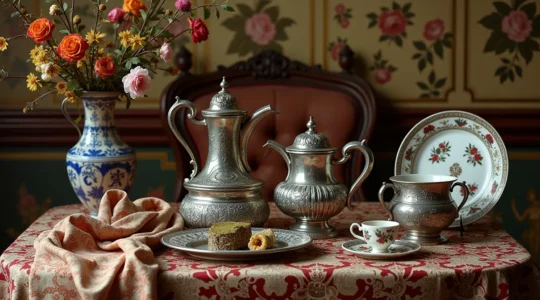
Why That Flower Pattern Might Be a Political Statement?
Decorative patterns are often dismissed as mere ornamentation, chosen for their aesthetic appeal. This view overlooks their function as covert political actors throughout history. Far from being passive, patterns have been actively designed and deployed as tools of propaganda, secret…
Read more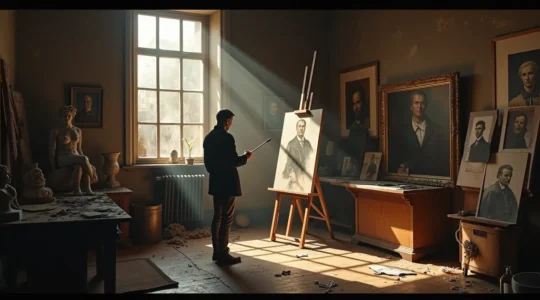
Why Art Styles Change Violently After Every Revolution
Contrary to popular belief, dramatic shifts in art after a revolution are not just about propaganda; they are the result of the total collapse and violent rebuilding of an entire artistic ecosystem. Patronage networks evaporate overnight, forcing artists to find…
Read more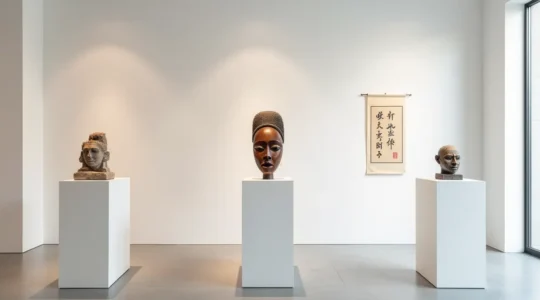
Deconstructing the Canon: Why the ‘Golden Ratio’ Is a Myth of Universal Beauty
Contrary to the belief that beauty standards like the Golden Ratio are universal truths, they are in fact a cultural construct. This article deconstructs the dominance of Western aesthetics, revealing how the European art historical canon was deliberately built by…
Read more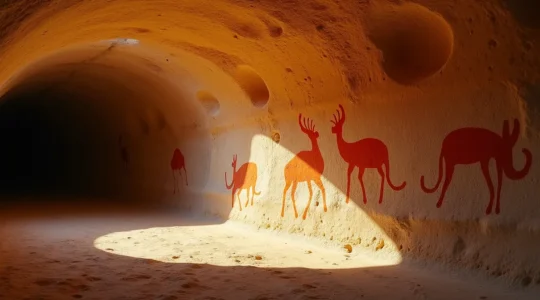
The Sculpted Canvas: How Paleolithic Artists Engineered Animation with Rock and Light
Paleolithic art’s genius lies not in the paintings themselves, but in how they were programmed to perform using the cave wall as a three-dimensional screen. Artists deliberately selected uneven surfaces, using bulges and cracks to create sculptural forms that imply…
Read more
How the Academy’s Strict Rules Accidentally Created Modern Art
Contrary to the popular narrative of rebellious artists fighting an old system, modern art was not born simply in opposition to the French Academy. Instead, it was an inevitable, systemic consequence of the Academy’s own rigid rules. This analysis shows…
Read more
The Unsigned Masterpiece: How Art Historians Decode Authorship
Attributing an unsigned artwork isn’t a simple checklist, but a forensic investigation where conflicting evidence must be weighed by a detective-like art historian. Scientific data like tree-ring dating provides objective timelines that can override subjective stylistic analysis. Historical documents and…
Read more