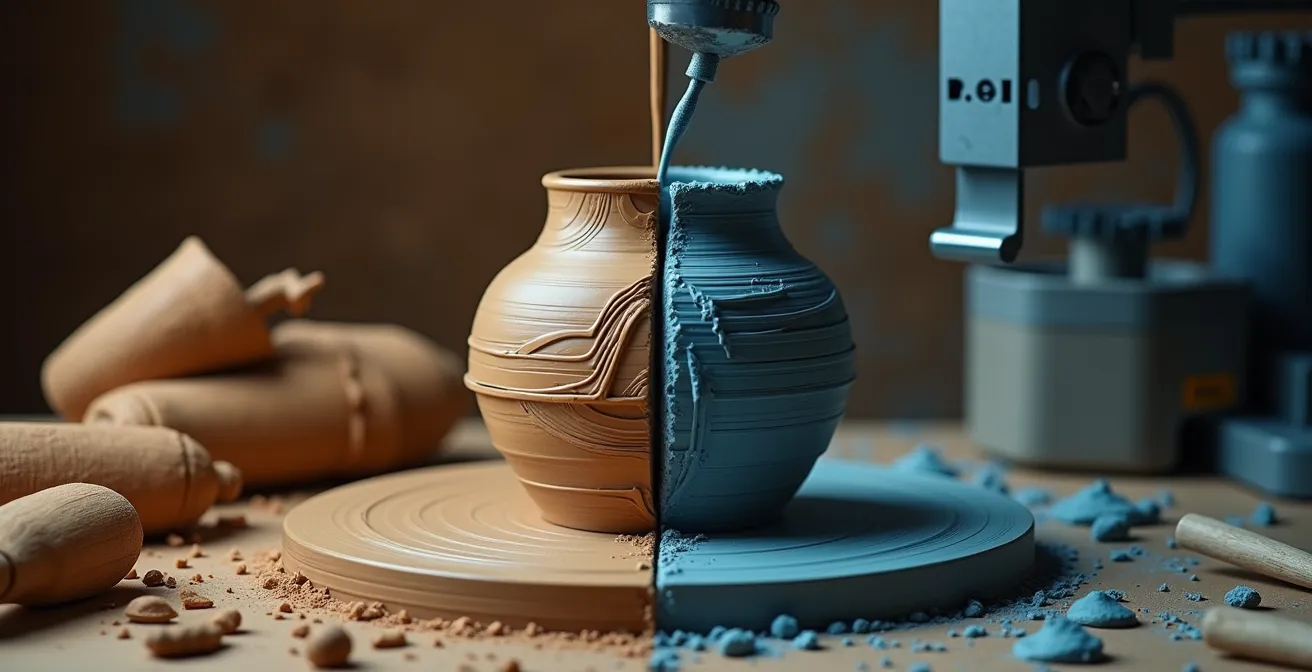
The fierce debate about 3D printing clay misses the point entirely; it’s not about the artist’s hand versus the machine, but a misunderstanding of how craft has always consumed and redefined itself through technology.
- Technology, from the 19th-century Jacquard loom to modern AI, has always been a provocative partner to art, not an enemy that replaces skill.
- The most innovative ceramic artists are not chasing sterile perfection but are deliberately embracing digital ‘glitches’ and material limits as a powerful new form of expression.
Recommendation: Instead of asking if it’s ‘cheating,’ the crucial question for traditionalists is how to master and manipulate these new technological collaborators to push the boundaries of the medium.
The scent of wet earth, the yielding resistance of clay beneath the fingers, the subtle tremor of the potter’s wheel—for centuries, these have defined the intimate dialogue between artisan and material. Then, an intruder enters the studio: a machine, methodically extruding perfect, identical layers of liquid clay with a clinical hum. For the traditionalist, this feels like a violation, a shortcut that bypasses the soul of the craft. Is 3D printing in ceramics an act of cheating, a soulless automation of a deeply human practice?
The common defense is that the printer is “just another tool,” an evolutionary step like the electric wheel. This view, however, is too simplistic. It fails to capture the radical potential and the philosophical shift that this technology represents. The anxiety is real, rooted in the fear that technology will erase the “hand of the artist” and replace it with cold, repeatable code. This fear stems from a fundamental misunderstanding of craft’s own history of survival and innovation.
But what if the true evolution lies not in achieving digital perfection, but in weaponizing its flaws? This article reframes the entire debate. We argue that 3D printing is not an outlier but the latest chapter in a long, aggressive history of craft cannibalizing technology to expand its own expressive language. By examining historical precedents, the materiality of the process, and the rise of the “algorithmic apprentice,” we will demonstrate that the most vital work happening today is not about replacing human skill, but augmenting it in ways previously unimaginable.
This exploration will guide you through the technological shifts that have always challenged and ultimately enriched the arts. We will unpack how today’s pioneers are finding the ghost in the machine—the unpredictable, the flawed, the uniquely digital—and turning it into a signature aesthetic. This is not a story of surrender to the machine, but of its conquest.
Summary: 3D printing clay and the technological evolution of craft
- The perfect cut: How lasers revived the art of marquetry
- Coding the thread: Jacquard looms as the first computers
- Vegan leather and bio-resin: Greenifying the old crafts
- The algorithm as apprentice: Designing decor with AI
- Materializing the error: When digital artifacts become physical objects
- How artisans recreate prehistoric texture with millimeter precision
- Run or rewrite: How to keep 90s net art alive
- How to collect art that doesn’t exist in the physical world
The perfect cut: How lasers revived the art of marquetry
Before we can address the specific anxieties around 3D printed clay, we must first establish a pattern: technology rarely replaces a craft wholesale. More often, it arrives as a disruptive force that, once mastered, breathes new life into age-old practices. Consider the intricate art of marquetry, the practice of applying pieces of veneer to a structure to form decorative patterns. The rise of laser-cutting technology could have been seen as its death knell, automating a skill that took years to perfect by hand. Instead, it triggered a renaissance.
Lasers offered a level of precision that opened up new geometric and figurative possibilities, allowing artists to work with a complexity that would have been prohibitively time-consuming before. The tool did not eliminate the need for artistry; it amplified it. The artist’s role shifted from pure manual dexterity to a hybrid of digital design and material knowledge. This pattern is echoed in the ceramics world, where pioneers see the 3D printer not as a threat, but as a logical progression. As ceramic artist Jonathan Keep notes in Ceramics Now Magazine, many believe that “clay 3D printing is just the next step in the evolution of pottery, much like the introduction of the electric pottery wheel in the early 1900s.”
Artists like Taekyeom Lee, who uses his custom-built printer to create “tangible typography,” exemplify this shift. He is not replicating traditional pots; he is using clay as a form of 3D ink, pushing the medium into the realm of graphic design and sculpture. The technology becomes a collaborator, not a replacement for creative vision.
Coding the thread: Jacquard looms as the first computers
The fear of code replacing craft is not a 21st-century phenomenon. It was born in the 19th century with the Jacquard loom, an invention that could be considered the first true computer. By feeding the loom a series of punched cards, weavers could automate the creation of incredibly complex patterns, effectively translating a binary system (hole or no hole) into physical textile. This was a direct precursor to the G-code that guides a 3D printer today. The loom provoked riots among weavers who feared their livelihood and skill were being rendered obsolete by a machine.
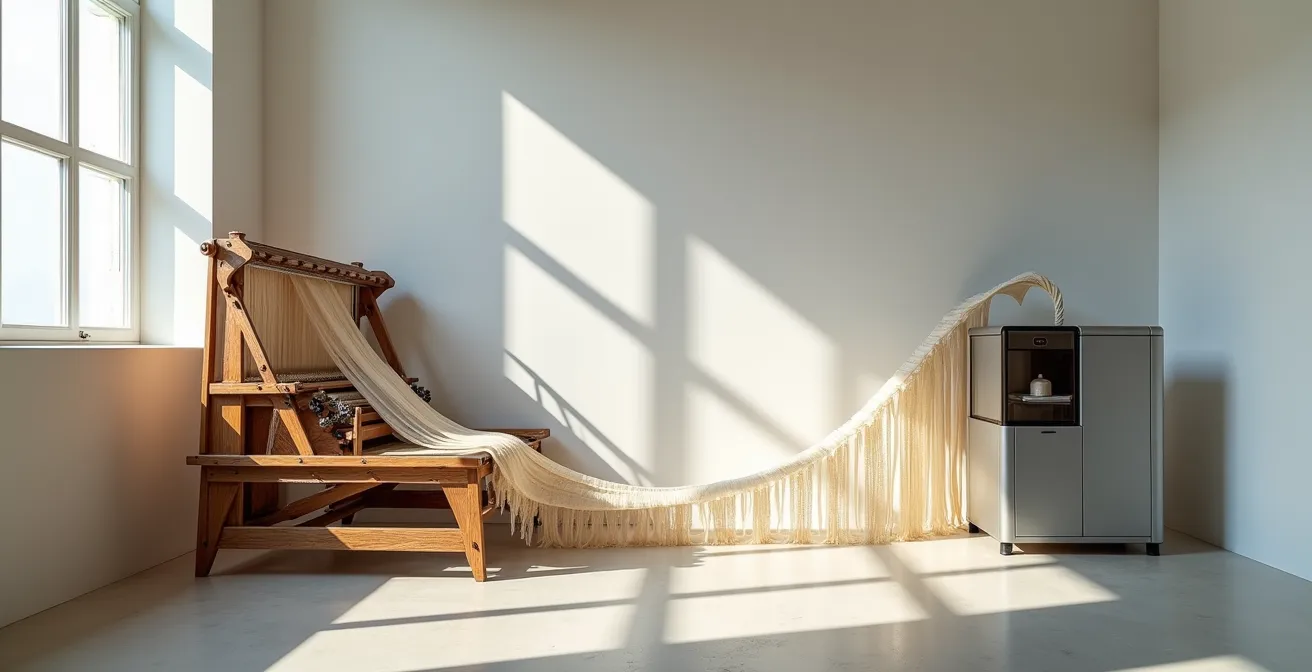
Yet, the Jacquard loom did not kill the art of weaving. It created a new category of artisan: one who could “program” the loom, who understood the relationship between the abstract code on the cards and the final, tangible fabric. It elevated the craft to an industrial art form and laid the conceptual groundwork for the entire digital age. The debate over 3D printed clay is merely an echo of this original conflict. The printer, like the loom, still requires a master operator who understands the material, the machine’s limitations, and the creative potential of the code.
This is not a niche academic pursuit; it’s a rapidly expanding industry. Projections show the ceramic 3D printing market demonstrates explosive growth, expected to swell from around $365 million in 2025 to nearly $3.5 billion by 2034. This explosive growth proves that, just like the loom, this technology is being integrated at a massive scale, creating new economies and new artistic languages.
Vegan leather and bio-resin: Greenifying the old crafts
The traditionalist’s argument often romanticizes the purity of natural materials. But even here, technology is not an enemy but a transformative ally, especially in the push for sustainability. The development of “vegan leathers” from pineapple leaves or mushrooms, and bio-resins from plant-based sources, represents a profound technological intervention in the material palette of ancient crafts like leatherworking and jewelry making. These materials don’t just mimic their traditional counterparts; they introduce new properties, textures, and ethical considerations for the artisan to explore.
This mirrors what is happening in 3D printed ceramics. The process is not a hands-off, magical act of creation. It is a constant negotiation with the raw material. As the research team at WASP, a leading manufacturer of ceramic 3D printers, explains, the process is fraught with physical constraints. They state, “When we set down fluid-dense materials like clay… there are some limits due to the geometries, to the collapses, to the drying and to the retirements.” In this context, true artistry comes from understanding and manipulating the material to work within these digital and physical limits.
This has led to a new field of material hacking. To overcome these limitations, artisans are not just accepting the default clay slurries; they are innovating by adding aggregates to modify the material’s properties. An analysis from WASP notes how materials like chamotte and paper clay are successfully being used in 3D printing applications to control shrinkage and improve stability. This is not cheating; this is deep material science, a 21st-century evolution of the potter’s age-old quest to perfect their clay body.
The algorithm as apprentice: Designing decor with AI
If the 3D printer is the tool, then Artificial Intelligence is its most provocative collaborator. The integration of AI into design software has allowed for the creation of forms that are not just complex, but fundamentally alien to the human hand. AI can generate structures based on mathematical principles, growth algorithms, or reaction-diffusion patterns, resulting in objects that seem grown rather than made. This introduces the concept of the algorithm as an apprentice—a partner in the creative process with its own non-human imagination.
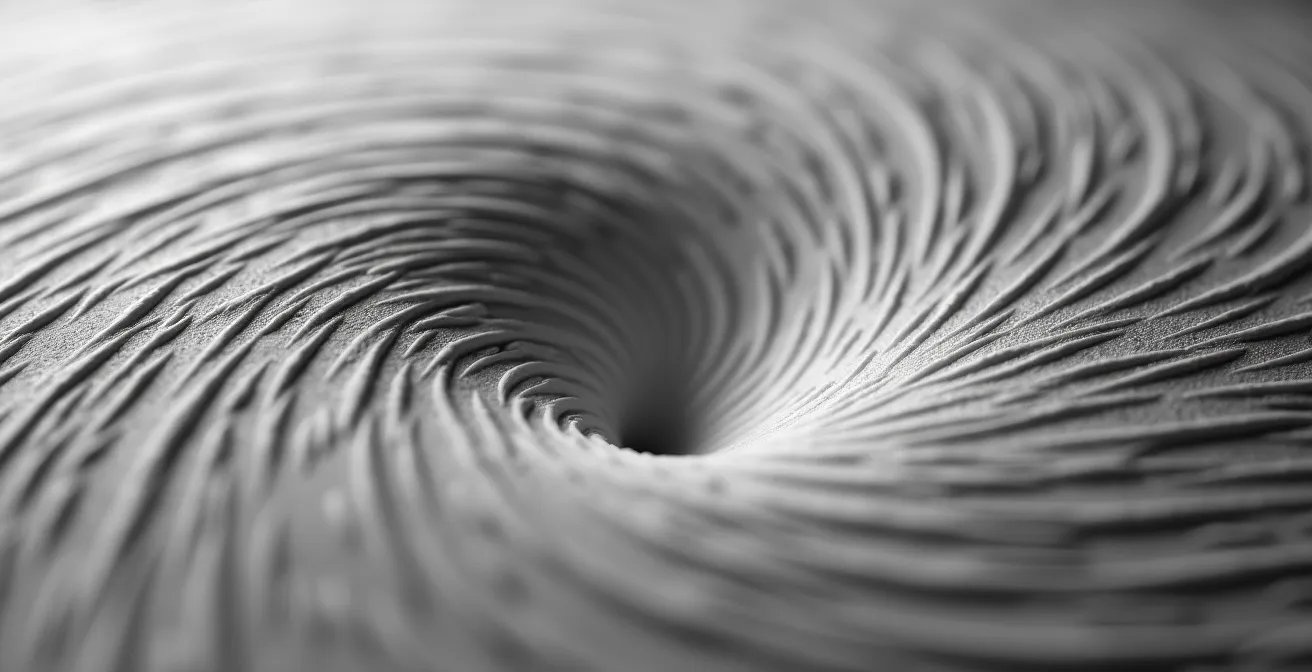
The artist’s role evolves into that of a conductor or a curator. They do not cede control; they set the parameters, guide the system, and select the most compelling outcomes from a universe of possibilities the AI generates. For example, parametric modeling apps now allow artists to manipulate a series of variables—shape, texture, even the G-code’s slicing pattern—to create unique design objects. The artist is no longer just shaping clay; they are shaping the logic that shapes the clay. This integration of artificial intelligence has transformed ceramic 3D printing, enhancing speed and accuracy while enabling designs of unprecedented complexity.
This collaboration results in a new aesthetic, one that celebrates mathematically impossible curves and non-Euclidean geometries. It’s an aesthetic born of pure data, yet rendered in the most ancient of materials. It forces us to ask a challenging question: if an artist uses an AI to generate a form they could never have conceived of themselves, does that diminish or expand their artistry?
Materializing the error: When digital artifacts become physical objects
Perhaps the most compelling argument against the “cheating” accusation lies in the deliberate embrace of the machine’s imperfections. The traditionalist fears the cold, clinical perfection of digital fabrication. Artist and designer Olivier van Herpt articulates this anxiety perfectly, noting that the drive for precision means “3D printing sometimes feels rather ‘kil.’ Kil is a Dutch word meaning cold, clinical, without feeling, an absence of humanity.” But what if this “kil” quality is not a bug, but a feature? What if the glitches, the misprints, and the digital artifacts are the new “hand of the artist”?
Pioneering studios are moving beyond the pursuit of flawless replication and are instead programming “intentional artifacts” into their work. A slight wobble in the extruder, a skipped layer in the code, or a subtle drooping caused by gravity can be controlled and repeated to create a unique, textured language. This is where the machine’s perceived weakness becomes its greatest strength. It is a direct refutation of the idea that digital means soulless. The soul is found in the controlled chaos, in the ghost in the machine that is deliberately allowed to manifest.
Studios like Unfold have been at the forefront of this movement, developing custom software that allows detailed line level control, which they use to unlock a completely new form language in 3D printing. This is not a passive acceptance of errors; it is the active, high-skill manipulation of code to produce a specific aesthetic outcome. It is the digital equivalent of a potter leaving a thumbprint in the clay, a mark of process and intention.
Action plan: How to embrace the digital artifact
- Identify the Variables: List all the points where “error” can occur in your digital fabrication process (e.g., extrusion speed, material viscosity, slicing parameters, axis vibration).
- Isolate and Experiment: Design small, controlled tests where you systematically alter one variable at a time. Document the results—the wobbles, the slumps, the layer shifts—like a scientist cataloging new species.
- Evaluate for Aesthetics: Review your “error library.” Which glitches have aesthetic potential? Confront them with your artistic goals. Is this “error” a texture, a pattern, or a structural element?
- Codify the Flaw: Once you find a desirable artifact, work to make it repeatable. Integrate the specific parameter changes into your G-code or design file. Turn the accident into an intentional brushstroke.
- Integrate and Compose: Begin using your codified flaws as part of your design language. Combine different artifacts, contrast them with “perfect” sections, and build a composition where the process itself is visible.
How artisans recreate prehistoric texture with millimeter precision
While some artists embrace the glitch, others harness the technology’s primary strength: its incredible precision. This is not about creating sterile, factory-like objects, but about achieving a level of detail and texture that is physically impossible by hand. It allows for a new kind of dialogue with history, enabling artisans to recreate, for example, the texture of a prehistoric fossil with absolute fidelity or to design surfaces with micro-patterns that alter the way light and shadow play across the form.
Modern machines offer a staggering degree of control. As technical specifications from manufacturers like Stoneflower 3D show, modern ceramic 3D printers achieve unprecedented precision with nozzle diameters as fine as 0.5 mm and layer heights of just 0.3 mm. This allows for the creation of impossibly thin walls and delicate filigree structures that would collapse under their own weight if attempted on a traditional potter’s wheel. This is not a replacement of skill, but an expansion of the physical possibilities of clay.
This level of control creates a fascinating tension between the digital tool and the organic material. As artist Shawn Protz of NC State’s College of Design explains, “You can’t defy gravity, and you can’t defy what the clay wants to do, but you can add texture that’s impossible to do by hand. That’s not better or worse — it’s just different.” His statement perfectly captures the modern ceramicist’s mindset: a deep respect for the material’s nature, coupled with a provocative willingness to push it into new territories with technology. The precision is not the end goal; it is a means to a new expressive end.
Run or rewrite: How to keep 90s net art alive
The comparison of a 3D printer to a “timeless potter’s wheel” has a critical flaw, one that connects this craft to the precarious world of digital art conservation. A clay wheel from ancient Rome is, in principle, identical to one used today. It is a timeless technology. Digital tools, however, are brutally ephemeral. As scholars Blair Subbaraman and Nadya Peek point out, “Unlike a timeless potter’s wheel, 3D printers rely on specific, proprietary parts and software.” This introduces the concept of digital patina: the decay, obsolescence, and data rot inherent in digital creation.
A ceramic piece created with a specific printer using proprietary software in 2024 may be impossible to replicate in 2044 when that hardware and software no longer exist. This challenge mirrors the crisis in conserving 90s Net Art, which often relies on defunct browsers, plugins, and operating systems. Does this fragility diminish the work? Or does it add a new layer of meaning? The artwork becomes not just the physical object, but the entire technological context of its creation—the code, the machine, the moment in time.
This forces a paradigm shift. The process of “making your own things” with personal fabricators, as described by Unfold studio, is about projecting the history of craft techniques into the future. But it also means that future generations will have to engage in a form of digital archaeology to understand and preserve these works. The object’s story is inextricably linked to its technological DNA, creating a new form of value and a new challenge for collectors and curators.
Key takeaways
- The debate over technology in craft is not new; it’s a historical pattern of disruption and assimilation, seen in everything from the Jacquard loom to laser cutters.
- The most innovative digital ceramicists are not chasing sterile perfection but are embracing the material limits and digital ‘glitches’ of the process as a core part of their aesthetic.
- The artist’s role is evolving from a hands-on maker to a ‘conductor’ of complex systems, collaborating with algorithms and code to achieve forms previously unimaginable.
How to collect art that doesn’t exist in the physical world
Ultimately, the debate leads us to a fundamental question of value. If the artistry lies not just in the final object, but in the code, the process, the hacked materials, and the mastery of an ephemeral machine, how do we “collect” it? The title of this section, taken literally, points to NFTs and purely digital works. But interpreted through the lens of our argument, the “art that doesn’t exist in the physical world” is the invisible, conceptual framework behind the tangible ceramic piece.
This is where the open-source movement in ceramic 3D printing offers a radical answer. Unlike the secretive guilds of the past or the proprietary models of the fine art market, much of this technology’s development is happening in the open. For example, the pioneering process developed by Unfold is based on the open-source RepRap project, with their findings documented under a Creative Commons license. They have actively helped artists and universities worldwide set up their own systems, fostering a community of shared knowledge.
In this paradigm, value is decentralized. It resides not only in the unique physical object but also in the shared code, the community’s modifications, and the open dialogue. Collecting this art means participating in its ecosystem. It suggests a future where an object’s provenance includes its Git repository log and where its value is tied to the generosity of its creation. This challenges the traditionalist’s notion of a singular genius and replaces it with a model of collective, distributed creativity—a fittingly disruptive end for a technology born from code.
The conversation must evolve beyond a binary of “cheating” versus “tool.” The evidence is clear: digital fabrication is a legitimate, powerful, and provocative new chapter in the long story of ceramics. The challenge for the traditionalist is not to resist this change, but to engage with it, critique it, and, ultimately, to find their own voice within its complex and thrilling new language.